
by Petrit Llunji
A brief introduction for those unfamiliar with these two events.
The Ulqin Castle has been besieged many times throughout its history, with the aim of conquest. Some of them resulted in the fall of the Castle, while others failed thanks to the resistance of the people. Two attacks, both the most documented, where the citizens of Ulqin emerged victorious and managed to defend the Castle are the sieges of 1696 (August 9 – September 5) and 1718 (July 23 – August 10).
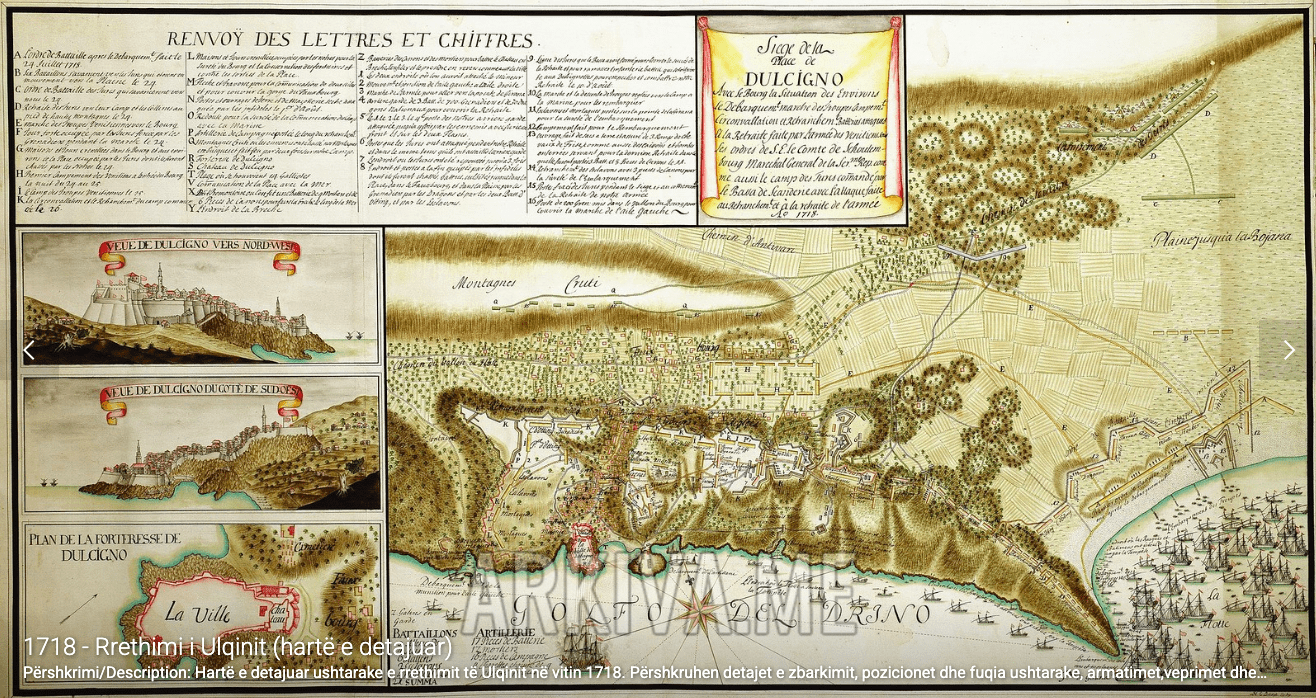
In both cases, the conqueror was Venice, one of the greatest naval powers of the Mediterranean. The siege of 1718 began on July 23 (307 years ago today) and involved about 200 ships of various types and about 11,000 soldiers (Turkish sources mention up to 20,000 soldiers) while the Ulqin Castle was defended by 2,000-3,000 people. A sophisticated operation where the Venetians brought the most advanced warships and two seasoned commanders such as Feldmarshall Schulenburg and Admiral Pisani.
Although peace had been reached between Turkey and Venice, the news took several days to arrive and the bombardment had already begun from the ships, Suka and Pinjeshi. Great damage was caused but the defenders fought back and resisted. An important role in the victory of Ulqin was also played by the storm that began between the night of 3 and 4 August, which caused serious damage to the Venetian fleet, complicated the supply of troops and accelerated their departure.
In the battle for the defense of Ulqin, the brothers Hysen and Lutfi Fani also lost their lives, for whom a tomb was built in Rana, which still exists today. The siege of 1696 was also very bloody. The invader, in anger that he could not take the Castle, even though he had bombarded it for almost a month and had not left a stone unturned, set fire to all the neighborhoods outside the Ulqin Castle and burned 60,000 olive trees.
The walls of the Castle were reportedly badly damaged, but the people of Ulqin sent word that they would not surrender to the last man. Seeing the determination of the defenders, General Delfino sent word to Venice that it was impossible to take the Castle and thus all operations were suspended in the first days of September.
These are not just some dates in old documents, or unverified traditions. They are real events where our ancestors, with extraordinary sacrifice, refused to bow down.Celebrating dates is memory, and memory is identity. We often boast of 2000 years of history but we do not celebrate any date from that history. In the celebrations of the past of every city, victories and resistance against occupation occupy a special place.
The sieges of 1696 and 1718 are victories and proof of exemplary resistance.We find such examples of bravery in books and legends, and we ignore them right in front of our noses. We pretend not to believe that our ancestors were brave, and we forget that there is nothing that deserves more exaltation and celebration than sacrifice and bravery.
Marking the dates of victories is an antidote to identity and cultural amnesia. By not giving them their importance, we forget who we were and who we are, and look to others for example and inspiration.In the mirror we often see strangers and not ourselves. So it is no wonder that we cling to and mention characters like Cervantes and Shabatai Zevin. The first is unknown if he ever visited Ulqin, and the second is a false messiah who promoted immorality.
We organize Mundial and Exit, while we ignore the most authentic offer possible and pretend it does not exist. With an inferiority complex, we hide history behind the curtains of multiculturalism lest we offend someone with a purely Albanian victory from Ulqin. In fact, we are promoted to those who fabricate history and declare defeats as victories while keeping our achievements quiet.
Appeasement for the foreigner and humiliation for ourselves. As descendants of those who challenged the greatest armada of the time from the walls of the Fortress, we have a duty to mark their courage but at the same time a human obligation to remember the lives lost. During both sieges, hundreds of civilians and fighters from Ulqin gave their lives and today, apart from the tomb of the Fans, there is no sign of honoring their sacrifice.
We have gone so far into oblivion that today in the Fortress there is not even a plaque that would immortalize the sacrifice, endurance and victories of our ancestors from 330 years ago. By celebrating important historical dates and events, we show and just speak that we are a city with an ancient history, while showing our children and the world that this place is more than beaches and sun loungers. These two important events occurred 22 years apart, but both in August.
The storm of the night of August 3-4, when Nature and God aligned themselves on the side of Ulqin, also has great symbolism. Which of the dates would be chosen for the manifestations is of little importance, but in any case, the commemoration and festivities should last at least a week, in harmony with the symbolism of the several-week resistance of the people of Ulqin. A city that forgets its triumphs and tragedies loses its soul and character, and instead of becoming an anchor for its citizens, it becomes a playground for foreigners.
PS: It is more than certain that such an event would arouse additional curiosity about this period for which documentation is abundant in the archives of Venice, Istanbul and Vienna. Our history is waiting to be discovered and presented, therefore it is vital for the future of the city that the Municipality of Ulqin in all future annual budgets reserve funds that will be used for historical scientific research.
Sources

