
by Elton Ligu
Abstract
In the Peloponnese, the origin of the Albanians is obscure. They were brought as colonists by Theodore, Despot of Mystras (d. 1407), with further arrivals especially after 1463 following the Turkish capture of Nafplion, although earlier migrations are also noted (mentioned as mercenaries in 1075). Albanian communities currently dominate in Argolis, Corinth, southern Elis, and the western coast from the Alpheus to Navarino. The Albanian dialect of the Peloponnese has preserved less of its individuality than that of Attica, which was still used in Athens courts and required knowledge by Bavarian officials in 1830.
Besides the Albanians, two other population elements exist: the Mainots and the Tsakonians. These groups have a stronger claim to descent from the ancient Greeks than other Greek-speaking populations. The Mainots inhabit the central promontory of the southern Peloponnese, while the Tsakonians are found in the western part of ancient Laconia. Both are brave, but the Tsakonians are honest and peaceful traders, whereas the Mainots were historically involved in piracy and plunder.
The Tsakonians, numbering about 15,000 families (with 1,000 in Leonidi), speak a modern Greek dialect recognized by philologists as a survival of ancient Doric due to its distinctive vocalization and grammar — the most ancient type among modern Greek languages. They once occupied a larger area and had a colony in Constantinople, where their men served as highly valued sailors. Hopf supports a more direct descent of the Tsakonians from the ancient inhabitants.
The Mainots have successfully resisted full subjugation, securing favorable treatment and tax exemptions. They were defeated by Villehardouin, devastated by the Catalans, and later paid tribute to the Turks, but enjoyed practical independence under Venetian rule. They rebelled against the Greek government in 1831 and 1834 but served honorably in the War of Independence.
The author writes:
“In the Peloponnese…..
The origin of the Albanians in the Peloponnese is obscure. The fiscal greed of the Byzantine government led to the depopulation of the country, and Theodore, the Despot of Mystras, who died in 1407, brought in Albanian colonists. There were further influxes, especially in 1463, after the Turks captured Nafplion.
But there had certainly been earlier migrations.¹
(¹They are mentioned as mercenaries of Nikephoros Basilakes in 1075.)
Today, Albanian communities dominate in Argolis, Corinth, southern Elis, and the western coast from the mouth of the Alpheus to Navarino.
However, the Albanian language of the Peloponnese has preserved less of its individuality than the Albanian of Attica, which has retained its language to a certain extent, although it is disappearing.
In 1830, Bavarian officials were required to learn Albanian, and earlier there was a court in Athens where this language was used.
During the Venetian rule in the 18th century, the population doubled due to a large influx of Greeks from the north. In 1821 and the following years, when only the Peloponnese was free, thousands of Greeks poured in from all the lands under Turkish domination.
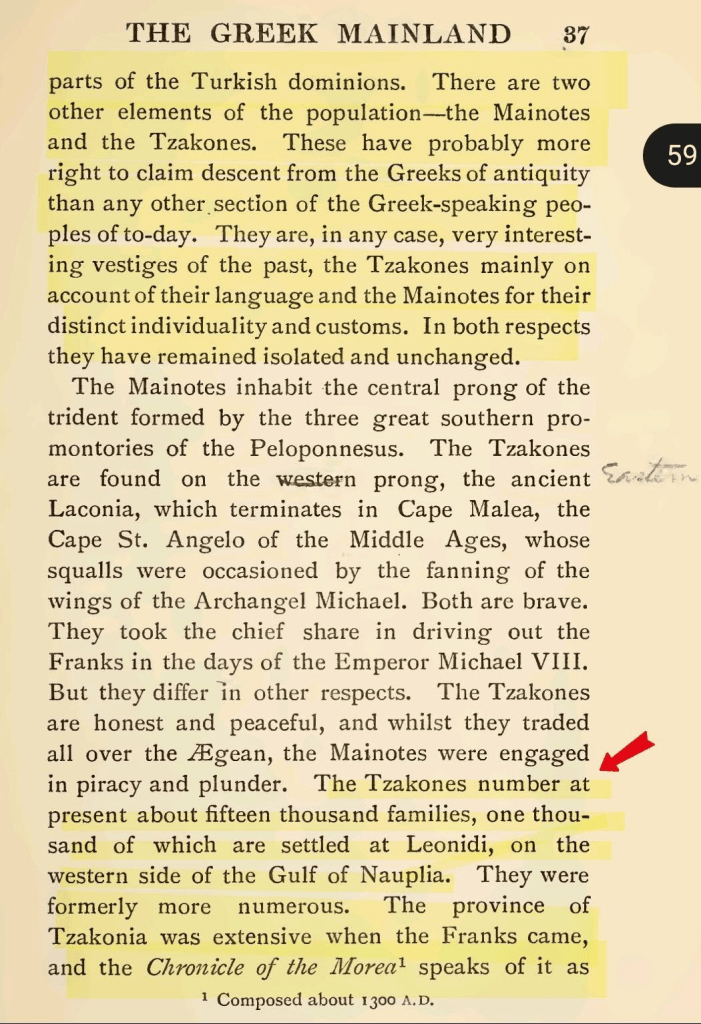
There are two other elements of the population — the Mainots (Maniots) and the Tzakonians (Tsakonians). These perhaps have a stronger claim to descent from the ancient Greeks than any other part of today’s Greek-speaking peoples. They are, nevertheless, very interesting survivals of the past: the Tsakonians mainly because of their language, and the Mainots because of their distinctive individuality and customs. In both respects, they have remained isolated and unchanged.
The Mainots inhabit the central promontory of the triangle formed by the three great southern capes of the Peloponnese. The Tsakonians are found on the western side, in ancient Laconia, which ends at Cape Malea — Cape of Saint Angelos in the Middle Ages — whose storms were caused by the beating of the wings of the Archangel Michael. Both are brave peoples. They played a leading role in expelling the Franks during the time of Emperor Michael VIII. But they differ in other respects. The Tsakonians are honest and peaceful, and while they traded throughout the Aegean, the Mainots engaged in piracy and plunder.
The Tsakonians currently number around fifteen thousand families, one thousand of whom are settled in Leonidi, on the western side of the Gulf of Nafplio. In the past, they were more numerous. The province of Tsakonia was large when the Franks arrived, and the Chronicle of the Morea speaks of it as distinct from the rest of the Morea. In 1573, Crusius found fourteen Tsakonian villages between Monemvasia and Nafplion. Now only seven remain.
In Byzantine times, there was a Tsakonian colony in Constantinople. The men served in the fleet and their skill as sailors was highly valued. At that time, the Tsakonians occupied the entire country from Argolis to Cape Malea. Even today, they speak a language which, due to its distinctive vocalization and grammatical forms, is recognized by philologists as a survival of a Doric dialect.
No other modern Greek language is of such ancient character.¹ The schoolmaster in Greece, as elsewhere, is the chief enemy of traditional ways of speaking, but Tsakonian, although greatly reduced in area, still lives on the Laconian coast. It is a justifiable assumption to attribute to the Tsakonians a more direct descent from the ancient inhabitants of the country than to any other part of the population.
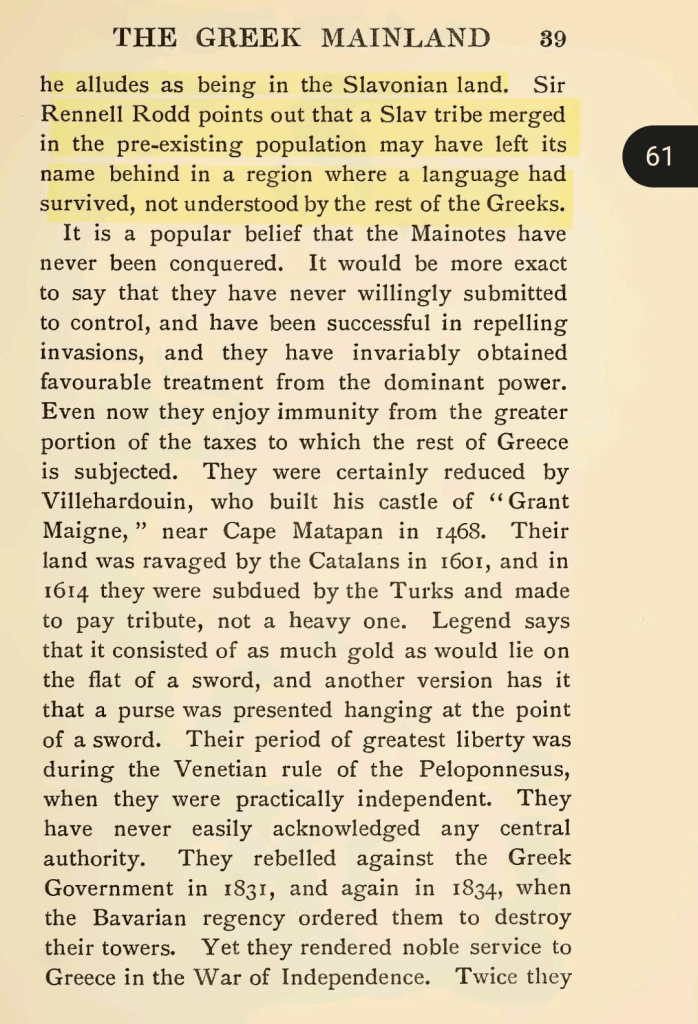
Hopf, who opposes Fallmerayer’s theory of the Slavic origin of the modern Greeks, supports this — strange as it may seem — in relation to the Tsakonians. Bishop Willibald, during his pilgrimage to the Holy Land in the eighth century, stopped at Monemvasia, which he connects with the Slav land. Sir Rennell Rodd notes that a Slavic tribe, merged with the pre-existing population, may have left its name in a region where a language survived that was not understood by the rest of the Greeks.
There is a widespread belief that the Mainots were never conquered. It would be more accurate to say that they were never willingly subjected to control; they have been successful in repelling invasions and have always secured favorable treatment from the dominant power. Even today, they enjoy exemption from most of the taxes to which the rest of Greece is subject.
It is true that they were defeated by Villehardouin, who built his castle “Grant Maigne” near Cape Matapan in 1468 [Note: likely a date error in the original; commonly 13th century]. Their land was devastated by the Catalans in 1301 [likely 1301, not 1601], while in 1614 they were subdued by the Turks and forced to pay tribute — though not a heavy one. Legend says the tribute consisted of as much gold as could fit on the flat surface of a sword, while another version speaks of a bag offered hanging from the tip of a sword.
The period of their greatest freedom was during Venetian rule in the Peloponnese, when they were practically independent. They have never easily accepted any central authority. They rebelled against the Greek government in 1831 and again in 1834, when the Bavarian regency ordered the destruction of their towers. Nevertheless, they served Greece with honor during the War of Independence.