by Muhamet Nikqi – Buxhovi
Abstract
The United States opposed the unification of Albanians into one state. American representatives at the 1919 Paris Peace Conference were largely unfamiliar with the Albanian question, especially that of Kosovo, and knew it mainly through negative, propagandistic literature written by Serbian and Greek authors. They viewed Albanians as not sufficiently developed economically, socially, and politically to benefit from the principles of nationality and self-determination.
In a memorandum submitted on 24 January 1919, American experts described a united Albania as “impractical” and recommended dividing Albanian territories into four parts. One part (north of the Mat River, including the regions of Peja, Gjakova, and Prizren) would become an autonomous unit within Yugoslavia under the protection of the League of Nations.
Due to the perceived weakness of Albanian national sentiment, backwardness of political institutions, communication difficulties, and intrigues by neighboring states, the American delegation did not support Albanian territorial demands, including those regarding Kosovo. The hearing of the Albanian delegation on 24 February 1919 before the Council of Ten was merely formal and produced no results — no commission was formed to examine the Albanian claims, unlike the case with other countries such as Greece.
In response to the unfavorable situation and the more positive consideration of Greek claims over Southern Albania, the Albanian delegation submitted another memorandum on 7 March 1919. It re-emphasized the justice of its demands based on the principle of nationality and proposed holding a popular plebiscite across all contested territories in the south and north (including Kosovo and Chameria). To ensure a free expression of the population’s will, it suggested stationing American troops temporarily in these areas for one to two years until the referendum was completed.
The USA was against the unification of the Albanians into one state.
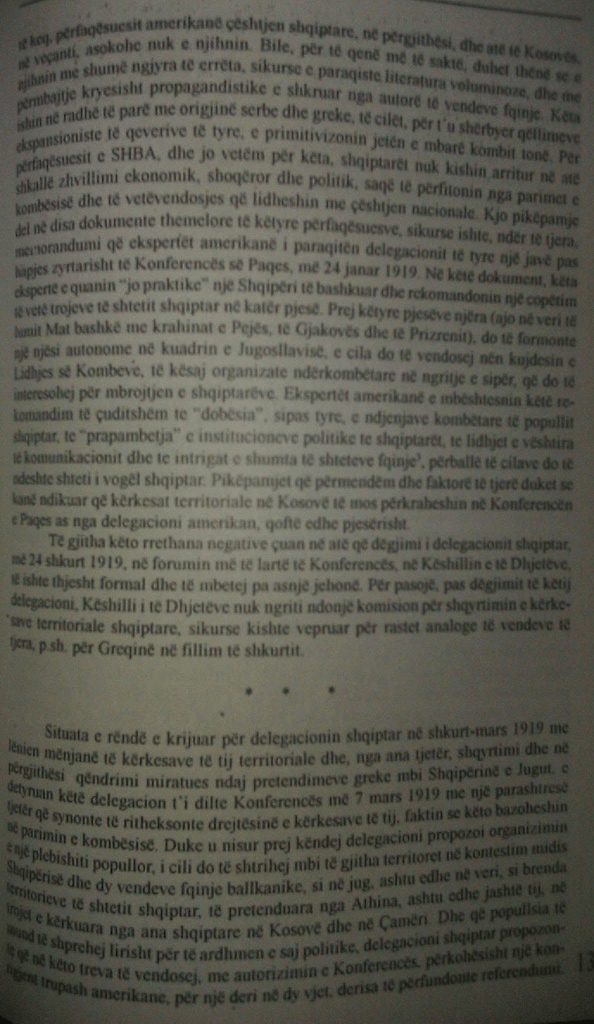
To make the text of the photograph more readable, I have transcribed and organized it into more orderly paragraphs:
“… Unfortunately, the American representatives, in general, were not familiar with the Albanian question, and in particular with that of Kosovo. To be more precise, it should be said that they knew it more in dark colors, as presented by the voluminous literature, mostly propagandistic in content and written by authors from neighboring countries.
These were primarily of Serbian and Greek origin, who, in order to serve the expansionist aims of their governments, portrayed the life of our entire nation as primitive. For the representatives of the USA, and not only for them, the Albanians had not reached that level of economic, social, and political development that would allow them to benefit from the principles of nationality and self-determination related to the national question.
This viewpoint emerges in several basic documents of these representatives, such as, among others, the memorandum that American experts presented to their delegation one week after the official opening of the Peace Conference, on 24 January 1919.
In this document, these experts described a united Albania as ‘impractical’ and recommended the partitioning of the Albanian state’s own territories into four parts. Of these parts, one (the one north of the Mat River together with the regions of Peja, Gjakova, and Prizren) would form an autonomous unit within Yugoslavia, which would be placed under the care of the League of Nations.
This newly rising international organization would take an interest in the protection of the Albanians. The American experts based this strange recommendation on what they called the ‘weakness’ of the national feelings of the Albanian people, the ‘backwardness’ of Albanian political institutions, the difficult communication links, and the numerous intrigues of the neighboring states, which a small Albanian state would face.
The views mentioned and other factors appear to have influenced the fact that territorial demands regarding Kosovo were not supported at the Peace Conference even partially by the American delegation.
All these negative circumstances led to the hearing of the Albanian delegation on 24 February 1919, before the highest forum of the Conference, the Council of Ten, being merely formal and remaining without any echo. Consequently, after hearing this delegation, the Council of Ten did not establish any commission to examine the Albanian territorial demands, as it had done in analogous cases for other countries, for example, for Greece at the beginning of February.”
“The difficult situation created for the Albanian delegation in February–March 1919, through the sidelining of its territorial demands and, on the other hand, the examination and generally favorable attitude toward Greek claims over Southern Albania, forced this delegation to submit another memorandum to the Conference on 7 March 1919. This aimed to re-emphasize the justice of its demands and the fact that they were based on the principle of nationality.
Proceeding from this, the delegation proposed the organization of a popular plebiscite that would cover all contested territories between Albania and the two neighboring Balkan countries — both in the south and in the north, both within the territories of the Albanian state claimed by Athens and outside it, in the lands claimed by the Albanian side in Kosovo and Chameria.
And so that the population could express itself freely about its political future, the Albanian delegation proposed that, with the authorization of the Conference, a contingent of American troops be temporarily stationed in these regions for one to two years, until the referendum was completed.”