
By Dr. Qazim Namani. Translated by Petrit Latifi, July 2026.
Abstract
This study examines the national and family origins of Atanasije Urošević (1898–1992), a prominent Serbian geographer, anthropogeographer, and ethnologist known for his studies on Kosovo. Challenging official Serbian biographical accounts, Qazim Namani argues that Urošević’s family was of Albanian (likely Catholic or crypto-Catholic) origin from the village of Tullarë near Medveđa. Through historical analysis of 19th-century Ottoman policies, Russian Pan-Slavic activities, Serbian schools, church influences, and local oral traditions, the Namani contends that his family was Serbized during the 19th–20th centuries amid broader efforts to assimilate Orthodox Albanian and Vlach populations in Kosovo and surrounding regions. It portrays Urošević’s work as both shaped by and potentially concealing this assimilated background.
Atanasije Urosevici, born on October 14, 1898, in the city of Gjilan, and died in Belgrade. On October 17, 1992, just 3 days after reaching his full 94th birthday.
Serbian sources state that: Atanasije Urosevici was a Serbian geographer, anthropogeographer and ethnologist, who made a great contribution to the study of the past in the territory of Kosovo.
According to Serbian sources, the origin of Atanasije Urosevic’s family is from Hoca e Madhe, but according to other accounts, it is said that this family originated from the city of Prizren. It is unbelievable, when Urosevic writes precisely about the origin of families and settlements in Kosovo, and does not write the truth about the origin of his family! Serbian sources also say that due to pressure from Albanians, this family was forced to abandon their birthplace and settle in several villages of Anamoorava.
This hypothesis has been raised for political purposes, because historical data and field sources provide other convincing arguments that the Serbian data intended to hide the truth about the nationality and origin of the Urosevic family. In any case, this suggests that in Serbian sources, there is no accurate data about the origin of this family.
Based on historical sources for Hoca e Madhe, but also for the city of Prizren itself, we understand that the population of these two settlements, during the late Middle Ages until the Balkan Wars, was not of Serbian origin, but that since the beginning of the 19th century, the Russian service was operating there for the Serbization of the Orthodox population.
Other data prove that during the 19th century, there was no pressure whatsoever on the Orthodox population in the city of Prizren.
On the other hand, it is well known that according to the Pan-Slavic platform led by Russia, since the beginning of the 19th century, pressure was exerted on the Ottoman Empire to grant privileges and certain rights to the Orthodox within the borders of the Ottoman Empire. These rights were even signed in several agreements that had been reached between Russia and the Ottoman Empire, since the end of the 18th century. Based on this historical evidence, we understand that the Orthodox population of Prizren, Hoçë e Madhe and other settlements in Albanian lands, had not experienced any pressure from
Albanians during this period, because their rights were protected by the Ottoman administration with a firman (law). Historical sources show that after Serbia gained autonomy in 1833, P. Osman allowed the opening of secular Serbian schools in the territory of present-day Kosovo, and the first secular school in the Serbian language was opened in the city of Prizren in 1836. A few decades later, several Serbian schools were opened in the cities and villages of Kosovo. The Orthodox Bogoslavia Seminary was also opened in Prizren in 1871, where clergy and teachers were trained for Serbian churches and schools in Kosovo.
So, as can be seen from the sources of the time and archival documents, in the city of Prizren, since the beginning of the 19th century, schools in the Serbian language had been opened, with the sole purpose of Serbizing the Orthodox Albanian and Vlach population in the city. These Serbian schools expanded and worked without interruption throughout the 19th century. During the last decades of the 19th century, new schools for boys and girls were built in many settlements, and in these schools, teaching was carried out according to the Serbian educational curriculum.


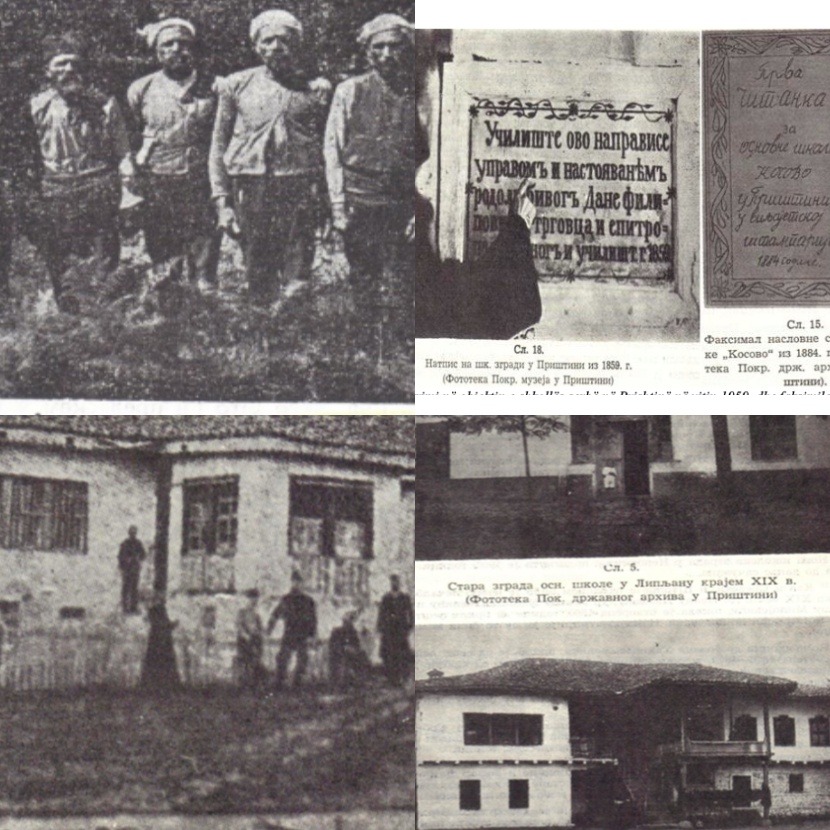
Photo 1. The building of the first Serbian primary school opened in 1836 and Photo 2. The building of the Serbian school opened in the village of Hoçë e Madhe, in 1872
In these schools, students were inspired by Slavic culture and languages, Slavic history, and the Orthodox religion. They were taught special religious lessons, which explained the churches of Kosovo, and Serbian nationalist songs were sung to raise the students’ love and morale for the Serbian language and the Slavs in general.
At the end of the 19th century, many new schools were built in many villages. These schools enrolled a large number of students. In these schools, students were separated by gender, so schools were opened for both men and women.

Mladen Ugarevic Primary School, in Prizren

Number of students in Serbian schools in Prizren and Greater Hoca, in 1906
It is also known that in the last decades of the 19th century, Serbian schools were opened in the city of Gjilan and two other villages of this municipality, in Ranilluk and Petrovc.
Urosevic completed his primary school education in Gjilan in Serbian, so the logical question arises: Why, after finishing primary school, did the family not send Urosevic to attend high school in Serbian, but sent him to study in Turkish?
It is understood that at this time it was only Albanians who were prohibited from teaching and opening schools in the Albanian language.
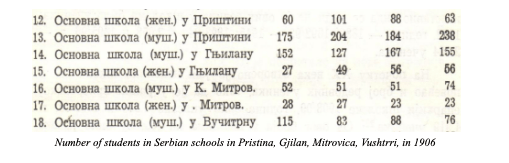
Number of students in Serbian schools in Pristina, Gjilan, Mitrovica, Vushtrri, in 1906
In addition, in the city of Prizren, Russia had sent as consul, its diplomat Ivan Stepanovic Jastrebov, who during his mission, developed propaganda and Pan-Slavic activities in Prizren, Shkodra and Mirdita. All activities of Jastrebov and the Russian Pan-Slavic platform were in function of the Serbization of the Orthodox population in Prizren and the surrounding area, as well as in the city of Shkodra. Jastrebov, who was educated in Russia to gain knowledge of oriental culture and eastern languages, spoke and wrote in the following languages: Arabic, Persian and Turkish. Immediately after his settlement in Prizren, he took all measures to implement all the rights of the Orthodox, according to the fermans that had been signed until that time, between Russia and the Ottoman Empire.

The text shows that Jastrebov had secured all Ottoman firmans and demanded that they be strictly implemented.
What we have provided is sufficient evidence to understand that there was never any pressure on the Orthodox in Prizren and the surrounding area, as written in Urosevic’s biography. Despite the violence against Albanians in the city of Prizren,
More and more rights were being added to the Orthodox population. From these privileges for the Orthodox in P. Osamne, which had been achieved through policies, the process of their Serbization had now begun.
On the occasion of the formation of the Vilayet of Kosovo, precisely in the city of Prizren, the first newspaper in Turkish and Serbian began to be published, and the editor of this newspaper for the Serbian language was appointed Todor Stankovici from Niš, who was later appointed Serbian consul in Pristina.

Newspapers in Serbian and Turkish as well as Serbian nationalist songs that were sung in Serbian schools opened in Kosovo.
In 1868, the Education Council was formed to assist Serbian schools and teachers in the Albanian territories that were under the rule of the Ottoman Empire. The secular Serbian schools at that time worked according to the curriculum of the Serbian schools, using the same textbooks, organization, teaching methods and administration. New schools were opened in the Albanian territories with teachers brought from Slavic regions. Nikola Mussolini was a teacher who had come from Croatia to teach in the Serbian primary schools that had been opened in Kosovo.
In these Serbian schools that opened in Kosovo, students gained greater knowledge than in some schools in Serbia.
As we mentioned, with the aim of Serbizing the Orthodox, nationalist songs and songs of bravery for Serbs were sung in these schools, in order to increase the students’ morale for Serbia. In addition to the secular Serbian schools that had been opened in many settlements in Kosovo, the church school “Bogoslavija” was also opened in the city of Prizren with the aim of preparing teachers and young clergy to work in Kosovo.
During this period, the Patriarchate of Istanbul, which was highly privileged by the sultan, was in conflict with the Serbian Orthodox Church, and did not allowed prayers to be held in the Serbian language in the largest churches in the city of Prizren.
We also learn from Serbian sources that from 1830, when Serbia gained autonomy, until 1896, the churches in Prizren, Ferizaj and Lipjan were in the hands of the Greeks, while after 1896, the Greek clergy were expelled, and Serbian clergy were appointed to the Orthodox churches. So until this time, the church of St. Friday in the city center was in the hands of Greek clergy.

Evidence from Serbian authors that in the vast majority of Orthodox churches in the territory of Kosovo, until 1896, the liturgy was held in the Greek language.
The Metropolitanate of Prizren during this period was in the hands of Greek clergy and the Patriarchate of Istanbul, but during the second half of the 19th century, due to the activities of Russian politics, especially Jastrebov, three churches in the city of Prizren were appropriated and renovated. After the renovation of these churches, the Slavic clergy began to pray in the Serbian language, for the sole purpose, which they had now transformed into a political platform, of the Serbization of the Vlachs in the city of Prizren.

Evidence from Serbian sources shows that until 1892, prayers were held in Serbian in only three churches in Prizren.
Considering all these facts, what is written in Urosevic’s biography, that his family, as well as many other families from Prizren, moved to seek better living and working conditions, or to hide their origins from Albanians, as written in Serbian sources, is not true.
In fact, we have nothing here, except a low attempt to hide the Albanian origin of the Urosevic family, and many other Serbian families today in Kosovo, which were Serbized after the occupation of Kosovo in the Balkan wars. From what can be seen, it does not even make sense to think that there is anything true from what is written in his biography, that supposedly the Urosevic family, out of fear of oppression and revenge by Albanians, from Prizren or even Hoç e Madhe, comes to live in the Anamorava region.
Also in his biography we find data that his family was closely connected to several settlements in the north-eastern area of Artana such as: Stanishor, Ropotovë, Kololeq, Rajonoc, Strelicë and Rahavicë. This data leads us to think that Urosecic’s family had its closest relatives in these villages, but that this family itself from these parts, during the 19th century, had settled in the city of Gjilan.
Looking at the geographical position of the villages mentioned in Urosevic’s biography, and based on the oral stories of the Albanian population of this area, we come to the conclusion that Atanasije Urosevic’s family was of Albanian origin from the village of Tullarë, today the municipality of Medvegja. Historical sources prove that the village of Tullarë, until the time it was occupied by Serbia in 1878, had been inhabited only by Albanians. Based on oral stories, the Urosevic family, due to a conflict that had occurred in Tullarë, at the beginning of the 19th century, had abandoned the village and settled in the village of Rahavica, north of Strezoc in the municipality of Dardana.
Urosevic’s grandfather or father had moved from Rahavica to the city of Gjilan, leaving the rest of his family in Rahavica. Rahavica is a small mountain village, bordered by many villages that once had an Albanian population, such as Krileva, Zajqec, Hajkobille, etc.
This village also borders Vananesh and Gregjenik, villages populated by an Albanian Orthodox population, which were Serbized during the 20th century.

Evidence from Urosevic’s writing about the Serbs of Rahavica, who he writes came from the village of Tullar
For the villages of the Galab highlands of this area, the traditional Albanian meetings and games for the day of Saint George, which were held every year at the place called “Lerthat” in Gregjenik, are well known. Gregjenik was a well-known village that also had its own Orthodox church. In these meetings and competitions, which were held until the seventies of the 20th century, residents of all the Muslim and Orthodox villages of this area participated.
Also for the village of Vaganesh, even today, the stories of Albanian families are preserved, that in that village during the 19th century an Albanian family from the village of Marec settled. This is also confirmed by Urosevic himself in his book, when he says that 170 years ago a family from Tirinca and another from Marec settled in this village.
Since these Albanian families had not yet accepted Islamization, over time, after the occupation of Kosovo by the Serbs, they were Serbized. Two Serbized Albanian families from this village, in 1929, settled on the lands of two Albanian families from the village of Krilevë, who had moved to Turkey. These Serbian families, with the Albanian families in the villages of Krilevë and Marec, were related by blood, and until 2000, they lived next to each other, without any conflict worth mentioning.
Also about these villages, writes Urosevic himself, who among other things says about Rahavica, that there are no old residents there, but before the arrival of new residents in this village, the oldest residents were Albanians.
Surely the Albanian residents could have previously settled in more fertile lands, in Dardana, Gjilan or other places. So from Urosevic himself, it is proven that the village had previously been inhabited by Albanians, and this is very important to illuminate the truth of this village. After the Albanians who had been in that village, the Serbian Stojkovic families settled there, but after 1878, Albanian immigrants also settled in this village, writes Urosevic. Also, Urosevic writes that the members of the Stojkovic family, who now numbered 11 houses in Rahavica, 140 years ago, had come from the village of Tullarë allegedly due to pressure from the Albanians in that village.
This data is completely consistent with the Albanian accounts, that precisely at the beginning of the 19th century, an Albanian family, after a conflict in the village of Tullarë, was forced to abandon the village and settled in Rahavica. Since the population of this area had not yet accepted Islamization, this family that lived in Rahavica was eventually Serbified.
From our field research, we have learned that the population of the villages of Dardana, Gjilan and Artana, who lived in these areas before the Balkan wars, who are today known as the Serbian population, were of Albanian origin, but were Serbized after the occupation of Kosovo by the Serbs.
Also, field research has proven that the Albanian population of the Galab highlands was Christian, with some settlements being Catholic and others Orthodox. The process of complete Islamization of this region lasted until 1912. The preservation of the Christian faith until the second half of the 19th century, in the vicinity of Gjilan, was made possible because the Gjinolls of Gjilan and Vrajë mainly married Orthodox women, and the Gjinolls themselves built churches for the Orthodox in these parts. It is also known that the Gjinolls were meticulous in implementing Ottoman decrees, which allowed numerous privileges for the Orthodox.
P. Osman had signed several firmans after losing the war against Russia in 1812, so this proves that the Orthodox, even in the vicinity of the cities where the Gjinollis ruled, did not face pressure from the Albanians.
From many family trees researched in these parts, the evidence of their Catholic ancestors is preserved from the sixth generation, and in some families up to the eighth generation. This convincingly proves that until the 19th century, despite the centuries-long occupation by the Ottoman Empire, the highlands of Upper Galab could only be crossed by large military campaigns and expeditions, because they were controlled by Albanians at all times and these areas were impassable even for Turkish officials.
With the announcement of the Tanzimat reforms, where the identification of the people was done according to religion, with the sole purpose of assimilating and merging the ancient Illyrian population into other peoples, this was the most anti-Albanian project prepared by Russia and European countries in collaboration with the Ottoman Empire.
Now, according to this project, everyone went on the hunt, against an unprotected population, competing among themselves, as to who could kill and assimilate as many Albanians as possible. Of course, the Albanian population did not agree with these reforms, and for this reason, rightly, they submitted demands for cultural and autonomous rights in their lands.
The Ottoman Empire did not meet any of the Albanians’ demands, so the population, regardless of religion, joined in an armed uprising against the Ottoman Empire. In 1843, when the High Porte proclaimed the “Hatishrefi of Gjylhane” in Kosovo, this was not well received by the Albanian population, riots immediately began and the population rose in rebellion.
The great anger of the Albanians was increased when, in addition to the large increase in taxes, the forcible recruitment of Albanians into the Ottoman army, the High Porte began replacing Albanian officials with Ottoman functionaries and officials, and began increasing repressive measures for the Islamization of the population, and the Ottomanization of the administration in Albanian lands.
The sultan’s regular army, sent to Albanian lands, took inhumane measures and exerted great pressure on Albanian crypto-Catholics in northern Albania, in order to further the process of Islamization of the Albanian population. A large number of the Albanian population in the northern regions, even after many sacrifices up to this period, had withstood all the pressures of the Ottoman government, which had undertaken for the violent Islamization of the Albanians.
After the announcement of the new reforms, where the identification of the nation was made according to religion, the Islamized Albanians were forced to register as Ottomans. The rest, the overwhelming majority of the Albanians of this area, to escape this process, were forced to register as Bulgarians, Serbs and Croats.
This persecution of Albanians from the Galab Mountains occurred because of their participation in the uprising, and therefore harsh measures were taken against them. by the Ottoman army. Also, a large number of Orthodox Albanian families from the villages of Artana, Dardana, Gjilan, Presheva, Vrajë, Leskoc and other Albanian areas, during the uprisings of the 1840s, were forced to register as non-Albanian.
It is important to note that, during all the Albanian uprisings that took place during the 19th century, the Albanian, crypto-Catholic population of the deepest northern Albanian areas, joined the Albanian insurgents, regardless of who led the uprisings, the pashas or the Albanian Muslim clerics. This was evidenced, both during the uprising of Mustafa Pash Bushatliu, and later also under the leadership of Dervish Cara.
The Albanian Orthodox population that was Serbized, in the second half of the 19th century, and during the 20th century, with the influence of politics and the Serbian Orthodox Church, appropriated all objects of worship, and through the process of conservation and restoration, with the aim of falsifying their history, the traces of Albanian culture were damaged and falsified.
The Catholic Albanian population of the area of Morava, Vardar, Veles, Prilep, present-day Kosovo and the highlands between Pristina, Niš and other Albanian areas, were very active in the Albanian uprisings, which were carried out by Mustafa Pashë Bushatliu and later by Dervish Cara. This is also evidenced in the Albanian uprisings to take Pristina, Leskoc, Vrajë, Skopje and other Albanian cities.
With this example, I am highlighting the role of the Albanian Christian population, who participated in taking over the city of Vrajë. The Catholic Albanian population of Morava, according to the announced reforms, was registered as a Bulgarian population, this caused a revolt among the Christian Albanian population, which joined in the uprising, alongside their Muslim brothers, against the Sublime Porte.
Under the leadership of a Catholic Albanian named Festol (a Christian resident of the village of Ternoc), the rebels from Ternoc, Selam Rogoqica from Dardana (Kamenica), Ymeri from Presheva, and other beylers and ajans from Presheva, Bujanovac and Vraja, in 1843, overthrew the rule of Hysen Pasha in Vraja. The Orthodox Albanians of Ternoc, in those years when they were Christians, were forced to register as Bulgarians according to Ottoman reforms.
The Orthodox Albanian inhabitants of Ternoz and some other villages, in order to deny their Bulgarian nationality and preserve their identity, were forced to accept Islamization. The Albanian inhabitants of these areas did not give up their language, clothing and national traditions, but they preserved these values with great zeal. Sources attested from the field confirm that many families were divided into two groups, where some accepted Bulgarian nationality, while others rejected it.
It is known that since the end of the 18th century, according to the Pan-Slavic platform, it was foreseen that Albanians would move from the Morava River valley, and according to this platform, they began to call the river the Bulgarian Morava.
So it is clear that only Albanians were not recognized as having the basic right to national identity, even according to the Russian platform, and the river that originates in Kosovo, and up to between Paraqin, Palanka and Cyprus, the Slavs called the Bulgarian Morava. The borders of autonomous Serbia in 1830, at that time, came to the Union of Bulgarian Morava with Serbian Morava (The other branch of the river that passed over Krushec and joined the Morava River, the Serbs began to call it the Serbian Morava).

The eastern and southern border of autonomous Serbia, and the evidence that up to Paraqin, the river was called the Bulgarian Morava, even though it was known that at that time this river, up to those places, passed through the territories called Arnautlluk (Albania).
The Ottoman army, after subjugating the Albanians in Vrajë and Leskoc, took shameful revenge against the Christian Albanian population, who had joined with the Muslim Albanians against the reforms, but also for the expulsion of Hysen Pasha and his gang from the city of Vrajë.
After this submission, the Ottoman soldiers were left free to do whatever they wanted with the Albanian population, so in the village of Trnoc, and several other villages, in addition to looting, the Ottoman soldiers also dishonored the women and girls of the Albanian population. Ismajl Pasha of Leskoc and the Christian Albanian population of that area also played a major role in these uprisings.
Ismajl Pasha of Leskoc supplied the rebels with food and horses. The Albanian rebels were pursued by the Ottoman army, which included Albanians from southern Albania, led by Omer Pash Latasi. When Omer Pasha’s army entered Leskoc on June 20, 1844, the people of Leskoc welcomed the sultan’s army, prepared food for them, and handed over all the money they had collected from the people for the organization of the uprising.
On April 5 1845 Ismajl Pasha of Leskoc was captured, and with his entire family, was sent to Asia Minor, where they disappeared without a trace. During this persecution, the Ottoman army planted 50 hunj in Leskoc to trap the Albanian rebels. With the Albanian rebels trapped in the hunj, the population surrendered and the Ottoman administration was established in the city.
After the suppression of the Albanian uprisings, the Ottoman army that had marched towards Vrajë, and the Albanian villages and towns to its north, according to some sources of the time, it is said that in these areas, 10,000 regular soldiers were forcibly gathered for the Ottoman imperial army.
During their stay in these parts, they tortured, burned down entire Albanian villages, and forcibly imposed Islamization and surrender of the insurgents. According to the platform of the Tanzimat reforms, it was demanded that the crypto-Catholicism of the Albanian population in the highlands between Niš, Pristina and Skopje be definitively renounced.
The Christian Albanian population of these parts, especially in the remote mountainous areas, where the crimes of the Ottoman army were not noticed. Since foreign observers did not arrive there, due to the violence exercised by the army of Omer Pasha Latas, the Albanian population was forced to finally give up the Catholic religion and embrace Islamization.
The Franciscans, in those circumstances, were unable to follow the situation of the Albanian Catholic population in those parts, not even on the northern side of the Albanian villages that lay north of Peshter near Janjevo. It should be emphasized that the Albanian population of the area of Vrajë, Leskoc, Artana and other northern cities had withstood the harsh pressure of the Ottoman Empire for several centuries, for full Muslimism until 1843/44.
The sultan’s regular army, which was sent to Albanian lands, took inhumane measures and exerted great pressure on Albanian crypto-Catholics in northern Albania, in order to further the process of Islamization of the Albanian population.
That the Albanian population of this area had preserved the ancient Dardanian language, tradition, and culture for centuries is also evidenced by foreign researchers who visited our lands during that period.
Several Serbian scholars later wrote about the preservation of religious buildings, the construction of Arbër churches, and the coping with Islamization until the mid-19th century. Atanasije Urosevici, during his studies and field research, also provides data on the late Islamization of Albanian families in the Galab Mountains.
As can be seen from his research, at the time he conducted it, the Albanian families of this region were Christians in the fourth generation.
Regarding the late Islamization of Albanians, we are offering this information from Urosevic, so we tore a page from his book.

As can be seen from Urosevic’s writings, it is noted that the ancestors of the Albanian families converted to Islam in these parts went back to the fourth generation to testify to the Christian faith. Today, this testimony is easily proven to go back to the sixth generation.
From these data we understand that until this period, the Albanian population resisted all Ottoman and Russian attacks and projects to change their religion. Although this uprising in the north was led by a Muslim cleric, from the events of the time, we learn that the armed uprising was supported by all Catholic and Orthodox Albanians of this area, showing solidarity with their Muslim brothers.
The Albanian Orthodox population that was Serbized, in the second half of the 19th century, and during the 20th century, with the influence of politics and the Serbian Orthodox Church, appropriated all objects of worship, and through the process of conservation and restoration, with the aim of falsifying their history, they were damaged.
This is also evidenced by several Serbian authors who have left notes about the Albanian church in the city of Leskoc. They write about the intervention in the frescoes of the church of Leskoc that was conserved in 1693, when all the frescoes, inscriptions and photographs were changed in 1902 and around 1930, out of ignorance of the original text. All this happened after these works were left in the hands of a young Russian, the Serbs write.

Dstories written by Serbian authors about the Russian intervention to falsify the church sAlbanian in Leskoc.
From this data we understand that the Russians, since the middle of the 17th century, had transformed their action into a political and military platform, to eliminate every trace of Albanians in the Illyrian lands. The Russian secret services throughout this time worked for the formation of Slavic states and the Greek state in the Illyrian lands.

Evidence that Russia was planning Bulgaria’s expansion into Albanian lands, especially in Anamorava and the present-day Vardar River.
From the text above we understand that since 1877, Russia, with all its secret services, had been working to form a Greater Bulgaria, which would extend into the territories of present-day Serbia, Macedonia, and Albania. Such a Bulgaria was desired by Russia for strategic issues in the Balkans.
That the population of Leskoc until the Eastern Crisis was Albanian, we also have the data published by the Serbs themselves about the visit made to the city by Georg Von Hahn in 1858. Among other things, Hahn wrote about the city that it had beautiful houses, but what had left a great impression on him was the house of Ismajl Pasha. Ismajl Pasha’s house in Leskoc and the house of Mahmut Begolli in Peja, are the most famous in all of Albania. So as can be seen in those years and until 1878, the entire Sandzak of Niš was called Albania, and even the Serbs themselves called it Arnautlluk (Albania).

Evidence written by Georg Von Hahn, about Albanian folk architecture, and that Leskoc in those years was considered an Albanian city.
The Albanians of this region were known as skilled merchants and good builders of residential buildings. The houses of the Albanian beylers built in Krushec, Leskoc and Vrajë are today preserved as the most architecturally developed objects during the 18th and 19th centuries, and have been transformed into museums of these cities.
All these additional arguments are further evidence that the population living between Leskoc-Pristina and Skopje was Albanian of the Orthodox, Catholic and Muslim faiths, therefore based on the data on the biography of Urosevic’s family, they lead us to think that her Albanian origin was intentionally hidden.
From all the sources gathered about the origin of the Urosevic family, a logical question arises: How is it possible that Atanasije Urosevic could write about the family origins of almost the entire population of Kosovo and not leave accurate records about the origin of his own family! As if he knew full well that his family did not have Serbian origins, but that it had been forcibly Serbized like many other families.
Let’s get back to the topic of Urosevic’s immediate family. Based on written sources, his father’s name was Kosta, while his mother’s name was Mara. Mara was the daughter of Qamil Aga’s family, which family had property and a beautiful house in the city of Vushtrri. Now let’s learn who the Qamili family was in the city of Vushtrri. For the city of Vushtrri we have information that during his visit in the mid-17th century, the Turkish traveler Evlija Çelebi wrote that in this city the Albanian and Ottoman languages are spoken, while Slavic languages are not spoken.
This information informs us to understand that at that time there was no Slavic population in this city, and Çelebi even called this region Albani (Albania).
From historical sources we learn that in many cities, as well as in the city of Vushtrri, during the 19th century, Serbian schools were opened for the Orthodox with the permission of the Ottoman Empire. A number of Orthodox who had attended classes in the Serbian school of this city, over time, became Serbized. From the Serbian school of Vushtrri, imbued with Serbian nationalism, several Serbian voivodes emerged who committed great crimes against the Albanian population at the beginning of the 20th century, especially during the Balkan wars.

Serbian language school, opened in the city of Vushtrri in the mid-19th century
In order to assimilate Albanians, Vlachs, and some families from Korça and Voskopoja who had settled in Lipjan and several other settlements in Kosovo at the end of the 19th century, Serbian primary schools were built during the 19th century.
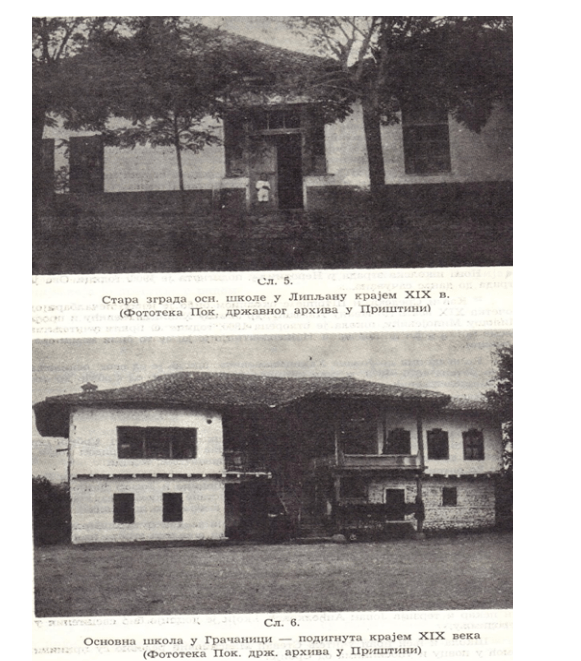
Serbian primary schools built during the 19th century, in Lipjan and Gracanica, this house representing the Albanian civic dwelling of the 18th and 19th centuries, was demolished by the Serbian government.
Since there were no Albanian-language schools in the city of Gjilan, Urosevic also completed primary school in the Serbian language in his hometown. After graduating from primary school in 1910, he continued his studies at the Turkish high school in the city of Pristina. The First Balkan War found him in the second grade of Turkish high school. After his studies at the Turkish school were interrupted, he returned to his hometown.
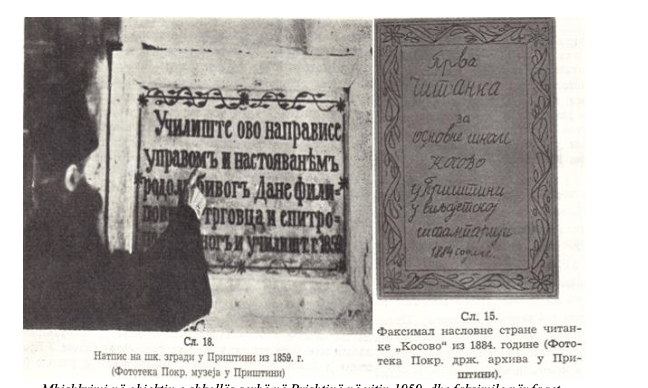
The inscription on the Serbian school building in Pristina in 1959, and facsimile of the summary pages of the Kosovo school book, from 1884 in Pristina.
Urosevic, in the school years 1913/14, continued his studies at the Serbian high school in Skopje. He enrolled in the second grade in Skopje and successfully completed it. Due to the First World War, he was forced to interrupt his studies and return to his family. After the end of the First World War, he continued his education in Skopje, where he graduated from high school in 1922 and enrolled in the Faculty of Philosophy in this city, in the Department of Geography and Ethnology. He graduated in 1926, and then was an unspecified assistant at this faculty; In 1927 (after completing his military service), he was elected assistant at the same faculty, where he received his doctorate in 1929.
During the thirties of the 20th century, we have no data on his activities, but in all likelihood, his activities were professional jobs, with which he was entrusted by the government. As can be seen, during the Kingdom of Serbs, Croats and Slovenes, he had also received a military rank, because during the Second World War, he was a reserve officer of the Kingdom’s army, and was arrested by the Germans, who released him on April 10, 1945.
After his release, he was elected associate professor at the Faculty of Philosophy in Belgrade, and at the end of 1946 he was transferred to Skopje at the Faculty of Philosophy, where in 1950 he became a full professor. Urosevic contributed to the opening of the faculty in Pristina. He retired in 1964, but his work and activities did not stop there.
From 1971 to 1973, he was the director of the Ethnographic Institute of the Serbian Academy of Sciences and Arts in Belgrade. Urosevic died on 17 October 1992, in Belgrade, where he is buried. Urosevic left several publications, mainly fieldwork for many regions and settlements of Kosovo. He especially left detailed notes for Anamorava, including Gjilan and other cities in the Kosovo plain. He left unpublished the results of his research for the Llapi area.
From his life it is very interesting to know how it happened that Urosevic, in 1910, continued his studies in the Turkish language in Pristina. Did his uncles from Vushtrri influence him to continue his studies in the Turkish language in Pristina? Atanasije Urosevic’s father, Kosta, was an abadžija (a slag maker, one who finishes, sells and works with slag). From his father’s activity we can understand that he was a wealthy craftsman and merchant in the city of Gjilan. His mother’s name was Mara and she was from the famous Qamili family in Vushtrri). From an economic perspective, it is seen that both of these families were wealthy. In all likelihood, both of these families were of Albanian origin who had embraced the Islamic faith over time for their family’s economic interests.
Let’s see who Atanasije Urosevic’s uncles were: Urosevic’s mother Mara was the daughter of Ali Agë Qamili’s family from Vushtrri. There is no exact information about the Qamili family in the city of Vushtrri, who they were, where they came from and their national affiliation. What is known is that this family lived in a beautiful house, very luxurious for the time of construction, in the center of Vushtrri. This house, due to its historical and architectural values, was protected as a cultural monument after World War II.
To obtain more information about this family and their home in Vushtrri, I contacted my professional colleagues Bedri Xhema, Burim Rexhepi, and Jeton Sallahu. With their help, I began to gather the first information about this family. Bedri Xhema, as a good connoisseur of the buildings and cultural heritage in the municipality of Vushtrri, informed me that this family had a house near the Employment Office in the city of Vushtrri. The house was two stories, built of bricks and had large windows. The building was covered with traditional tiles and had a yard of 6 ari. In the yard right next to the house was the qeshma, which was used only by this family.
According to Bedriu, this house had previously belonged to an Albanian bey, who after the occupation of Kosovo was expelled to Turkey, then that building was given to the Qamilović family. What more can I say about this family, it is thought to have originated from Trepça. After 2000, this house was planned to be converted into the city’s ethnographic museum, but it burned down in the meantime.
The house had valuables in the interior spaces, the facade was fully decorated, and when it burned, the ceramic pipes of the sewage and water supply were observed. A member of this family, Mishko Qamilovic, Bedriu had been the director of the House of Culture in Vushtrri. Bedriu remembers him as a reasonable man, and that he had the impression that he was afraid of what the Serbs were doing in Kosovo. Bedriu remembers that at the time when the decision was made to remove books in the Albanian language from the city library, with Bedriu’s suggestions, Mishko had decided not to remove the books in the Albanian language, even though the Serbs later fired him from his job. His first neighbor was Shaban Zekiqi.
Jeton Sallahu, in his published book: Issues of the history of Vushtrri and its surroundings, mentioned the Camilovic family house, but with the information he had received from Bedri Xhema. Jeton recalls Bedri Xhema’s stories that when the Serbs removed the photograph of Hasan Prishtina, Mishko Camilovic was very upset. Burim Rexhepi, through a friend of his from Vushtrri, has received some information about Misko Camilovic. Misko Camilovic has stated that his family is the oldest family in the city of Vushtrri. Also according to Camilovic, after them as an old family in Vushtrri were the Vllajiqës. The source has received information that this family also had another house opposite the kindergarten in the city of Vushtrri.
If this is true, then we have sources that in the 17th century, Slavic languages were not spoken at all in the city of Vushtrri, so this family could not have been Slavic either.

Published evidence about the population structure of Vushtrri, during the visit of Evlija Çelebi, in the 17th century.
Evliya Çelebi, when he visited this city, about the population structure of the city of Vushtrri writes that the population did not know how to speak Slavic languages, but they spoke in Albanian and Turkish languages.
As can be seen, Misko Camilovici must be the nephew of Ali Agë Qamili, but the data The truth about this family can only be revealed after his statements.From Serbian literature I learned that at the end of the 19th century, two Albanian brothers from the village of Batair, Mitrovica district, had committed several thefts and robberies against several families in that region. They had mainly stolen various animals from several villages. During the thefts, they had often created incidents with weapons, injuring several villagers.
Ali Agë Qamili was forced to meet these thieves and force them to return all the stolen animals to the affected families. This case occurred in 1898, from the letters that Stojan Novakovic had sent to Tefik Pasha, about the incidents during this period between Muslims and Orthodox Christians in Kosovo. From these letters we understand that Stojan Novakovic, for every incident that occurred between Orthodox Christians and Muslim Albanians, in Albanian territories within the territory of the Ottoman Empire, he also notified Spiridon Gopçeviç in Belgrade.
As can be seen, the case occurred in 1898, when Ali Aga Qamili forced thieves to return the stolen cattle.
What made me curious to know is because in this same year Atanasije Urosevic was born, and his mother Mara was from the Qamili beyler family of Vushtrri. Then the question arose as to whether Mara was called by this name in 1898, and was Mara Christian or Muslim? It is also of interest to know whether Urosevic’s family, in the year of his birth, was Christian or Muslim? These dilemmas can only be removed if Ali Aga Qamili’s family is willing to tell the truth, even though they have now been Serbized.
Based on this evidence collected in the field, as well as from literature in the Serbian language, we can conclude that Atanasije Urošević’s family was an Albanian Catholic family, indigenous to the village of Tullarë, near Medveđa, which, as Christians, due to a dispute, moved to the village of Rahavica in the municipality of Dardana.
The grandfather or father of Atanasije Urošević, in the first half of the 19th century, moved from Rahavica to the city of Gjilan. This family integrated quite well in the city of Gjilan, converted to Islam and began to successfully practice trade and craft activities, for the processing and sale of zhguna. Being a prominent family in the city of Gjilan, this family also made friends with the well-known family of Ali Aga Qamili, in the city of Vushtrri.
Atanasije Uroševiqi, after being educated in a Serbian school, was forced by the government of that time to mainly deal with the origin of the families of the Albanian territories, of Anamorava and the Kosovo plain. “His studies were aimed at the population. The Serbian Orthodox should be described as an indigenous population in these regions, while the Catholics should be described as having flooded from the Albanian highlands northward into Serbian lands.
However, from his studies, important information can still be found to investigate the truth of the Albanian population in these regions. It remains incomprehensible why only the data collected by him in the Llap region remained unpublished until today. Of course, in his notes there is enough evidence that in this region, until the Balkan wars, no Serbian family lived.
With the occupation of Kosovo during the Balkan Wars, both of these families, in order to preserve their wealth and not move to Turkey, were forced to become Serbs. Such cases of Serbization of Albanian families in Kosovo during this period are numerous. According to field testimonies, these families during Serbian rule were under strict surveillance by the authorities, and did not dare to mention their national identity even to their children.
Alexander Lambert, a historian and academic director of the School of International Training in Geneva, is the author of several books and articles in the fields of international politics, relations between states and peoples, political philosophy, security policy, and civil-military relations. Lambert, since his youth, has visited Albania, and has begun to do studies on the Albanian issue.
In order to better understand the Albanian issue, he has researched numerous documents on Albanians in the Archives of the League of Nations in Geneva. Researching Albanians, and important personalities who emerged from the bosom of this people, Aleksandre Lambert writes that it is no coincidence that many Albanians have excelled during different periods of history, leading empires and states, and have left their name in various fields of science in several countries of the world.
Lambert, in his studies, criticized the most powerful states in the world, describing the great contribution that Albanians made to civilization and the civilization of humanity. In fact, after the defeat of the Turks in the Russo-Turkish War, the international press began to ignore the Albanians by changing the name of the former Illyrian peninsula, inhabited since prehistoric times and to this day by Illyrian tribes (Albanians). Due to the numerous influences of the circles and movements formed in Europe against the Albanians, the Illyrian Peninsula was baptized with the new name, the Balkan Peninsula, from the Balkan mountain range that starts from the Black Sea.
Albanians and Bosniaks of Illyrian origin who had converted to Islam were ignored by most conservative European diplomacy. Europeans saw them as a threat to Western culture and civilization, so they began to call them by the pejorative term “Turks” to describe them as Turks, even though they were a more an ancient culture and a completely different language, Albanians had nothing in common with the Ottomans.
Europe has supported and enlarged the lands of Greece, Serbia, and Montenegro, at the expense of the Albanians. None of the major European powers has supported the Albanian cause. Lambert rightly says that Albanians have a history that they themselves do not even know. and in the last three centuries Europe has ignored them by not supporting their rights, but by creating the possibility of Slavism and Grecism of the indigenous Albanian and Vlach population.
So, as seen by the great powers of the time, the assimilation and fusion with other peoples of the indigenous Albanian and Vlach population had become a political and military platform in Europe. In order for Albanians to survive in their indigenous lands, they must deepen their studies of antiquity, identity, and traditional culture, offering the international public convincing scientific arguments for their autochthonism and early cultural and neighboring ties with other ancient peoples of the Mediterranean.
To achieve this, a nationwide cultural movement is necessary, based on scientific resources and supported by Albanian political and academic circles. In particular, studies should be added about the Vlachs and their coexistence with Albanians, from Roman rule until the 20th century, when, due to the influences of Russian Pan-Slavic politics, these two communities were misused by politics, to push them towards assimilation and killing among their own kind.
The very spread of the Vlachs throughout the Illyrian territories, starting in the west, from present-day Slovenia, to the Mediterranean Sea and the Aegean Sea, testifies to an Illyrian population Romanized during Roman rule, which over time lost some traditional Illyrian characteristics, but which survived and developed, alongside the other Illyrian (Albanian) population, which survived Romanization and complete alienation to the present day.
Aleksa Bogosavleviqi tells us what the connection is of these Arbër and Vlach families with the Albanian families and tribes in the northern regions of Albania in his book ‘O arnautima’ published in the city of Niš in 1897. Here is how Aleksa Bogosavleviqi, a Serbized Vlach, describes the closeness of Albanians and Vlachs, who in his book “O Arnautima” writes about Albanians:
“What is this people like, readers will read from books, but my belief is that often everything that comes to us from the Arnauts, happens only because we do not obey at all, or what separates us is a small hill, they were our closest neighbors since ancient times. Because they took our old homes from us after the unfortunate migration of 1690, they have enough of our blood. We are more Albanians of one tribe by blood, and brothers by suffering, especially with the Drenicas, Rugovas, Lumbards, Shkodrans, Dibrans, Malësors, Llapjans and many others, who are divided into 9-10 tribes. They are cousins of the Serbs of the Orthodox and Catholic faiths, claiming tribal descent through blood, custom, festivals and tribe.”

Evidence of how the closeness of Albanians to Vlachs (now Serbified) is described by the author of the book “O Arnautima” Aleksa Bogosavleviqi, of Vlach origin.
As seen in this text written during the 19th century, by a Vlach, we understand that the entire northern Illyrian Peninsula was inhabited by Arbër and Vlach populations. It is also clearly observed here that the Serbs were formed as an ethnicity and nation in this century by including Albanians assimilated from all the northern territories and tribes of Georgia.
So the formation of Slavic states in the northern Albanian territories was a Russian project, initiated during the 18th and 19th centuries, by the Pan-Slavic movement founded in Paris, led by the Poles and Russians, but also supported by the French, Prussians, and other northern Germans.
According to the political and historical circumstances that occurred in the Illyrian Peninsula after the Ottoman conquest, and especially since the 17th century, when Russia became an important political and military factor in our lands, the process of Slavization and Grecization of the Arbëro and Vlach population began.
From these data we conclude that: Neither the Serbian nation nor the Serbian ethnicity was excited in the Middle Ages! Serbia was created as a political entity in the 19th century, by assimilating the Albanian and Vlach populations. Today’s Serbs never had a state, nor an ethnic identity, before the 19th century. XIX – Servia is the name of the region in service and not the name of an ethnicity.
During the 18th century, according to Pan-Slavic projects in the central part of peninsula, centered in Smederevo, a political group was first created Orthodox who called themselves Serbs, and who had strong support from Russia and the Patriarchate of Istanbul. From this political platform by assimilating the Arbër and Vlach population of the Orthodox faith and to the detriment of the lands Albanians, the Serbian nation and political state were formed.

