
Abstract
Chapter IX explores the trade of Albania, including ancient Epirus, within European Turkey. The region’s commerce is chiefly conducted via its ports with the Ionian Islands, Venice, and Trieste. Although blessed with a favorable climate and soils suitable for corn, hemp, vines, currants, and other valuable crops, meaningful progress in agriculture and trade is stifled by the existing government.
Particular attention is given to the Albanian ports of Prevesa and Arta. Prevesa, situated at the entrance and on the north side of the Ambracian Gulf, served as the former entrepôt of Epirus and remains conveniently positioned for trade, despite a modest population of around 4,000 inhabitants. Arta, located on the river of the same name approximately six miles from the gulf, retains commercial importance even after near-destruction during the Greek insurrection. It features several bazaars and supports local manufactures of cotton, wool, leather, floccatas (shaggy capotes), embroidery, and related goods.
The chapter also notes the potential of other ports such as Durazzo and Avolona, and the role of Scutari as a larger commercial and manufacturing center. Overall, it underscores the untapped economic potential of Albanian territories like Prevesa and Arta, which could become significant with improvements in agriculture, infrastructure, and governance. Consular returns are referenced to illustrate the state of trade at the time.
Cited:
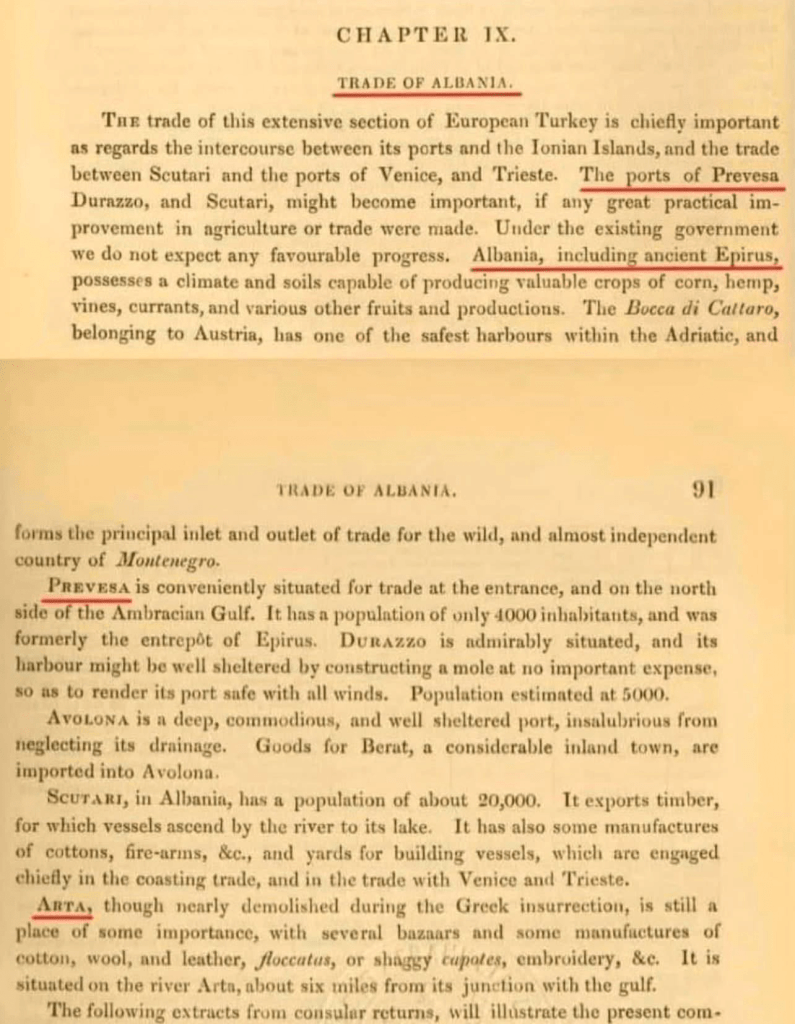
“CHAPTER IX. TRADE OF ALBANIA.
The trade of this extensive section of European Turkey is chiefly important as regards the intercourse between its ports and the Ionian Islands, and the trade between Scutari and the ports of Venice, and Trieste. The ports of Prevesa Durazzo, and Scutari, might become important, if any great practical im-provement in agriculture or trade were made.
Under the existing government we do not expect any favourable progress. Albania, including ancient Epirus, possesses a climate and soils capable of producing valuable crops of corn, hemp, vines, currants, and various other fruits and productions. The Bocca di Cattaro, belonging to Austria, has one of the safest harbours within the Adriatic, and forms the principal inlet and outlet of trade for the wild, and almost independent country of Montenegro.
PREVESA is conveniently situated for trade at the entrance, and on the north side of the Ambracian Gulf. It has a population of only 4000 inhabitants, and was formerly the entrepôt of Epirus. DURAZZO is admirably situated, and its harbour might be well sheltered by constructing a mole at no important expense, so as to render its port safe with all winds. Population estimated at 5000.
AVOLONA is a deep, commodious, and well sheltered port, insalubrious from neglecting its drainage. Goods for Berat, a considerable inland town, are imported into Avolona.
SCUTARI, in Albania, has a population of about 20,000. It exports timber, for which vessels ascend by the river to its lake. It has also some manufactures of cottons, fire-arms, & and yards for building vessels, which are engaged chiefly in the coasting trade, and in the trade with Venice and Trieste.
ARTA, though nearly demolished during the Greek insurrection, is still a place of some importance, with several bazaars and some manufactures of cotton, wool, and leather, floccatas, or shaggy capotes, embroidery, &. It is situated on the river Arta, about six miles from its junction with the gulf. The following extracts from consular returns, will illustrate the present com…”
Source
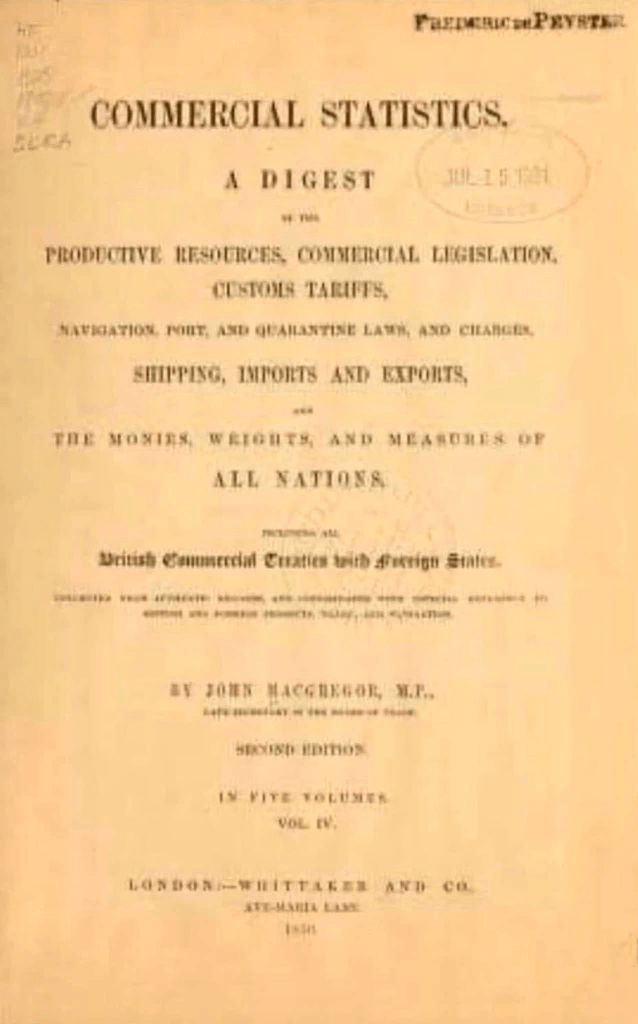
[ Trade of the cities of Albania ]. 1850. John Mcgregor. Commercial Statistics: A Digest of the Productive Resources, Commercial Legislation, Customs Tariffs, of All Nations. Including All British Commercial Treaties with Foreign States.

