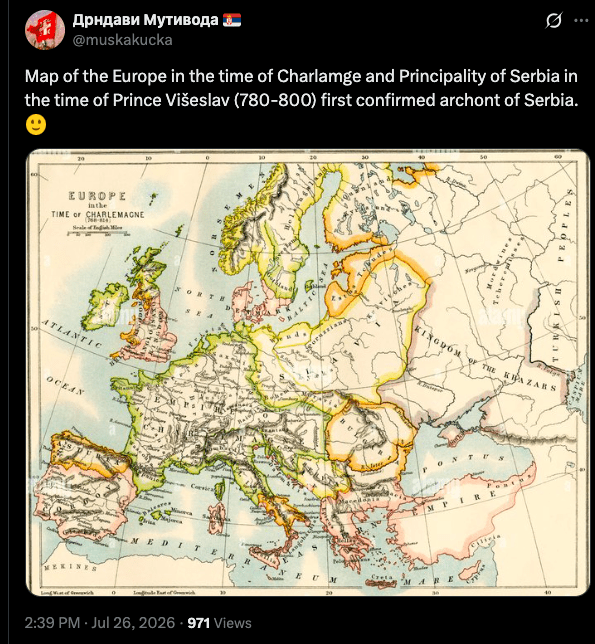

A recent X post by @muskakucka shares a historical map of Europe during the time of Charlemagne (roughly 768–814 AD) and highlights the “Principality of Serbia” under Prince Višeslav (780–800), described as the “first confirmed archont of Serbia.” While the post contains a small sand corn of historical truth, it exemplifies how selective presentation and nationalist framing can distort the sparse realities of early medieval Balkan history.
The very small piece of “truth”
Prince Višeslav (also rendered as Vojislav or the Greek Boïsesthlabos) is indeed the first ruler of Serbian lands known by name. According to the 10th-century Byzantine text De Administrando Imperio (DAI) by Emperor Constantine VII Porphyrogenitus, he ruled around 780 as part of a hereditary line descending from an earlier unnamed archon who settled Slavic groups in the western Balkans under Byzantine suzerainty.
Where the Claim Misleads
The problem lies in implication and emphasis rather than outright falsehood. The post presents the “Principality of Serbia” as a notable, defined entity on the grand map of Charlemagne’s Europe, suggesting a level of cohesion, size, and importance that the evidence does not support.
Sparse and late sources
Almost everything we know about Višeslav comes from a single Byzantine text written over 150 years later. Contemporary 8th-century records are virtually silent. Historians describe the period as “almost unknown” in specifics. The polity was a loose confederation of tribes, not a centralized medieval state with clear borders or administrative apparatus.
Exaggerated scale
Popular maps often project later territorial claims backward. In reality, control was limited and fluid. It was under nominal Byzantine oversight and bordered emerging Bulgar influence to the east. It did not rival the scale or organization of the Carolingian Empire.
Nationalist baggage
The Balkans’ early medieval history is heavily contested. A separate (or possibly conflated) figure named Višeslav is traditionally associated with early Croatian history via the famous Višeslavova krstionica (baptismal font), a symbol of Christianization often linked to Dalmatia and Carolingian influence. Some Serbian sources aggressively claim the font and deny a Croatian duke of that name. These debates frequently serve modern identity politics rather than scholarship.
Early medieval “states” in the region were typically tribal alliances in a chaotic landscape of migrations, raids, and shifting suzerainties—not proto-nation-states. Projecting modern Serbian (or Croatian) national continuity onto them is anachronistic.
Historical Context Matters
The late 8th century Balkans were a frontier zone. Slavic groups had settled over previous centuries, mixing with local populations. Power was fragmented among tribes, residual Byzantine authority, Bulgar expansion, and Frankish campaigns to the northwest. The DAI itself was compiled for Byzantine diplomatic and ideological purposes, blending oral tradition with political narrative.
More substantial Serbian consolidation occurred later, particularly under Prince Vlastimir in the 9th century, with clearer records of conflicts and expansion. Višeslav represents an early progenitor figure, but elevating him to headline status on a continental map overstates the case.
Misleading Presentation
By spotlighting this prominently alongside Charlemagne’s era without caveats, the post engages in typical historical exaggeration common in online nationalist discourse. It implies a grandeur and continuity unsupported by the fragmentary sources. For those interested in the period, consult scholarly works such as John V.A. Fine’s The Early Medieval Balkans or critical analyses of De Administrando Imperio. Early medieval Balkan history is complex and poorly documented; social media maps should be viewed with healthy skepticism, especially when they align neatly with modern national narratives.

