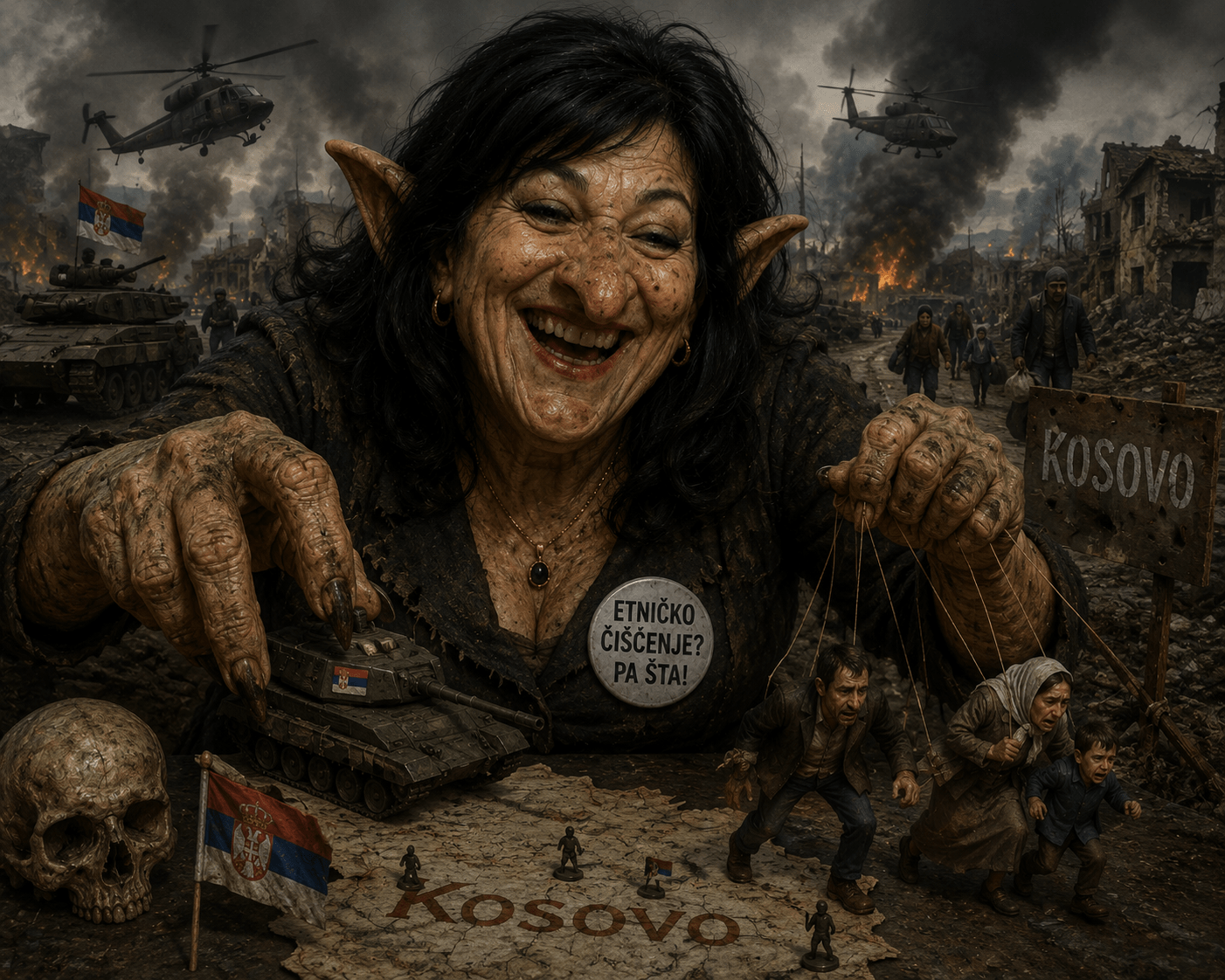

A German government minister publicly declared that, if given the chance, they would have supported the forced removal of Jews from Germany during the Nazi era. Imagine that this person did not immediately resign. Imagine that political allies defended the statement as “historical frustration” or “patriotism.” Imagine that parts of society dismissed the outrage as an attack on German identity.
The reaction across Europe would be immediate and overwhelming. The person would be condemned as a defender of one of history’s greatest crimes.
And rightly so.
Yet when a Serbian government official speaks approvingly about the idea of ethnic cleansing of Albanians in their country, the response is somehow treated by some as a regional political dispute rather than what it actually represents: the public rehabilitation of a criminal ideology that brought suffering, expulsion, and death to hundreds of thousands of people.
This is the disturbing reality behind the comments of Snežana Paunović, a Serbian minister who stated that, had she been in Slobodan Milošević’s position during the Serbian aggressions of 1998-99, she would have carried out ethnic cleansing. Such a statement from an ordinary extremist would already be alarming. Coming from a member of government, it becomes a test of the political culture that allowed it to be spoken.
What kind of society allows this?
The question is not only who Snežana Paunović is.
The question is what kind of society allows a person with such views to sit in a position of state power.
Europe was built after the Second World War on one fundamental lesson: when politicians begin describing ethnic groups as obstacles, enemies, or populations that must be removed, democracy itself is in danger.
Ethnic cleansing is not a harmless political opinion. It is a concept connected to forced displacement, terror, persecution, and crimes against humanity. The world has seen where such thinking leads.
The Balkans saw it in the 1990s.
The Albanian country was not a theoretical conflict. Thousands were killed, hundreds of thousands of ethnic Albanians were displaced, and entire communities were destroyed during the war. The policies of Slobodan Milošević’s government became internationally condemned and were examined by the International Criminal Tribunal for the former Yugoslavia.
Yet decades later, a senior Serbian politician can publicly express sympathy for the idea that such policies should have gone even further.
That should disturb every European democracy.
The problem is not one woman — it is the ecosystem around her
It would be wrong to claim that every Serbian citizen supports such views. Many Serbs reject nationalism, support reconciliation, and have worked for a different future.
But democratic societies are not measured only by the existence of extremists. They are measured by how they respond when extremists gain influence.
When politicians who glorify ethnic exclusion are rewarded with public office, when historical crimes are reframed as national victories, and when victims are treated as obstacles to a political narrative, society sends a dangerous message:
That some lives matter less than others.
A European double standard?
Europe rightly reacts with horror when Nazi symbols are displayed, when Holocaust denial appears, or when politicians glorify Hitler’s crimes.
But the same moral standard must apply everywhere.
A minister who praises the idea of removing an ethnic population from its homeland is not engaging in ordinary political debate. They are touching one of the darkest ideas in modern European history.
The name of the victim group changes. The language changes. The historical context changes.
But the principle remains the same:
A government official defending ethnic cleansing is defending the idea that people can be removed because of who they are.
That idea was supposed to have been buried in the ruins of the twentieth century.
The uncomfortable question Serbia must answer
The issue is not whether Serbia has a complicated history. Every nation does.
The issue is whether Serbia is willing to confront the darkest parts of that history — or whether some politicians will continue exploiting old wounds to gain power.
A country’s democratic maturity is not measured by the absence of ugly opinions. Ugly opinions exist everywhere.
It is measured by whether those opinions are rejected when they cross the line into the justification of crimes against humanity.
Europe did not say “never again” only for one nation, one religion, or one ethnic group.
It said “never again” for everyone.
And that promise must apply to Albanians just as it applies to every other victim of ethnic persecution in European history.

