
by Dr. Qazim Namani
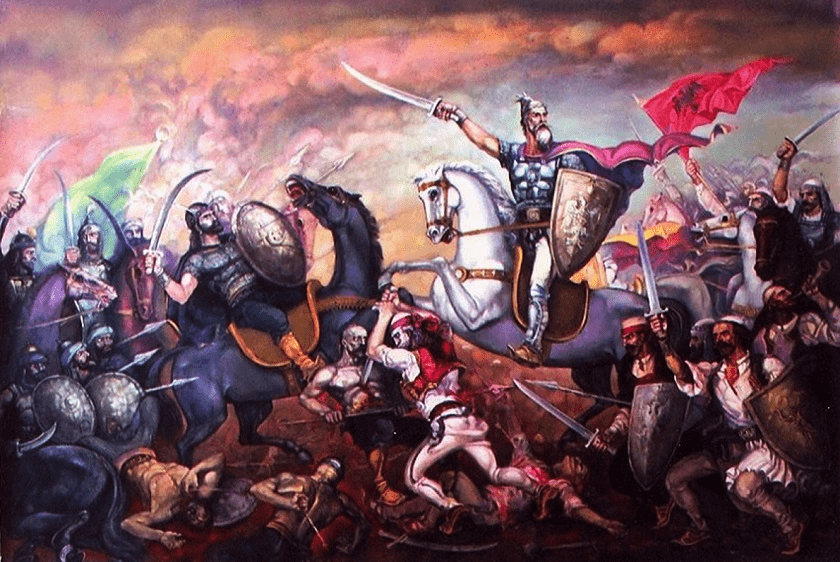
In the northern regions of ancient Dardania during the 15th century, under the leadership of the despot of Mysia and other Christian princes, a series of uprisings against the Ottoman occupation were organized. Regarding these events, Marin Barleti writes that in those years Gjergj Branković was the prince of Mysia. [1]
Sultan Murad relied on the help and advice of Skanderbeg to face this campaign, because he knew those areas after having fought many wars there before. [2] In one of the battles of the Hungarian army and the Mysians with the Ottoman army that took place in the vicinity of the city of Niš, Sultan Murad sent Skanderbeg to suppress this uprising. During his expeditions, Skanderbeg was waiting for the opportunity to abandon the war and return to his homeland.
Skanderbeg aimed to restore the fortress of Kruja in which the sultan kept a military garrison. In one of the battles for the possession of the territories in Mysia, the sultan himself participated. After the defeat in this war, Gjergj Branku left without any resistance and took refuge with the Hungarians and Poles. The Hungarians organized attacks against the Ottoman army to liberate the territories of Mysia.
The Sultan organized a powerful army against the Hungarians to preserve his conquests in Myz. In this battle against the Hungarians, the Pasha of Rumelia and Skanderbeg participated. Hunyadi also participated in the Hungarian army, who had distinguished himself in several battles for the protection of Christian forces against Ottoman invasions.
The Ottoman army was positioned across the present-day Morava River. Hunyadi, after receiving sufficient information about the position and the Ottoman army, crossed the Morava River and attacked the Pasha of Rumelia. This was a favorable opportunity for Skanderbeg to think about realizing his earlier plans to abandon the battle. Skanderbeg often made concessions in positions, giving Hunyadi the opportunity to succeed. Skanderbeg had explained his plans to return to his homeland to his friends and comrades.
Skanderbeg spread fear among the Ottoman soldiers so that they would abandon the war as much as possible. The Ottoman army suffered a crushing defeat. In the chaos that ensued, Skanderbeg went after the secretary, who was also the pasha’s advisor. After capturing and handcuffing the secretary, he asked him to write a letter as an order from the sultan to allow Skanderbeg to govern the city of Kruja.
After the secretary wrote and sealed the letter, he was killed. Skanderbeg, after receiving the letter, with his 300 Epirote soldiers began his journey towards Kruja. After seven days of travel, they reached Debar. [3]
Since Marin Barleti’s book on the life of Skanderbeg was written based on the accounts and writings of Martin Segoni and Konstantin Mihajli, which are known as the first writings about our national hero, we can say that for this data we must collect every detail from the writings of various authors and the memory of the current population in those areas to give a preview of the events at that time. Even though more than five centuries have passed until today, every piece of information must be tested by giving it a possible logical meaning.
Slavic historiography in the late Middle Ages, especially since the 19th century, adopted the culture of the Arbër humanists who operated in the territory of Dardania, considering them of Slavic origin. Many international scholars during the 19th and 20th centuries who wrote about the Arbër territories relied on Serbian literature, therefore they write about Martin Segoni and Konstantin Mihajli that they were Serbs, Greeks, denying their Arbër origin.
Some authors describe the origin of Martin Segoni as doubtful, so there are theses that attribute Serbian, Croatian or even Arbër nationality to him. It is Dhimitër Shuteriq who provides details on Segoni’s life, showing that he served in the Catholic church of Novobërda, an Arbër province, which refutes the thesis of Serbian origin. Skënder Rizaj, Jahja Drançolli, Skënder Gashi and many other Albanian scholars from Kosovo have also written about Martin Segoni’s Albanian origin.
According to Dhimitër Shuteriq, Segoni is either Dalmatian or Albanian, but not Serbian. [4] M. Segani had been a parish priest of the (Catholic) church in his hometown of Artana (Novoberdë). In a documentary about Skënderbeg produced by RTSH in Tirana, it is stated that: the first writings about our national hero come from a Serbian priest, Martin Segoni, and a Serbian janissary, Konstantin Mihajlović. This information does not hold because neither of them had Serbian origin.
Konstantin Mihajli, born in 1435, came from a poor Arbër family that was involved in mining activities in the Medvedja region. The Medvedja region extended to the northern part of Atrani, a region rich in minerals and with several mines known since early antiquity. Within this region, mines were included in the villages of: Medec, Tullar, Petrile, Gërbac, Braninë, Tupalla, Sfirca and other villages on the southern and northern sides of today’s Medvedja.
Dragoljub Trajkovic, in his description of Konstantin Mihajli’s birthplace, writes that: His birthplace must be near the city of Artana (Novobërdë). Based on 15th-century records, including those of Mikel Llukar and the writings of other authors, he writes that the birthplace of Constantine Mihajli should be the village of Hostryza on the southern side of the village of Tullarë, in present-day Medec, which lies between Gubac and Poroshtica (Prapashtica QN).
For the village of Medoiec, he thinks that it is the present-day village of Medec adjacent to the village of Prapashtica. [5] It is important to note that near Medec, Tullarë and Prapashtica, in the village of Brainë, there are ruins of a castle that is thought to be Bederiana, the birthplace of Emperor Justinian.
Trajkovic relies heavily on the data of Serbian historian MJ Dnic to find the birthplace of Konstantin Mihajli.
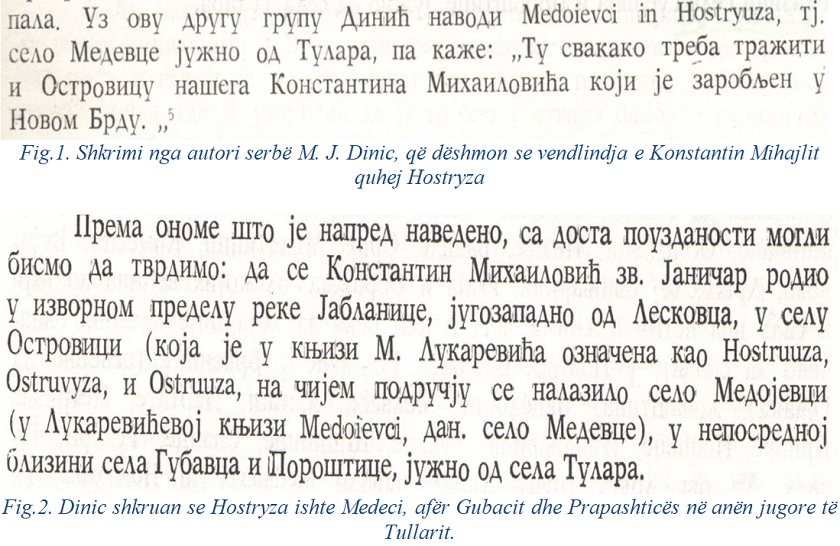
This author in this article, although he makes an effort to give villages with etymologies in Albanian their etymologies and meanings in Slavic languages, where he calls the village of Hostryza Ostrovicë, and Prapashtica Poroshtica, forgets that the village of Hostryza also had the letter Y, which is not found in the Serbian language, and that Prapashtica in medieval records from the 15th century is recorded as: Prapatinza, Prapatinca, Paratincea, Grapashnica and Prapashtica.
We have information about the life and activities of Konstantin Mihajli from the Ottoman chroniclers of that time. Konstantin had learned mining techniques for extracting minerals from the earth from a young age, and having this experience, he had participated in the Ottoman army for the conquest of Constantinople in 1453.
During the siege of Artana in 1455 by the Ottoman army, Konstantin, along with his brothers, were captured as prisoners of war and sent deep into Anatolia to be trained as Janissaries. As a Janissary, he participated in several famous battles in the east and in the territories of the Illyrian Peninsula.
During the battles fought in the territory of Bosnia in 1463, he was a commander of Ottoman units, he had passed to Hungary, then in the Czech Republic he developed diplomatic activities to organize battles by Christians against the Ottoman army. From 1468 until his death he operated in Poland, developing various activities against the Ottoman invasions in Europe. [6]
According to Serbian literature dedicated to the life and work of Konstantin Mihajli, it is said that he originated from a Greek family, perhaps from a poor Serbian family.
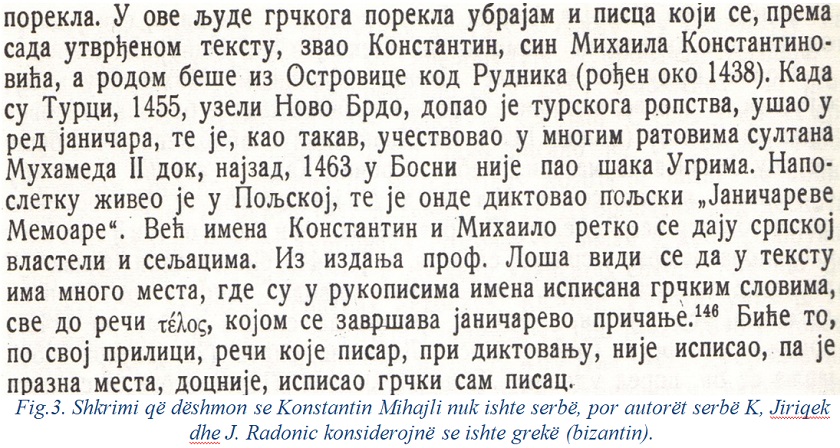
Some of the Serbian authors who have written the history of the Serbian people, and who are known to be a little more objective, write that: Of Greek origin is also a writer named Konstantin, the son of Konstantin Mihail. The names Konstantin and Mihail are rarely given to Serbian leaders and peasants. From the data of Prof. Llosha, and from what is seen in the text, it is seen that there are many places in the text where the names in the manuscripts are written in Greek letters. [7]
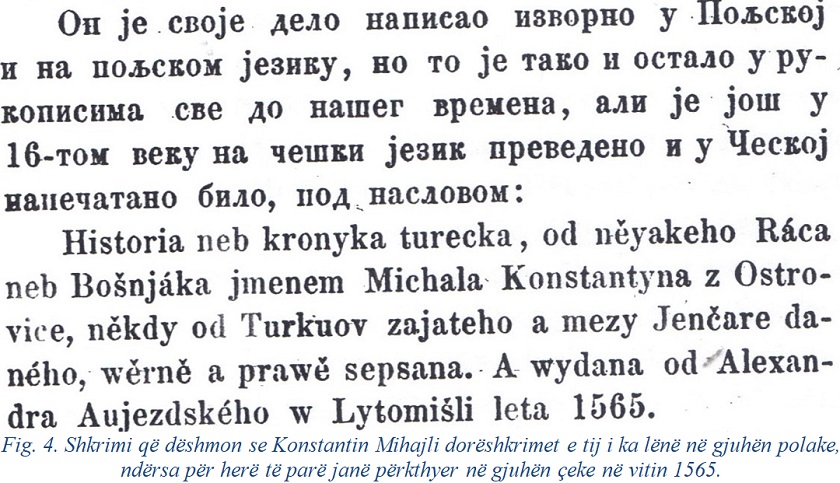
Konstantin Mikhailovich is believed to have written his memoirs in Polish, and they are preserved as manuscripts to this day. His manuscripts were translated into Czech in the 16th century. [8]
Based on written sources from the 15th century, population censuses, and toponyms, we can affirm that the majority of the population of this region, including the city of Niš, was an indigenous Dardanian-Arbër population that for centuries preserved its language, tradition, culture, and toponyms in the Arbër language until the 19th century.
These territories, from late antiquity until the time of the Ottoman conquest, were, in fact, under the rule of the Byzantine Empire throughout the centuries. From Serbian scholars we learn that during the 13th and 14th centuries, the city of Niš was not included in the control of the Rus, but in 1336 it was the seat of the Bulgarian kingdom. [9]
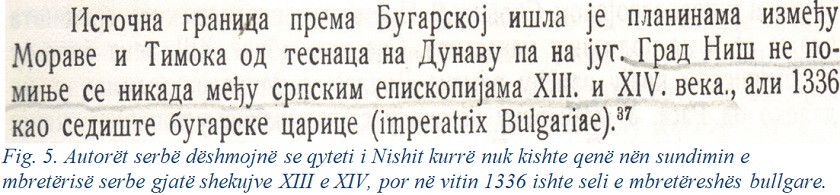
From this we understand that the population of the Gallapi Highlands was generally Arbëro, was autochthonous since ancient times and being a region rich in mines and cities since the Dardanian kingdom, the Roman period, but also the birthplace of the emperors Constantine the Great and Justinian in late antiquity, we can affirm that this region was the bearer of economic, administrative and military development in the kingdom of Dardania.
A document (1430) containing the accounts of a merchant from Ragusa states that Artana had a wide commercial and financial network that connected it to a number of other cities in eastern Dardania. It also states that the majority of the population in these cities had Arbër names such as Gjin, Gjon, Tanush, Progon, Lekë, etc. [10]
The French chronicler Philip Mezieres, who visited these regions after the Battle of Kosovo, three months after this battle, in October 1389, based on the information he received, published his chronicle and wrote that the battle took place in Albania. [11]
From this we understand that the territory of Dardania in the Middle Ages was continuously inhabited by Albanians, which is also confirmed by the data of the Albanian population in the Gallapit Mountains. In some families of Albanians from lower Anamorava who migrated from these areas during the 19th and 20th centuries, from the vicinity of Niš to the region of Bujanovac and Kamenica (Dardana), it is said that Skanderbeg had stayed with the Albanian population in their villages in the vicinity of Niš. [12]
Such data has also been preserved among the autochthonous Albanian population in the vicinity of Artana (Novobërda), where it is said that Skanderbeg and his soldiers passed through the villages of the Gallapit Mountains, namely the village of Prapashticë, to reach Krujë. [13] The Albanian population of the village of Prapashticë and its surroundings still preserves the tradition that the name of the village of Prapashticë is also associated with the journey of Gjergj Kastrioti in the direction of Tetovo-Dibra to Krujë.
Almost all the important roads coming from the east to the city of Novobërda passed through the village of Prapashticë. The ancient road that connected Justiniana Prima (the City of the King near Medvegja) with Justiniana Seconda (Ulpiana near Prishtina) also passed through this village, which passed through Zllashë, about 10 km north of Novobërda.
Adjacent to the village of Prapashticë is the village of Medec, which is thought to be the birthplace of Constantine Mihajli. Also near Medec and Prapashticë are the villages of Tullarë and Petrila e Arbneshit. To the south of the village of Prapashticë lies the village of Marec and the Castle of Novobërda. From the village of Prapashticë, two other important roads, one to the east and the other to the north with Novobërdo, pass in the south and west directions, avoiding the Novobërdo Castle for about 5 km.
Knowing that the village of Prapashticë was a strategic point connecting the Novobërdo Castle with the cities of the east, it is said that a tactic was used that the horseshoes of Gjergj Kastrioti and his horsemen were removed from the back in order to lose track of the direction of their march, and since then the village has been called Prapashticë.
Legends in such cases play an important role and help a lot to come to the conclusion that the population of a settlement or region is autochthonous. Without a doubt, the population of this village is Dardanian-Arbër who for centuries preserved the Dardanian culture and identity. In the village of Marec there are archaeological traces of a church called Martin’s Church, near the foundations of the church there is a cave that was known by the same name Cave of Martin’s Church.
Since the church and the cave lie on the north-eastern side of the Artana Castle at a distance of about 2 km, on the steep hill, and very close to the galleries and the entrance to the Artana mine, I think that this church can be connected with the very name and birthplace of the Arbër humanist Martin Segoni.
In the 15th century records, Prapashtica as a settlement is written with the name Prapatinza. With this name it is registered in the debtors’ register of the merchant Mikel Llukar in the first half of the 15th century. As can be seen, the etymology of the village is in Albanian, which means back and tinza (secretly) from the dialect of the Albanian population of this region.
From this we understand that this village had this name even before Skanderbeg’s journey to Krujë, but the legend about the horseshoes being shod from the back may have earlier origins, which is the repetition of the same tactic in 1443. With this name it is also found in later records.
In the cadastral register of the Artana kaza of 1498, the settlement Prapatinca is registered with 36 heads of households and a village head. It is later recorded under the name Papratincë in the cadastral register of the Vushtrri sandžak from 1566-74 with 17 houses and 5 single people. It is recorded under the name Grapasnica on an Austrian map, drawn based on records from 1689. [14]
In the Ottoman register at the end of the 15th century, discovered in the archive of the Turkish Prime Minister’s Office, in 1986 in Prapashtica we find many heads of families who prove their Albanian ethnic affiliation such as: Niksa Rajini, Stepa Marko, Raja Lisic (I think today’s Lisi-Lisica), Leshjana the widow, Bashtina Tusha in the hands of the Papas, bashtina vogla (small bashtina). [15]
In the census during the time of Sultan Selim II in the 16th century in Prapashtica we find Marko Mati as the head of the family, and even today in the Balajve neighborhood we find the toponym Bregu i Matës , then Lugu i Pjetrit (Today Lugu i Selimit) etc. In Prapashtica we also find these other heads of families such as: Lleshko Dane, Lleshko Dimja, Lleshko Rajko, Gjuro Lleshko etc. With which the Albanian ethnogenesis of these heads of families is proven.
Much has been written about the role of medieval humanists originating from Artana. In the 15th century, a Jewish community was registered in Artana, which had 6 houses. The Jews had their own schools and libraries. Educated people came out of these schools and thus an upper class of Jews was formed. [16]
From this data we understand that in Novobrdo in those years, tolerance and coexistence of all communities living in the city dominated. There is no doubt that when there was a school for 6 Jewish families, there was undoubtedly a school for the Arbër population in Novobrdo.
From the sources of the time, it is known that during the 15th century, Valerian (Valerius) Novobrdasi worked as a theology teacher in Novobrdo, so this leads us to believe that Martin Segoni had received his first lessons in his homeland to study and later obtain a doctorate in the field of theology and canon law at the University of Padua. This certainly indicates that Martin Segoni had received basic knowledge in his homeland before studying in Padua.
Jahja Drançolli also wrote about the role of the medieval humanists from Artana, who were distinguished for their theology, philosophy, art and diplomacy during the Middle Ages. He mentions Martin Segon, Valerian Novoberdas, Gjon Vaji, Gjon Ignaci, Gjon Progoni, where Ignaci and Progoni left their mark in painting and decorative arts (silversmithing). Gjon Progoni, after coming to Ragusa after the fall of Artana, became famous for his valuable works in applied arts (silversmithing).
His most famous work, which occupies an important place in the applied arts of Ragusa, is Jesus Christ on the Cross. That he was a highly sought-after artist is proven by many contracts and documents from the Ragusa chancery and notary office. Progoni’s works reveal the rare talent of the author in the late Gothic style, and with advanced Renaissance ideas. [17]
Among the most prominent humanists and diplomats of the time of Gjergj Kastrioti was undoubtedly Gjergj Pelini, born in Artana. Pelini’s year of birth is still unknown, but until his death in 1463, he was in the service of the League of Lezha and Gjergj Kastrioti for about two decades.
Pelini was a Catholic priest and a prominent diplomat of the time, he was the leader of the Abbey of St. Mary in Ratec (today Sutomore, west of Tivar). His abbey was under the jurisdiction of the Catholic Church in Tivar. Gjergj Pelini and Gjon Gazuli are mentioned in 1441 as diplomatic missionaries in Italy.
He also, together with the bishop of Arbri, Andrean, during the years 1447-1448, participated in the talks that took place between Skanderbeg and the Republic of Venice. From contemporary sources it is known that Gjergj Pelini remained very close and loyal to Gjergj Kastrioti until his death in 1463. [18]
The city of Artana, until it was conquered by the Ottoman Empire, had educated a considerable number of humanists of Arbëro origin, who, through their work, distinguished themselves by participating in religious and diplomatic combat activities for the defense of Arbëro lands from the Ottoman occupation.
Considering these activities, there is no doubt that our national hero Gjergj Kastrioti had established contacts with the Dardanian Arbëro people of Artana even before the decision to abandon the Ottoman army, therefore the first publications about the wars and bravery of our hero were written by two Dardanian Arbëro people from Artana and the surrounding area.
There is no doubt that before the definitive conquest of Artana, in this rich mining town, in addition to mining, the education of the population was also developed.
So far we have also researched the settlements of other Arbër humanists from Artana. Based on the population census during the 15th century, the Progoni family lived in Arbanashka Petrila, which leads us to think that Gjon Progoni was from Arbanashka Petrila (Guri i Arberit), which is today’s Petrila, near Medec, the birthplace of Konstantin Mihajli and today’s Medvedja. For Gjon Ivaji, Gjon Injazi and Valerian Novobrdasin we cannot say which place they may have come from, but it is believed that they were born in Artana (Novobrda).
Two centuries later, Pjeter Bogdani, who worked among the Arbëror inhabitants of the villages of Galab and other areas, expressed in his writings his interest in educating the poor Albanians and Serbs, who he said mostly spoke Albanian. [19]
Johan Georg Von Hahn writes that in the 19th century, Ami Boue defined the Albanian region after these cities: Vranje, Gjilan, Novoberdë, Prishtina, Kratovë, Kusumli, Prokuplje and Medokë. The inhabitants of these areas call them Arnauts, the land in which the Arnauts live was an integral part of old Dardania and the Dardanians were otherwise Illyrians.
The author heard that these Albanians are also called Lapë-Gulap and that they are the wildest of all the people. They were not well known in Albania and the author could not understand whether this name was used for all the inhabitants of those areas or only for their main tribe, the Gulab. This name in Serbian means pigeon. This name also reminds us of the Galabres, a tribe of the Dardanians (Galabreja) who call the flower of the spring on the slope. [20]
Several Serbian authors have also written about the presence of Albanians in these areas. Mita Rakic writes that in the Gallap mountains there lived a pure Albanian population through which foreigners and even Turks from Leskoci could not pass freely. Hani, during his visit to these areas, traveled as far as Medvedja and was forced to return due to fear of the Albanians. [21]
Serbian historian Jovan Radonic also wrote about the presence of Catholic Albanians deep in the territories of present-day Serbia, stating that the core of Catholics in Serbia was made up of Albanians, which is why the Catholic religion here was called “La fede Albaneze”. [22] It is known from contemporary sources that in these territories, including Novo Brdo and its surroundings, there have never been, nor are there today, Serbs of the Catholic faith.
According to the Serbian historian, Haxhi Vasileviqi, at the time of the Serbian-Turkish wars, 1876-1878, the Albanian lands and settlements from Vranje, Leskoc, Prokuplje, Kušumlija, Niš and extending to Kopaonik were called Arnautlluk [23] .
The autochthonous Albanians in the village of Prapashtica are also evidenced by a piece of information from Johann Georg Von Hahn, who in 1858 made a trip from Belgrade to Thessaloniki to examine the possibility of building a railway line through this region. During this expedition, he also visited several Albanian towns and villages in eastern Dardania and left some important notes about our people and the organization of popular assemblies, which he calls Dardania assemblies.
During his writings, Hahn also wrote some information about the Gallapi Highlands, where he also mentions the organization of the Albanian population in Prapashtica and other villages. He divided the Gallapi Highlands into regions, stating that in Upper Gallapi there are 19 villages that hold their assemblies in the Prapashtica Mosque. [24]
According to Hahn, in Lower Gallapi, 21 villages gather and hold their assemblies near Sfirca. The popular assemblies continued in other villages, where Hahn also mentions the assembly of 20 villages held in the village of Orllan. From this note, it can be seen that the Dardanian Albanians hold popular assemblies, just like the highlanders of the homeland, but, unfortunately, they were not held in Pristina.
Hahn writes that the Dardanian Albanians, like the Albanians in the mountainous areas of Mirdita and the homeland, are divided into tribes, but tribal unity here is weaker. The Krasniqe are mainly located around Pristina and constitute almost the entire Muslim population of that city. [25] From this we understand that at this time the Muslimism of the Krasniqe tribe and other tribes in Pristina and its surroundings had ended.
This information by Hahn is important because he calls the popular assemblies in the villages of Gallapit Dardanian assemblies, which proves the autochthonous and ancient Dardanian origin of this population. Regarding the popular assembly that Hahn mentions in the Prapashtica Mosque, I think that this was precisely the time when the inhabitants of Prapashtica finally accepted Islam and adapted the space of the old church as a mosque.
Serbian history since the 19th century was in the service of Pan-Slavic projects and this has influenced that during the translation of original documents from foreign languages into Serbian, quite a few changes of names were made.
In the absence of original documents, I want to say how important it is to research some sources translated by some authors, to get to know the terrain and to collect memory in the broad popular strata. And if I have done a valuable work on this topic, it is the sources from these three factors summarized in a writing, however small, but which give the message that before various publications and documentaries about our national history are made, we must be careful not to serve our invaders.
Sources
[1] Marin Barleti; “History of the life and works of Skanderbeg”, Tirana, 1964,p. 61
[2] Ibid., p. 63
[3] Yes, pp. 63-65.
[4] Dhimitër Shuteriqi; Historical-literary work “Marin Beçikemi and other writings”, Tirana, 1987
[5] Trajkovic Dragolub,; “Iz proslosti Leskovca i vilga”, Leskovac, 1977, p. 10-15
[6] Konstantin Mihajlovic iz Ostrovice, janicarove uspomene ili turska hronika, SSAN, 1959, p. 107; Constantine
Jiricek; Istorija serba, II, Belgrade, 1952, pg. 376; Konstantin Mihajlovic, janicarove uspomene ili turska hronika,
Belgrade 1986; Dorde Zivanovic; zivot i delo Konstantina Mihajlovica iz Ostrovice, Belgrade, 2006.
[7] K, Jiriqek & J. Radonic; “Srba history, Kulturna istorija, knjiga II”, Belgrade, 1978, p. 376
[8] Janko Shafarik; “Mijailo Konstantinovic, Serbian of Ostrovia”, Belgrade, 1865. p. 5.
[9] K, Jiriqek & J. Radonic; “Serbian History, Kulturna istorija, knjiga II”, Belgrade, 1978, p. 7
[10] Noel Malcolm; “Kosovo a Short History”, Prishtina, 1998, p. 89
[11] Dr. Gjyltekin Shehu; “The Ethnocultural and Historical Heritage of Llapi” p. 94
[12] Ibid. p. 94
[13] Ibrahim Namani (1909), Prapashtica.
[14] Jusuf Osmani; “Settlement of Kosovo 1” Prishtina 2003, p. 172
[15] Ilaz Rexha; “Annual” XXVII-XXVIII”, Prishtina 2004, p. 103,
[16] Skender Rizaj; “Kosovo during the 15th, 16th, 17th centuries” Prishtina, 1982, p. 417
[17] Jahja Drançolli; Feature “The Albanian Contribution to the Humanism of the European Renaissance”,“Koha”, July 13,1994.
[18] Jorjo Tadic; “Johanes Gazulus, Dubrovacki humanista XV veka, Zbornik filozofskog fakulteta knjiga VIII,
Spomenica Mihajla Dinica 2″, Belgrade, 1964, pp. 429-451; https://wikivividly.com/wiki/Georgius_Pelino
[19] Gasper Gjini; “The Skopje-Prizren Diocese through the Centuries”, Zagreb, 1992, p. 181
[20] Johan Georg Von Hahn; “Albanian Studies”, Tirana, pp. 49, 50
[21] Mita Rakic; “From New Serbia”, Leskoc 1987, p. 55
[22] Jovan Radonic; “Rimska kurija i juzhnoslovenske zemlje od XVI do XIX veka”, Belgrade 1950, pg. 257, 404, 474, 511
[23] Jov. Haxhi-Vasilevic; “Arnautski pokreti u XIX veku”, Belgrade, 1905, p. 6
[24] [Extract from Johann Georg von Hahn,Reise von Belgrad nach Salonik, nebst vier Abhandlungen zur alten
Geschichte des Moraëagebietes. Denkschrift der Kaiserlichen Akademie der Wissenschaften, phil.-hist. Class.
1, II. Abteilung (Vienna: Tendler, 1861, 2nd ed. 1868), p. 112-128. Translated from the German by Robert Elsie.]
[25] Ibid.
Article

