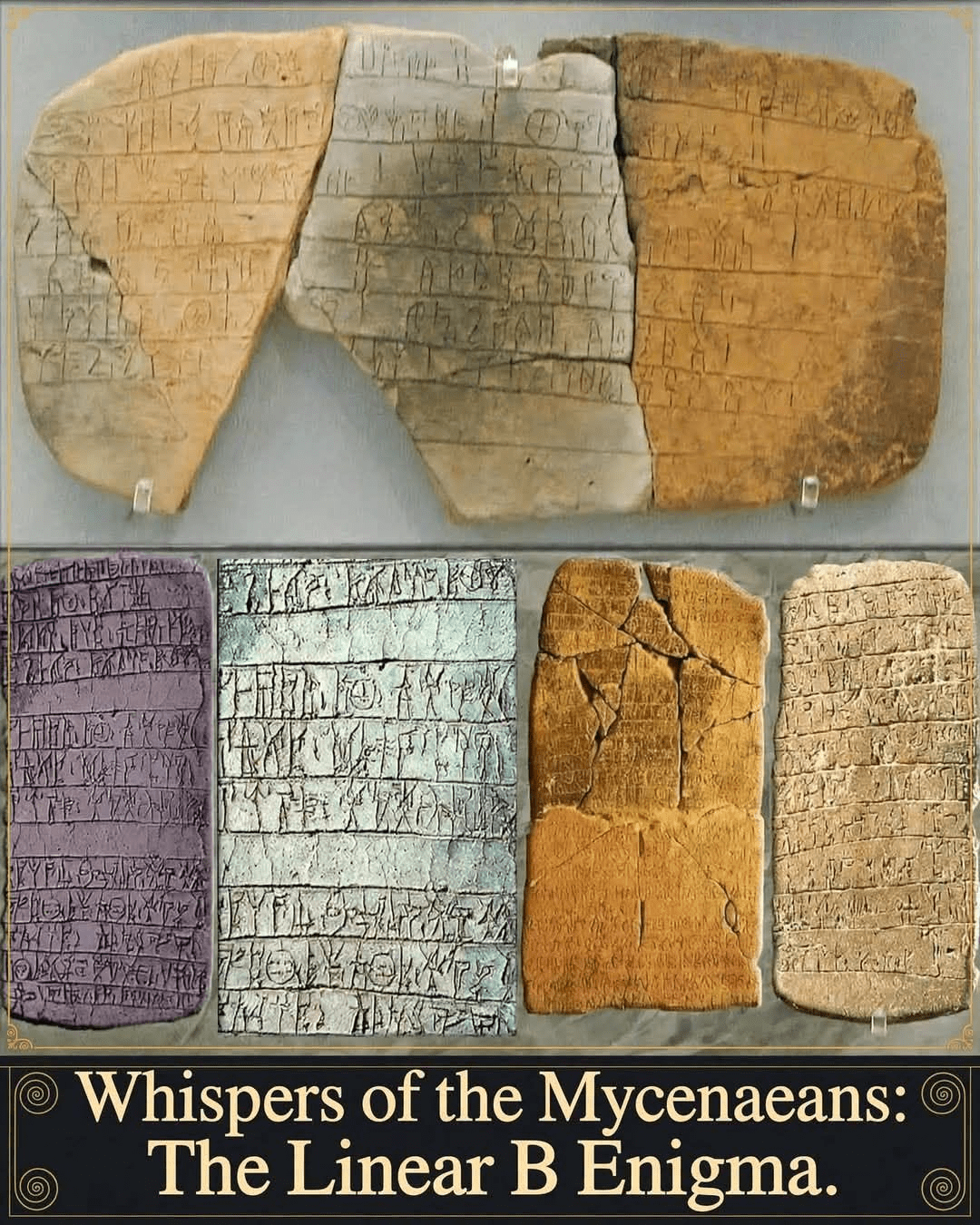

For centuries, the clay tablets unearthed from the ruins of Knossos on Crete and Mycenaean sites on the mainland stood as silent witnesses to a forgotten world. Bearing the intricate Linear B script—Europe’s oldest readable writing system—these artifacts puzzled scholars, who long presumed they recorded a non-Greek “Minoan” language tied to the enigmatic civilization of Crete.
The 1952 decipherment by architect and linguist Michael Ventris, aided by Alice Kober’s groundwork, upended this view: Linear B encoded an early form of Greek, pushing the language’s documented history back roughly seven centuries before Homer.
The tablets’ contents—palace inventories, tax records, agricultural tallies, and administrative lists—lacked epic poetry but anchored the Mycenaean era, including the Trojan War’s historical kernel, in tangible reality. Mainstream scholarship celebrated this as proof of Greek-speaking Mycenaean dominance over the Aegean, with Minoan Crete eventually falling under their influence.
Yet this narrative invites deeper scrutiny through the lens of Pelasgian (or pre-Greek) heritage theories, which posit a substantial indigenous substrate predating Indo-European Greek arrivals. Far from resolving the Aegean’s linguistic and cultural mosaic, the Linear B decipherment may instead highlight layers of continuity, admixture, and cultural borrowing from pre-Greek peoples.
The Pelasgian Framework: Pre-Greek Inhabitants and Linguistic Substrate
Ancient sources, including Herodotus, Thucydides, and Dionysius of Halicarnassus, describe the Pelasgians as early inhabitants of Greece, Thessaly, the Peloponnese, Attica, and Crete—often portrayed as autochthonous or foundational to what became Hellenic civilization. They were not uniformly “barbarian” outsiders but contributors to place names, religious practices (e.g., elements of Demeter and Persephone cults, Eleusinian Mysteries), and monumental architecture like the Cyclopean walls of Mycenae and Tiryns.
Linguistically, scholars identify a “pre-Greek” or Pelasgian substrate in Greek vocabulary: words with non-Indo-European (or divergent IE) phonology and morphology, especially toponyms (Athēnai, Mykēnai), flora/fauna terms (asáminthos “bathtub,” terébinthos), and cultural vocabulary. Figures like Paul Kretschmer, Vladimir Georgiev (who proposed phonetic laws for a “Pelasgian” IE language), and later Robert Beekes advanced substrate studies, distinguishing it from incoming Greek (a Central Indo-European variety arriving ca. 2200–1500 BCE). Minoan Linear A, still undeciphered, is frequently linked to this pre-Greek layer, potentially Pelasgian or related.
Genetic evidence complicates but does not erase this picture. Minoans and Mycenaeans share predominant ancestry from Neolithic western Anatolian/Aegean farmers, with Mycenaeans showing additional “northern” (steppe-related) input absent in Minoans—consistent with Indo-European speaker influx. Yet substantial continuity exists, and substrate influence on language and culture suggests pre-Greek populations were absorbed rather than replaced.
Challenging the Linear B Triumph: Administrative Greek Over a Pelasgian Base
Ventris’s breakthrough proved Mycenaean elites used Greek for bureaucracy, supporting their role as Aegean powerbrokers by the Late Bronze Age. However, this does not necessitate a clean “Greek conquest” erasing prior heritage. Knossos tablets in Linear B (post-Minoan destruction phases) indicate Mycenaean administration of a formerly Minoan center, but the underlying society likely retained Pelasgian/Minoan elements in religion, art, technology, and lexicon.
Critics and alternative views note limitations in the decipherment and its interpretations. Some early skepticism (e.g., from A.J. Beattie) questioned over-reliance on assumptions, while substrate researchers argue many Greek words—especially those tied to Aegean agriculture, seafaring, and ritual—derive from pre-Greek sources, surviving into Mycenaean records. Linear B’s mundane focus on inventories may mask deeper cultural syncretism; Greek served as the language of power, overlaying a Pelasgian substrate in toponyms, loanwords, and possibly spoken vernaculars among subject populations.
Homer’s Odyssey (Crete passage) evokes linguistic diversity with Achaeans, Eteocretans (“true Cretans,” likely Minoan remnants), Cydonians, Dorians, and Pelasgians—hinting at persistent multi-ethnicity. Eteocretan inscriptions in eastern Crete further suggest non-Greek continuity. Pelasgian theories frame Mycenaean “Greekness” as an elite overlay on a richer pre-Greek foundation, with Cyclopean architecture, palatial organization, and goddess-centric iconography owing debts to indigenous traditions.
Some fringe or speculative works even explore Pelasgian as an early IE language or link Minoan to other families (e.g., Uralic hypotheses), but the core challenge holds: Linear B confirms Greek in administration without disproving substantial pre-Greek demographic and cultural persistence.
Implications for Aegean Prehistory
Viewing the tablets through a Pelasgian lens reframes the Mycenaean achievement not as wholesale replacement but as fusion. The “mundane paperwork” affirms Greek speakers’ organizational prowess while underscoring what it omits: grand narratives possibly rooted in older oral traditions. This aligns with broader evidence of substrate influence persisting into classical Greece—place names, myths, and rites preserving pre-Hellenic memory.
Ventris’s decipherment remains a monumental scholarly success, but it solves one riddle while illuminating others. The Pelasgians, once dismissed as mythic, represent the deep indigenous heritage that shaped Hellenic civilization. Future work on Linear A, genetics, and archaeology may further clarify this layered past, revealing Bronze Age Greece as a crossroads of continuity and innovation rather than a simple Greek triumph.
Sources
Beekes, Robert S. P. Pre-Greek: Phonology, Morphology, Lexicon. Leiden: Brill, 2014. (Referenced via secondary summaries.)
Lazaridis, Iosif, et al. “Genetic Origins of the Minoans and Mycenaeans.” Nature 548 (2017): 214–218.
Myres, J. L. “A History of the Pelasgian Theory.” Journal of Hellenic Studies 27 (1907): 170–225.
Ventris, Michael, and John Chadwick. Documents in Mycenaean Greek. Cambridge: Cambridge University Press, 1956.
Additional sources on substrate: Fournet, Arnaud. The Pelasgian Pre-Greek Substrate and the Linear A. (Online PDF summaries.)

