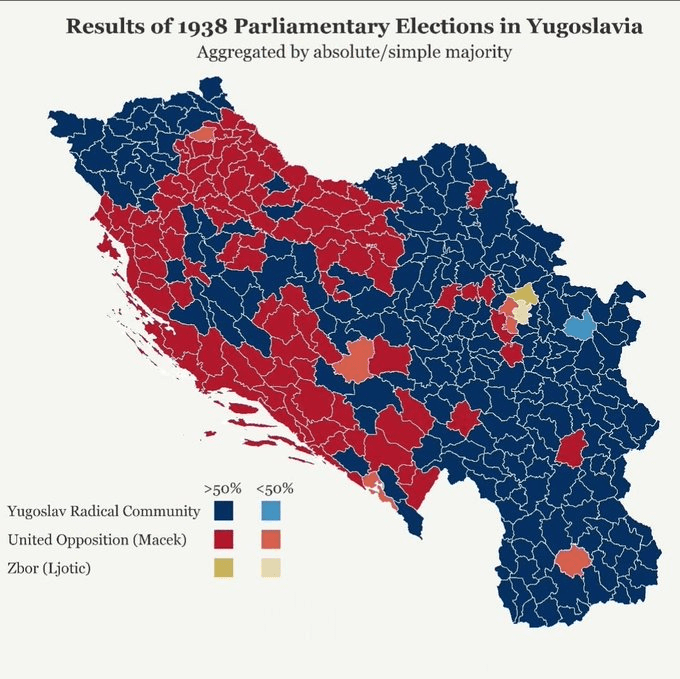

The 1938 parliamentary elections in the Kingdom of Yugoslavia challenge the simplistic nationalist narrative that Yugoslavia was uniformly dominated by Serbian political will. The electoral map reveals a far more complex political landscape.
The Yugoslav Radical Community (JRZ), led by Milan Stojadinović, performed strongly across much of Serbia, Montenegro, Macedonia, and parts of Bosnia. However, the United Opposition, led by Vladko Maček, won majorities across much of Croatia and significant areas of Bosnia-Herzegovina, demonstrating that Croatian political opposition enjoyed broad democratic support before the Second World War.
The election exposed deep political divisions within the kingdom. Rather than reflecting a unified Yugoslav state, voting patterns followed regional, historical, and national lines. Croatian voters overwhelmingly backed Maček’s opposition, which demanded greater autonomy and constitutional reform. Serbian voters, by contrast, generally supported the governing JRZ, although even within Serbia there were notable opposition strongholds.
These results undermine later narratives that portray interwar Yugoslavia as enjoying unanimous legitimacy among its constituent peoples. Long before the Axis invasion in 1941, substantial portions of the population sought constitutional change or a different balance of power within the state.
At the same time, the map should not be overinterpreted. The 1938 election was conducted under conditions that favored the incumbent government, including restrictions on the opposition and an electoral system that amplified the government’s parliamentary majority despite its vote share. Therefore, the map reflects regional voting tendencies rather than an ideal measure of free democratic preference.
History is best understood through contemporary evidence rather than retrospective nationalist mythology. Electoral data, census records, diplomatic archives, and contemporary newspapers provide a stronger foundation than later political narratives.
Sources
Banac, Ivo. The National Question in Yugoslavia: Origins, History, Politics. Ithaca, NY: Cornell University Press, 1984.
Ramet, Sabrina P. The Three Yugoslavias: State-Building and Legitimation, 1918–2005. Bloomington: Indiana University Press, 2006.
Tomasevich, Jozo. Peasants, Politics, and Economic Change in Yugoslavia. Stanford, CA: Stanford University Press, 1955.
Nohlen, Dieter, Dolf Sternberger, Bernhard Vogel, and Klaus Landfried. Die Wahl der Parlamente und anderer Staatsorgane. Vol. 2. Berlin: Walter de Gruyter, 1969, p. 784.
Kingdom of Yugoslavia. Izbori za Narodnu skupštinu 1938. Belgrade: Opšta državna statistika, 1938. (Official election statistics.)

