
By: Agron Dalipaj
Abstract
This study presents Agron Dalipajs study of the mythological figure of the Cyclops through the framework of TEM/EM (Embryomorpheme Theory), contrasting it with the etymology accepted in classical philology. While traditional Greek linguistics derives Kyklōps (Κύκλωψ) from kyklos (“circle”) and ōps (“eye”), yielding the meaning “circular eye,” the present study argues that this explanation describes only the physical form of the Cyclops without accounting for its deeper mythological symbolism. Instead, the proposed etymology derives the word from the Albanian conceptual compound SY-GROP (“eye-pit” or “eye socket”), suggesting that the term originally evoked an eye emerging from a hollow or cave. Through a sequence of proposed natural phonetic transformations, SY-GROP is argued to evolve into CIKLOP, linking the Cyclops directly to its characteristic dwelling place in caves. Symbolically, the Cyclops is reinterpreted as the “eye of the Earth”—a figure representing light, perception, and knowledge emerging from darkness within the Earth’s interior. The study concludes that, although this theory differs from the phonological reconstructions of classical Indo-European linguistics, it seeks to preserve the symbolic and experiential logic of the myth and invites further interdisciplinary discussion among scholars of etymology, mythology, and symbolic thought.
Cyclops – “The Eye-Hollow of the Earth’s Light”
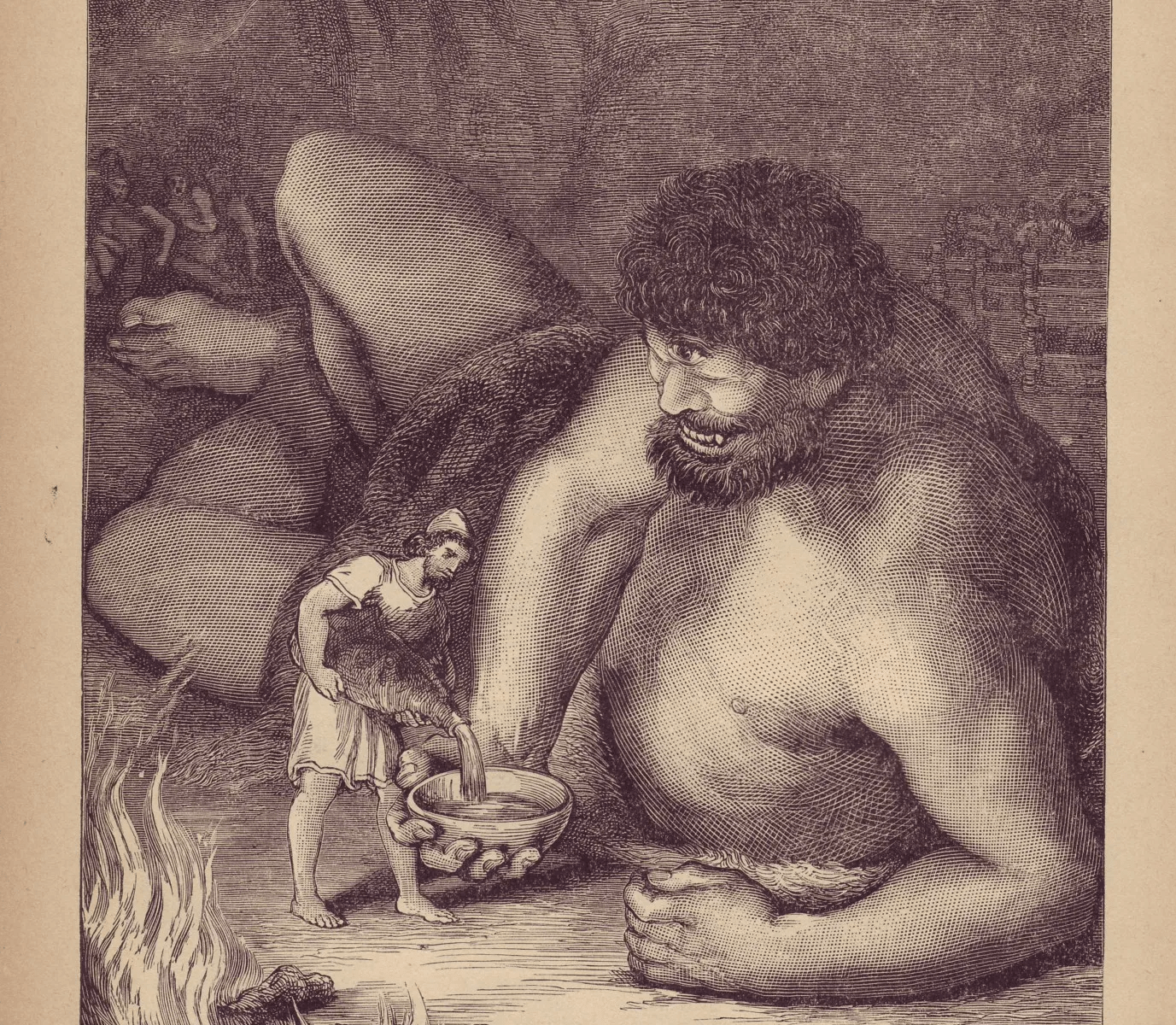
In so-called Greek mythology, the Cyclopes are giant beings with a single eye in the middle of their forehead. They lived in deep caves, beneath mountains, or inside volcanoes, where they forged Zeus’s thunderbolts. The best-known among them is Polyphemus, the son of Poseidon, who was blinded by Odysseus after the famous episode in the cave.
At the heart of this myth lies the idea of light imprisoned within darkness: the Cyclops’ single eye, which gazes from within, is itself the vision of the Earth’s light being forged in its own hollow.
Etymology According to Comparative Linguistics
According to the traditional Greek etymology, the word Κύκλωψ (Kyklōps) is divided into κύκλος (kyklos), meaning “circle” or “wheel,” and ὤψ (ōps), meaning “eye” or “face.”
Thus, Kyklōps means “circular eye” or “the one who has a circular eye.”
This etymology is found in authors such as:
- Hesiod, Theogony, lines 139–146.
- Liddell & Scott, Greek–English Lexicon, entry Κύκλωψ.
- Beekes, Etymological Dictionary of Greek (2010), which emphasises the connection with the Proto-Indo-European root kʷekʷlo- (“circle, wheel”).
This etymology explains the formal aspect (the circular eye), but it does not explain the mythological significance of the unique eye, nor the Cyclops’ connection with the cave, fire, and darkness.
Etymology According to TEM/EM (Embryomorpheme Theory)
According to TEM, the meaning of a word does not arise from the mechanical combination of two roots but from the form and lived experience that the word itself carries. In this sense, since all Cyclopes lived in caves or hollows, Cyclops may derive from the mental image of the hollow or pit in which it dwells.
A Cyclops lived in a cave or cavity (like the eye socket in a human skull), and at the entrance to the cave or pit emerged a being with one large eye that looked outward. In the imagination of mythical man, the Cyclops could have been an EYE observing from a PIT, producing the combination:
EYE + PIT
In Albanian, the eye socket is called [GROPa e SY]rit (“the pit of the eye”), or alternatively:
[SY-GROP]
According to the natural process of phonetic change described by TEM/EM, the following development is proposed:
SY-GROP
→ SI-GROP (y → i, as in di : dy; si : sy)
→ CI-GROP (s → c, as in sisë : cicë)
→ CI-KROP (g → k, as in agrep : akrep)
→ CI-KLOP (r → l, as in çakra : çakla)
→ CIKLOP
Thus, the word would not describe a circular eye but rather an eye situated in a hollow, or the inhabitant of the eye’s cavity.
In myth, this corresponds perfectly with the fact that the Cyclopes dwell in caves (hollows within the body of the Earth).
Therefore, the Cyclops is the “eye of the Earth”—light forged within its own cavity.
On the Symbolic Level
- The eye = light, knowledge, understanding.
- The hollow = darkness, the maternal earth.
- The Cyclops = the union of light and darkness, a being possessing a single gaze that looks inward rather than outward.
Conclusion
In this interpretation, the Cyclops is not a “circular eye” but an “eye in a hollow”—a figure embodying the Earth’s own inward vision.
Although this etymology does not correspond with the phonetic analysis of the classical languages, it nevertheless preserves the truth of the mythical experience and may perhaps bring us closer to the word’s original meaning: one formed through imagination rather than grammar.
I invite scholars of etymology, mythology, and symbolic thought to compare this etymology with their own, for only through living debate and the exchange of questions and answers can the true meaning of a word emerge.

