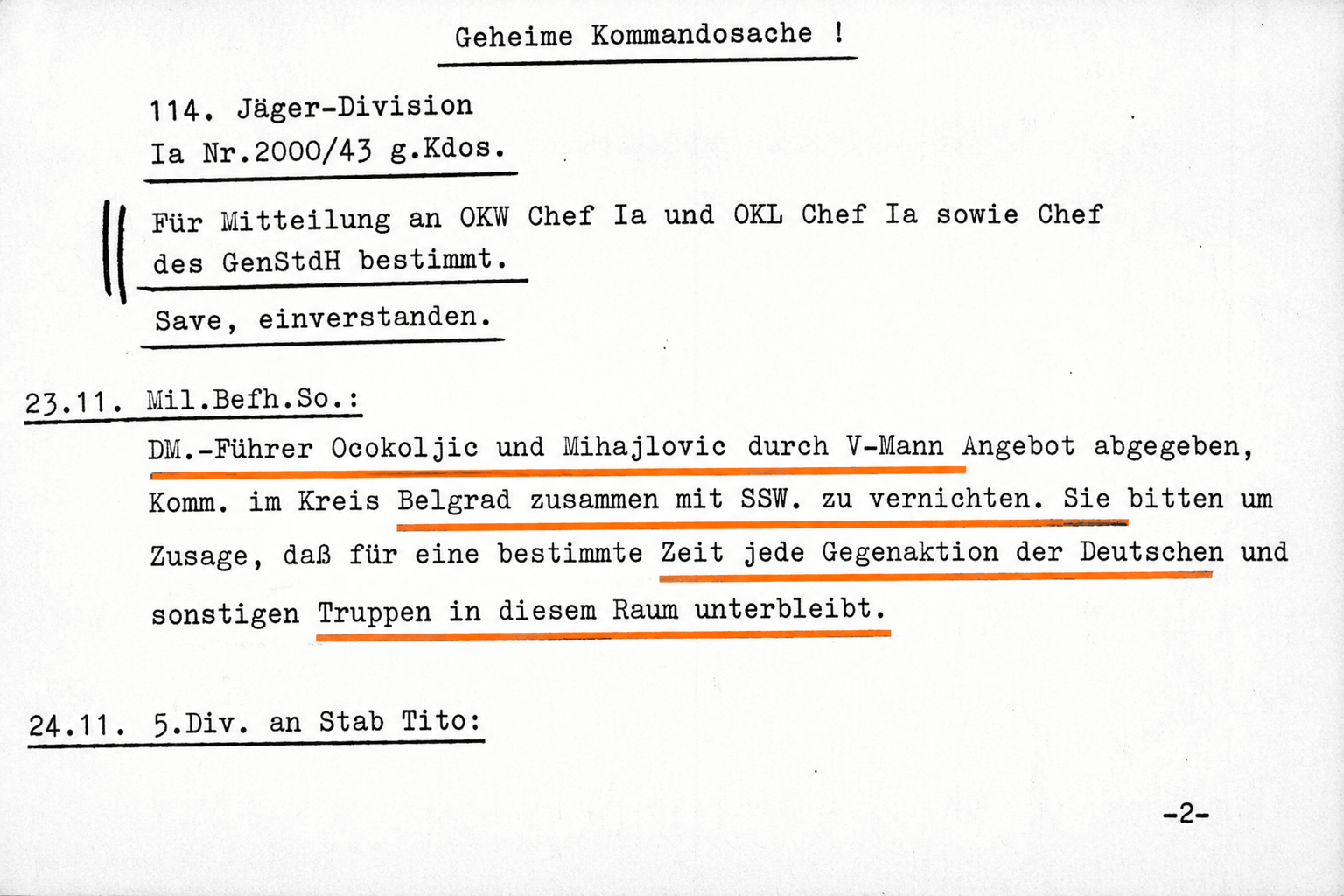

A wartime German military telegram preserved in the U.S. National Archives provides evidence of proposed cooperation between Chetnik commanders and German occupation authorities during late 1943. The document records an offer by prominent Chetnik leaders to participate in a joint operation aimed at destroying Communist Partisan forces in the Belgrade area, provided that German and other Axis troops temporarily suspended independent military actions in the region.
The telegram states:
“DM leader Ocokoljić and Mihajlović, through an intermediary, submitted an offer to destroy the Communists in the Belgrade district together with the SSW. They request an assurance that, for a specified period, the Germans and other troops will refrain from military operations in this area.”
The abbreviation “DM” refers to Draža Mihailović, commander of the Yugoslav Chetnik movement, while “SSW” refers to the Serbian State Guard (Srpska državna straža), the collaborationist security force operating under the German occupation administration.
This document illustrates that, despite the Serbian Chetnik movement’s official portrayal as a resistance force, segments of its leadership engaged in negotiations with German authorities and proposed coordinated military operations against the Communist Partisans.
Such cooperation formed part of a broader pattern documented in German military records and postwar historical research, particularly from 1942 onward, when anti-Partisan warfare increasingly became a common objective for German occupation forces and numerous Chetnik detachments.
The telegram is especially significant because it predates atrocities committed by Chetnik units in villages such as Vranić. Those killings, carried out under the command structure of Draža Mihailović and justified as operations against alleged Partisan supporters, occurred after several Chetnik commanders—including Nikola Kalabić, Simić Jovanović, and Čačić—had already entered into agreements or operational understandings with German forces.
Rather than representing isolated incidents, these arrangements reflected a strategic convergence in which defeating the Partisan movement often took precedence over confronting the Axis occupation.
The document therefore contributes to the historical record demonstrating that, in certain regions of occupied Yugoslavia, collaboration between German forces and elements of the Chetnik movement extended beyond local ceasefires to include proposals for coordinated military action against a common enemy.
Source
National Archives and Records Administration (NARA), Records of German Armed Forces High Command, 1939–1945, Record Group 242, Microfilm Publication T316, Roll 196, Frame 313 (Document No. 176), telegram dated 23 November 1943.

