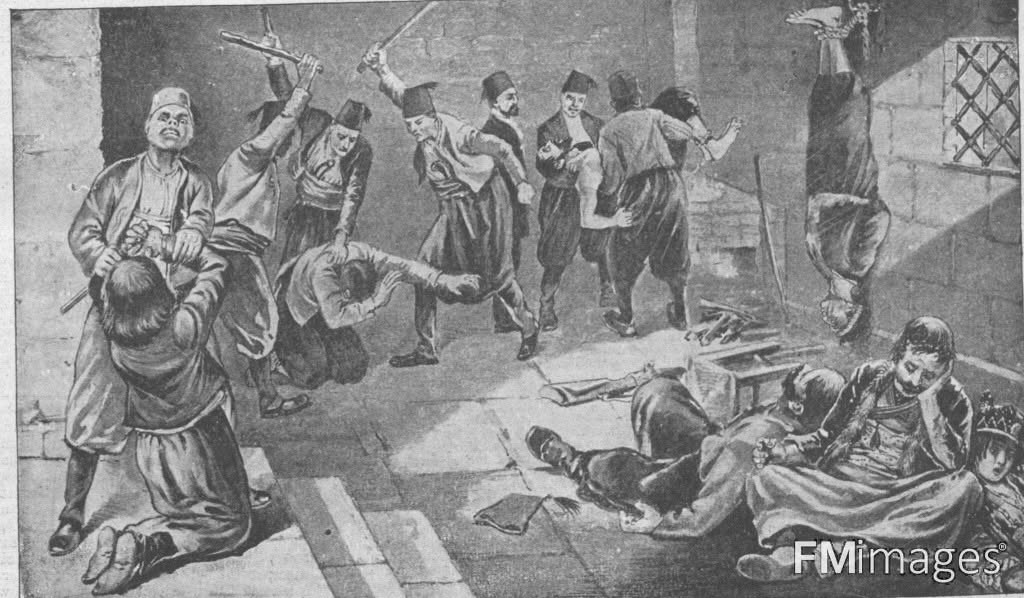

Turkish Oppression of Albanians in 1903: A Stark Reminder That Ottoman Rule Spared No One
The Ottoman Empire’s long decline in the Balkans was marked by widespread violence, arbitrary rule, and brutal suppression of dissent. While narratives often focus on the suffering of Christian populations—Slavs, Greeks, and others—under Ottoman governance, the experience of Muslim Albanians demonstrates that oppression was not limited by religion or ethnicity.
Loyalty to the Sultan offered no protection when local interests clashed with imperial policy. A harrowing illustration from Skopje (Üsküp) in 1903 captures this reality: Albanian rebels imprisoned and subjected to torture by Ottoman forces in one of the city’s prisons.
The image depicts a chaotic prison courtyard filled with brutality. Ottoman soldiers or irregulars, some in traditional attire with fezzes, wield clubs and swords against prisoners. One man hangs upside down, bound by his ankles—a common method of torture and humiliation. Others lie beaten on the ground or kneel in submission, while a figure in regal or notable attire sits distressed amid the carnage. This scene, dated to Skopje 1903, documents the fate of Albanian rebels who resisted Ottoman authority during a period of intense regional upheaval.
Context: 1903 and the Broader Crisis in Macedonia
1903 was a pivotal year of turmoil in Ottoman Macedonia, dominated by the Ilinden–Preobrazhenie Uprising (primarily August 1903), led by the Internal Macedonian Revolutionary Organization (IMRO). This mainly involved Slavic Christian groups seeking autonomy or independence, resulting in severe Ottoman reprisals against villages, massacres, torture, and destruction across regions like Bitola and Skopje.
Albanians, predominantly Muslim and often viewed by the Porte as loyal “pillars” of Ottoman rule in the Balkans (with many serving in the army and administration), were not immune. Many Albanians opposed the Mürzsteg Agreement reforms pushed by Russia and Austria-Hungary, which aimed to introduce international oversight, including mixed Christian-Muslim gendarmerie in sensitive areas. These reforms threatened Albanian dominance in Kosovo and western Macedonia and were seen as favoring Christians.
In March 1903, Albanian forces attacked Kosovska Mitrovica (Mitrovica) to resist reforms and target foreign consuls, notably the Russian consul. This led to clashes with Ottoman troops. Albanian gatherings in Drenica and elsewhere underscored widespread discontent. While the Ilinden uprising focused on Slavic areas, Albanian resistance to centralizing policies and reforms simmered concurrently, provoking Ottoman crackdowns.
Systematic Repression
Ottoman responses to unrest—whether from Christians or resistant Muslim Albanians—included mass arrests and torture. Prisons like those in Skopje became sites of beatings, hangings, and other abuses to extract confessions or deter rebellion.
Military suppression
Regular troops and irregulars (bashi-bazouks) burned villages, disarmed populations, and conducted reprisals.
Replacement policies
Loyal Albanian units were sometimes sidelined in favor of Anatolian Turkish regiments to enforce control.
Sultan Abdul Hamid II had cultivated Albanian loyalty, using them as bodyguards and frontier defenders. Yet, when Albanians prioritized local autonomy, customary rights (kanun), or resistance to reforms over blind obedience, the empire turned on them. This pattern intensified later with the Young Turk revolution (1908) and Albanian revolts of 1910–1912, but the roots were visible in 1903.
Evidence That Oppression Transcended Religion
The Skopje prison scene is powerful evidence that Ottoman rule in its final decades relied on coercion against any group challenging central authority or the status quo. Muslim Albanians—fellow believers—faced the same tools of repression (torture, imprisonment, execution) as Christian Slavs. This undercuts simplistic narratives framing Ottoman decline solely as religious persecution of Christians. Governance was driven by power, taxation, centralization, and fear of fragmentation, not consistent religious ideology.
Albanians suffered both under Ottomans and, later, during the Balkan Wars and partitions, when neighboring states targeted them regardless of prior allegiances. Their 1903 experience highlights the empire’s indiscriminate brutality in its death throes.
Legacy
The events of 1903 accelerated the Albanian National Awakening (Rilindja), pushing intellectuals and leaders toward demands for rights, autonomy, and eventually independence (proclaimed 1912). The image from Skopje serves as a grim historical document: a reminder of shared suffering across Balkan peoples under Ottoman misrule and the complex ethnic-religious dynamics that defined the region’s path to nation-states.
Such episodes underscore a broader truth: empires in decay often consume their own supporters when loyalty falters. For Albanians in 1903, being Muslim offered no shield against the Sultan’s prisons.
Souces
Koha.net. “Year 1903: Russian Pressure, the Sultan at War with His Loyal Albanians.” December 21, 2025. https://www.koha.net/en/shtojca-kulture/viti-1903-presioni-rus-sulltani-ne-lufte-me-shqiptaret-e-tij-besnike.
The New York Times. “Memorandum from Bulgaria Powers; Government Tells of Turkish Atrocities in Macedonia.” August 17, 1903. https://www.nytimes.com/1903/08/17/archives/memorandum-from-bulgaria-powers-government-tells-of-turkish.html.
DOAJ. “The Attack of the Albanians to Kosovska Mitrovica in 1903.” Accessed 2026. https://doaj.org/article/b57afa536678484681d66f58064c7b7a.
Gawrych, George Walter. Ottoman Administration and the Albanians, 1908-1913. University of Michigan, 1984. (Contextual background on Albanian-Ottoman relations).
Wikipedia contributors. “Ilinden–Preobrazhenie Uprising.” Last modified 2026. https://en.wikipedia.org/wiki/Ilinden–Preobrazhenie_Uprising. (For broader uprising context).
Wikipedia contributors. “Albanian Revolt of 1910.” Last modified 2026. (For patterns continuing after 1903).

