
The demographic future of Russia has become one of the most debated geopolitical questions of the 21st century. A rapidly declining ethnic Russian population, combined with higher fertility rates among some Muslim communities and large-scale migration from Central Asia and the North Caucasus, has led to speculation about whether Russia could eventually become a country where ethnic Russians no longer form an overwhelming majority.
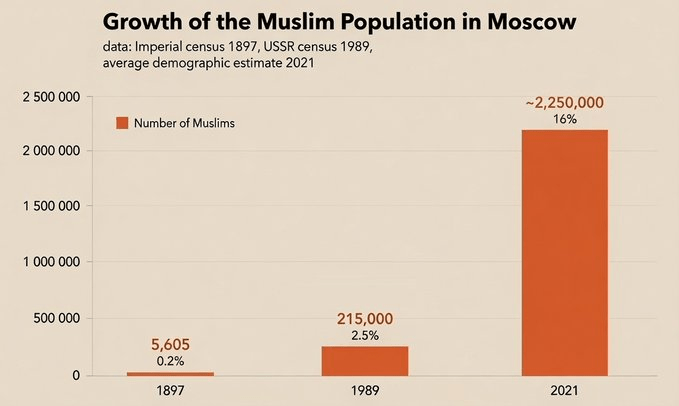
One of the most visible examples of this transformation is Moscow. According to historical census data, the Muslim population of the Moscow region was extremely small in the late Russian Empire, but has grown dramatically during the Soviet and post-Soviet periods.
In 1897, the Imperial Russian census recorded approximately 5,600 Muslims in the Moscow Governorate, representing only around 0.2 percent of the population. By the end of the Soviet period, the 1989 census recorded around 215,000 Muslims in Moscow, approximately 2.5 percent of the city’s population. Today, various demographic estimates place the Muslim population of Moscow at roughly 1.5–2.5 million people, with estimates often ranging between 10 and 20 percent of the city’s inhabitants.
This transformation reflects several overlapping processes: migration from Muslim-majority regions of Russia, immigration from Central Asia after the collapse of the Soviet Union, urbanisation, and different fertility patterns between population groups.
Russia’s Demographic Crisis
The broader demographic challenge facing Russia is not primarily caused by Muslim population growth, but by a severe decline among ethnic Russians and many other Slavic populations.
Russia has experienced decades of:
- low birth rates,
- high mortality compared with other developed countries,
- emigration,
- population ageing,
- and the demographic consequences of the collapse of the Soviet Union.
The Russian fertility rate has remained below replacement level for decades. Meanwhile, many predominantly ethnic Russian regions are experiencing population decline. Regions such as Pskov, Tambov, and others have recorded significantly more deaths than births.
The Russian state has attempted to counter this through pronatalist policies, including financial incentives for families and programmes encouraging migration.
Migration and the Growth of Muslim Communities
After 1991, Russia became a major destination for migrants from former Soviet republics, particularly:
- Uzbekistan,
- Tajikistan,
- Kyrgyzstan,
- Azerbaijan,
- and parts of the North Caucasus.
Many migrants settled permanently, bringing families and creating new Muslim communities in major cities such as Moscow and St Petersburg.
The 2007 introduction of expanded family support policies, including the maternity capital programme, encouraged some families to have additional children and contributed to demographic changes among all population groups, including Muslim communities.
However, claims that migration alone will transform Russia into a Muslim-majority country are debated among demographers. Migration patterns, assimilation, fertility convergence, government policy, and economic conditions will all influence future outcomes.
Are Half of Moscow’s Newborns Muslim?
In 2025, some Russian political figures claimed that Muslims account for a very large share of newborns in Moscow and other major cities. Such statements have attracted attention but remain difficult to verify independently.
Official demographic statistics generally classify residents by citizenship or ethnicity rather than religion, making precise measurements of “Muslim births” complicated.
Some estimates suggest that children born to migrant families make up a significant and growing share of births in Moscow, while other estimates place the proportion considerably lower.
Could Russia Become a Muslim-Majority Country?
Predictions that Russia will become an “Islamic state” vary widely and are often influenced by political perspectives.
More moderate demographic projections generally do not foresee Russia becoming Muslim-majority by 2050. The Muslim population is expected to grow as a proportion of the total population, but ethnic Russians are still likely to remain the largest single ethnic group.
Some researchers estimate that Muslims could represent around 15–20 percent of Russia’s population by the middle of the century, while higher projections suggest larger shares depending on migration and fertility assumptions.
A scenario where Muslims exceed 50 percent of Russia’s population within a generation is considered highly unlikely by most professional demographers.
The Political Question: What Happens to Russian Identity?
The more realistic question may not be whether Russia becomes an Islamic state, but how Russia defines itself as a multi-ethnic federation in the future.
Russia has historically been a diverse empire and federation containing dozens of ethnic groups, including:
- Tatars,
- Bashkirs,
- Chechens,
- Dagestanis,
- Ingush,
- and many others.
Islam has existed inside Russia for centuries, especially in the Volga region and the North Caucasus. The growth of Muslim communities in Moscow is therefore not entirely a foreign phenomenon, but part of a longer historical development.
However, rapid demographic change combined with economic inequality, migration tensions, and declining ethnic Russian numbers creates political challenges that the Russian government has struggled to address.
The future of Russia will likely depend less on a simple religious demographic shift and more on questions of integration, citizenship, economic development, and whether the state can maintain a shared national identity among increasingly diverse populations.
References
Anderson, Barbara A., and Brian D. Silver. Russia’s Changing Population: The Demographic Consequences of the Collapse of the Soviet Union. Boulder, CO: Westview Press, 1995.
Bruk, Solomon I. The Population of the Soviet Union: History and Prospects. Geneva: United Nations Research Institute for Social Development, 1981.
Federal State Statistics Service (Rosstat). Population of Russia: Demographic Yearbook. Moscow: Rosstat, various years.
Heleniak, Roman. “Migration and Population Change in Russia.” Post-Soviet Geography and Economics 43, no. 6 (2002): 364–385.
Karimov, N. “Muslim Communities in Contemporary Russia: Demographic and Social Trends.” Central Asian Survey 32, no. 4 (2013): 527–543.
Laruelle, Marlène. Russian Nationalism: Imaginaries, Doctrines, and Political Battlefields. London: Routledge, 2019.
United Nations Department of Economic and Social Affairs. World Population Prospects 2024. New York: United Nations, 2024.

