

Authored by Bep Jubani. 1985.
(Tipare të kulturës ilire në trevën e Dardanisë / Traits de la culture illyrienne dans la régions de la Dardanie)
Abstract
This study examines the archaeological evidence for Illyrian culture in Dardania, a region centred on present-day Kosovo and extending into northeastern Albania, North Macedonia, and parts of southern Serbia. Bep Jubani argues that archaeological remains from the Bronze Age through the Hellenistic period demonstrate strong cultural continuity and support the view that the Dardanians were an Illyrian people.
The paper traces the development of settlements, burial customs, pottery, metallurgy, and urbanisation from the Early Bronze Age onward. Bronze Age tumuli, urn burials, and Mycenaean imports indicate both local continuity and long-distance trade. During the Iron Age, fortified settlements, distinctive ceramics, tumulus cemeteries, and expanding iron production reveal a flourishing regional culture closely connected to northern Albania and other southern Illyrian regions.
Jubani highlights increasing economic and cultural development during the 6th–5th centuries BC, including the growth of local pottery workshops, sophisticated metalworking, and extensive trade with Greek colonies such as Dyrrachium and Apollonia. By the 4th–2nd centuries BC, Dardania experienced significant urban development while maintaining its distinctive Illyrian cultural traditions.
A central argument of the paper challenges theories that identify the Dardanians as Daco-Mysian, Thracian, or a separate ethnic group. Jubani contends that the archaeological record overwhelmingly supports an Illyrian identity, emphasising the continuity of indigenous traditions from the Chalcolithic and Bronze Age through the Iron Age. He concludes that Dardanian culture formed an integral part of the broader Illyrian cultural sphere and that attempts to deny its Illyrian character are not supported by the available archaeological evidence.
AREAS AND TYPES OF ILLYRIAN CULTURE IN THE DARDIAN REGION (1)
Historical-archaeological studies on Dardania, the core of which is the territory of Kosovo, have increased significantly in recent decades. This growth is driven by the importance of the historical values that the Dardanian territory preserves, and above all, by the undeniable fact that, since ancient times, the indigenous population of Dardania has always attracted the attention of contemporaries.
The spread of the Dardanian tribes is traced,2 through archaeological data, to the northern borders of Novi Pazar, Niš, the entire territory of Kosovo, North Macedonia and the districts of Kukës,3 Tropoja (the territory of the “Dardan alpinists”4) and Dibër in northeastern Albania.
We trace the Illyrian culture in these regions since the early Bronze Age with the settlements of Gladnica,5 Karagaç6 and the Kukës tumuli, which for us have the greatest cultural affinities with the Cetina culture of the Shkreli tumuli,7 in Shkodra and with the southern basin of the Morava valley. The urn burial of Fafos in Prishtina8 is related to autochthonous traditions of the central Balkans.
1) Within a single paper, it is impossible to summarize the vast archaeological subject and issues of Dardania, therefore here we will suffice to highlight those features that express the main directions of ethnocultural development in this region.
The established culture of the Early Bronze Age in Kosovo continues to develop generally undisturbed in other periods of the second millennium BC.
Thus, even in the Middle Bronze Age, the tumulus burial rite continued to be used in Dardania (Rogovë, Kukës). From this period, objects of Mycenaean import began to appear in Dardania, brought here through trade links with the regions in southern Kosovo. The discovery of a urn in the village of Ljushtë in Kosovo is evidence of the continued use of urn burials in this region even in the Middle Bronze Age.
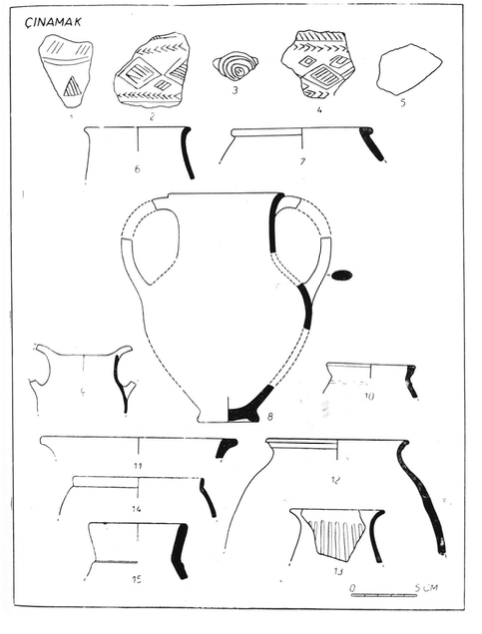
The Late Bronze Age and its transition to Iron Age is poorly documented in Kosovo. The weapons found in Lower Bernice9 and Igllarevo date back to the 13th-10th centuries BC. The cemetery of Çinamak (Kukës) has yielded Mycenaean bronze objects as well as other objects that are apparently more related to the Oltenia basin (Northern Romania).10
The Iron Age for Dardania is the period of development over previous traditions and of Illyrian cultural formation, with features, level and pace of development characteristic of other southern Illyrian regions.
Reports of settlements from this period, especially for Kosovo, are numerous, as E. Çershkov11 and Z. Mirdita inform us,12 however, of those that have been excavated, we only see partially published Bellaqevci13 and Hisar.14
Bellaqevci is a fortified settlement with dry-stone walls, of the Gajtan type. From the examination that we have made in the Prishtina Museum, of the archaeological material discovered in Bellaqevci, we are convinced that the material that has significant differences with the Illyrian centers outside Kosovo has been published, while the main part that connects it with them, especially with Gajtan of Shkodra, has been left out of the publication.
For us, what has been published (with the exception of the stone axe and urn) should be linked to the end of the 7th century or the beginning of the 6th century to the 5th century BC This center, apparently from the publication, must have had a beginning of life at least since the end of the Bronze Age with a continuity beyond the 6th century. pesone.
From Dardania, a settlement of the Gajtan type, similar to Be¬ llaqevci, we also have the town of Vila in Bushtricë in Kukës. Alongside these settlements in Kosovo, the most widespread tradition is the establishment of settlements surrounded by wooden walls, as evidenced, for example, by Hisar.15
Of the typical Dardanian material culture, the bowl with rounded rim, widely used in the Iron Age II and III, deserves mention. The Gajtan-type bowls of the Iron Age I (Bujan, Çinamak) are less common.
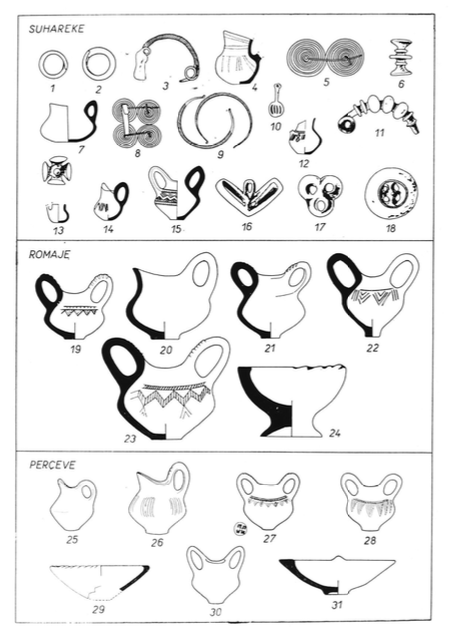
The finds in Kosovo (Bellakevc, Hisar) introduce us to perfect bowl shapes, decorated, so to speak, to the extent of a “prehistoric rock” that does not find its comparisons outside the territory of Kosovo, as well as with other types of objects, widely known in the Illyrian region (Tab. I, II).
We find Dardanian pottery decorated with the usual tradition, characteristic Illyrian motifs and compositions (Tab. I). A Dardanian feature is the decoration of pottery with “rolls” from the end of the 7th century or the beginning of the 6th century BC. This decoration technique was also used, although very rarely, by the Dardanians of the Kukës area.
It is worth noting that, in the Iron Age, in Kosovo and the Dardanian neighborhoods, Illyrian tumulus cemeteries found widespread use, known in over 18 Kosovo villages such as Romaja, Rogovë, Rahovec, Shiroka, Dibiçak, Malishevë, Klinë, Igllarevë, Dre-nicë, Vollujë, Kovrag, Llapushnik, Verbovc, Tushile, Lladraviq, Sankovc, etc. To these should be added the numerous tumuli of Northeastern Albania, of which the Çinamak field in Kukës stands out, with the largest tumulus cemetery in Dardanian.
The material discovered in Romaja10, Suhareka17 and P-erçevë i Klina18 and further on in the eastern edge of Fushë-Kosovo, in the Llashtica mounds,19 finds more typological connections with Mati, as well as with North Macedonia, and therefore has a clear Illyrian character. In particular, the vessels with their shapes, style of workmanship and decorative motifs cover the entire territory of Kosovo, and the Dardanian neighbors with very obvious similarities.
Burials with urns continued to be used in the 10th-8th centuries BC; they indicate the continuity of ethnocultural traditions in the Dardanian territory. The special architecture of the urn graves of Kosovo, while preserving typical Illyrian tumulus traditions, differs from that of the urn fields of Central Europe or the Danubian regions. The use of two burial methods in Kosovo does not seem to us to disrupt the ethnic homogeneity of the Dardanian region, especially since the tumulus rite should not be taken as the only form of burial for the Illyrians, while urns are an ancient Central Balkan tradition.
The 6th-5th centuries BC mark a major turning point in the economic and cultural development of Dardania. In these changes, which began somewhat earlier, we do not need to look for a “very fatal crisis”-21 for Dardania; on the contrary, this fact expresses the positive progress of Dardania’s inclusion in the rhythm of development of southern Illyria, in the transformations of the beginnings of slave-owning civic life here as well.22
For this period, it is worth paying attention to three directions that express the main trend of the development of the Illyrian typology in Dardania:
1) In the sphere of traditional production, the production of iron tools and weapons increased considerably, and here they are presented in a great variety, often with original local creations.23 Local ceramics with Matjan and Macedonian features reach their most perfect level, especially in the Kuksian centers. The fact that it generally differs from the territories of Romania and Western Bulgaria, accepting to a certain extent some influences related to the Basarab culture of Romania, especially in the decorative motifs of ceramics, speaks for the Illyrian character of this typology.
2) In the 6th-5th centuries, Dardania’s relations with the southern regions of Albania and Macedonia intensified, as evidenced by the Greek, Dyrrachian and Apollonian objects that increased significantly in Kosovo, brought here, as Edi Shukriu-Hoti rightly notes, through Shkodra24. The most interesting manifestation of the time is the emergence of local workshops where pottery was made with a foot wheel, with a Greek and local typology.
3) Another very important phenomenon of the time is the development of the craft of precious metals, gold and silver. From Kosovo, the discoveries of Peja, in the Dukagjin Plain, deserve mention. According to the data we have from comrade Muzafer Korkuti, who had the opportunity to see this material, over 10 pieces of silver objects have been discovered in Peja, along with vessels of Greek and Illyrian typology, as well as 3 Illyrian helmets, which are also widely known in Kukës and other centers of our country.
Accepting them as Illyrian objects, the main area of distribution of this silver has so far been determined to be the Smederevo basin, east of Belgrade, and the basin around the Morava. The tribal affiliation of this silversmithing has been assumed to be the Autariats, Desidiats, Breucs, etc. at a time when the Dardanians have been categorically excluded from its affiliation.25
If we follow the topography of the spread of these objects from Umçar, Mramorac, Novi Pazar, Kukës26, it is clear that the line of centers where similar silver objects have been discovered runs and develops around the mountain massif of Kopaonik in Kosovo (fig. 1). As is known, it is precisely in this area that the metallogenetic structure of Kopaonik begins, with the well-known Trepça source in the center, in which mineral centers containing gold, silver and lead are widely distributed.
Therefore, given this correspondence of the archaeological findings with the silver wealth of Koisovo, it would be more correct to view these objects as Dardanian products. For this reason, the coincidental designation, a find of the type « Mramorac » or « Umçar » would be more complete if it were used in conjunction with the designation « of Dardanian silversmithing ».
In the 4th-2nd centuries BC, the territory of Kosovo experienced a rapid Illyrian civic development,27 a development that included all of Southern Illyria.
So far, we know of many centers where this urban culture has been discovered.
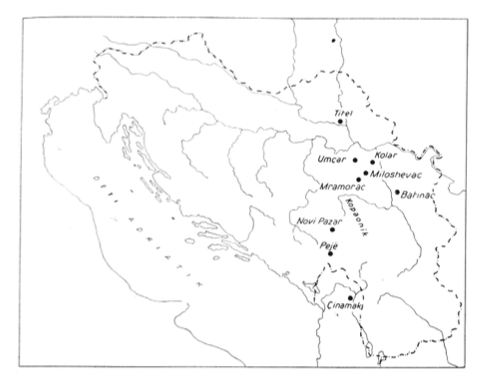
Fig. 1
In Dardania: Upper Gadimje, Karagaç, Cernicë, Bellaqevc, Orao-vicë, Vlashne, Rogovë, Shirokë and Çinamak, Kënetë and Bicaj of Ku-kes and Bujan of Tropoja, in Northeastern Albania, Kreshevicë of Northern Macedonia, etc.
As we see from the numerous burials of this time in the mounds of Kukes, cremation continued to be used at this time, accompanied by the throwing of pieces of pottery into the grave, but now, in the 4th-2nd centuries AD, as we see from Kukes, Shiroka and Suhareka, there was a shift from tumulus burials to flat burials, reusing the mounds in special cases.
As in many Kosovo centers, in Kukës, wheel-based production is dominant over traditional production. As can be seen, the urban culture of Dardania developed with the same typology as in other parts of Southern Illyria, but with a lower intensity than that of the regions of coastal Albania. Contrary to the opinion that in the 4th-2nd centuries CE some see the Hellenization of the Dardanian culture28, the Illyrian typological and worldview traditions in Dardania seem to be quite well-developed.
(Tab. II) Even stronger than in other Illyrian, southern and western centers, outside Dardania. The data so far suggest that the Dardanian civic culture flourished in the 4th-3rd centuries BC, while in the 2nd century BC there was a decline, due to the well-known political circumstances.
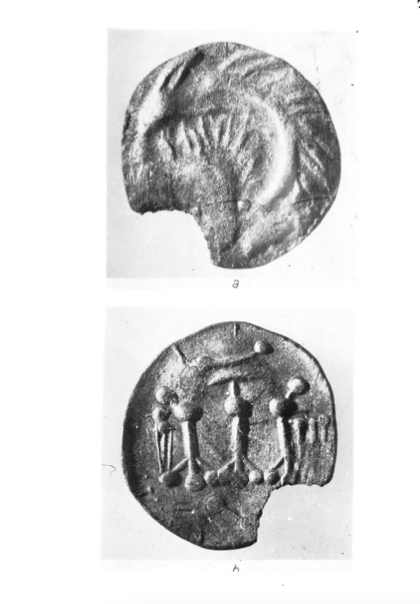
The coins of the city of Damastion also speak of such a development, which has the greatest possibilities to be found in the Dardanian territory, as Zef Mirdita rightly claims,29 perhaps also in Kukës. For this reason, we are excited by the discovery in mound V of Çinamak of a silver coin which has elements in common with the Damastion coins, but which so far constitutes the only specimen in the numismatic literature, (Tab. III)
All the material being discovered in Kosovo and other Dardanian regions supports the ongoing and traditional assertions of most scholars that the Dardanians are Illyrian tribes.
Archaeological evidence clearly shows that Illyrian culture in Dardania developed on autochthonous Eneolithic and Bronze Age foundations. From its earliest phase, in the Bronze Age, the Illyrian culture of Dardania had closer cultural and economic ties with its southern areas, while also maintaining contacts with the regions in the northeast of the Dardania region.
Thus, from the Bronze Age onwards, the phenomenon that began in the Neolithic period in Kosovo continues to deepen, of the fusion of autochthonous traits with the temporally parallel cultural traits of the southern Adriatic (30) and Macedonia, which forms the foundation of the ethno-cultural traits of the later Illyrian unit of Dardania.
The Dardanian culture of the Iron Age further strengthened this view, to the point of creating a typical shared cultural image with the Illyrian regions south of Kosovo, especially with Northern Albania and Northern Macedonia, which also implies a common ethnicity.
In contrast, in recent times, there has been a significant increase in Yugoslav literature in attempts to deny the Illyrian identity of the Dardanians by calling them Daco-Myza, Illyrianized Daco-Myza (31) or by viewing them as a separate Dardanian ethnic group distinct from the Illyrians. (32)
Attempts to deny the Illyrian identity of the Dardanians, opposed by many authors (33), do not correspond to the real state of the archaeological findings of Kosovo; (34) thus, the denial of the Illyrian ethnic character of the archaeological culture discovered in Kosovo and, in connection with this, of the Dardanians, always remains the desire of some authors.
Types of Illyrian culture in the Dardani region 217
Typical of ethnic interpretations of Kosovo is the generalizing (!) statement by D. Srejović that the Dardanians are related and similar to the Triballians and Mesians, Thracians, Panonians and Paeonians, Macedonians and Greeks,35 without noting any connection with the Illyrians. Such lines, in essence, are easy to arrange for the ethnogenesis of any population, wherever it may be, but without bringing any help to the main problem.
Following the extent of comparisons of the Illyrian culture of Kosovo 3 with its close neighbors with the vast territories of the Western Balkans clearly show that Dardania has features completely similar to the basins known as the Illyrian regions, so there is no special culture in Kosovo that could correspond to an ethnicity that is distinctly Dardanian or different from what is traditionally known as Illyrian.
The archaeological material, now known from Kosovo, as well as the large part that is preserved unpublished in museum collections, are living witnesses to the historical fact that a powerful Illyrian population was formed in the Central Balkans, whose characteristics, just like in Albania and in Kosovo and its surroundings, the locals inherited and protected until our days.
Features of Illyrian culture in the region of Dardania [Summary]
Historical and archaeological studies relating to Dardania, of which Kosovo constitutes the core, have multiplied considerably in recent decades. This is due to the importance of the historical values that the Dardanian region contains, to the political interests of the times and, first and foremost, to the undeniable fact that the local population of Dardania has, since antiquity, constantly attracted the attention of its contemporaries with its vitality, its “perpetuum bellum dardanicum”.
According to archaeological data, the Dardanian region extended from the Novi Pazar — Nis line in the north, encompassing the entire region of Kosovo and northern Macedonia, to Kukës, Tropojë and Peshkopi in northeastern Albania.
The Early Bronze Age culture at Gladnice, Karagaç, and the Kukës burial mounds, in our opinion, bears greater similarities to the Cetina culture of the Shkrel burial mounds at Shkodër (Table 1) and that of the southern Morava Valley basin. The Fafos urn burial at Prishtinë is linked to the indigenous traditions of the central Balkans.
The Early Bronze Age culture, which had formed in Kosovo, continued to develop without encountering difficulties, in other times of the 2nd millennium BC.
During the Middle Bronze Age, the burial rites of tumulus and urns were still practiced in Dardania. From this period onward, Mycenaean imports began to appear, their arrival facilitated by trade links with regions south of Kosovo.
The Late Bronze Age and its transition to the Iron Age have not been sufficiently documented in Kosovo. The swords and knives discovered at Lower Berenice, at Igllareve (Table II), date from the 13th-10th centuries BC. The necropolis of Çinamak (Kukës) yielded Mycenaean artifacts (Table II), as well as weapons (Table II) and other objects bearing a resemblance to those from the Oltenian Basin.
The Iron Age represents for Dardania a period during which this region experienced a further development based on previous traditions, and we witness the formation of a culture with traits, a level and rhythms, my development patterns are similar to those of other regions of Southern Illyria.
Belaqevc and Hissar are among the many well-known settlements in Kosovo that have been excavated, but whose results have only been partially published.
Belaqevc, a Gajtan-type settlement, appears to have existed from the end of the Bronze Age to the 5th century BC. The materials published concerning this settlement are what distinguish it from other regions; indeed, some materials are even found there that are related to the Gajtan site. The site of Vilë at Kukës (northeastern Albania) is another Gajtan-type settlement. A widespread tradition in Kosovo is the construction of inhabited centers surrounded by wooden palisades.
Regarding the material culture typical of the Dardanians, it is worth mentioning the cup with a folded rim, which was widely used during the first and second phases of the Iron Age. Objects discovered in Kosovo exhibit perfect forms of this type of cup, embellished, one might say, to a degree of “prehistoric baroque” that has no parallels outside the Kosovo region.
As for its ornamentation, Dardanian pottery adheres closely to the Illyrian tradition (Table V). However, a distinctive feature of Dardanian pottery is the use of motifs created using the roulette wheel, which, in our opinion, date back to the late 7th or early 6th century BC. This decorative technique was used, albeit very rarely, even by the Dardanians of the Kukës region.
The necropolises with tumuli have been widely distributed; to date, they have been discovered in more than 18 villages, not to mention the tumuli in northeastern Albania, of which Çinamak constitutes the largest necropolis in Dardania.
The archaeological material discovered so far in Kosovo relating to the Iron Age is mainly linked to northern Albania and North Macedonia.
The flat burial with urns is still in use. The particular architecture of the urns in Kosovo is linked to the typical tradition of Illyrian tumuli and differs from that of the urnfields of Central Europe or the Danube regions.
The use of the two burial methods seems to be linked to two different social systems: to the patriarchy (the tumulus and the burial of the body) and to the vestiges of the matriarchy (open cremation and the urn).
The 6th-5th centuries BC mark a major turning point in the economic and cultural development of Dardania due to the transformations that took place as it embarked on the path of its urbanization.
The 6th-5th centuries BCE are characterized by the following three trends: 1) In the sphere of traditional production, there is a marked increase in tools and weapons, which are often original creations. Locally produced pottery reaches its highest level of perfection. Its forms differ from those of western Romania and Bulgaria, although some influences from Bes-Sarab culture are evident. 2)
A gradual phenomenon for the period is the emergence of local workshops dedicated to pottery production, with foot-operated pottery wheels. 3) Another phenomenon is the development of precious metalworking, particularly in gold and silver. The objects discovered at Banjot e Pejës are especially important in this regard. While the Illyrian origin of these objects is generally accepted, their Dardanian origin is categorically excluded.
Simply tracing the topographical distribution of these silver objects reveals that the line of their discovery corresponds to the contours of the Kopaonik massif in Kosovo. For this reason, even the “Mramorac” type finds—in our opinion—should be considered Dardanian productions.
During the 4th-2nd centuries BC, the region of Kosovo experienced significant urban development. Urban culture thus developed in Dardania according to a typology identical to that of the rest of southern Illyria, but with the difference that in Dardania Illyrian traditions were better preserved. It was in the 6th-3rd centuries BC that urban culture reached its zenith, while the 2nd century BC marked a certain decline.
The coins of the city of Damastion, whose ruins, according to Zef Mirdita, should be sought in Dardania, or even, in our opinion, at Kukës, testify to the flourishing mentioned above. This is confirmed by the discovery in Tumulus V at Şinamak of a silver coin, the minting of which shows similarities to the coins of Damastion.
The archaeological material unearthed in Kosovo and other Dardanian regions confirms what has been traditionally accepted by most researchers, namely that the Dardanians are Illyrian tribes.
Illyrian culture developed in Dardania on an autochthonous Chalcolithic and Bronze Age basis, maintaining closer links with the southern regions, and even with the regions located to the northeast of its territory.
The Dardanian culture of the Iron Age further reinforced this trend until the creation of a typical and common cultural aspect in the Illyrian regions located south of Kosovo, namely in Albania and northern Macedonia, which even presupposes a common ethnic affiliation.
The views that the Dardanians were Daco-mysians, Illyrianized Daco-mysians, or a population other than the Illyrians, are not supported by archaeological data.
Among the interpretations relating to the ethnicity of Kossovë, it is worth mentioning the synthetic formula of D. Srejovic according to which “the Dardanians have kinship ties and similarities with Mysian, Thracian, Pannonian and Paeonian, Macedonian and Greek tribes while remaining silent on the links with the Illyrians.
The archaeological material now known in Kosovo, as well as the abundant material preserved in the collections of its museums and which has not yet been published, proves beyond a doubt the historical fact that even in the central part of the Balkans a powerful Illyrian population arose, whose traits have been transmitted, defended and preserved to this day by their successors, in Albania as in Kosovo.
Footnotes
35) D. Srejović, An attempt to define the ethnic boundaries of the ancient Balkan tribes, «Burial among the Illyrians», Belgrade 1979, f. 82.
29) Z. Mirdita, Dardanian Studies, p. 106.
30) M. Korkuti, The prehistoric settlement of Kolsh, «Iiiria» VII-VTII, p. 242-244.
31) M. Garasanin, Towards a historical and ethnic interpretation of burials under tumuli in the Illyrian region, «Burials among the Illyrians», Belgrade 1979, f. 10.
32) N. Buric, Romaja. . . , p. 131.
33) A detailed analysis and argumentation of this problem has been made by Zef Mirdita in “Dardan Studies” pp. 15-49; see also the accompanying literature there.
34) B. Jubani, Tumat e Krumës, f. 180 ; Tumat ilire të Kénetës f. 116-118 ; F. Prendi, N. Buric…, Romaja parahistorike, «Iliria» 1981, 1, f. 265.
28) N. Buric, Romaja. . . , p. 127; D. Srejovic, Karagaé. . , p. 63.
2) Regarding the spread of Dardania, see: F. Papazoglu, Srednjebalkanska ple-mena u predrimsko doba, Djela knj. XXX, CBI knj. 1, Belgrade 1969, p. 129 ff. Z. Mirdita, Studime dardane, Prishtina 1979, p. 37. D. Srejovic, Karagac and the problem of the ethnogenesis of the Dardanians, «Balcanica» IV, Belgrade 1973, p. 55.
3) B. Jubani, The Tumulus of Kruma (Kukës District), «Iliria» Tirana 1982, 2, p. 180; The Illyrian Tumulus of Kënetës, -«Iliria», Tirana 1983, 2, p. 117.
4) Notitia dignitatum, XXXII, 53.
5) J. Glisic, The emergence of early Bronze Age cultures in Kosovo and Metohija, GMKM, VI, Prishtinë 1961, f. 141.
6) D. Srejovic, Karagac. . , f 42.
7) Unpublished material, excavations of 1983 (see B. Jubani, Archaeological excavations of 1983 — Shkrel (Shkodër), Iliria, Tirana 1983, 2, pp. 248-249.
8) D. Srejovic, Karagac. . . , f 45, Necropolis of Donjoj Bernici GMKM IV-V, Prishtinë 1959-1960, fig. 14.
2) Regarding the spread of Dardania, see: F. Papazoglu, Srednjebalkanska ple-mena u predrimsko doba, Djela knj. XXX, CBI knj. 1, Belgrade 1969, p. 129 ff. Z. Mirdita, Studime dardane, Prishtina 1979, p. 37. D. Srejovic, Karagac and the problem of the ethnogenesis of the Dardanians, «Balcanica» IV, Belgrade 1973, p. 55.
3) B. Jubani, The Tumulus of Kruma (Kukës District), «Iliria» Tirana 1982, 2, p. 180; The Illyrian Tumulus of Kënetës, -«Iliria», Tirana 1983, 2, p. 117.
4) Notitia dignitatum, XXXII, 53.
5) J. Glisic, The emergence of early Bronze Age cultures in Kosovo and Metohija, GMKM, VI, Prishtinë 1961, f. 141.
6) D. Srejovic, Karagac. . , f 42.
7) Unpublished material, excavations of 1983 (see B. Jubani, Archaeological excavations of 1983 — Shkrel (Shkodër), Iliria, Tirana 1983, 2, pp. 248-249.
8) D. Srejovic, Karagac. . . , f 45, Necropolis of Donjoj Bernici GMKM IV-V, Prishtinë 1959-1960, fig. 14.
16) M. Buric, J. Glisic, J. Todorovic, Prehistoric Rome, Belgrade, Prishtina 1975, Tab. I-XXV.
17) N. Slavkovic-Buric, Ilirski tumuli near Suve Reke, GMKM IX, Pristina 1964, Tab. IV.
18) N. Tasic, Burials at the Boka necropolis in Prcevo near Klina «Burials among the Illyrians», Belgrade 1979, Tab. III-V.
19) Archaeological research in Kosovo, «Iliria», Tirana 1981, 2, p. 284.
20) Of the cemeteries with Dardanian urns, the most interesting are the cemeteries of Lower Bernica, Karagaçi and Lower Toponica.
21) D. Srejovic, Karagac, f. 51.
22) B. Jubani, Data on the tumulus culture of Northeastern Albania, «I Congress of Illyrian Studies», vol. I, Tirana 1974, pp. 197-199.
23) M. Parovic-Pesikan, The Greek Maharaja and the Problem of Crooked Swords, -«Annual»-, XX, CBI vol. 18, Sarajevo. 1982.
24) E. Shukriu-Hoti, Dardanian material culture in the second half of the first millennium BC, «Albanological traces, Shk. Hist. series». XIII, Pristina 1984, p. 13.
25) D. Garasanin, Studies from the Metal Age of Serbia, «Starinar» XI 1960, Belgrade 1961, f. 90; Catalogue of Metals, Praistoria I, Belgrade 1954, f. 64.
26) B. Jubani, Data on culture. . . , p . 206, Tab. VII, 2,3.
27) Z. Mirdita, Dardanian Studies. . . , p. 77 et seq. E. Shukriu-Hoti, Material Culture. . . , p . 7-17.
Source
Traits of Illyrian culture in the region of Dardania [article] no link Bep Jubani Iliria Year 1985 15-2 pp. 211-222 Part of a thematic issue: Kuvendi II i studimeve ilire / IIth Colloquium of Illyrian Studies (Tiranë, 20-23. XI. 1985). https://www.persee.fr/doc/iliri_1727-2548_1985_num_15_2_1368

