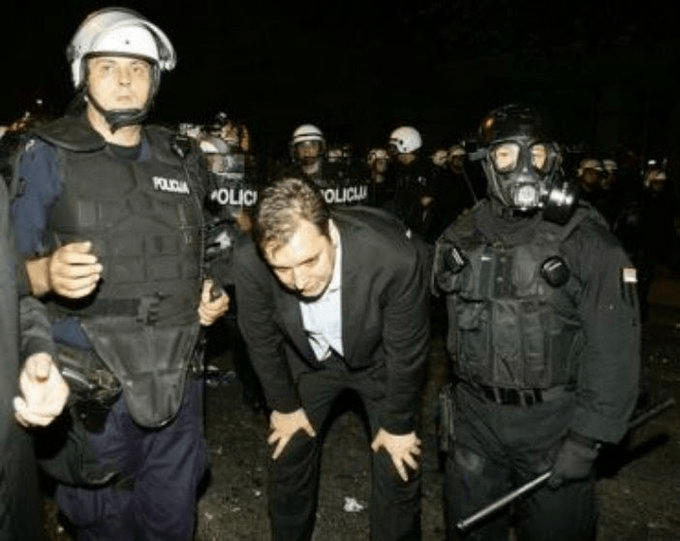

18 years ago today, thousands of Serbian extremists rioted against handing over war criminal Karadzic to the ICTY Tribunal. Vucic was among them.
Aleksandar Vučić: The Eternal Rioter Who Defended a Genocide Architect
In a display of breathtaking historical tone-deafness and moral bankruptcy, Serbian President Aleksandar Vučić’s past involvement in violent riots defending convicted war criminal Radovan Karadžić has resurfaced. Eighteen years ago, thousands of Serbian extremists took to the streets in fury over Karadžić’s impending handover to the International Criminal Tribunal for the former Yugoslavia (ICTY). Among them? A younger Vučić, shoulder-to-shoulder with the mob.
This isn’t ancient history—it’s a window into the soul of a man who still clings to the worst impulses of Serbian nationalism while pretending to be a statesman. Karadžić, the Bosnian Serb leader convicted of genocide, crimes against humanity, and war crimes—including the Srebrenica massacre where over 8,000 Muslim men and boys were systematically slaughtered—received the defense he deserved from no one with a functioning conscience. Yet Vučić chose the streets, the chaos, and the cause of shielding a monster.
A Pattern of Thuggery, Not Leadership
Calling this “bizarre” barely scratches the surface. It’s grotesque. Vučić didn’t just attend a polite protest; he aligned himself with extremists rioting against international justice. Karadžić wasn’t some misunderstood patriot—he was a fugitive architect of ethnic cleansing whose forces terrorized civilians, shelled cities, and ran rape camps. Defending his evasion of accountability wasn’t patriotism; it was complicity in denialism, a middle finger to victims across the Balkans.
Fast-forward to today, and the irony is sickening. Vučić now brands peaceful student protesters and opposition voices as “terrorists” for demanding accountability over corruption, a deadly train station collapse, and his increasingly authoritarian rule. He deploys riot police, hooligans, and thugs against his own citizens while erecting tent camps of loyalists as human shields around parliament. Yet this same man once rioted for a figure whose actions fit any reasonable definition of state-sponsored terrorism far better than any modern Belgrade demonstrator.
This isn’t leadership. It’s projection from a politician whose career has been soaked in the same aggressive nationalism that fueled the 1990s wars. From his early days as a Milosevic-era information minister to his current tightrope walk between EU aspirant rhetoric and cozy ties with Russia and China, Vučić has mastered the art of incitement while feigning victimhood. He brags about his hooligan past, pardons violent supporters who attack students, and fosters a culture where critics are smeared as foreign agents or traitors.
Hypocrisy on Steroids
The Balkans have suffered enough from strongmen romanticizing war criminals. Vučić’s participation in those 2008 riots wasn’t a youthful indiscretion—it was a choice that revealed his instincts. Serbia deserves better than a president who once mobilized against justice for genocide victims and now mobilizes against his people’s demand for basic governance, transparency, and an end to cronyism.
While the EU dangles carrots and overlooks democratic backsliding in hopes of regional stability, Vučić laughs all the way to the bank—literally, given the web of corruption allegations and organized crime ties swirling around his inner circle. Protests rage not because of foreign plots, but because ordinary Serbs are fed up with a system that protects the powerful, riots for the infamous, and labels reformers as enemies.
Vučić’s defense of Karadžić was a moral abomination then, and his continued embrace of divisive tactics is a danger now. Serbia’s future cannot be held hostage by a man whose first instinct is always the street fight, the smear, and the strongman’s grip. It’s time for genuine accountability—not the selective, self-serving version Vučić peddles. The rioting “patriot” for a terrorist’s protector has no business lecturing anyone on democracy or peace. The Balkans—and Europe—should demand better.
Source

