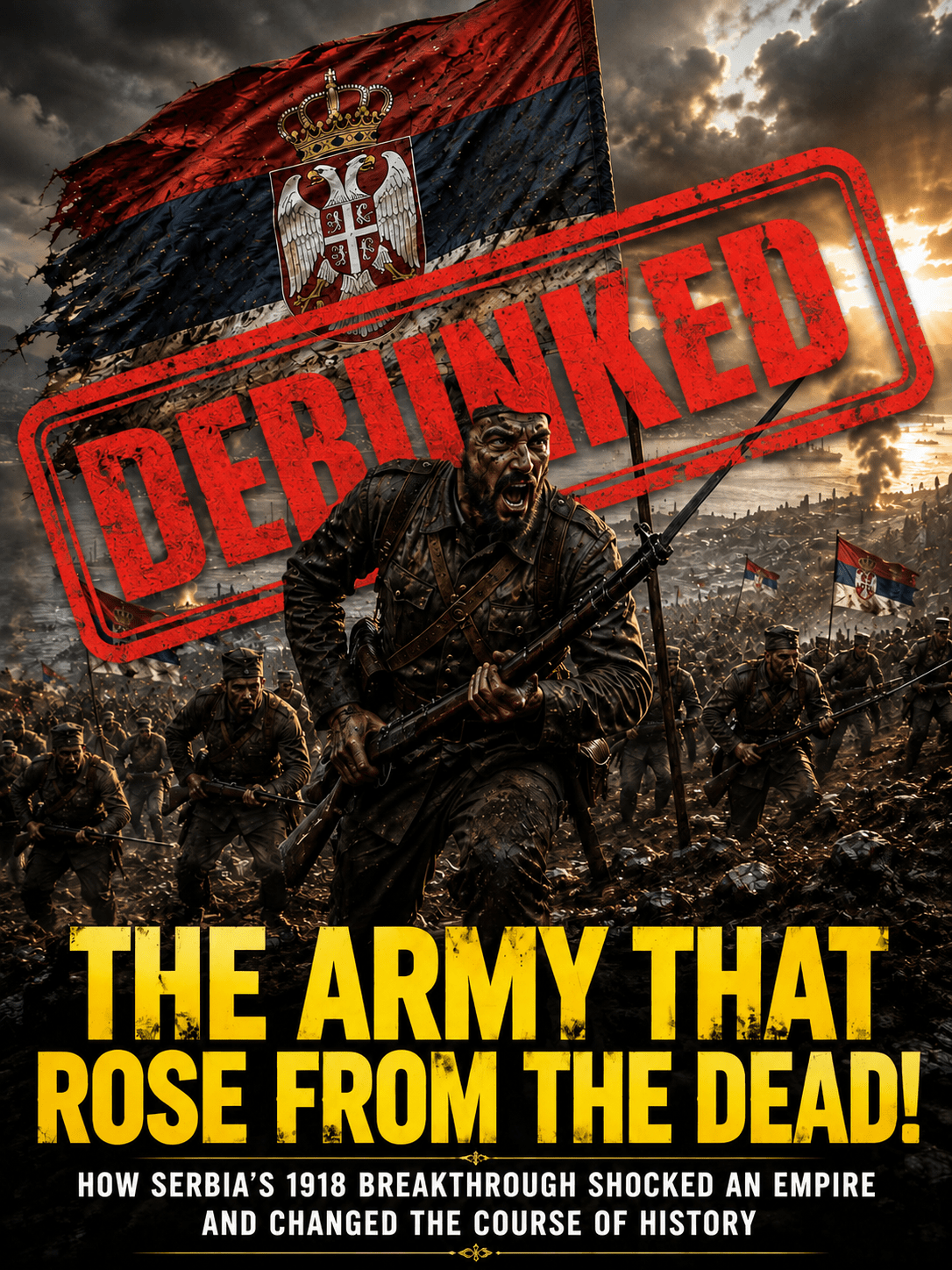

This text is cherry-picked nationalist fanfiction that turns a badly beaten small power’s partial recovery—enabled by bigger allies—into a messianic “army that rose from the dead” legend. It whitewashes Serbia’s aggressive role in igniting wider conflict, its own war crimes, and the coalition reality of 1918 while inflating one secondary front’s importance. Here’s a sharper takedown.
The Core Myth: “Everyone Thought Serbia Was Finished… Then It Single-Handedly Changed WW1”
False framing. By late 1915, Serbia was finished as an independent fighting force on its own soil. A combined German-Austro-Hungarian-Bulgarian offensive crushed it. The “shattered army” fled in one of WW1’s worst routs. Rebuilding happened on Corfu with French ships, French guns, British logistics, and Allied protection. The 1918 Salonika/Dobro Pole “decisive breakthrough” was a Franco-Serbian operation under French General Franchet d’Espèrey. Serbian troops fought hard, but French colonial divisions led assaults on key heights, artillery did the heavy lifting, and Bulgarian exhaustion/mutinies did the rest.
Bulgaria exited fast, but this was no Serbian superweapon that toppled empires alone. Germany was crumbling on the Western Front (Hundred Days Offensive), under blockade, and facing revolution at home. Salonika accelerated the endgame in the Balkans; it did not “change the course of history” as the decisive factor. Historians treat it as important but secondary—hence “Forgotten Front.” The text’s question-begging (“Did it actually help end WW1?”) is rhetorical sleight-of-hand.
1915 Retreat: Tragedy, But Not the Whole Story
The suffering was real—snow, starvation, disease, ~77k soldiers + 160k civilians dead/missing in the Albanian mountains. Horrible. But:
This disaster followed Serbia’s expansionist wars (1912–13) that exhausted its army and depleted resources. Serbia wasn’t some innocent victim minding its own business. It had just doubled in size through conquest. The text romanticizes the “impossible choice” and King/Crown Prince marching with the people. Reality: strategic collapse after overreach.
Rebuilding and Motivation
Allied aid rebuilt the army. Motivation from occupied homes? Common in defensive wars. Plenty of soldiers on all sides felt the same. This doesn’t make Serbs uniquely dangerous or heroic. The text skips how Serbia’s pre-war irredentism (Greater Serbia dreams, Black Hand terrorism) helped start the wider slaughter.
Dobro Pole: “Extraordinary” Serbian Assault
Overhyped. Steep mountains, yes. Fierce fighting, yes. But:
Bulgarian positions were undermanned and demoralized after years of attrition.
The breakthrough succeeded due to overwhelming local superiority, massive bombardment, and enemy collapse—not miraculous Serbian bayonets alone.
Speedy advance followed because the front disintegrated. Central Powers commanders couldn’t respond because their coalition was rotting.
The text admits “combined Allied success” then pivots back to Serbian determination. Classic propaganda technique: concede a little, then ignore it.
Consequences and “Domino Effect”
Bulgaria out first—significant for the Balkans. Austria-Hungary and Ottomans isolated. But Germany was the lynchpin, already losing badly elsewhere. Crediting Salonika as a war-ender is like saying a supporting actor carried the movie. The armistice on Nov 11 was driven by the Western Front and internal German collapse far more than Belgrade’s liberation on Nov 1.
What the Text Conveniently Forgets (The Real Debunk)
Serbia helped start WW1: Black Hand (Serbian military intelligence links) assassinated Franz Ferdinand. This wasn’t random; it was part of ongoing destabilization of Austria-Hungary over South Slav territories. Austria’s ultimatum was harsh, but Serbia’s nationalism provided the pretext and spark.
Serial aggressor in the Balkans: Balkan Wars 1912–13 involved ethnic cleansing, massacres of Albanians (tens of thousands killed/expelled in Kosovo, etc.), Bulgarians, and Muslims. Carnegie Commission documented Serbian army atrocities—burned villages, summary executions. The user’s points on killings of Montenegrins (post-1918 tensions/annexation), Bulgarians, Albanians hold up.
Montenegro: “Liberated”? The 1918 Podgorica Assembly was a rigged unification/annexation. It deposed the Montenegrin king and sparked uprising. Serbia absorbed its smaller neighbor.
Human cost hypocrisy: Serbia lost hugely (hundreds of thousands dead, huge per capita). But it inflicted plenty too, and entered the meat grinder after its own expansionist gambles.
This is textbook militarist propaganda: Glorify “our” sacrifices, erase context and crimes, inflate one episode into world-saving heroism, use dramatic language (“rose from the dead,” “shocked an empire”). The AI image with the crooked bayonet perfectly symbolizes it—flashy but flawed and artificial. Real military history respects Serbian endurance in 1914 and 1918 without the myth-making. The Balkans were a powder keg of competing nationalisms; Serbia lit matches while crying victim when the explosion came.

