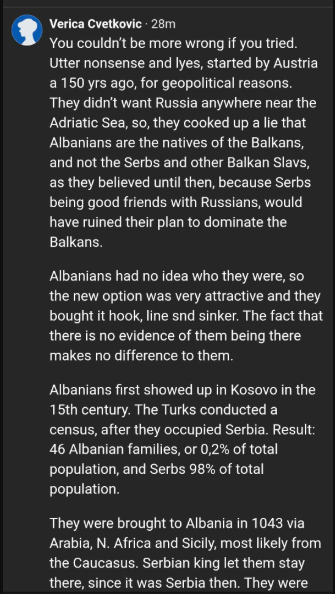

This text is classic Serbian nationalist propaganda, mixing selective facts, distortions, exaggerations, and outright fabrications to delegitimize Albanian presence in the Balkans (especially Kosovo) and portray them as late-arriving Muslim invaders enabled by foreign powers. It echoes long-standing revisionist narratives aimed at justifying historical Serb claims.
Albanian Origins and “Invention” by Austria
Albanians are a Paleo-Balkan people with roots in the western Balkans (Illyrian and related groups) dating back to the Bronze/Iron Ages, with linguistic and genetic continuity. The Albanian language is an independent Indo-European branch (Albanoid/Albanic), with no close living relatives but ties to ancient Balkan languages.
Illyrian descent is the leading scholarly hypothesis (not “invented” 150 years ago). References to Albanoi appear in antiquity (Ptolemy, 2nd century CE), and medieval attestations (11th century onward) show them as established in the region. Ancient DNA confirms strong continuity of West Balkan Bronze/Iron Age ancestry in modern Albanians, distinct from heavier Slavic-era turnover elsewhere.
Austria-Hungary (and others) supported Albanian national awakening in the late 19th/early 20th century for geopolitical reasons—to counter Slavic (Serb/Russian) expansion toward the Adriatic. They aided standardization (e.g., 1908 Congress of Monastir) and independence (1912), but did not “cook up” Albanian identity or origins. The ethnonym and identity predate this by centuries (e.g., Arbëreshë diaspora in Italy from the 15th century). The “Austria invented Albanians as natives” claim is a conspiracy theory inverting real great-power politics.
Migration from Caucasus/1043 “Cattle Herders”
This is fringe pseudohistory. The George Maniakes story (1042–43) mentions Albanoi in his army, but scholars interpret them as Balkan natives, not imports from Sicily/Arabia/Caucasus. No mainstream evidence supports mass migration from North Africa or Caucasus in 1043; Albanian ethnogenesis reflects local Paleo-Balkan continuity with some admixture.
DNA: Albanians show predominant West Balkan Bronze/Iron Age ancestry. Key Y-haplogroups include E-V13 (common in Balkans, peaks among Albanians/Kosovo ~30-40%, with local expansions) and J2b-L283 (strong Illyrian/Paleo-Balkan links, peaks in northern Albania). These are not “North African/Middle Eastern imports” in the propagandistic sense—E-V13 has deep Balkan roots.
Language, NATO Bombing, and Other Claims
Marine vocabulary
Albanian (inland/mountain pastoral origins) borrowed many nautical terms (as did other languages). It retains native terms for core concepts like “sea” (det), waves, etc. This reflects geography/history, not foreign invention.
1999 NATO intervention
Sparked by Yugoslav/Serb forces’ campaign against Albanians (displacement, massacres documented by international bodies). Bondsteel was built post-intervention as a KFOR base for peacekeeping/stability—not the “real reason” for bombing (geopolitics played a role, but humanitarian crisis was central). Framing it purely as “stealing Kosovo for a base” ignores the context of ethnic cleansing.
Broader Critique
This narrative relies on:
Selective statistics (one defter, ignoring broader trends and pre-1455 evidence).
Conspiracism (Austria “cooking up” history; Albanians as eternal opportunistic robbers).
Essentialism (portraying one ethnicity as inherently expansionist/violent while ignoring parallel Serb actions, Ottoman complexities, and mutual suffering).
Denial of continuity: Ignores genetic, linguistic, and archaeological data showing Albanians as indigenous with deep roots, alongside Slavic arrivals/migrations in the medieval period.

