
by Marios Dimopoulos
Abstract
This text surveys the long-standing scholarly debate on the linguistic classification of Ancient Macedonian. Drawing on statements by Georgios Hatzidakis (1896) and subsequent classifications by Miltiades Hatzopoulos, it demonstrates that from the late nineteenth century onward a substantial body of Indo-European linguists did not regard Ancient Macedonian as a straightforward Greek dialect. Instead, scholars such as Vittore Pisani, Ion I. Russu, Vladimir Georgiev, Eric P. Hamp, Jan Henrik Holst, Brian D. Joseph, Danilo Savić, and Bilyana Mihaylova have variously treated it as an independent Indo-European language, a sister language within a broader Helleno-Macedonian or Balkan Indo-European branch, or a language showing significant links to Thracian, Phrygian, or other Paleo-Balkan tongues. The scarcity of continuous texts in pure Macedonian is repeatedly cited as the reason for persistent uncertainty. The author presents these views as evidence against the claim that the Greek-dialect hypothesis has always been the unchallenged scholarly consensus.
“English Translation:
I had told some people in a well-known Facebook group not to provoke me, because I would make them look ridiculous internationally. You wanted it, you got it!
This post of mine constitutes the prologue to my scientific announcement at an international conference on the origin of the ancient Macedonians and their language.
After the prologue, in which I prove that ALL the giants of Indo-European linguistics from 1890 to 2025 did NOT consider Ancient Macedonian to be Greek (I wonder why the Skopjans never noticed all these scholars so they could make mincemeat of you—other projectiles, those Makedonski!), I will present my own linguistic views and our national hero Alexander will return to where he belongs!
You may think that Albanian academics lack the credentials to answer you (them too!!!), but I, the Pelasgist, holder of the worldwide bibliography, do have them!
The text below is FORBIDDEN to be republished in Greek or any other language without mentioning my name and WITHOUT MY WRITTEN PERMISSION! You may only share this Facebook post of mine. Otherwise there will be legal sanctions for copyright infringement.
The present article will be published in the coming days in English, Albanian, Serbian, Slavomacedonian, Bulgarian, Russian, German, and Italian, so that the whole world may learn the truth!
Don’t get on my nerves, gentlemen of the well-known group!
DISTINGUISHED LINGUISTS FROM ALL OVER THE WORLD HAVE QUESTIONED—AND SOME STILL QUESTION—THAT ANCIENT MACEDONIAN WAS SIMPLY A GREEK DIALECT
Others connected it with Illyrian or Thracian elements, others classified it as an independent Indo-European language, and others as a sister of Greek within a common Helleno-Macedonian branch.
Yesterday I presented to you an almost unknown text (to most Greeks) by Georgios Hatzidakis, the man rightly regarded as the father of Greek linguistics. Hatzidakis published in 1896 his work “On the Hellenism of the Ancient Macedonians,” with the aim of defending the Greek origin of the Macedonians and proving that their language was Greek, probably related to the Doric or northwestern Greek dialects.
Precisely because he himself supported the Greek theory, his admission that a powerful opposite current dominated European scholarship of his time is of particular significance.
Hatzidakis wrote:
“In recent years both the linguists and the majority of historians deny the Hellenism of the Macedonians.”
And he continued:
“I know that many, if not all, of the younger professors of linguistics and history in Germany teach from their university chairs that the Macedonians were Hellenized, while originally they were barbarians and of different stock.”
He did not write that this was necessarily the unanimous position of all the universities on the planet. He did, however, write something extremely weighty: that the majority of the historians and linguists of his time rejected the original Greek character of the Macedonians, and that many, “if not all,” of the younger professors in Germany taught that the Macedonians were originally of different stock and were Hellenized later.
Hatzidakis’s book was not written to confirm a self-evident and universally accepted truth. It was written precisely because the leading Greek linguist felt he had to overturn a very powerful international scientific tradition. The original work was published in Athens in 1896 and is preserved in digitized form in the library of the University of Crete (Anemi).
This alone demolishes a modern myth: that supposedly no serious scholar ever questioned the Greek character of Ancient Macedonian and that those who did so were necessarily “anti-Hellenes,” “Skopian propagandists,” or ignorant of linguistics.
Reality is very different.
THE TREE OF JAN HENRIK HOLST
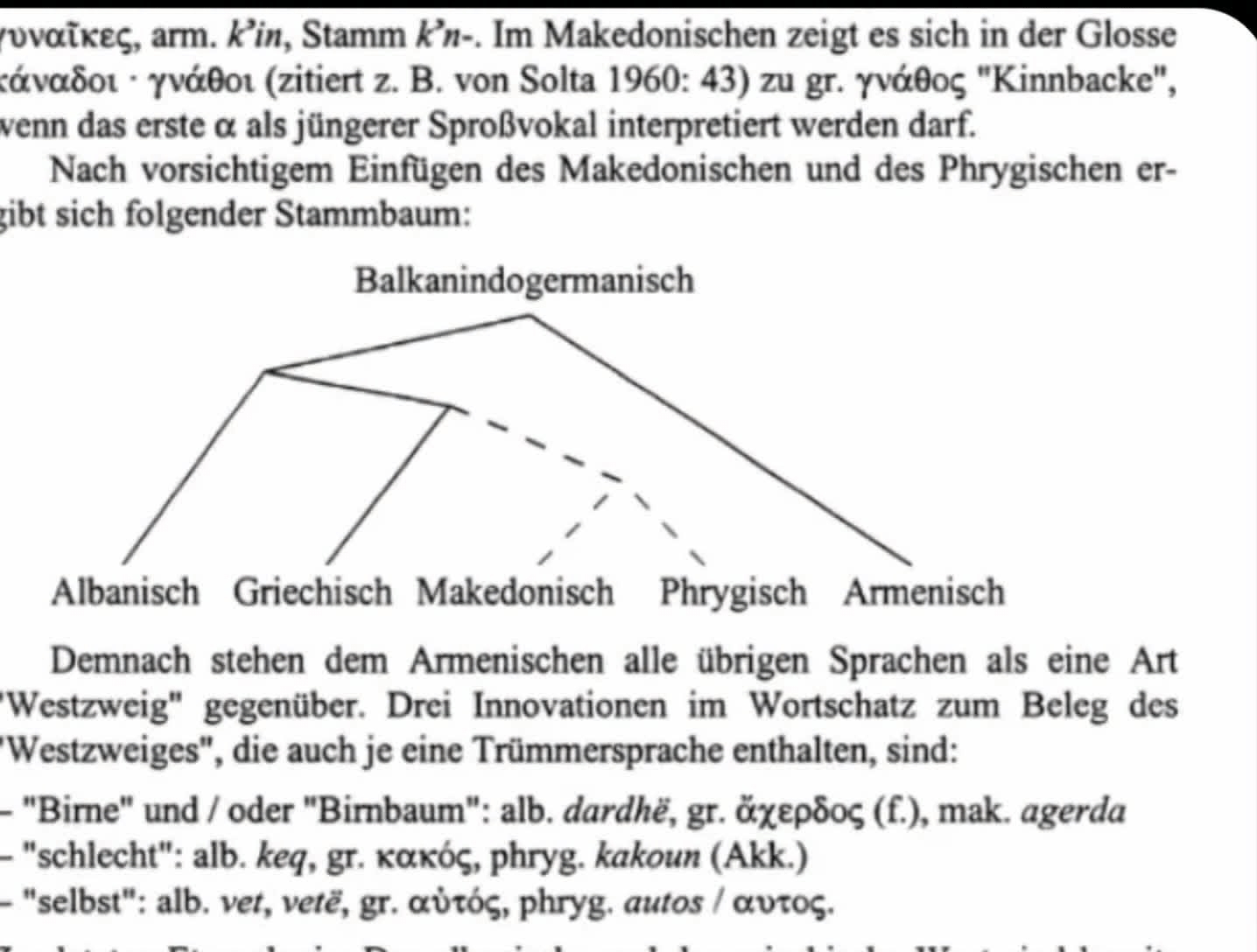
In the photograph I publish you see a linguistic genealogical tree from the book:
Jan Henrik Holst, Armenische Studien, Harrassowitz Verlag, Wiesbaden 2009.
The author’s name is Jan Henrik Holst. He is a German linguist, author of works on comparative linguistics, phonology, morphology, language typology, and language classification. He has taught at the University of Hamburg; in an official university program he is recorded as a lecturer in Iranian Studies and not as a permanent professor with a university chair (Universität Innsbruck).
In the specific work Holst attempts to reconstruct a broader prehistoric Balkan Indo-European space, which he names:
Balkanindogermanisch — Balkan Indo-European.
At the top of the tree stands “Balkan Indo-European,” and from it derive:
Albanisch — Albanian
Griechisch — Greek
Makedonisch — Macedonian
Phrygisch — Phrygian
Armenisch — Armenian
Note the crucial point: Holst does not place Macedonian under Greek, as we would place Attic, Ionic, Aeolic, or Doric dialect.
He places it as a separate linguistic node, parallel to Greek.
Above the diagram he writes:
“After the careful inclusion of Macedonian and Phrygian the following genealogical tree results.”
In simple terms, according to Holst:
- Greek and Macedonian are related,
- they belong to a broader prehistoric Balkan Indo-European space,
- but Ancient Macedonian is not presented as a simple Greek dialect.
The fact that the two languages are very close does not mean they are identical. Spanish and Portuguese are sister Romance languages; this does not turn Portuguese into a Spanish dialect. In an analogous way, a linguist may consider Greek and Macedonian very closely related, yet different descendants of a common prehistoric language.
Holst’s tree constitutes irrefutable proof that even in a modern Indo-European study of 2009 Macedonian could be classified as a language distinct from Greek.
THERE WAS NOT ONLY ONE THEORY
The Greek historian and epigraphist Miltiades Hatzopoulos, who emphatically supported the Greek nature of Macedonian, himself presented the history of the scientific controversy.
According to his own classification, from the 19th century onward four main schools took shape:
The first regarded Macedonian as a mixed language, with a strong Illyrian or Thracian element. To this belonged Otfried Müller, G. Kazaroff, Mikhail Rostovtzeff, Milan Budimir, Henrik Barić, and D. Tzanoff.
The second regarded Macedonian as a separate Indo-European language. Hatzopoulos records in this group Vittore Pisani, Ion I. Russu, Georgi Mihailov, Pierre Chantraine, Ilija Pudić, Carl Darling Buck, Eduard Schwyzer, Vladimir Georgiev, W. W. Tarn, and Olivier Masson in his youth.
The third regarded Macedonian as a Greek dialect. To this belonged, among others, Friedrich Sturz, August Fick, Georgios Hatzidakis, Otto Hoffmann, Johannes Kalléris, N. G. L. Hammond, and Olivier Masson in the mature period of his career.
The fourth group, in which Hatzopoulos places Antoine Meillet and Arnaldo Momigliano, considered the evidence insufficient for a safe conclusion.
And Hatzopoulos himself explains the reason for this enormous divergence: not a single complete sentence in pure Macedonian had been preserved. The material consisted mainly of isolated glosses, names, and later information from ancient lexicographers, often corrupted in manuscript transmission.
Therefore we are not speaking of a theory invented by some Balkan nationalists in the 20th century. We are speaking of a major European scientific discussion in which leading names of Indo-European linguistics participated.
VITTORE PISANI: A LANGUAGE WITH ITS OWN PHYSIOGNOMY
The Italian Vittore Pisani was a historical and comparative linguist, Indo-Europeanist, Indologist, and professor of Linguistics. His work covered Sanskrit, Greek, Latin, the Germanic languages, and Indo-European languages in general. He was not a political commentator, but one of the most important Italian Indo-Europeanists of the 20th century.
In 1937 he published the extensive study:
“La posizione linguistica del macedone” — “The Linguistic Position of Macedonian.”
He does not accept that the use of Greek as an official or literary language proves that Macedonian was Greek.
At the beginning of the study he examines the argument that the Macedonians used Greek as the language of culture and writing. He asks:
“Do we want to conclude from this that, because the Macedonians used Greek as a literary language, their regional language must be considered Greek? Not even in a dream.”
The original Italian is:
Vogliamo concludere da ciò che, se i Macedoni usavano il greco come lingua letteraria, la loro lingua regionale è da considerarsi greca? Nemmen per sogno.
Thus Pisani clearly distinguishes:
- Greek as the language of writing, culture, and the upper social strata,
- from the native Macedonian language.
His position may be summarized as follows:
Macedonian was neither simply a Greek dialect nor some mechanical “Greco-Illyrian salad.” It was a particular Indo-European language that had close kinship and many common isoglosses with Greek, but also relations with other Paleo-Balkan languages. Later, with the political and cultural predominance of Greek, the particular Macedonian was absorbed by it.
This is not the same as the claim that the historical Macedonians remained forever outside Greek culture. Pisani described a process of change and Hellenization.
ION I. RUSSU: TOWARD THE THRACO-PHRYGIAN WORLD
The Romanian Ion I. Russu was a linguist, historian, and researcher of ancient Balkan onomastics.
In 1938 he published the major study:
Macedonica. Osservazioni sulla lingua e l’etnografia degli antichi Macedoni
that is:
“Macedonica: Observations on the Language and Ethnography of the Ancient Macedonians.”
It is a work of more than one hundred pages, with an extensive catalogue of Macedonian names and glosses. A modern bibliographic presentation characterized it as a fundamental study of the Macedonian language and onomastics (Persée).
Russu did not place Macedonian among the ordinary Greek dialects. He brought it closer to a Thraco-Phrygian Paleo-Balkan space. The modern Oxford Classical Dictionary records him precisely as a representative of the school that directed Macedonian toward the Thraco-Phrygian direction (OUP Academic).
The mere existence of such an extensive specialized study shows that the theory of independent Macedonian was a real scientific current and not an internet fabrication.
VLADIMIR GEORGIEV: GREEK AND MACEDONIAN AS SISTER LANGUAGES
Vladimir Georgiev was a Bulgarian Indo-Europeanist, professor and rector of the University of Sofia, academician of the Bulgarian Academy of Sciences, and specialist in Paleo-Balkan languages, the pre-Greek substrate, and comparative-historical linguistics. He was also a member or corresponding member of many European academies, including the Academy of Athens (Libruse).
Georgiev recognized that Macedonian had a particularly close relationship with Greek. He did not, however, place it simply beside Attic, Doric, and Aeolic as yet another Greek dialect.
In his model, Greek and Macedonian derived from a common Helleno-Macedonian prehistoric unity.
The distinction is essential:
Greek and Macedonian as sister languages means they derive from a common ancestor.
Macedonian as a Greek dialect means that Proto-Greek has already separated and Macedonian belongs internally to the Greek branch.
Georgiev essentially chose the first version. He did not move Macedonian far from Greek, but treated it as a particular and very closely related branch. This means that the ancient Macedonian could not understand the ancient Greek, because Ancient Macedonian was a sister language to Greek (as is also Albanian!) but not a Greek dialect!
ERIC P. HAMP: HELLENO-MACEDONIAN BRANCH
The American Eric P. Hamp was one of the most important Indo-Europeanists of the 20th century, distinguished professor at the University of Chicago and leading specialist in Albanian, the Celtic languages, and many less-studied language families. His scientific output exceeded 3,500 publications (University of Chicago News).
In the revised genealogical tree of the Indo-European languages that he presented in 2012 and published in 2013, Hamp created the branch:
HELLENO-MACEDONIAN — HELLENO-MACEDONIAN
Under it he placed two separate descendants:
Greek — Greek
Macedonian — Macedonian
In his earlier tree of 1989 this relationship was accompanied by a question mark. In the revised tree of 2012 the question mark was removed (Sino-Platonic Papers). Hamp, therefore, did not present Macedonian as distant or unrelated to Greek. He did, however, present it as a sister language, not as one of the internal dialects of Greek.
This is perhaps the most balanced form of the “independent” theory: the two languages were extremely close, derived from a common Helleno-Macedonian base, but had already acquired a different linguistic status. This means that the ancient Macedonian could not understand the ancient Greek, because Ancient Macedonian was a sister language to Greek (as is also Albanian!) but not a Greek dialect!
BRIAN D. JOSEPH: THE EVIDENCE DOES NOT ALLOW DOGMATIC CERTAINTY
Brian D. Joseph is distinguished professor of Historical Linguistics at Ohio State University and an internationally recognized specialist in the history of the Greek language, Indo-European linguistics, and Balkan languages.
In his study: “Historical linguistics and the Macedonia name issue: What’s in a name?” he presents three scientifically possible classifications:
- Macedonian as a separate Indo-European branch,
- Macedonian as a sister of Greek within a broader Greek or Helleno-Macedonian branch,
- Macedonian as an internal Greek dialect, parallel to Aeolic and Doric.
Joseph does not turn into a categorical adherent of the non-Greek theory. He insists, however, that the material is limited, the methods of classification have specific prerequisites, and national ideologies have influenced interpretation from both sides. In the official extract of the chapter he states that basic and well-documented principles of historical linguistics were often ignored and that certain judgments were dictated more by political ideology than by good science (OUP Academic).
This is very important. Joseph does not tell us “the Macedonians were definitely non-Greeks.” He tells us that linguistics does not permit the nationalist certainty with which the issue is often presented.
Even the famous Pella curse tablet, written in a Doric-type Greek of the 4th century BC, proves with certainty that a Greek dialect was used in Pella. It does not by itself prove that every population of the Macedonian kingdom always spoke the same language, nor that all the so-called Macedonian glosses derive from it.
DANILO SAVIĆ: CLASSICAL PHILOLOGIST OF THE UNIVERSITY OF BELGRADE: ANCIENT MACEDONIAN PROBABLY WAS NOT GREEK (STUDY 2021)
The Serbian Danilo Savić, classical philologist and researcher of historical, Indo-European, and Paleo-Balkan linguistics, is connected with the University of Belgrade, the Institute for Balkan Studies of the Serbian Academy, and the EPHE-PSL of Paris.
In his 2021 presentation:
“Palaeo-Balkan Languages: Sources and Etymological Constraints”
he examined Macedonian, Illyrian, and Thracian as three particular Paleo-Balkan linguistic corpora.
For certain Macedonian glosses he concluded that they belong to the Greek dialect of Macedonia. For others he considered their linguistic affiliation uncertain. And for types such as:
ἀβροῦτες – ὀφρύες
κεβαλή – κεφαλή
Γαλάδρα – χαράδρα
he wrote that they can constitute:
“possible indication for Macedonian as a language separate from Greek.”
BILYANA MIHAYLOVA: MACEDONIAN AS A PARTICULAR PALEO-BALKAN LANGUAGE IN 2025
The Bulgarian Bilyana Mihaylova is associate professor in the Department of General, Indo-European and Balkan Linguistics at the University of Sofia.
She holds a doctorate in General and Comparative Linguistics with a dissertation on the etymological problems of the pre-Greek linguistic substrate, a master’s in Balkan Studies, and specialization in Modern Greek Philology. She deals especially with Indo-European and Paleo-Balkan linguistics.
In her presentation:
“The Paleo-Balkan World,”
Belgrade, 31 October–2 November 2025,
she presents the following list:
PALEO-BALKAN LANGUAGES
Greek
Phrygian
Thracian
Dacian
Macedonian
Illyrian
Pre-Greek
Greek and Macedonian stand on separate lines, as different linguistic categories.
In another place she writes that it is difficult to distinguish certain pre-Greek words from loans coming from “other Paleo-Balkan languages, such as Thracian, Phrygian, or Macedonian.”
Throughout the presentation she uses separately:
Gk. — Greek
Mac. — Macedonian
and contrasts Macedonian and Greek types:
Mac. ἀβροῦτες – Gk. ὀφρύς
Mac. γόλα – Gk. χολάδες
Mac. γαβαλάν/καβαλήν – Gk. κεφαλή
Mac. νίβα – Gk. νίφα.
Mihaylova treats Macedonian functionally and taxonomically as a particular Paleo-Balkan language, distinct from Greek.
She does not devote a special monograph to prove that Macedonian was non-Greek. Her study has an etymological and comparative purpose. Nevertheless, her classification is clear—and it was made not in 1896 or 1938, but in 2025.
In a forthcoming post of mine I will present maps based on ancient Greeks from which it is proven that ancient Macedonia was a multi-tribal/multi-ethnic mosaic and the Greeks were the minority, something that proves that the Macedonians were Hellenized Illyrians, Thracians, Pelasgians, and a whole host of non-Greek tribes of the region.
Marios Dimopoulos
Philologist-Linguist-Ethnologist
Author-Researcher-Presenter of papers at international conferences
Sources
Hatzidakis, Georgios N. Περί του ελληνισμού των αρχαίων Μακεδόνων. Athens: Typographeion ton Adelphon Perri, 1896.
Holst, Jan Henrik. Armenische Studien. Wiesbaden: Harrassowitz Verlag, 2009.
Pisani, Vittore. “La posizione linguistica del macedone.” Revue Internationale des Études Balkaniques, 1937.
Russu, Ion I. Macedonica. Osservazioni sulla lingua e l’etnografia degli antichi Macedoni. 1938.
Georgiev, Vladimir. Works on Paleo-Balkan languages and the Helleno-Macedonian relationship (various publications, mid-20th century).
Hamp, Eric P., and Douglas Q. Adams. “The Expansion of the Indo-European Languages.” Sino-Platonic Papers 239 (2013).
Joseph, Brian D. “Historical Linguistics and the Macedonia Name Issue: What’s in a Name?” In Language, History, Ideology: The Use and Misuse of Historical-Comparative Linguistics, edited by Hans Henrich Hock and Camiel Hamans, 105–124. Oxford: Oxford University Press, 2024.
Savić, Danilo. “Palaeo-Balkan Languages: Sources and Etymological Constraints.” Presentation, 2021.
Mihaylova, Bilyana. “The Paleo-Balkan World.” Presentation, Belgrade, 31 October–2 November 2025.
Hatzopoulos, Miltiades B. Various works summarizing the scholarly schools on the classification of Ancient Macedonian (references as cited in secondary literature).

