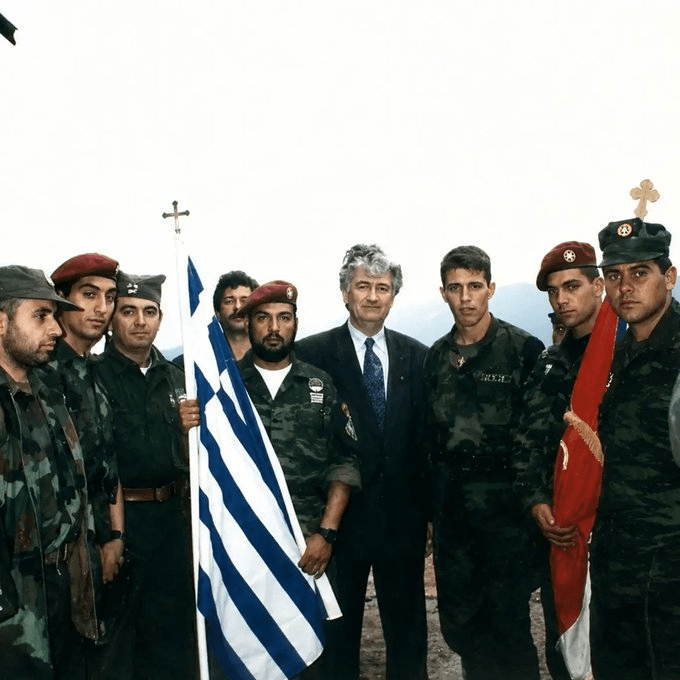

They called it defending Orthodox brothers. History calls it something far uglier.
In the mid-1990s, as Bosnia burned, a few dozen to roughly a hundred Greek men packed up, crossed into the war zone, and joined the Army of Republika Srpska. They formed the Greek Volunteer Guard (Ελληνική Εθελοντική Φρουρά), based in Vlasenica under the Drina Corps. Ratko Mladić himself wanted them. They got their own insignia—a white double-headed eagle on black—and some of them wore red berets and Orthodox crosses while flying the Greek flag next to Serbian ones.
Their self-image was pure romantic nationalism: Orthodox Greeks rushing to the aid of Orthodox Serbs against “the Muslims.” The reality was participation in a campaign of ethnic cleansing that culminated in the Srebrenica genocide.
When Mladić’s forces overran the UN “safe area” in July 1995, Greek volunteers were there. Intercepted communications and the Dutch NIOD report record Mladić ordering the Greek flag raised over the conquered town specifically to honor “the brave Greeks fighting on our side.” Photos and later investigations place roughly ten to twelve of them on the ground as the killing of more than 8,000 Bosniak men and boys began. Some later boasted. Greece never seriously prosecuted any of them.
A number of these “volunteers” had ties to Golden Dawn, the neo-Nazi outfit that would later sit in the Greek parliament before being ruled a criminal organization. One sergeant later identified as a Golden Dawn central committee member appears in the record. Others spoke the language of Greater Greece, a Europe free of Muslims and “Zionists,” or simply Orthodox solidarity against Islam. Ideology, not pay, drove most of them. That is not a defense. It is an indictment.
Greek society and parts of the state apparatus largely looked the other way or actively cheered. Karadžić was welcomed in Athens; he declared that the Serbs had “only God and the Greeks” on their side. Arms and ammunition reportedly flowed. Greek newspapers ran recruitment numbers and heroic profiles. Decades later, some of the same men still post the old photos and treat Srebrenica like a proud campaign ribbon. Greek investigators opened a file, then closed it for “insufficient evidence.” Impunity holds.
This was not abstract geopolitics or ancient Balkan blood feud. It was modern Europeans choosing a side in a war defined by systematic murder, rape camps, and the deliberate erasure of a civilian population. Dressing it up as Christian solidarity does not wash the blood off. The same religious rhetoric that claims to defend the Cross was used to justify standing with the perpetrators of the worst atrocity on European soil since 1945.
The photo of Greek volunteers posing with the flag and the men in camouflage is not a picture of heroes. It is a snapshot of men who decided that “Orthodox brothers” meant looking the other way—or worse—while thousands of Muslim men and boys were separated, trucked away, and executed. That choice was voluntary. The consequences were permanent. And the silence that followed in Greece remains a national stain.

