
Abstract
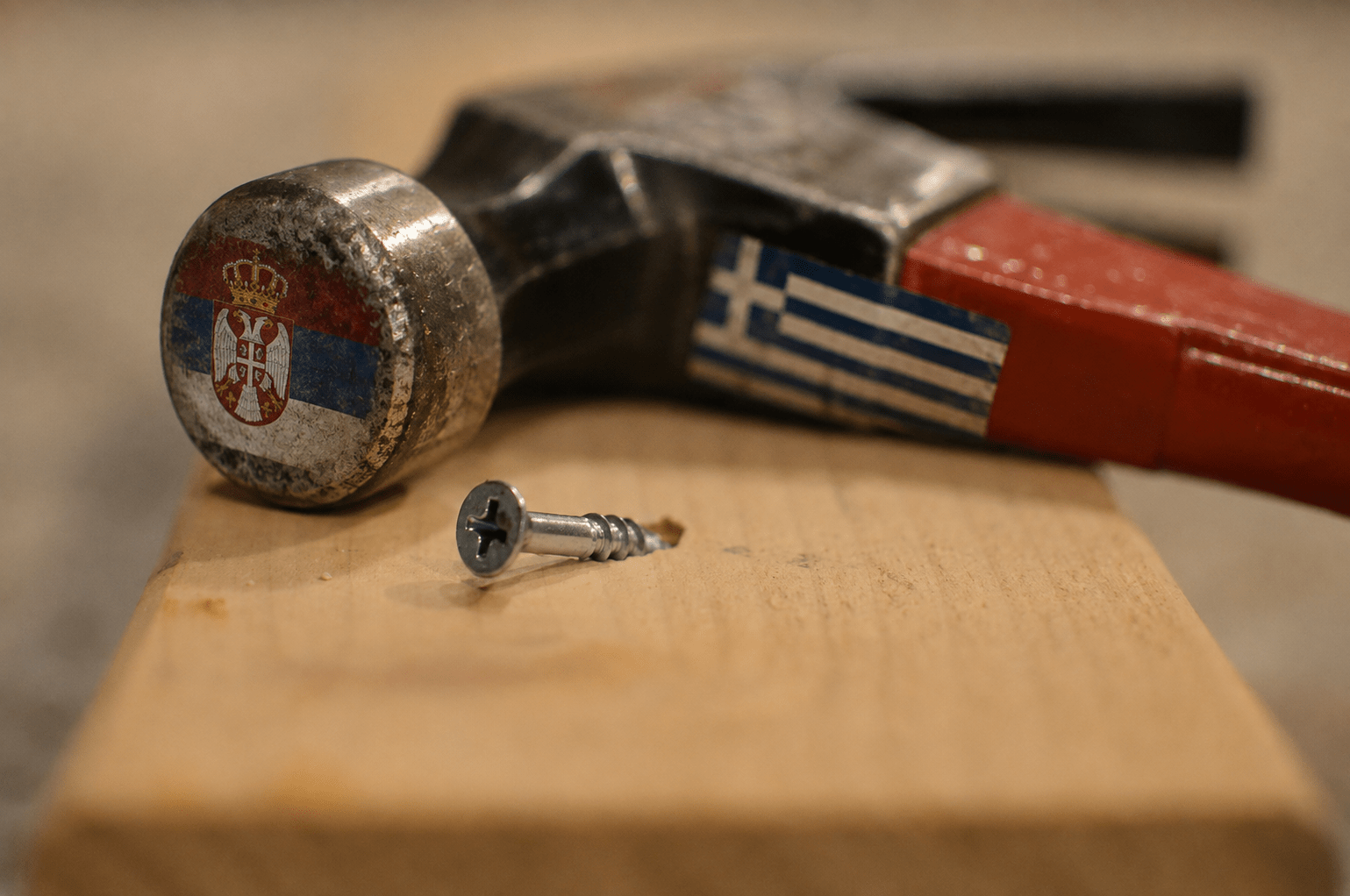
This article applies Abraham Maslow’s concept of the “hammer” (the tendency to treat every problem as a nail when one possesses only a single tool) to Greek and Serbian national discourses that elevate Orthodoxy as the primary marker of collective identity. It argues that ethnophyletism—the conflation of church and nation—has shaped the entire Greek and Serbian self-understanding in ways that render religion the only lens for interpreting difference, territory, and belonging.
This framework helps explain persistent irredentist, hierarchical, and exclusionary attitudes toward Albanians, whose national identity has long been constructed primarily through language, shared ancestry, and cultural continuity rather than religion. The article further contends that religion, as a historically imported system, cannot serve as a foundational autochthonous identity marker, a realization Albanian intellectual and popular tradition articulated earlier and more consistently than all other neighboring Balkan nationalisms.
In the Balkans, national identity has frequently been articulated through religious affiliation. For Greeks and Serbs, Eastern Orthodoxy has functioned not merely as a faith but as a central pillar of collective self-definition. This fusion of confessional and ethnic categories is a classic expression of ethnophyletism (or phyletism)—the principle that ecclesiastical organization and identity should follow national or tribal lines. The Holy and Great Synod of Constantinople formally condemned ethnophyletism as a heresy in 1872, yet the practice has remained deeply embedded in the national churches and popular discourses of Greece and Serbia.
Abraham Maslow observed that “it is tempting, if the only tool you have is a hammer, to treat everything as if it were a nail.” When Orthodoxy becomes the near-exclusive instrument for defining “who we are,” every question of belonging, loyalty, territory, and otherness tends to be processed through a religious filter. Greek and Serbian national narratives often treat Orthodoxy as the decisive criterion of authenticity: to be fully Greek or fully Serbian is to be Orthodox. Non-Orthodox populations, or those who refuse to subordinate ethnicity to the dominant confession, are thereby rendered incomplete, foreign, or threatening.
This single-tool logic helps illuminate patterns of exclusionary and hegemonic behavior toward Albanians. Albanian national identity developed along markedly different lines. Divided among Muslim, Orthodox, and Catholic communities, Albanians could not rely on a single confession as a unifying principle. Instead, language, shared historical experience, and a sense of common descent became the primary axes of identification.
The nineteenth-century slogan attributed to Pashko Vasa—“the religion of the Albanian is Albanianism”—captured this trans-confessional orientation. Albanian nationalism subordinated religious difference to ethnic and linguistic solidarity, producing a form of identity that does not fit the Orthodox ethnophyletic model.
From the perspective of a discourse that knows only the Orthodox hammer, Albanian insistence on language and ethnicity rather than religion appears in Serbo-Greek eyes anomalous or illegitimate. The result has often been the portrayal of Albanians as religiously incomplete, historically derivative, or geopolitically expansive—perceptions that have fueled irredentist and chauvinist claims, hierarchical ranking of peoples, and expansionist hostility. Where identity is reduced to confession, those who refuse the reduction are easily cast as outsiders whose presence must be managed, assimilated, or resisted.
The deeper irony lies in the historical character of the religions themselves. Eastern Orthodoxy, like other branches of Christianity and Islam, originated in the Near East and was transmitted into the Balkans through imperial, missionary, and cultural channels. It is not an autochthonous creation of the Greek or Serbian ethnos. National identity, by contrast, rests on continuous linguistic, cultural, and territorial foundations that predate the adoption of any particular creed.
To elevate an imported religious system to the status of core national essence is therefore to invert the logical order: the borrowed becomes foundational, while the foundational is made secondary. Albanian tradition recognized this inversion earlier and more consistently than all other neighboring nationalisms, treating religion as a personal or communal choice rather than the defining substance of the nation.
Maslow’s hammer illuminates a structural tendency within Greek and Serbian national discourses: when Orthodoxy is treated as the sole reliable marker of authenticity, every challenge to that marker appears as a nail requiring the same confessional response. The Albanian alternative—identity grounded in language, ethnicity, and shared heritage rather than confessional uniformity—exposes the limitations of that tool and underscores a more general principle: national identity is autochthonous and foundational; religion, however deeply felt, remains historically contingent and borrowed.
Sources
Maslow, Abraham H. The Psychology of Science: A Reconnaissance. New York: Harper & Row, 1966.
“Phyletism.” Wikipedia. Accessed August 7, 2026. https://en.wikipedia.org/wiki/Phyletism.
Council of Constantinople (1872). Official condemnation of phyletism (Horos). In various Orthodox historical collections and secondary analyses.
Jordan, Peter. “An Exception in the Balkans: Albania’s Multiconfessional Identity.” In The Changing World Religion Map, edited by Stanley D. Brunn, 1577–1597. Dordrecht: Springer, 2015.
Vickers, Miranda. Works on Albanian national identity and the subordination of religion to language and ethnicity (as cited in secondary Balkan studies).
Additional secondary literature on ethnophyletism in the Serbian and Greek Orthodox churches and on Albanian nationalism’s linguistic-ethnic foundations (various scholarly articles and monographs on Balkan nationalisms).

