
Technological Ingenuity and Proto-Industrial Craftsmanship among the Highlanders of Rugova un the seventeenth century
At first glance, the objects displayed in the Museum of Peja may appear to be nothing more than traditional agricultural and textile implements. Yet the machinery preserved in the museum raises a much more interesting historical question: how sophisticated was the technological culture of the Albanian highlanders of Rugova before the modern Industrial Revolution?

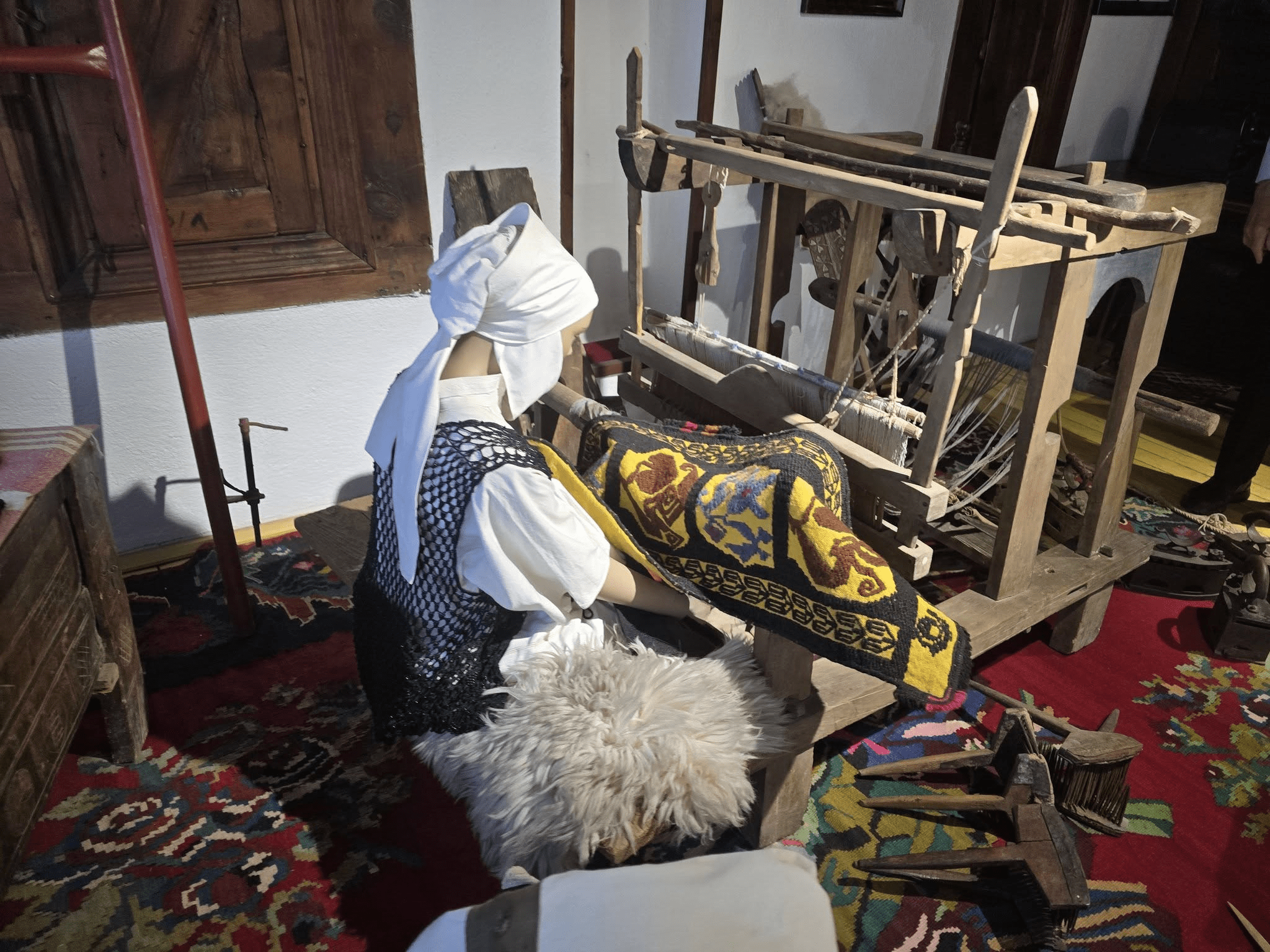
The photograph shows a traditional wooden loom surrounded by an assortment of wooden implements, wool, carpets, and other objects associated with textile production. Its construction is entirely or overwhelmingly based on locally available materials, principally wood. Nevertheless, the machine incorporates a surprisingly complex system of frames, beams, tensioning mechanisms, moving components, threads, supports, and manually operated elements.

The important point is not that Rugova possessed an industrial factory in the seventeenth century. It did not. Rather, these objects demonstrate something historically significant that is sometimes overlooked: advanced mechanical knowledge existed in European rural societies long before industrialization became synonymous with steam engines, iron machinery, and factories.

The Museum of Peja was established as an institution dedicated to preserving and presenting the material and spiritual heritage of the Peja region, while its ethnological museum was established in 1977 specifically to preserve the region’s material culture.

A machine before the machine age
The traditional loom is particularly revealing.
A loom is not simply a piece of furniture. It is a mechanical system designed to control thousands of individual threads and repeatedly perform a sequence of operations with considerable precision. The frame must maintain tension; different components must move in relation to one another; the warp must remain correctly aligned; and the weaver must coordinate these mechanisms with the insertion and compression of the weft.

The photograph therefore illustrates a form of mechanical engineering at the household or village level.
This distinction is important. In modern historical terminology, the Industrial Revolution is normally associated with the large-scale mechanization of production, factories, new energy sources, capital-intensive machinery, and eventually steam power. The British Industrial Revolution is conventionally dated from approximately the mid-eighteenth century onward, although recent scholarship has argued that Britain’s transition toward manufacturing and proto-industrial production began substantially earlier.
But mechanization itself was considerably older.
Europe had possessed mills, looms, spinning devices, water-powered machinery, woodworking technologies, and specialized craft production for centuries. What changed during industrialization was not the sudden discovery of machines, but the scale, energy source, organization, and economic purpose of mechanical production.
That makes the Rugova example particularly interesting.
Rugova: technology adapted to the mountains
Rugova was a mountainous region where communities had to make extensive use of the resources immediately available to them. Wood was abundant. Skilled manual labor was indispensable. Imported machinery would have been expensive or difficult to obtain.
Consequently, technological knowledge had to be embedded within the community itself.
A machine such as the loom photographed in Peja represents this principle perfectly. Its builders did not require a modern factory, standardized steel components, electrical tools, or an industrial supply chain. Instead, the craftsman needed an understanding of:
- structural geometry;
- wood selection and seasoning;
- joints and connections;
- tension and pressure;
- rotational and reciprocating movement;
- measurement and proportion;
- textile production;
- maintenance and repair;
- and the practical conversion of human movement into repetitive mechanical work.
That is an impressive body of technical knowledge.
The Municipality of Peja itself describes Rugova as possessing a distinctive material and spiritual culture, preserved across generations.
The significance of making machines entirely from wood
Perhaps the most striking feature of the objects in the photograph is their material.
Wood is everywhere.
To a modern observer, this can make the machinery look primitive. Historically, however, the opposite interpretation is often more appropriate.
Wood was one of Europe’s most important engineering materials before the widespread availability of industrial iron and steel. Complex machines could be constructed from timber if the craftsman understood the mechanical properties of the material.
A wooden machine therefore should not automatically be interpreted as a technologically primitive machine.
Indeed, the later European Industrial Revolution itself continued to use wooden machinery before iron increasingly replaced it. In textile manufacturing, for example, the transition toward industrial machinery involved a long progression from hand-operated tools and wooden frames toward increasingly sophisticated water-powered, iron, and eventually steam-powered machines.
The crucial difference was therefore not simply wood versus metal.
It was human-scale production versus mechanized industrial production.
Was this an Albanian “Industrial Revolution”?
Calling this phenomenon “the Albanian Industrial Revolution” is provocative, but it needs to be qualified.
There is currently insufficient evidence to claim that Rugova experienced an Industrial Revolution in the same sense as eighteenth- and nineteenth-century Britain. There were no steam-powered factories, industrial cities, coal-powered production systems, or factory-based mass production.
However, the phrase can be useful if understood as a conceptual challenge to the conventional narrative of technological development.
What these objects demonstrate is that Albanian highland communities possessed sophisticated traditions of mechanical craftsmanship long before the famous industrial transformation of Britain.
If the particular objects photographed here can be securely dated to the seventeenth century—or if documentary and archaeological evidence demonstrates that substantially similar machines were in use in Rugova at that time—then they become especially valuable evidence of early European proto-industrial technology.
And that would place Rugova’s traditional mechanical culture centuries before the period normally associated with industrialization.
The forgotten technological history of the Balkans
European technological history has often been written around a small number of major centers: Britain, France, the Netherlands, Germany and northern Italy.
This creates a danger.
When technology is associated primarily with factories, patents, universities, industrial cities and famous inventors, the technological achievements of rural communities can disappear from the historical narrative.
Yet a highland craftsman who constructs a functional loom from locally harvested timber is solving engineering problems no less real than those faced by an urban manufacturer.
His workshop simply operates on a different scale.
In Rugova, knowledge was transmitted through practice rather than patents, apprenticeship rather than engineering schools, and generations rather than written technical manuals.
The machine itself became the textbook.
From household industry to industrialization
There is also an important parallel with Western Europe.
Before the Industrial Revolution, textile production throughout Europe was frequently a household and small-workshop activity. In eighteenth-century Britain, for example, spinning and weaving were still largely domestic activities before new machinery, water power and eventually steam transformed the organization of production.
This means that a Rugovan household possessing a loom should not be dismissed as existing outside European technological history.
It belonged to the same broad historical phenomenon of pre-industrial and proto-industrial production, even though the economic environment, geography and technology were very different.
The difference is that Britain eventually developed the economic conditions that allowed such technologies to be concentrated, mechanized, powered by external energy sources, and operated on an unprecedented scale.
Rugova retained a predominantly decentralized model.
A mountain workshop as a technological ecosystem
The photograph also shows something broader than one loom.
The loom exists alongside tools for processing wool, textiles, wood, and other materials. This suggests a technological ecosystem rather than an isolated invention.
The same community needed to know how to:
raise sheep → obtain wool → process the wool → spin yarn → construct and maintain the loom → weave the textile → finish the product.
Such an integrated production chain required specialized knowledge at every stage.
The sophistication therefore lies not merely in the individual machine, but in the entire production system surrounding it.
This is particularly important in the case of Rugova, where geographic isolation encouraged communities to develop a high degree of self-sufficiency.
Not “primitive,” but appropriate technology
Perhaps the greatest mistake would be to describe these objects simply as “primitive.”
They are better understood as examples of appropriate technology.
The builders used what was available.
Wood was abundant, so they mastered woodworking. Human muscle was available, so they designed machines around human power. Wool was available through pastoralism, so textile production became important. The machinery was repairable locally because the people who used it also understood how it was constructed.
In a modern factory, replacing a broken component might require an international supply chain.
In a Rugovan mountain household, the craftsman could potentially walk into the forest, select timber, shape the replacement and return the machine to operation.
That is not technological absence.
It is technological adaptation.
A reconsideration of Europe’s technological map
The machines preserved in the Museum of Peja therefore deserve to be considered within a much wider European history of technology.
They do not prove that Albanians invented the Industrial Revolution.
Nor do they prove that Rugova was industrialized in the seventeenth century.
What they do demonstrate is that the Albanian highlands possessed a substantial indigenous tradition of mechanical craftsmanship, textile engineering, woodworking and decentralized production.
If seventeenth-century dating can be independently established for these particular machines or for their immediate technological predecessors, the evidence becomes even more remarkable.
It would mean that while European industrialization is conventionally associated with Britain in the eighteenth century and afterward, Rugovan communities were already practicing sophisticated forms of mechanical production at least at the household and artisanal level centuries earlier.
The appropriate historical term may therefore be not “Industrial Revolution,” but proto-industrial technological culture.
And perhaps that is even more interesting.
Because the real story of European technological history was not created overnight by the steam engine.
It was built over centuries by countless anonymous craftsmen—blacksmiths, weavers, carpenters, millwrights, spinners and mechanics—who learned how to transform raw materials into increasingly sophisticated machines.
The Rugovan highlanders were part of that history.
Their machines may have been made from wood rather than iron, powered by human hands rather than steam, and operated in mountain households rather than factories. But they embody the same fundamental human capacity: the ability to turn practical knowledge into mechanical systems capable of multiplying human labor.
In that sense, the wooden machines of Rugova represent not the absence of an industrial tradition, but one of the many technological traditions from which Europe’s later industrial age emerged.
Important historical qualification: I would title the piece this way rather than state flatly that “Albanians had an Industrial Revolution in the 17th century.” The photographs are excellent evidence of sophisticated traditional technology, but the exact date, provenance, and original function of each museum object need to be established from the museum’s catalogue or object labels before making the seventeenth-century claim. The Museum of Peja’s ethnological collections are specifically intended to preserve the material heritage of the Peja region.


