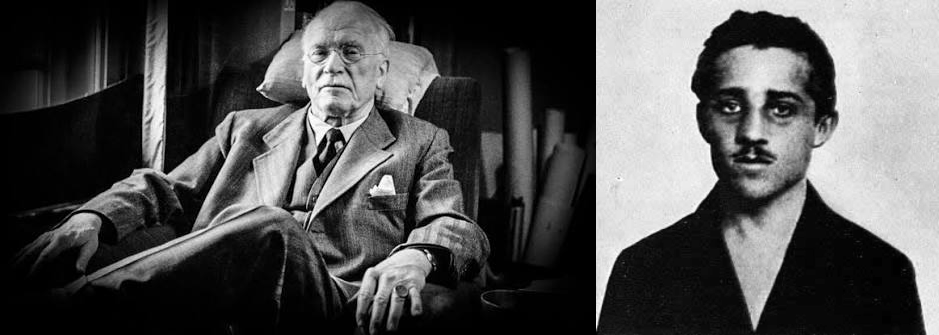

The Assassin in the Collective Psyche: Gavrilo Princip, the King-Slayer Archetype, and Carl Jung’s Encounter with Doom
On 28 June 1914, in Sarajevo, the nineteen-year-old Bosnian Serb Gavrilo Princip fired the shots that killed Archduke Franz Ferdinand of Austria and his wife Sophie. Princip, a member of the nationalist group Young Bosnia (with ties to the Serbian terrorist group Black Hand), acted from a mix of Slavic irredentism and anti-Habsburg resentment. The assassination provided the immediate trigger for the cascade of alliances and mobilizations that became the First World War—a catastrophe that killed millions and shattered the old European order.
Carl Gustav Jung, then in his late thirties and recently separated from Freud, experienced this historical rupture not merely as an external event but as a profound confirmation of processes already unfolding in his own psyche. In the months preceding the war, Jung underwent a series of overwhelming visions and dreams that he initially feared signaled personal psychosis.
Only the outbreak of hostilities revealed their collective dimension. The figure of the “nameless” assassin who raised the weapon against the monarch entered Jung’s inner work as an emblem of the king-slayer archetype, the necessary (and catastrophic) sacrifice of the old heroic order, and the eruption of what he later called the spirit of the depths.
Premonitions of Blood
In October 1913, while traveling alone, Jung was seized by a waking vision of a monstrous flood inundating the lowlands of Europe from the North Sea to the Alps, reaching from England to Russia. Yellow waves carried the wreckage of civilization and the bodies of countless thousands; the sea then turned to blood. The vision recurred more intensely two weeks later, accompanied by an inner voice insisting on its reality.
That winter, when asked about the political outlook, Jung replied that he saw only rivers of blood. Further dreams followed: an Arctic cold freezing the land in midsummer, seas of blood, processions of the dead, and images of destruction. He interpreted these at first as signs of his own impending madness—an “over-compensated psychosis.”
The war’s declaration in August 1914 lifted the personal terror. Jung later wrote that the visions had been prophetic of the collective disaster. Switzerland, protected in the visions by rising mountains, remained neutral; Europe drowned in the blood of the trenches. In the Red Book (Liber Novus), composed largely from material of this period, Jung explicitly links the outer event to his inner one: “As predicted by the first vision, the assassin stepped forward from the depth and confronted me, just as in the destiny of the nations of this time a nameless one stepped forward and raised the murder weapon against the monarch.” The “nameless one” is Princip. Because Jung “carried the murder” and “the war” within himself, he foresaw them.
The Murder of the Hero
Parallel to these flood visions ran Jung’s dream of the assassination of Siegfried, the Germanic hero. In December 1913 Jung and a “brown-skinned savage” ambushed the golden-haired warrior on a mountain path, shooting him from his chariot of bones as he rode magnificently in the dawn light. Overcome by remorse and the fear of discovery, Jung fled; a purifying rain erased the traces. He felt he must solve the riddle of this murder or kill himself.
Jung came to understand the dream as the necessary dethronement of the heroic ideal—the ego’s will to mastery, the superior function, the “sun-god” of progressive Western consciousness. Siegfried embodied the spirit of the times: forceful, efficient, triumphant. Killing him opened the way to the spirit of the depths. In the Red Book Jung reflects that men kill their princes because they cannot kill their gods, and because they do not yet know they must kill the gods within themselves. The gods require renewal through sacrifice. The hero must die so that something deeper may be born.
Princip’s act externalized this same pattern on the historical stage. The Archduke stood as a living emblem of the old monarchical and imperial order—the “king” whose death would release the accumulated tensions of nationalism, militarism, and repressed collective forces. Jung saw the war itself as a vast, unconscious self-sacrifice: “I saw the mountain of the sacrifice, and the blood poured in streams from its sides… The spirit of the depths has seized mankind and forces self-sacrifice upon it… He leads mankind through the river of blood to the mystery.”
Archetype, Doom, and Renewal
From a Jungian perspective, Princip functions as a carrier of the king-slayer (or regicide) archetype—an ancient motif found in myths of dying gods, sacred kingship, and the periodic overthrow of the old order so that fertility and a new dispensation may return. The assassin is both criminal and instrument of fate; the murdered king is both tyrant and necessary victim.
In the collective unconscious such figures constellate when the dominant cultural attitude has grown rigid or exhausted. The “doom” Jung sensed was not mere pessimism but the enantiodromia of an age: the heroic, rational, progressive consciousness of the nineteenth century tipping into its opposite—mass slaughter, irrationalism, and the unleashing of the shadow.
The war confirmed for Jung the reality of the collective unconscious and the autonomy of archetypal forces. Individuals and nations could be seized by contents that overwhelmed personal ego control. The “blond beast” of the Germanic psyche, the Wotan-like storm god of later essays, already stirred beneath the surface. Princip’s bullet did not “cause” the war in any simple sense; it punctured the membrane that had contained the rising pressure of unconscious collective energies.
Yet Jung refused to leave the matter in pure darkness. The river of blood leads “to the mystery.” The sacrifice of the hero and the king opens the possibility of a new god-image, a renewed relation to the Self. In his own case the confrontation with these forces produced the Red Book, the elaboration of active imagination, and the core concepts of analytical psychology—archetypes, individuation, the tension of opposites. What nearly destroyed him became the crucible of his life’s work.
The Shadow of the King-Slayer
Princip himself remains a shadowy, almost archetypal figure: young, tubercular, idealistic, and ultimately consumed by the very forces he sought to serve. He died in prison in 1918, before the war’s end. Jung never wrote an extended clinical portrait of him, yet the “nameless assassin” stands in the Red Book as the outer counterpart to the inner murderer of Siegfried. Both acts—historical and imaginal—enact the same psychic necessity: the death of the old king so that consciousness may deepen.
The First World War, precipitated by that single act of regicide, demonstrated with terrifying clarity the power of the collective unconscious to seize history. For Jung it was both a personal ordeal and a collective initiation. The king-slayer had appeared; the blood had flowed; the old order lay shattered. What remained was the long, difficult work of integrating the shadow, sacrificing the one-sided hero, and seeking the new center that alone could give meaning to the doom.

