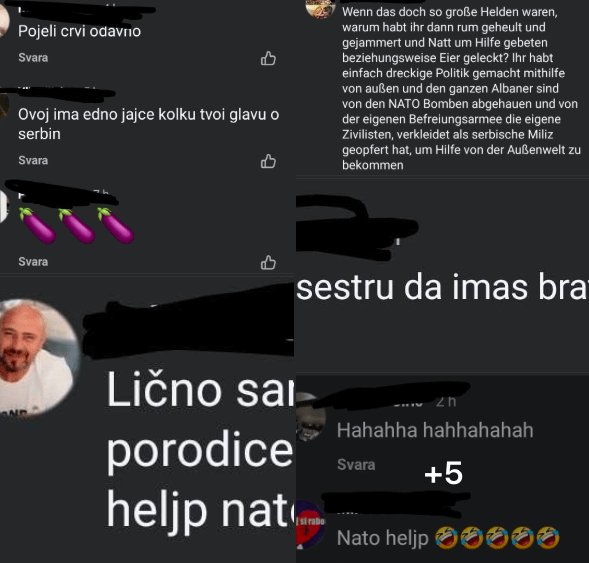

The provided Facebook screenshots capture a cluster of comments under posts involving Albanian-related themes (often coded as “Šiptar,” a historically pejorative term for Albanians). The language is consistently vulgar, ethnically targeted, and dehumanizing. These examples illustrate patterns frequently observed in Serbian-language online spaces when Kosovo, Albanian identity, or inter-ethnic flashpoints appear.
Core linguistic and thematic patterns
The comments rely on a narrow repertoire of insults:
Explicit sexual violence directed at female relatives (“Jebem ti sestru da imaš brata,” “A jebem vam mamu šiptarsku,” “Mamu vam šiptarsku”). These are classic Balkan patriarchal curses that weaponize the honor of mothers and sisters. When combined with the ethnic marker “šiptarsku,” the insult becomes collective: the target is not an individual but an entire group reduced to sexual property.
Genital and body-part mockery (“Ovoj ima edno jajce kolku tvoi glavu o serbin,” eggplant emojis). These function as dominance displays, equating Albanian masculinity with deficiency while asserting Serbian superiority.
Dehumanization and death imagery (“Pojeli crvi odavno” — “worms have eaten them long ago”). This erases living people and frames them as already corpses.
Ethnic slurs as primary identifiers (“Pičkice šiptarske”). The term “Šiptar” is used not as neutral self-designation but as a racialized marker of inferiority.
Symbolic violence (see-no-evil monkey + sheep + knife). The combination evokes slaughter or ritual killing of the “other,” a recurring visual motif in ethnic online conflict.
Collectively these form a rhetoric of ethnic hierarchy: Albanians are portrayed as sexually available, physically deficient, historically defeated, and legitimate targets of violence or contempt.
Chauvinism, racism, and residual irredentism
The dominant tone is chauvinist and racist rather than elaborately ideological. There is little explicit policy argument about borders or historical rights. Instead, the comments assert an emotional hierarchy: Serbs occupy the superior position; Albanians exist to be insulted, mocked, or erased. This is ethnic chauvinism expressed through everyday vulgarity.
Irredentist undercurrents appear indirectly. References to NATO (“Nato heljp” with laughing emojis) recycle the post-1999 narrative that Western intervention “stole” Kosovo and that Albanians are illegitimate beneficiaries of that theft. The death-and-worms comment and the knife imagery align with a broader discursive refusal to accept Albanians as permanent political equals in the region. While not spelling out territorial revisionism, the language treats Albanian presence and agency as anomalous and temporary.
Racism here operates less through biological pseudoscience and more through cultural essentialism and collective sexual degradation. Albanians are not debated as individuals with agency; they appear as a monolithic, degraded category defined by ethnicity.
Online discourse dynamics
These comments exhibit typical features of Balkan Facebook/YouTube comment sections during ethnic flare-ups:
Anonymity and low moderation lower the cost of extreme speech.
Group reinforcement (likes, laughing emojis, piled-on insults) normalizes escalation.
Historical grievances (Kosovo war, Ottoman legacy, 1990s conflicts) are compressed into meme-like insults rather than articulated analysis.
The result is a feedback loop that hardens stereotypes, rewards the most aggressive voices, and makes measured discussion rarer.
Broader implications
Such discourse does not invent the Serb-Albanian conflict, but it keeps it emotionally charged and resistant to resolution. By reducing the other side to sexual and animalistic caricatures, it makes political compromise appear as humiliation. It also mirrors patterns seen elsewhere in the post-Yugoslav space: ethnic identity becomes a zero-sum moral currency in which the other must be lowered for the self to feel elevated.
The screenshots are not outliers; they are representative samples of a persistent register of online speech. Documenting and analyzing them without romanticizing either side remains necessary if the region is ever to move beyond cycles of reciprocal dehumanization.

