
by Drizan Shala | 12 August 2026
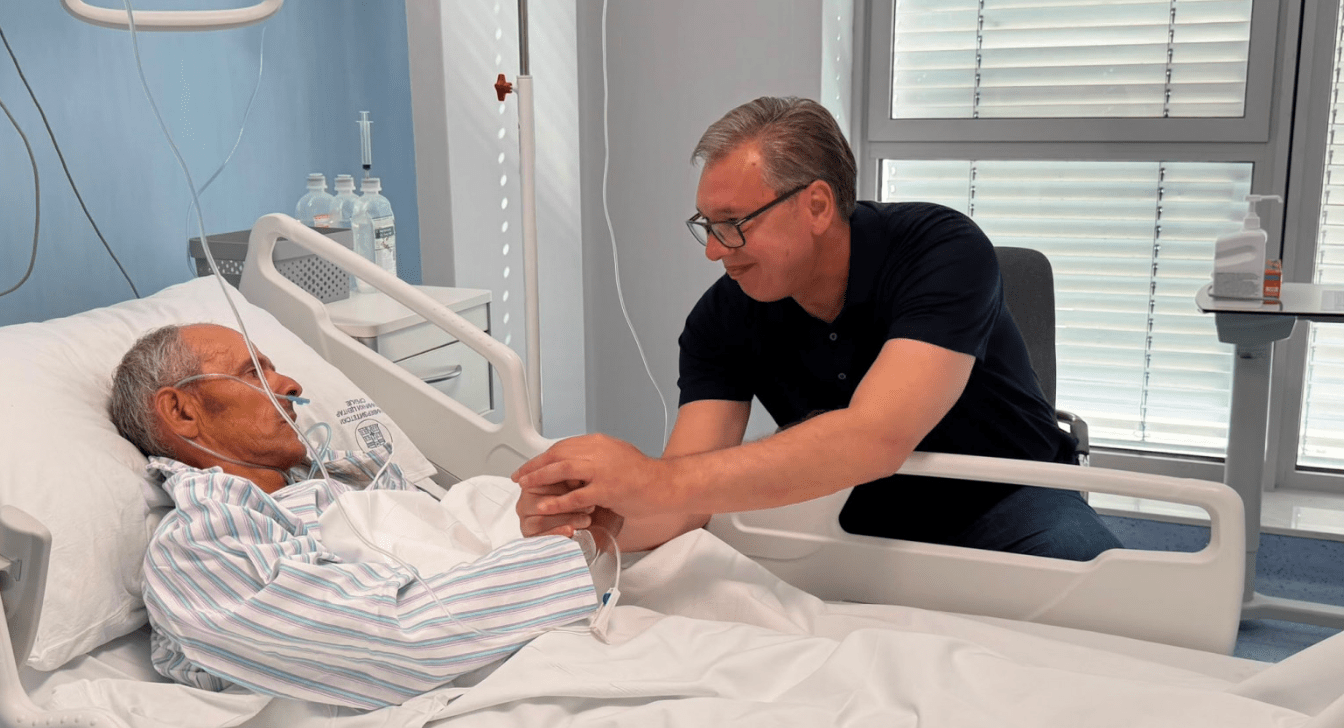
On Tuesday night, Nenad Rašković was a patient in North Mitrovica with a story that needed testing. Police officers and a representative of the Police Inspectorate of Kosovo took his statement at his hospital bed the same evening, and the Inspectorate opened a formal case; the Ombudsperson’s principal deputy opened a file of his own motion. At 09:17 on Wednesday morning, EULEX put in writing that it would “carefully follow the case with the competent authorities.” Shortly after midday, Rašković was in Belgrade. By evening, Serbia’s president was at his bedside, announcing his injuries on Instagram.
Every mechanism that can test his account is in Kosovo. The man is not.
Begin with what the account requires. Rašković told Kosovo Online that three officers came to his house in Dren, in Zubin Potok, threw him on a bed and beat him. “They demanded a rifle. I have no rifle” (“Tražili su pušku, ja pušku nemam”). Then, he says, the handcuffs, the forest, a beech tree, a hose, a rag in his mouth. Srpska Lista, which published the case first, says the officers demanded he confess to a war crime from 1999.
In a third telling, to Radio Kontakt Plus, he says he denied any crime and was asked whether he knew Momir Jakšić, the man arrested in July in the Kalludra investigation. Three accounts now place different demands at the center of the encounter. Only one person can reconcile them, under questioning by investigators with the power to check his answers against warrants, duty rosters, and the police’s own concession that units operated in that area that night.
The injuries make the same demand on a shorter clock. Allegations of this kind are tested against forensic medicine: the dating of bruises, the correspondence of wound patterns to what he described, a beating in the house and a hose in the forest, the documentation standards that exist precisely because mistreatment claims otherwise collapse into word against word. That examination cannot wait, and another institution’s paperwork is a weaker substitute for it.
The transfer to the Clinical Center of Serbia is defensible on its face, and the defense should be stated in full. The hospital in North Mitrovica operates inside Serbia’s health system; upward referral of a polytrauma case is routine medicine. The Inspectorate holds a statement taken before he left. Police say the medical documentation from Mitrovica is being handed over. Nobody needs to allege a motive for the transfer, and this piece does not.
The consequence stands regardless of motive. Serbia does not cooperate with Kosovo’s investigative institutions; it does not recognize the state they belong to. From the moment Rašković crossed the border, the Inspectorate could reach him only on Serbia’s terms, and every medical fact about him after that moment is produced by institutions beyond the investigation’s reach, then published by politicians before any forensic report exists. It was Serbia’s president, on Instagram, who announced the second broken rib, in a post that attributed it to “Albanian thugs” and closed with the assurance that all of Serbia loves him boundlessly. The diagnosis now travels faster than the evidence.
The transfer also carries a cost for Belgrade’s own position. If Rašković’s account is true, no evidence now within Serbia’s reach corroborates it more strongly than an independent forensic examination under monitoring. EULEX committed itself in writing on Wednesday morning; within hours, the man at the center of the case had left Kosovo. When the Eparchy of Raška and Prizren demanded at 14:22 that afternoon that the investigation run under EULEX and Ombudsperson monitoring, the demand arrived at an empty hospital bed. A party confident in the injuries invites the examination. No invitation has come.
One move dissolves this argument, and Belgrade can make it today. Make Rašković available for an examination conducted under EULEX and Ombudsperson monitoring. If the injuries are what Serbia’s officials say they are, the examination costs them nothing and proves everything they have claimed. Keep him beyond reach instead, and the refusal will be read as a finding of its own.
Drizan Shala writes on security, institutions, and political violence for Kosovo Dispatch and Tirana Examiner. He is a doctoral candidate at the University of Sarajevo.
Source
https://www.kosovodispatch.com/en/prishtina/the-witness-leaves

