
According to Hamdi Bushati, “the Tophanë neighborhood is a field about 5 km outside the city that Sultan Mehmet II Fatih used to cast cannons during the siege of the Rozafat castle of Shkodra. Here the large cannons were cast with metal materials, which he brought himself. Due to the lack of good roads, he did not have the opportunity to carry the heavy artillery up here.”
According to the order of Caliph Omar, also implemented by the Turkish sultan, Christians did not have the right to live in the same neighborhood as the Muslim population. For this reason, Catholics who once lived in the area of the Old City of Qafe e Kalasë were forced to move to live in the outskirts, such as in the Kasenë neighborhood after the Buna River, Sh’Lavrendi, Qafa, Kishaj, Zarufa, Shiroka and Kepi i Madh, in the Tophanë neighborhood (which according to Hamdi Bushati is also called Mahalla e Re), Arra e Madhe, Serreq, Gjuhadol, Dugajtë e Reja, in the village of Rrëmaj 5 km outside the city near the sandbank of the Kiri River, where in 1610 they were given permission to celebrate mass. The Catholic Cemetery of Rrëmaj was later built here.
With the expansion of Shkodra to the north, the Catholic population of Shkodra was forced to flee from the Tophanë neighborhood (Mahalla e Re) where they had their own parish, their own Church, and their own parish priest Dom Pal Kamsi (year 1736) to make way for the ever-increasing Muslim population.
But the Catholics of Shkodra were unable to take their own Church with them, but they took with them the Baptism (birth) Registers and the Marriage and Death Registers, which are today in the Central State Archive of Tirana, from where researchers have extracted data about this population.
In the topic “Shkodra in the Ottoman period” it is written: “…. Around 1700 the qela (priest’s house) and the parish of the Kazena neighborhood were transferred to Tophanë, near the headquarters of the Venetian bailiff (representative). The first to build a house in Tophanë as a subconsul was Anton Duoda.
Duoda wrote in 1736 that the city had 1000 shops. In 1745 Tophana was the center of the parish with 180 houses and 680 inhabitants and a church built there. The register of Bishop Pal Kamsi mentions the following Catholic settlements: Tophana, Rëmaji, Kazena, Sh’Lavrendi, Qafa, Kishaj, Zarufa, Shiroka and Kepi i Madh…..” .
The parish priest of the Church of Tophane, Dom Pal Kamsi.
The renowned Kamsi merchant family of Shkodra is among the oldest Shkodra families, appearing as early as 1736 in the baptismal register kept by the parish priest of Tophane, Dom Pal Kamsi.
One of the prominent members of this family was Bishop Pal Kamsi. He was one of the most well-known figures of the Catholic Church, who served as parish priest of the Church of Our Lady of Shkodra in Tophane, and on May 25, 1742, he was appointed by Pope Benedict XIV as Bishop of Shkodra.
Dom Pal Kamsi also served in Tivar and is notable for the fact that he managed to register for the first time in the church book, while he was parish priest in Tophane. The baptismal book, the first population register made by Monsignor Pal Kamsi, is kept in the Archbishopric of Shkodra (today in the Central State Archives of Tirana). He led the diocese of Shkodra for 29 years, and died in the Franciscan Assembly of Kastrati on April 14, 1771.
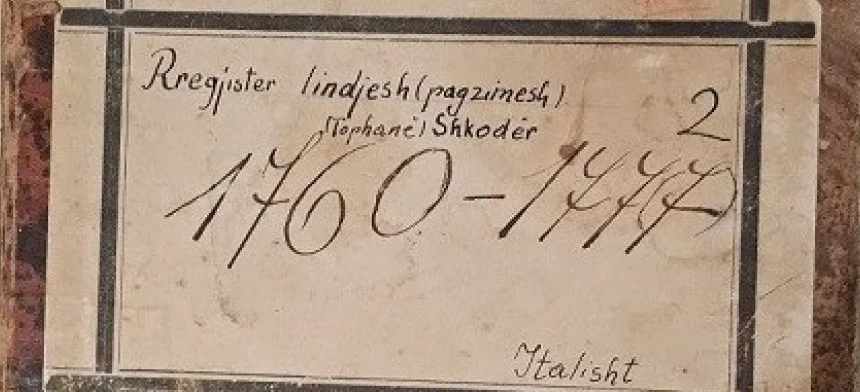
Here is the list of names of Catholic families from 1736 in the parish of the “Church of Our Lady of Shkodra” in the Catholic neighborhood of Tophanë, where Dom Pal Kamsi was the parish priest. These are taken from the Register of Baptisms and Births in the Tophanë – Shkoder neighborhood of 1736, volume I (first), which was kept in the Archbishopric of Shkoder and which is now in the Central State Archives of Tirana. The Central State Archives of Tirana also contains the Register of Baptisms and Births in the Tophanë – Shkoder neighborhood of 1760-1777, volume II, as well as all the registers of later years.
This list of names is also found in the two-volume book “SHKODRA AND THE WEATHERS” by author Hamdi Bushati:
Abrashi, Ashiku.
Babi, Belbaqori, Banda, Bardhi, Bashi, Batuçi, Beltoja, Berdica, Bjanki, Bibashi, Bobozi, Bojaxhija, Boriçi, Bushati.
Çapaliku, Çarkaxhija, Çeka, Çoba, Çobani, Çobi, Çurçia.
Dajçi, Daka, Dashi, Dedgudha, Dengilaj, Deniva, Demiri, Dika, Dobraçi, Doda, Dodmasej, Domnori, Drita, Dukagjini, Dushi.
Ejlli, Engjelli.
Galigadi, Gavoçi, Gega, Giadri, Gici, Gjota, Gjata, Gura.
Gjeçi, Gjeloshi, Gjergji, Gjinaj, Gjika, Gjonlala, Gjini, Gjura, Gjurashi (Gurashi), Gozzi (Gjoci), Grashi, Gruda, Guga, Gurakuqi.
Hoti, Hysenaga.
Junki.
Kabashi, Kakarriqi, Kalamashi, Kamsi, Kasneci, Kazazi, Kazena, Kiçi, Kodheli, Koleci, Komani, Kovaçi, Kosmaçi, Krajli, Kraja, Kranja, Krroqi, Kujxhija, Kukli, Kurti.
Lala, Lazri, Leka, Leniqi, Lezhëi, Lindi, Linëza, Logoreci, Lozani, Luka, Lufi, Luli, Llupi.
Marashi, Marjani, Marini, Markiçi, Marku, Matrishi, Mazi, Mazrreku, Melgushi, Memi, Mesi, Midha, Mjeda, Mida, Misloci, Mosli, Muzhani.
Ndoja, Negri, Nënshati, Nikaj, Nikanji.
Paci, Pali, Parruca, Preçi, Pema, Pepa, Pici, Pjetrushi, Pilota, Pistoli, Plauti, Prendçi, Prendanji, Prifti, Pulti.
Radoja, Radovani, Ramadani, Reçi.
Saçi, Saraçi, Sardari, Serreqi, Shahini, Sheldija, Shestani, Shiroka, Shkreli, Shpori, Shkjezi, Sina, Simiçija, Simini, Simoni, Sinadini, Spathari, Stani, Suma.
Tedeskini, Todri, Topalli, Troshani, Toksi, Tuzi.
Vakanji, Valanji, Vala, Vasa, Vasija, Vata, Vala, Vjerdha, Vladanji, Vuçi, Vuka, Vukashini.
Zadeja, Zanji, Zorba, Zojzi, Zuzi.
(The photo shows a photocopy of the Baptism/Birth Register, Volume 2, for the years 1760-1777, of the Tophanë Neighborhood in Shkoder, which is located in the Central State Archives in Tirana).
Article

