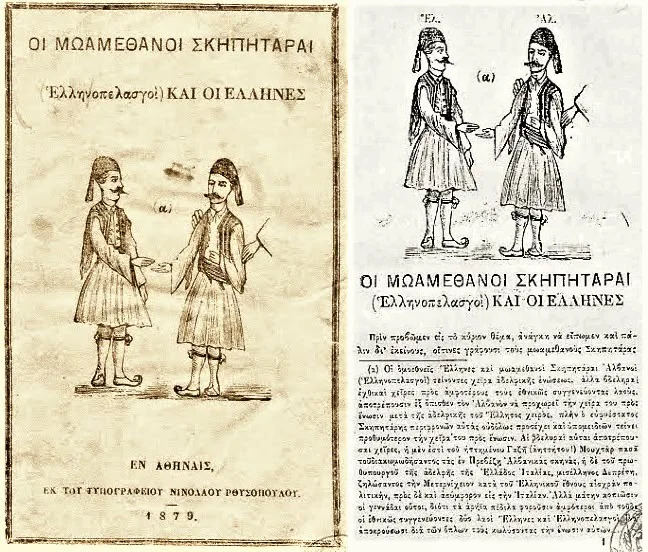

When Greeks in 2026 consider the Serbs their brothers and express themselves in racist terms against Albanians, let us see what we Greeks were saying about Albanians in the 19th century. In 1879, the author “Epirotis” (“the Epirote”), the pseudonym of Antonios Georgiou, published the book The Mohammedan Skipetars (Greco-Pelasgians) and the Greeks.
As you can see on the cover of the book, our two fustanella-clad forefathers, the Greek and the Albanian (the Mohammedan Greco-Pelasgian), shake hands for the union of Greece and Albania!
It is noteworthy that the author speaks specifically about Muslim Albanians, and not about Catholic or Orthodox Albanians. This shows that the understanding aimed at the union of Greece and Albania did not concern Christians alone, but Muslims as well. Furthermore, the author calls the Muslim Albanians “Greco-Pelasgians”, whereas Greek nationalists contemptuously call all Albanians—Christians and Muslims alike—“Turco-Albanians”, and spread false claims about their origins, alleging that they are supposedly Turks from the Caucasus!
Below I reproduce, in Modern Greek, what the author writes at the beginning of his book:
“The Greeks of the same nation and the Mohammedan Skipetar Albanians (Greco-Pelasgians), extending a hand of brotherly union, are confronted from behind by vile and hostile hands which seek to prevent the Albanian from extending his hand toward union with the brotherly hand of the Greek. Yet the highly intelligent Skipetar Albanian, despising these hands, pays them no attention whatsoever and, with a faint smile, extends his hand even more willingly toward union. These vile hands seeking to restrain the Albanian are, on the one side, that of the defeated Ghazi (‘Invincible’) Mukhtar Pasha, and on the other, that of the anti-Greek Italian Prime Minister Depretis. But these two labour in vain, because the two ethnically related peoples, the Greeks and the Greco-Pelasgians, will repel with arms those who seek to prevent their union.”
Let us now see what Google AI says about this book:
1. The actual author: The work The Mohammedan Skipetars (Greco-Pelasgians) and the Greeks was originally published in Athens in 1879 by Antonios Georgiou, who used the literary pseudonym “Epirotis.”
2. The central idea: The text reflects ideological and national concepts prevalent among sections of the Greek intelligentsia in the late 19th century. During that period, there was a strong belief in a broad “Greek ethnic kinship.” According to this theory, large sections of the populations of the Balkans—such as the Albanians/Skipetars—shared a common Pelasgian/Greek origin, regardless of whether they had embraced Mohammedanism or spoke another language.
3. The purpose of the work: Throughout its 54 pages, the book attempts to highlight the common historical and cultural ties of these populations with the Greek nation, at a time when the borders of Epirus and the wider Balkan region were still in the process of being formed.
4. Its value today: Today, the book is viewed primarily as a historical source—a document of its era—for the study of the development of national ideology and Greek-Albanian relations in the 19th century, rather than as a modern handbook of history or ethnology.
The book has been republished as part of the series Epirotic Homeland Studies by Elikranon Publications.
This is what GOOGLE AI says.
The book is available in the Digital Library of the University of Crete, and I will provide the link in the comments.
Source
Marios Dimopoulos. Philologist – Linguist – Ethnologist. Author – Researcher – Presenter of Papers at International Conferences

