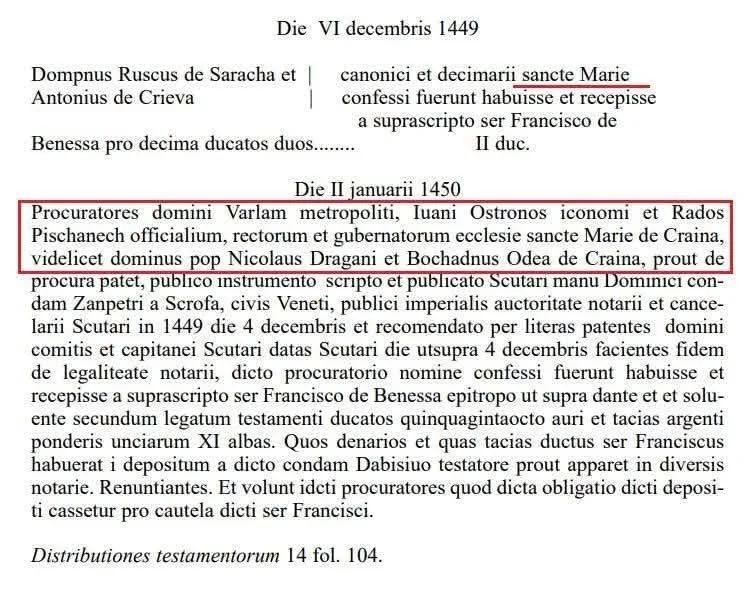

This document is in two parts, the first part from 1449 is on tax payments for the Church of Krajë, while the second part is a historical notarial deed in Latin, which dates back to 1450 and is directly related to the region of Shkodra and Krajë (Craina). The importance lies in the fact that the church of Krajë is heavily donated by its subordinates and taxes are levied on its inhabitants, so it is a true Institution.
A wealthy local man of the time named Dabisius left part of his property to this Church after his death through his representative Francisco Benessa, which was certified by a notary in Shkodra. The Church of Krajë clearly appears to be an organized institution with a real administration, from its leader the Metropolitan to officials of other levels and church representatives.
So, what you see in this document is a record of payments, and an act of delivery of property and fulfillment of church bequests (wills).
The first part (December 6, 1449) is a simple certificate of payment of church tax (tithe / decima). So two clerics/canons (Rusco de Saracha and Antonius de Crieva) from the church of Santa Maria confirm that they received a payment of 2 ducats from the nobleman Francisco de Benessa.
The second part (January 2, 1450) is the most important part historically and administratively. An official delivery of an inheritance/bequest of property (money and valuables) left by a deceased person named Dabisius.
The recipients of this wealth are the representatives of the Church of Saint Mary of the Land (ecclesie sancte Marie de Craina), including the highest ecclesiastical authorities such as Metropolitan Varlam, the economist Iuani Ostronos, and the official Rados Pischanech. To withdraw the wealth, they had sent two procurators (authorized representatives) priest Nikollë Dragani (pop Nicolaus Dragani) and Bochadnus Odea from the Land.
The donor is the nobleman Francisco de Benessa, who was acting as guardian of the will (epitropos). The property handed over is 58 gold ducats, a silver cup weighing 11 white ounces.
The document mentions in detail the power of attorney (legal authorization) that was issued in Shkodra on December 4, 1449. This power of attorney was drafted by the notary and imperial chancellor of Shkodra, Dominic (son of the late Zanpetri a Scrofa, a Venetian citizen). The document was officially confirmed and sealed with letters of arms by the Count and Captain of Shkodra himself.
In conclusion, the representatives of Krajë confirm that they received the money and silverware, therefore they declare Francisco de Benessa’s obligation closed and canceled, freeing him from any further legal responsibility.
In 1450, this donation of 58 gold ducats and silver vessels to the church of Saint Mary in Krajë represented quite a considerable capital, not just some pocket savings, but a real estate asset or investment that could sustain a church structure for several years.
_______________________
Document translation:
On December 6, 1449
Lord Rusco de Saracha and Antonius de Crieva, canons and collectors of tithes of St. Mary’s, admitted that they had received from the above-mentioned Sir Francisco de Benessa for tithes two ducats……… 2 ducats.
On January 2, 1450
The attorneys of Mr. Varlam, metropolitan, Iuani Ostronos, economist, and Rados Pischanech, official, rectors and governors of the church of Saint Mary of Kraja, namely the gentleman priest Nicolaus Dragani and Bochadnus Odea of Kraja, as appears from the power of attorney, written by public instrument and published in Shkodra by the hand of Dominic, the late Zanpetri a Scrofa, Venetian citizen, with public imperial authority notary and chancellor of Shkodra in the year 1449, on December 4, and recommended by open letters (patent) of the lord count and captain of Shkodra, given in Shkodra as above on December 4, testifying to the legality of the notary; in the name of this power of attorney they admitted that they had and received from the above-mentioned Sir Francisco de Benessa, guardian as above, who gave and paid to them according to the testament fifty-eight ducats of gold and a silver cup weighing 11 white ounces.
Which money and cup the said Sir Francisco had in deposit from the late Dabisius, testator, as results from the various notarial acts. And they waive [any other right]. And the said prosecutors want this obligation of the said deposit to be canceled for the protection (security) of the said Sir Francisco.
_______
Distributions of wills 14 folios 104.

