
Original text by Ramiz Lushaj.
Hoti and Gruda are two ancient tribes of the Great Highlands who have brought glory to the Albanian nation, honored our national history, and raised a high name for themselves. Where there is Hoti, there is definitely Gruda, as a settlement, as an activity or as a toponym. On the shores of Lake Plava, in the territorial heights of Hoti i Vendit, there are the Gruda Meadows. Over the centuries, all these documentary stones, even the chancelleries of the world, mention them together.
The philosophy of the people has enlightened the expressions of the proverbs: “Hoti’s rifle” and “Gruda the sword”.
Among the 12 tribes of the Highlands, for many reasons, Hoti is mentioned first. History mentions Hoti early, as early as 1330, while Gruda a century later, around 1445.
Even in an official public Request of November 14, 1918 addressed to the Peace Conference in Paris, to the Foreign Ministers of the four Great Powers: the United States of America, the United Kingdom of Great Britain, France and Italy, the two tribes of Hot and Gruda, together, as often in history, are its signatories with mind and pen, with heart, with names and surnames, with settlements like boats and neighborhoods-villages.
“We, – they say, – the undersigned, legal representatives of the various neighborhoods that make up the tribes of Hoti and Gruda, have the honor to submit to the kind attention of the Great Powers of Understanding the following request, humbly begging them to have the kindness to take into account and satisfy our national desires.”
The Hoti of the Country in Plavë-Guci is the first rifle of the Upper Lim War (Nokshiq War) on December 4, 1879. The first to fire was the martyred warrior Murat Osmani of the Mahmuds of Hoti, and the first December battle was followed by the brave leader Alush Zmajli of the Haxhajs of Hoti with over 40 warriors from his Hoti brothers: Sinanaj, Mehaj, Hysenaj, Mujaj and with them the brother-in-law Bajram Musa – of Dedushaj, who left the shepherd’s post in the pasture in Zabel and grabbed the war rifle.
In this frontal war with two battles (December 1879-January 1880) our Highland tribes from Kelmendi i Rrafshit, i Guri, i Rugova, from Malësia e Gjakova, from Peja… and finally from Tetovo and Tepelena took part. Warriors from more than four vilayets of that time. It was the first time in history that the Albanians of “Little Albania” (Plavë-Gucia) and “Greater Albania” (Ethnic Albania), with inspiration and direction from the Albanian League of Prizren, fought such a frontal war alone against the 7 largest kingdoms in the world as well as against the two new kingdoms of the Balkans: Montenegro and Serbia. It is no coincidence that after this war, on the battlefield, several flags of imperial Russia were found.
What I want to say separately in this documentary statement has to do with the fact that Hoti of Rrafshit near Lake Shkodra and between Shkodra and Podgorica, included in the Shkodra vilayet, came quickly and strongly to the aid of his brothers in Hoti of the Country beyond Lake Plava, in the Gucia basin of the Kosovo vilayet. They were led by Çun Mulaj, Hoti’s bajraktari.
They came to the side of their blood and kin brothers. They came to the forefront of the war with the Montenegrins. Of course, with the Hoti, there were also the Grudas. When Hoti felt the first step, Gruda waited for the second.
Hoti and Gruda from the Shkodra vilayet went and fought with courage, blood and wounds in Plavë-Gucinë of the Kosovo vilayet, because they fought many times: both for Plavë-Gucinë (and Hoti there), and for Albania that God has blessed with its natural ethnic borders, and for Hoti and Gruda, its own Albanian Trojan. If Hoti were to take the rifle, only God would stop him. Even today, whoever fights for the ethnic Albanian lands under Montenegro has fought for Albania and for his home, for his own heads and his own generations.
The ambassadors of the Great Powers on April 18, 1880, approved the Italian proposal for the “Korti Line” to give the Principality of Montenegro, instead of Plav and Guci, the territories of Hoti and Gruda. They signed the Istanbul Protocol, known as the “Protocol on the Borders of Turkey and Montenegro”. The handover of these territories was decided to take place on April 22, 1880.
The next day, on April 18, 1880, in Shkodra – the capital of the vilayet, a very large popular rally was held for pan-Albanian loyalty and resistance to the Great Powers. There, the people of Hoti took down the flag of the Ottoman Empire and their flag-bearer, Çun Mulaj, raised the Albanian Flag. Both were high and rare acts for that difficult time. On April 22, 1880, after the Ottoman forces left the Albanian Tuzi, over 5,000 Albanian forces were stationed there (some sources speak of about 8,000 fighters), who fought and won for the defense of Hoti and Gruda against the Montenegrin army, which had about 10,000 soldiers mobilized for the fighting and enjoyed international support in the spirit of the decisions of the Congress of Berlin.
After the War of Rzhanica, the areas of Hoti and Gruda, liberated by the Ottoman armies, but not occupied by the Montenegrin ones, remained de facto under the sovereignty of the Albanian League of Prizren for 8 months, from April 22, 1880 to December 28, 1880, when the Ottoman administration was restored in Tuzi.
The First Balkan War (1912-13) Krajl Nikola’s Montenegro could not enter Hot and Gruda, the Tuzi of Albanian history. This time only with blood, charm, partnership, with Slavophile support, which is a (s)payment that the new generations of today’s generation will not have to suffer until tomorrow.
Hoti and Gruda, the two signatory tribes together, would like to remind you in their Request of November 14, 1918, addressed to the Peace Conference in Paris, to the Great Powers of America, the United Kingdom, France and Italy, of their wars for the threshold of the Trojan House and for Ethnic Albania:
“The whole world testifies that the steep slopes of Hoti and Gruda have always been for Albania an insurmountable wall (barrier) against Montenegro, since the brave inhabitants of these regions have opposed them with weapons in hand, which always prevented the hordes of Montenegrins from entering Albanian territory. And as proof of our words, it is enough to cite the bloody stance that the first ones took against the violent release of our Tribes Montenegro decided by the Congress of Berlin, a position that ultimately exposed our rights and convinced Europe that Hoti and Gruda should be left to our homeland, Albania.”
Of course, Hoti and Gruda, united like two eagle heads in Tuz, as long as the sun shines and the earth sheds water, seeking and fighting, sacrificing and living for their own freedom and independence and that of the Albanian Nation in the Balkans.
The leaders of the Albanian League of Prizren in Shkodra and its Highlands gathered precisely in Tuz – one of the hotbeds of Albanian national glory, on July 16, 1880, on the issue of Hoti and Gruda and came up with concrete demands, where – among other things – they declared: “…we declared war for the independence of Albania, for which we are determined to sacrifice even the last drop of blood”.
The two tribes of the rifle and the pen, Hoti and Gruda, raised the Albanian National Flag in Decic on April 6, 1911, turning this blessed historical place into eternity, as the song of the Albanian people echoes, into a “Second Head, First Vlora”. These two tribes of Albanian national pride, alongside other rebellious tribes of the Malësia e Madhe, were in the Assembly of Gërçe (Kelmend i Gurit), were among the signatories of the Gërçe Memorandum (Albanian-French).
In this historical pan-Albanian document, part of the continuity of the Platform of the Albanian National Movement of the League of Prizren and a comprehensive Program for the Autonomy of Albania with 12 demands, the signatories from the Hoti tribe are Ded Gjo’ Luli and Gjet Mark Ujka and from the Gruda tribe Sokol Baçi and Dedë Nika.
In their Request of November 18, 1918, the two tribes together, Hoti and Gruda, see it appropriate and timely to acknowledge some of their Albanian and pro-Western national contributions to the Peace Conference in Paris: “In 1911, the inhabitants of our Tribes, together with our brothers of Këlmendi, Shkreli and Kastrati, took up arms against the oppression of the Young Turks, and in 1912 they fought again against Turkey, side by side with the Balkan Allies, for the freedoms and independence of Albania.
Yes, alas, the London Conference did not want to recognize our rights, and our Tribes were given to Montenegro, thus joining us with the same bad fate as many other regions of Albania, which were separated from the Fatherland. “at a time when that Conference itself was creating it freely and independently.”
Hoti and Gruda, with history and tradition in their genes and footsteps, with the pain in their souls and hearts from the separation from the ethnic national motherland of Albania, with rifles in their eyes and arms to reunite with their nation, with the suffering on their backs from the Serbian invasion of the Kingdom of Montenegro, with many sacrifices, destruction, emigration and ethnic cleansing during the two Balkan Wars (1912-1914) and the First World War (1914-1918), from Shkodra spoke at the Peace Conference in Paris, textually:
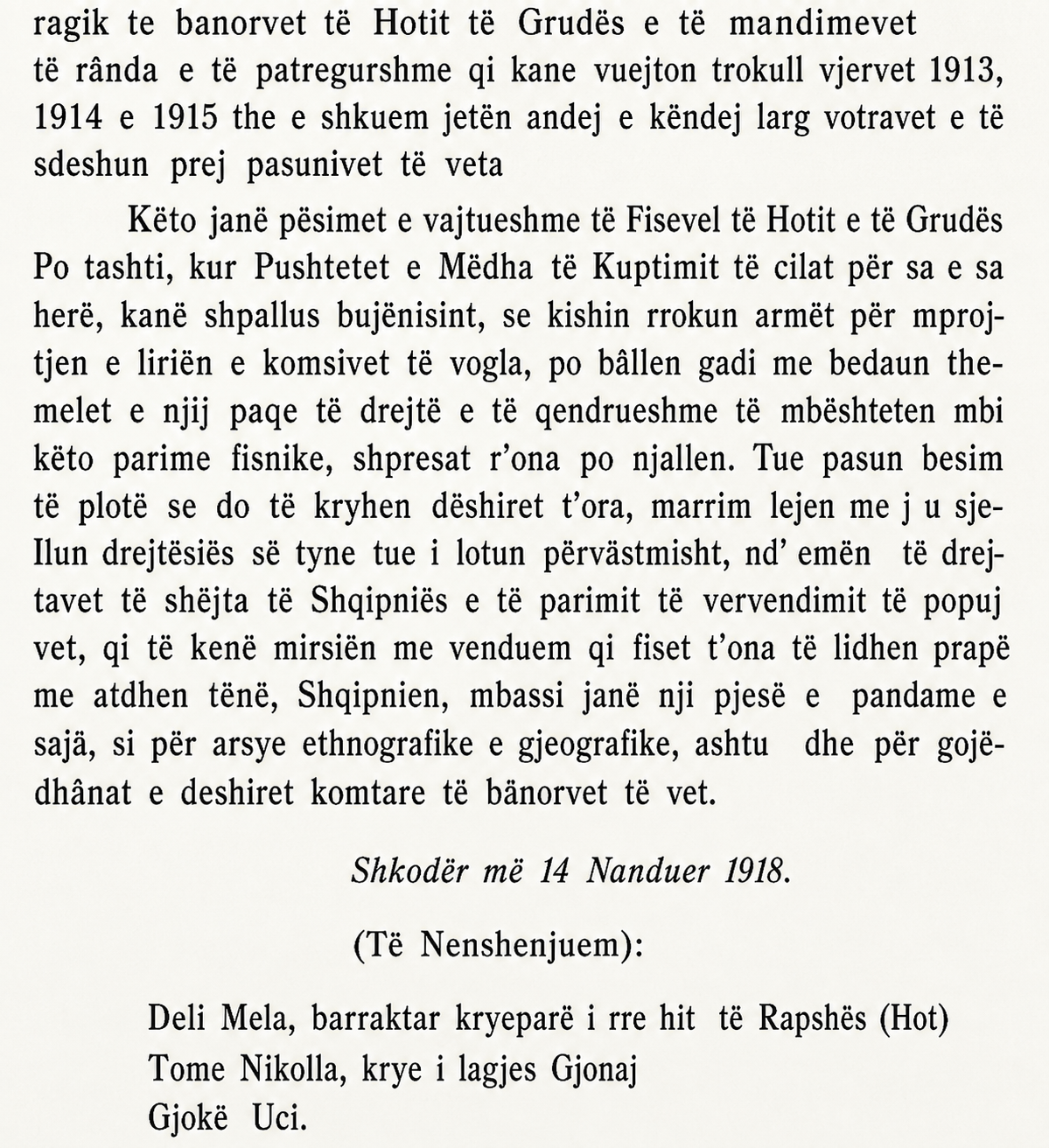
“…The Consuls of the Great Powers and the International Armies of Shkodra have been witnesses to the tragic deportation of the inhabitants of Hoti and Gruda and the severe and unspeakable suffering they suffered during the years 1913, 1914 and 1915, while they were taking their lives, here and there, far from their homes and their wealth”.
At the same time, they informed the Great Powers gathered in Paris that: “The people of our regions, who for their customs and traditions, and for their national language and traditions are purely Albanian, protested strongly, several times against this unjust and violent concession… These are the lamentable sufferings of the Hoti and Gruda Clans”.
The two bajraks of Hoti and the bajrak of Gruda, 45 men of these two tribes, by the Right of God, in the name of the Land, its History and its own local and national Future, gathered on November 18, 1918 in Shkodra, exactly two months before the Peace Conference in Paris. They had faith and hope that in this International Conference “the foundations of a just and lasting peace based on these noble principles are about to be laid” and they made it known that in anticipation of the beginning of its proceedings “our hopes are being revived”.
The signatories of this official public Request for the Peace Conference in Paris, to the Foreign Ministers of America, the United Kingdom, France and Italy, are the most prominent men of Hoti and Gruda:
From the Hoti tribe in Tuz, 24 prominent men signed, two bajraktars, a chief and the head of the neighborhoods (vlazni, barqe) there, according to these titles of ownership and in the order of the time:
Deli Meta – bajraktar and chief of the Rapsha district (Hot)
Tom Nikolla – head of the Gjonaj neighborhood
Gjekë Uci – head of the Gjonaj neighborhood
Nikoële Luca – head of the Jungji neighborhood
Gjush Marku – head of the Kolçekaj neighborhood
Nikë Martini – head of the Pepaj neighborhood
Lekë Marku – Head of the Gjelaj neighborhood
Lucë Ula – Head of the Gjoknikaj neighborhood
Marash Doka – Head of the Ndrekaj neighborhood
Zef Muça – Head of the Vuksalaj neighborhood
Prelë Dushi – Head of the Prekaj neighborhood
Prenk Gjetja – Head of the Lulashpepaj neighborhood
Gjon Ujka – Head of the Brigje neighborhood
Haxhi Mustafa – Head of the Nënhelm neighborhood
Lucë Nishi – bannerman of the Traboina district (Hot)
Prelë Keri – head of the Arrza neighborhood
Gjon Ujka – Head of the Gojçe neighborhood
Sokol Mali – Head of the Dushaj neighborhood
Nikë Gjeloshi – Head of the Vuksanlekaj neighborhood
Gjokë Elezi – Head of the Bardhaj neighborhood
Nikë Gjeloshi – Head of the Nabom neighborhood
Dedë Gjoni – Head of the Rranza neighborhood
Prenk Zeka – Head of the Çemerr neighborhood
Gjon Nika – Head of the Skorraq neighborhood
From the Gruda tribe in Tuz, 21 prominent men signed, the chieftain, three chiefs, and heads of the neighborhoods (brotherhoods, barges) there, according to these titles of ownership and in the order of the time:
Dedë Nika – the flag bearer of Gruda
Pjetër Preka – head of the Rranza e Sukas district (Grudë)
Mirash Hasi – head of the district of Lower Gruda – Gruda
Dede Nika – leader of Dinosha
Lulash Baçi – head of the Pikala neighborhood
Lekë Luli – Head of the Prifti neighborhood
Palokë Marku – Head of the Levka neighborhood
Lucë Gjeloshi – Head of the Bregcem neighborhood
Kolë Leka – Head of the Kurreci neighborhood
Dokë Ujka – Head of the Grimaj neighborhood
Tomë Gjeku – Head of the Setanaj neighborhood
Losh Gjeka – Head of the Ubrunçaj neighborhood
Dede Preka – Head of the Kalaj neighborhood
Tomë Gjoni – Head of the Sinishtë neighborhood
Prelë Doka – Head of the Vulaj neighborhood
Gjek Preloci – Head of the Nikaj neighborhood
Marash Pëllumbi – Head of the Meshkallë neighborhood
Prenk Deda – Head of the Vucok neighborhood
Mehmet Murati – Head of the Gjokaj neighborhood
Bisho Caku – Head of the Haxhiaj neighborhood
Zef Martini – Head of the Preçaj neighborhood
The two ancient Albanian tribes of Hoti and Gruda, the 45 signatories of the Petition, address the Peace Conference in Paris “with full confidence that our wishes will be fulfilled” and, at the same time, emphasize in the lines of this petition that “we obtain permission to approach their justice, humbly begging them, in respect of the sacred rights of Albania and the principle of self-determination of peoples, to have the good will to decide that our tribes be reunited with our homeland, Albania”.
At the conclusion of their Petition, they present their arguments that Hoti and Gruda “are an inseparable part of it (Albania), both for ethnographic and geographical reasons, as well as for the traditions and national desires of its inhabitants”.
This Request of Hoti and Gruda remained in the large unclosed Dossier of the Paris Peace Conference (1919-’20). It remained as Request II of Note XXII, since Annex 1 was the Request of the Mountain and Krajës Side. Just as these ethnic Albanian territories on the Adriatic Coast and the Lower Podgorica, on both sides of the Cem and Moraça, those in the alpine heights such as Plavë-Gucia, Rrozhaja, etc., remained under Montenegro from then on and to this day. These were injustices of the 19th and 21st centuries, while the 21st century must be different.
Cited from the letter:
“We, the undersigned representatives of the inhabitants of Hoti and Gruda, express the heavy and inexpressible sufferings that they endured throughout the years 1913, 1914 and 1915, living a life of wandering here and there far from their homes and deprived of their property.
These are the sufferings and lamentations of the tribes of Hoti and Gruda. But now, when the Allied Powers, which have repeatedly proclaimed their generosity in taking up arms for the defense of the freedom of small nations, are preparing to lay the foundations of a just and lasting peace based on these noble principles, our hopes are rekindled.
Having full confidence that our desires will be fulfilled, we take the liberty of presenting to their justice, entrusting to them in particular the sacred rights of Albania and the principle of the self-determination of peoples, so that we may have the kindness to decide that our tribes be reunited with our fatherland, Albania, of which they form an inseparable part, both for ethnographic and geographic reasons, as well as for the wishes and national aspirations of their inhabitants.
Shkodër, 14 November 1918
(The Undersigned):
Deli Meta, standard-bearer and chief of the three villages of Rapsha (Hoti)
Tomë Nikolla, head of the Guajaj neighborhood
Gjekë Uci, neighborhood”
Original article published in the Gazeta e Alpeve.

