

Abstract
This study examines the historical layering of toponyms in Montenegro and the surrounding western Balkan regions, with particular attention to the possibility of pre-Slavic, Proto-Albanian, Albanian, Vlach/Romance and other substrate elements beneath modern Slavic forms. Rather than proposing the removal or “erasure” of contemporary Slavic toponyms, the study uses de-Slavisation as a historical-linguistic reconstruction method: the central question is what linguistic forms may have preceded the modern names and how processes of translation, adaptation, replacement and Slavization transformed the regional toponymic landscape.
Drawing particularly on Noel Malcolm’s work concerning the early Albanian linguistic zone around Dardania (Kosovo), the Malësi and the mountain systems extending northward through Montenegro, the study investigates a broad group of settlements and geographical features, including Nikšić, Kolašin, Pljevlja, Durmitor, Bijelo Polje, Mojkovac, Berane, Rožaje, Sjenica, Tutin, Andrijevica, Bobotov Kuk, Kamena Gora, Hum, Uvac and Trijebine. Selected names are examined as possible survivals or adaptations of older Albanian/Proto-Albanian, Latin/Romance, Vlach or otherwise pre-Slavic nomenclature, while others are treated as uncertain cases requiring further investigation.
The study argues that the modern predominance of Slavic toponyms cannot, by itself, demonstrate that the Slavic forms represent the original nomenclature of these regions. Centuries of Slavic settlement, political and ecclesiastical influence, linguistic assimilation and administrative standardization could have translated, reshaped or replaced earlier names.
Consequently, the disappearance of an older name from the modern map should not automatically be interpreted as evidence that no earlier linguistic layer existed. Particular attention is therefore given to micro-toponymy, archival records, medieval attestations, Ottoman geographical terminology, historical linguistics and comparative phonology as potential sources for reconstructing otherwise lost nomenclature.
The study does not assume that every Slavic toponym conceals an Albanian origin. Instead, it proposes a stratigraphic model in which each name must be evaluated independently against Slavic, Albanian, Latin/Romance, Vlach and wider Balkan evidence. The objective is ultimately to determine whether the present-day toponymic landscape of northern Montenegro and the adjacent Kosovo–Sandžak region preserves traces of linguistic communities and naming systems that predate the Slavicization of the region.
1. Scope and methodological position
This study treats “de-Slavisation” as a historical-linguistic reconstruction project, not as a proposal to erase contemporary Montenegrin, Serbian or Bosniak names. The objective is to ask a narrower scholarly question: What linguistic layer lies beneath each modern toponym, and is there evidence for a Slavic, Albanian/Proto-Albanian, Latin/Romance/Vlach, or older Balkan substrate?
This distinction is essential. A modern Slavic-looking place-name does not automatically prove that the locality was originally Slavic. Names can be translated, calqued, adapted phonologically, replaced, or re-used after population movements.
Noel Malcolm’s Kosovo: A Short History is particularly relevant to the geographical hypothesis in the supplied image. Malcolm argues that the early Albanian linguistic zone should be sought on the Illyrian side of the Balkan divide, especially around Kosovo, the Malësi, and the mountain systems extending north through Montenegro.
He simultaneously stresses that linguistic evidence is more useful than simply assuming that modern ethnic distributions reproduce ancient ones. He also notes that high-mountain Albanian vocabulary contains a strong inherited element, whereas vocabulary associated with lowland agriculture and crafts contains substantial Slavic influence.
That makes toponymic layering a better research model than a simple “Albanian versus Slavic” binary. Modern Balkan toponyms frequently contain several historical strata. The recent Cambridge synthesis of Balkan linguistics likewise treats the region as an intense contact zone in which languages converge and exchange vocabulary, morphology and place-names.
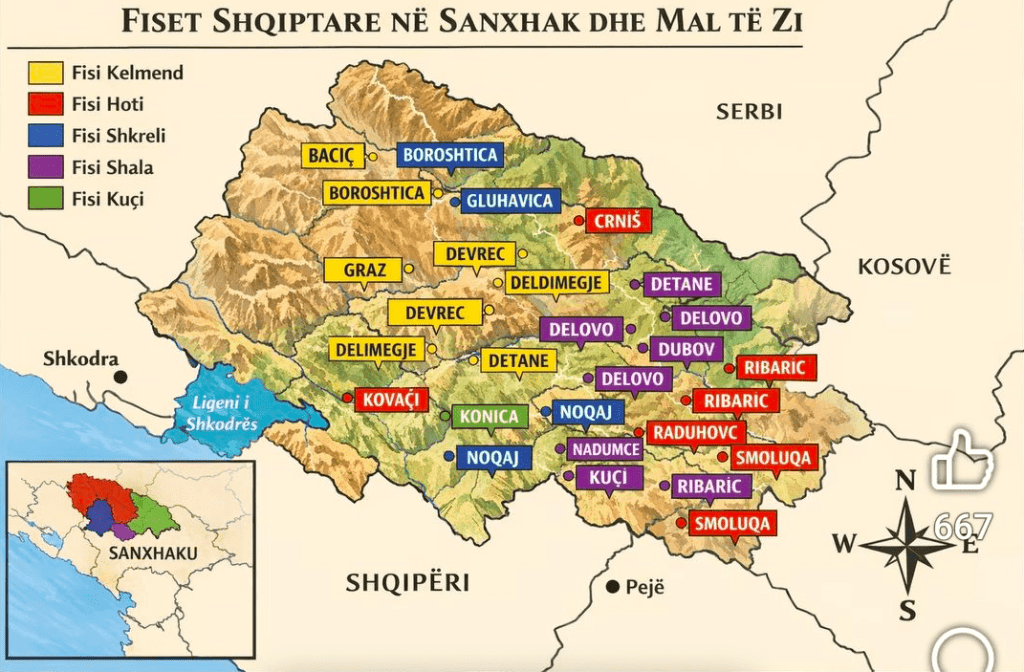
Tribes and regions in Montenegro deriving from Albanian tribes
Malcolm writes:
“The origins of the Albanians must be sought, therefore, on the Illyrian side of the divide – particularly in the mountains round Kosovo, in the Malesi, and in the tangle of mountains stretching north from there through Montenegro.
The Latin elements in Albanian help to confirm this location. From the fact that so much general vocabulary was absorbed into Albanian from Latin, and so little from Greek, it is clear that the proto-Albanians lived some way to the north of the Latin-Greek linguistic divide.
This language frontier ran from the Adriatic coast near Lezha across the middle of Albania, then up to the line of the Sar mountains, curving southwards to take in Latin-speaking Skopje, and then running northwards roughly along the Serbian-Bulgarian border.
One thing is quite certain: the Albanians did acquire their Christianity from a Latin-speaking teacher or teachers. The Albanian language contains much Latin-derived vocabulary anyway, having obviously absorbed words from nearby Romans or Romanized barbarians from the second century bc onwards; but the Latin element is especially rich in the area of Christian belief and Christian practice.
Thus we have:
meshe (mass), from missa;
ipeshk (bishop), from episcopus;
ungjill (gospel), from evangelium;
mrekull (miracle), from miraculum;
and a great number of other words, extending far into the vocabulary of psychology, morality and even the natural world (such as qiell, meaning heaven or sky, from caelum).”
Source: Kosovo: A Short History. Chapter 2. Sir Noel Malcolm.
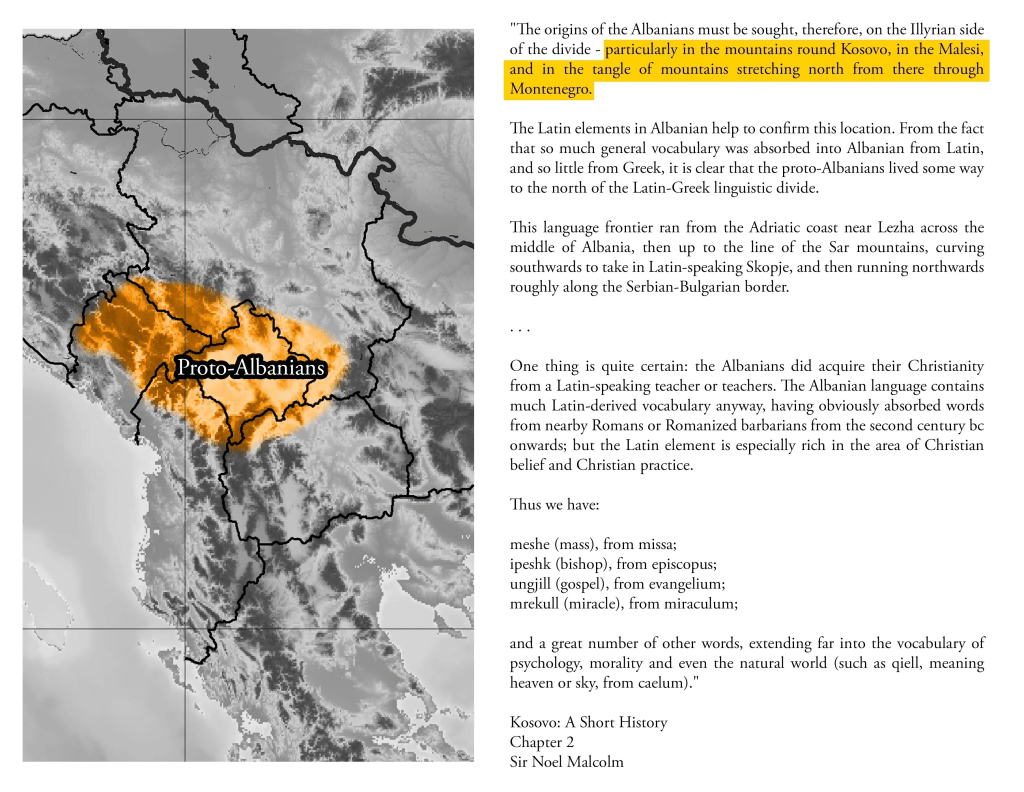
Following Malcolms theory, the orange covered area in the map would include the following settlements, villages, regions and cities:
Bijelo Polje, Nikšić (from the Albanian Nikqi), Rastovac, Kolašin (Albanian St. Cole, or Shenkolaj), Pljevlja (Roman Splaunon), Durmitor, Plužine, Zaton, Mojkovac (Moikaj), Brodarevo, Gostun (?), Sjenica, Duga Poljana, Tutin (Illyrian), Petnjica, Berane (from Burrëhani (“man of taverns”), Rozhaje (Illyrian region), Andrijevica (Albanian Ndre), Pišće (needs research) , Boričje, Bobotov Kuk, Trsa, Žabljak, Borje, Njegovuđa (needs research), Barice (Albanian “Bari”, “grass”) , Stožer, Kovren, Vrbnica, Dobrakovo, Sutivan (latin Sanctus), Donja Brezna, Pošćenje (?) , Dobrilovina, Bistrica (meaning crystal clear water in Albanian), Prošćenje, Polja, Štitarica, Krnovo, Ljevišta, Gornje Lipovo, Rovačko Trebaljevo, Drijenak, Lubnice, Poda, Tušanje, Vidrovan, Brezovik, Lukovo, Vinica, Hum (Pre-Slavic), Brijeg (Breg?), Jabuka, Ivanje, Kladnica, Kormine, Grevo, Zabrđe, Kamena Gora, Sopotnica, Uvac, Medare, Mijakovići (Mijaki), Vrulja and Trijebine.
Settlements with an Albanian / Vlach / Pre-Slavic / Roman origin
Kolashin
Rebecca West recorded a local tradition of Kol i Shen (“St. Nicholas” in Albanian), linked to earlier Catholic Albanian population later Islamized and partially displaced.
Pljevlja (Splaunon)
Transparent Slavic from pljeva (“chaff”), traditionally explained by wind-blown chaff from monastic threshing floors. Earlier medieval name Breznica/Breznik (after the local river/župa). Ottoman Taşlıca (“stony place”). A minority scholarly suggestion links the modern form to a possible pre-Slavic Splaunon. Roman Municipium S (name only partially recovered) lay nearby.
Durmitor (and peaks such as Bobotov Kuk)
Most widely accepted etymology is Balkan Romance/Vlach dormitor / durmitor (“sleeper,” “sleeping place,” cognate with Latin dormire and English dormitory), paralleled by nearby Visitor (“dreamer”) and Cipitor (“sleeper”). This fits the well-documented Vlach pastoral presence in Dinaric high pastures. Celtic proposals (“water mountain” or similar) exist but are weaker. Mythic readings (“abode of the gods”) are secondary.
Bijelo Polje (Nikol Pazari, or Nikollë Pazari)
Transparent Slavic “White Field” (bijelo + polje), traditionally linked to white flowers (or snow). Ottoman Akova/Akovo carries the same meaning. Albanian form Bellopojë/Fusha e Bardhë is a direct calque/translation. Earlier medieval references include Nikolj-pazar.
Mojkovac (Moikaj)
Linked to personal name Mojko / Mojković or a folk etymology involving medieval coinage at the nearby Brskovo mines (“moj kovani novac”). Albanianizing proposals offer Moik/Moikaj. The wider Tara valley preserves Illyrian Autariatae associations and early Romance/Vlach traces.
Tutin
There are several legends and opinions about the name of one of the oldest settlements, Tutin. According to one legend, the last Illyrian queen, Teuta, had her castle on the hill near the present settlement, and according to her, the settlement was named Tutin.
While another legend says that the city got its name from the Slavic word tutanj, which means echo, echo. According to this legend, which is very late, that is, from the 19th century, when Husein Gradaščević and his army had passed here first, on the way to Kosovo, the echo of his army was heard.
Source: Koha Ditore, Saturday, February 21, 2015, page 24, Pristina.
Toponyms which need more research
Pišće, Gostun, Trsa, Njegovuđa, Dobrakovo, Sutivan, Pošćenje, Štitarica, Krnovo, Ljevišta, Rovačko Trebaljevo, Lubnice, Tušanje (Tushanë?), Vidrovan, Vinica, Hum, Kormine, Grevo, Uvac (Uvë?).
Slavic Toponyms does not explain everything
The prevalence of Slavic toponyms across the northern Albanian and Montenegrin borderlands should not, by itself, be taken as proof that the present names represent the original nomenclature of the landscape. As Malcolm’s approach to Balkan toponymy suggests, names can be adapted, translated or replaced as linguistic communities and political structures change.
The immense concentration of Slavic forms across places such as reflects a long process of Slavicization of the visible toponymic landscape.
Older pre-Slavic names could have been translated, reshaped or completely displaced, meaning that their absence from the modern map does not necessarily indicate their absence from the earlier landscape. If traces of such nomenclature survived, they may now exist only in archival forms, oral traditions or micro-toponyms—the names of small fields, hills, springs, streams, pastures and localities overlooked by later cartographers.
Therefore, modern Slavic toponyms should be treated as evidence of a later linguistic layer, not automatically as evidence of original Slavic nomenclature; the crucial question is what names and linguistic forms existed before centuries of Slavic linguistic and cultural pressure transformed the map.
References
Azizi, Ismet, and Petrit Latifi. “Albanian Toponyms in Sandzak and Peshter.”
Duridanov, I. “Illyrische Flussnamen in Serbien.” Linguistique Balkanique 6 (1963).
Latifi, Petrit. “Bosniakization (Slavization) of Albanian Tribes and Toponyms in Montenegro and Sandžak.”
Malcolm, Noel. Kosovo: A Short History.
Numanović, Š. Koničani. 2004.
Popov, I. “Bemerkungen über die vorslavischen Ortsnamen in Serbia.” Zeitschrift für slavische Philologie 28 (1960).
Rexha, Iljaz. “Slavisation of Medieval Albanian Onomastics in the Area of Kosova, Nish and Shtip.”
“Crmnica.” Crmnica/Kučevo and proposed Albanian kuq “red” connection.
“Durmitor.” Romanian/Vlach durmitor < Latin dormio.
“Lješanska nahija.” Proposed Slavicized Albanian Lesh/Lješ.
“Sutivan.” Sanctus Johannes → Stivan/Sutivan.

