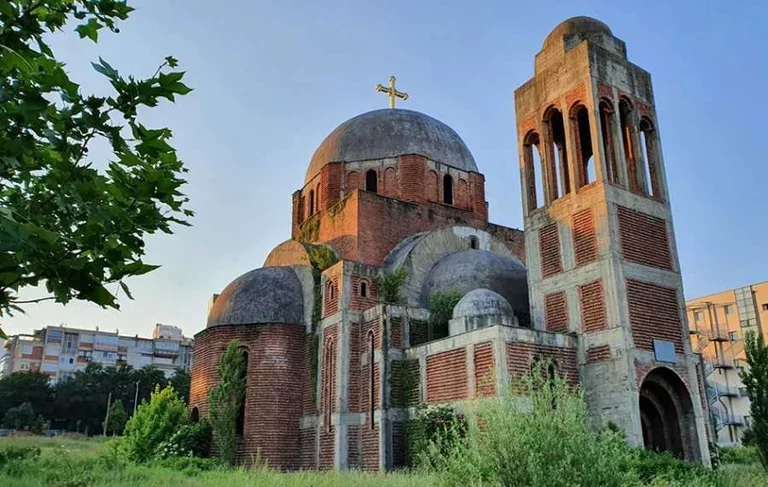

The Serbian Orthodox Church today held a religious service in the unfinished church of the University Campus of Pristina. This was the first time this religious ceremony was held since the war. The doctor of cultural heritage in Kosovo and historian, Qazim Namani, in an interview for Periscope, has told in a chronology about the history of this church, while […]
Namani emphasizes that there has never been a genuine strategy for the state of Kosovo, nor an urban plan that would end this ‘war’ between Albanians and Serbs over the church located in the courtyard of the University of Pristina.
“We haven’t even had a proper, well-studied strategy. Whether political, scientific, or urbanistic to deal with that object. And after the burning of the churches in 2004, that object was also taken under protection, as a monument that does not meet any criteria to be a cultural monument,” Namani emphasized to Periscope.
He further indicates that action should be taken to solve this problem.
“Since the only solution for that space, a building that was built during the violent measures, would be to draft an urban plan, a University campus in the space where the church is located, including other university buildings, the relocation of residential buildings from that area so that we could prevent the construction of that building, or its implementation. Then, the expropriation or cancellation of those signed documents that were made during the violent measures in 1992 should be initiated,” said the expert on the matter.
Qazim Namani raises the concern that the issue of the Orthodox Church has now been politicized to a very large extent and that action in this regard will be very difficult.
“Of course it is unreasonable and should not be allowed. It is a political object and it was built violently. State bodies should have prevented it in time and not politicized it to this extent. I believe it is very difficult for them now that it has been politicized and they probably have the support of the international factor, but we must stand against the politicization of cultural objects in Kosovo. It is very, very difficult now after 2-3 decades to act,” says Namani.
According to him, a mosque was intended to be built within the university complex, but he says that there should never be any religious buildings there.
“Religious rites, there were attempts to include a mosque within that university complex, but no religious object should be allowed within that university complex.”
Namani also provided a chronology of the entire history of the Orthodox Church, from its construction to the present.
“Based on my research and my knowledge, the Church project was initiated in 1985 by the Serbian community in America, specifically in Chicago, and that project began to be implemented in the early 90s. As a project, it was strategic, with specific planning for the Serbization of the city of Pristina, where the site in the middle of the University campus was chosen. It is known how the property of the municipality of Pristina was handled at that time.
The plan is that the part of Arbëria that was unbuilt be expanded with the Serbian Orthodox cemetery. I remember having had some trainings and we constantly had questions from professors from Strasbourg about what we were going to do with this object.”
The organization ‘Student Democracy’ also gave a reaction regarding today’s development to Periscope , emphasizing that they will initiate a petition and continuously demand that this church not be functional.
Source
Published in the /PERISCOPE/. https://periskopi.com/sq/2021/6/liturgjia-fetare-ne-kishen-brenda-kampusit-te-up-se-historian-namani-tregon-cka-duhet-te-behet?

