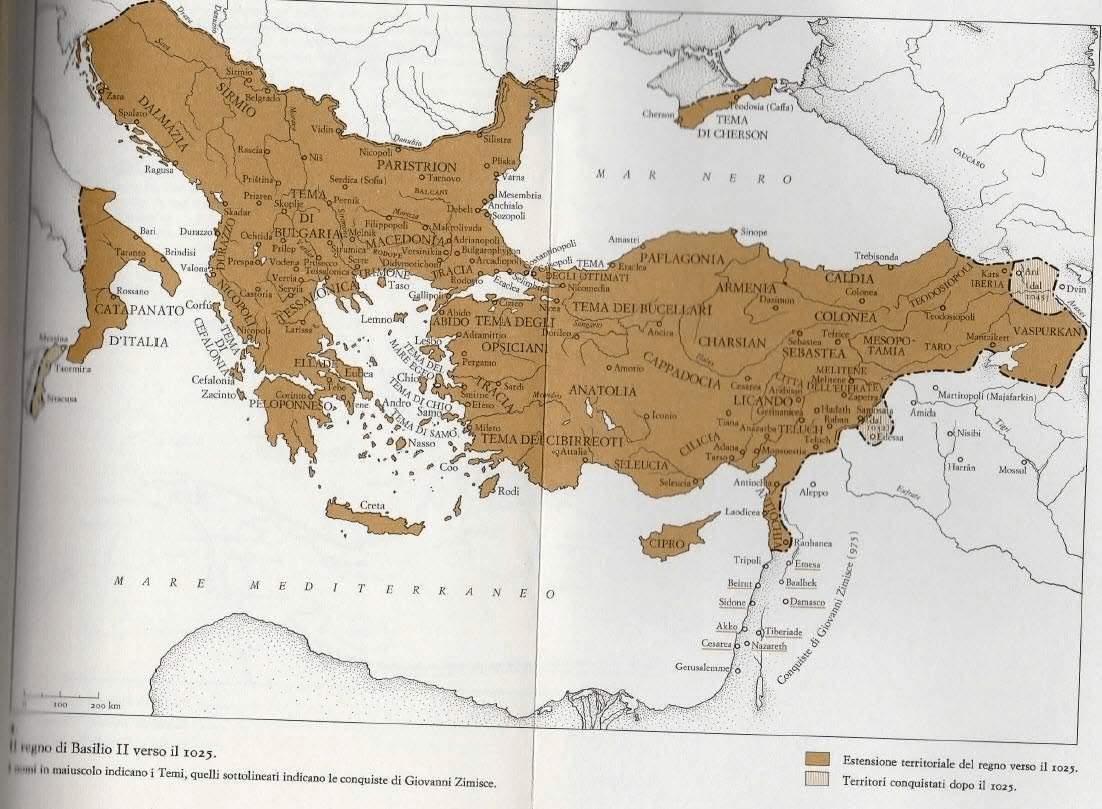

Original text in Albanian by Etnor Canaj.
As the modern-day descendants of the nomadic tribes of the Russian steppes, who began settling in the Balkans centuries ago, threaten to change the course of the Ibar River in Kosovo, we remind them that they have been clashing with the native Arbëror Albanians for at least 1,500 years.
The connection of Serbian tribes with the territories below the Danube.
In the 9th century, the Byzantine mission ends with the conversion of the Slavs (southern and eastern) to the Orthodox Christian faith, precisely under Constantine of Thessalonica, who, together with Methodius, Patriarch Photius, and the Byzantine emperor Barda (Βάρδας), takes credit for this initiative. Constantine of Thessalonica creates a Slavic alphabet (the Glagolitic alphabet) and begins the translation of the Holy Scriptures into the Slavic language (in the Slavic-Macedonian dialect). Constantine of Thessalonica dies in 869 and takes the name Cyril.” (Ostrogorsky, Byzantine History)
In 1183 the Hungarians and Serbs formed an alliance and conquered the empire. Belgrade, Branišev, Nish and Sofia were destroyed: six years later the Crusaders found these cities uninhabited and partially destroyed. By fighting against Byzantium, Nemanja (Stefan Nemanja) was able to secure his country’s independence and expand it to the south and east at the expense of the Byzantine Empire. At the same time, he extended his power over Zenta (or Zeta), which was united with Rashia into a single principality”. (Ostrogorsky, Byzantine History).
The two above data are the main indicators of the connection of the Serbian tribes with the lower Danubian territories. These data are given in the work “Byzantine History” by the historian Georg Ostrogorsky. Georg Ostrogorsky (1902-1976), was a professor at the University of Belgrade and is considered one of the greatest Byzantologists of the last century.
If we were to analyze the first information, i.e. when the Slavic tribes embraced Christianity in the 9th century, we would come to the conclusion that these tribes had not yet created a sedentary connection in terms of territory and this is the century of this sedentarism (implantation), i.e. the 9th-10th centuries.
Further, in the second information, i.e. the definition of these tribes in the 12th century above the Danube River as territories conquered by them, the question naturally arises: For what reason did they destroy Belgrade, Nish and Branishevo? Why did the Serbs plunder and destroy centers such as Belgrade and Nish, where according to the claims of today’s (Serbian) historians they have always been inhabited by Slavic populations?
Ostrogorsky in this historical fact that he brings, relies on the work of Jericek entitled “Geschichte”, Vol. I, p.264, where the latter as the main sources for the events in the Balkans of the time relied not only on Byzantine authors, but also on the information of the chronicles of the priest of Diocles, these chronicles which coincide with the second half of the 12th century and have come down to our days in Latin; as well as related to the life of Stefan Nemanj, written in Slavic by his sons Saint Sava and Stephen the First Crowned.
It should also be added that Nemanja, with this alliance with the Hungarians, extended his power towards the south and towards the east, thus a genuine expansionism and population replacements in the territories that the Serbs were conquering and crowding.

