
Abstract
This study challenges the interpretation of stećci as a primarily Serbian or Slavic cultural phenomenon and argues that their origins should instead be examined within the much older pre-Slavic cultural landscape of the western Balkans. With particular emphasis on Montenegro, it proposes that the stećci represent the medieval transformation and continuation of indigenous funerary traditions associated with the populations conventionally identified as Illyrian. The argument does not depend on identifying every medieval individual buried beneath a stećak as ethnically Illyrian, but on tracing cultural continuity in funerary practices, monumental landscapes, symbolism, and the persistent use of ancestral burial sites.
Montenegro is especially significant because major concentrations of stećci occur in regions such as Nikšić, Piva, Durmitor, Plužine, Šavnik, Pljevlja, and Cetinje, areas that also contain extensive evidence of prehistoric tumuli, Iron Age settlements, ancient cemeteries, and other pre-Slavic archaeological remains. The repeated association of medieval stećak necropolises with older burial landscapes suggests that the medieval monuments should not be understood independently from their prehistoric and ancient surroundings. Rather, they can be interpreted as a later layer in a long-standing tradition of monumentalizing the dead and maintaining ancestral landscapes.
The study further argues that the adoption of Slavic language, Christianity, and medieval political institutions did not necessarily constitute a complete replacement of the indigenous population or its cultural traditions. Medieval Slavic-speaking communities in Montenegro could therefore have inherited and transformed older local practices. Christian crosses, Slavic inscriptions, medieval weapons, and contemporary artistic motifs represent later adaptations of the tradition rather than proof of its original ethnic or cultural source.
Consequently, the use of stećci by medieval Slavic-speaking populations cannot by itself establish Serbian origin. Their distribution, archaeological context, relationship to prehistoric burial landscapes, and symbolic repertoire instead support investigation of a deeper indigenous Balkan substrate. The stećci are thus approached here as medieval monuments with a pre-Slavic cultural ancestry: a tradition rooted in the ancient indigenous landscape of the western Balkans and subsequently inherited, Christianized, and transformed by Slavic-speaking communities in medieval Montenegro.
Introduction
The attempt to present the stećci primarily as a Serbian or broadly Slavic cultural phenomenon rests on a fundamental chronological and methodological problem: it begins with the medieval language and political structures associated with the monuments and works backwards from them to determine their origin. That approach is misleading.
The stećci belong to a much older cultural landscape. Their appearance as a recognizable medieval tombstone tradition does not mean that the funerary ideas, sacred landscapes, symbolism and monumental treatment of the dead that they embody originated in the Middle Ages. In Montenegro especially, the stećci should be understood within the long continuity of the indigenous pre-Slavic population of the western Balkans, above all the Illyrian cultural environment that preceded Romanization, Christianization and Slavicization.
The medieval Slavic-speaking population of Montenegro inherited this landscape. It did not create it from nothing.
The distinction is essential: a monument can be medieval in date while preserving a much older cultural tradition.
The stećci belong to an ancient Balkan funerary landscape
Montenegro is exceptionally rich in prehistoric burial monuments. Long before the arrival of Slavic-speaking populations, the mountainous regions of present-day Montenegro were covered with tumuli, stone-built graves, fortified settlements and other monuments associated with the indigenous populations of the Bronze and Iron Ages.
This archaeological landscape is especially prominent in areas where stećci later became concentrated: Nikšić, Piva, Durmitor, Plužine, Šavnik, Pljevlja, Cetinje and the surrounding highlands.
The geographical continuity is therefore significant.
The same mountains that contain medieval stećak necropolises also contain prehistoric burial mounds and Iron Age archaeological sites. The medieval population did not arrive in an empty landscape and establish an entirely new funerary culture. It occupied an already ancient cultural landscape filled with ancestral monuments.
This is precisely where the Serbian-origin theory becomes problematic.
If the stećci were fundamentally an imported Serbian or Slavic invention, why do they appear so naturally within landscapes that had already been used for monumental burial for centuries and, in many cases, millennia?
A more historically coherent explanation is that medieval communities inherited and transformed existing indigenous traditions.
The form changed.
The religion changed.
The language changed.
Political rulers changed.
But the relationship between the community, the dead and the ancestral landscape could survive.
The Illyrian background cannot simply be ignored
The western Balkans possessed a substantial indigenous population before Romanization and long before the arrival of the Slavs. Much of present-day Montenegro belonged to the wider cultural world conventionally described through Illyrian archaeology and historical sources.
These populations developed their own funerary customs, monumental burial practices and sacred landscapes.
Tumuli were particularly important.
The practice of constructing monumental burial mounds and marking the resting places of the dead with substantial stone structures was not invented by medieval Slavs. It is deeply rooted in the prehistoric Balkans.
This creates an obvious historical problem for any attempt to treat the stećci as an essentially Serbian invention.
A Serbian or Slavic population could inherit the tradition, continue it and modify it.
But inheritance is not the same thing as origin.
The same principle applies to Christianity.
The fact that medieval Christians buried their dead in a particular place does not mean that the place became sacred only when Christianity arrived. Christian communities frequently adopted older sacred landscapes and incorporated earlier monuments into new religious environments.
The stećci should be examined in precisely this manner.
Slavicization did not erase the indigenous population
One of the greatest weaknesses of ethnic interpretations of the stećci is the assumption that the arrival of Slavic languages necessarily meant the replacement of the previous population.
There is no need for such an assumption.
The Balkans experienced Romanization, Christianization and later Slavicization, but these processes did not necessarily involve the complete physical replacement of local populations.
A population can change language without changing its ancestry.
It can change religion without abandoning every earlier custom.
It can become politically incorporated into a Slavic kingdom while retaining local traditions inherited from pre-Slavic ancestors.
This is particularly relevant in the mountainous regions of Montenegro.
The medieval inhabitants of Piva, Nikšić, Durmitor and the surrounding highlands eventually became part of a Slavic-speaking cultural world. But this does not mean that every element of their material culture suddenly became Slavic.
The more reasonable historical model is cultural layering:
pre-Slavic indigenous traditions were incorporated into Roman society; Roman and indigenous traditions were subsequently transformed through Christianization; and later these communities became increasingly Slavic-speaking.
The result was not a cultural tabula rasa.
It was a composite culture.
The stećci are one of its clearest expressions.
The distribution of stećci contradicts an exclusively Serbian explanation
The geographical distribution of stećci is another major problem for attempts to assign them exclusively to Serbian culture.
Stećci are distributed across Montenegro, Bosnia and Herzegovina, Croatia and Serbia. They are particularly concentrated in the mountainous western Balkans.
This is a regional cultural phenomenon.
The monuments do not follow the borders of medieval Serbia.
Nor do they correspond to a specifically Serbian political territory.
Their distribution instead corresponds to a broad cultural zone of the western Balkans, precisely the region where ancient indigenous populations had lived for centuries before the formation of medieval Slavic states.
Therefore, the fact that some stećci existed in territories ruled by Serbian dynasties does not make the tradition Serbian.
Political sovereignty does not determine archaeological origin.
If a Serbian ruler conquered an ancient settlement, that did not make the settlement Serbian in origin.
Likewise, if medieval Slavic-speaking inhabitants buried their dead beneath stećci, that does not prove that the stećak tradition itself was invented by Serbs.
Montenegro is especially important
The Montenegrin evidence is particularly revealing because many of the major stećak zones are located far from the central areas that could reasonably be described as the core of medieval Serbian culture.
Piva, Durmitor, Nikšić, Plužine, Šavnik and Pljevlja possess extensive stećak necropolises.
These regions also preserve a dense archaeological record of prehistoric and ancient occupation.
The connection between the two periods deserves much greater attention.
The necropolises should not be studied as isolated medieval phenomena. They should be studied together with the prehistoric burial mounds, Iron Age settlements, ancient cemeteries and Late Antique archaeological sites that surround them.
Once this longer chronology is considered, the stećci appear less like an entirely new medieval invention and more like the latest expression of an established local relationship with the dead and the landscape.
The names “Greek Cemetery” and “Mramorje” are significant
Traditional names associated with stećak cemeteries also deserve consideration.
Throughout the western Balkans, local populations have historically referred to stećak necropolises with names such as Greek Cemetery, Mramorje and other terms suggesting that the monuments were regarded as belonging to an earlier population.
Such terminology does not prove that the people buried there were literally Greeks.
Rather, it reveals something about historical memory.
Later communities often recognized these cemeteries as ancient.
The monuments were visibly different from ordinary contemporary graves and were therefore associated with a remote population whose identity had become obscure.
The term “Greek” in Balkan folk tradition frequently functioned as a designation for something ancient, pre-Ottoman or belonging to an earlier Christian or pre-Christian population.
The important point is that local tradition did not necessarily remember these monuments as “Serbian.”
Their very distinctiveness suggests that the communities who inherited them recognized them as remnants of an older world.
The symbolism is older than medieval Serbia
The iconography of the stećci also demands a broader chronological interpretation.
Among the recurring motifs are:
sun and lunar symbols;
rosettes;
circles;
spirals;
vegetal ornament;
animals;
horses and horsemen;
hunting scenes;
warriors;
swords;
shields;
spears;
dances;
crosses;
and various geometric compositions.
Symbols can travel between cultures.
But the total symbolic system must be considered.
The combination of solar and lunar imagery, circular motifs, vegetation, animals, horses, warriors, weapons and monumental funerary architecture belongs to a much older symbolic environment than medieval Serbia.
The horseman, for example, cannot automatically be transformed into evidence of Serbian origin simply because medieval Slavic elites also used horses and weapons.
Likewise, the solar and lunar motifs cannot be dismissed merely because they occur in medieval Christian art.
The important question is one of continuity.
Why did these particular motifs survive?
Why were they placed on monumental graves?
Why were these monuments repeatedly established within ancient burial landscapes?
And why does the same broad visual vocabulary appear across communities that did not share a single medieval political identity?
These questions point toward a much older Balkan cultural substrate.
The stećci are not explained by the Serbian state
Another fundamental error is to use medieval political history as an explanation for archaeological origin.
The territory of Piva, for example, passed through different political formations during the Middle Ages. It was connected at various times with Raška, Bosnia and the territories controlled by different noble families, including the Vojinović and Kosača families.
But none of this tells us who invented the stećci.
A political border can change within a generation.
A funerary tradition can persist for centuries.
The political history of a region therefore cannot be used as a shortcut for determining the ethnic origin of its material culture.
The stećci belong to the communities that lived in these landscapes, not automatically to whichever medieval state happened to exercise political authority over them.
This distinction is particularly important when discussing Montenegro.
The history of Montenegro cannot be reduced retrospectively to the history of medieval Serbia.
The indigenous populations of the Montenegrin mountains existed before the medieval Serbian state, just as the archaeological traditions of those populations existed before medieval Serbian political institutions.
The Christian crosses do not make the tradition Serbian
One of the strongest objections to a pre-Slavic interpretation is the Christian character of many stećci.
But this objection misunderstands cultural transformation.
Christianization occurred throughout the Balkans.
The adoption of Christianity did not require the complete abandonment of indigenous traditions.
Indeed, throughout Europe, Christianity frequently incorporated pre-Christian sacred landscapes, seasonal traditions, symbols and burial customs.
The presence of crosses on stećci therefore demonstrates the Christianization of the monument tradition.
It does not establish Serbian origin.
The same applies to Christian inscriptions.
A medieval inscription written in Slavic Cyrillic tells us something about the language and literacy of the community at the time the inscription was made.
It does not tell us that the entire funerary tradition originated with Slavs.
The language of an inscription and the ancestry of a cultural practice are two different questions.
Petko Krstjanin demonstrates medieval continuity, not Serbian origin
The famous stećak of Petko Krstjanin at Šćepan Polje is an excellent example.
Its inscription belongs to the medieval Christian world and explicitly refers to Duke Stjepan.
This tells us that the monument belongs to the medieval political and religious environment of the region.
But it does not demonstrate that the practice of monumental stone burial originated with medieval Serbs.
Rather, it shows how an older regional tradition could be incorporated into medieval society.
The monument is therefore evidence for continuity and transformation.
The medieval population inherited a landscape and a tradition of monumentalizing the dead, and expressed that tradition through the religious language, artistic conventions and political relationships of its own time.
That is exactly how cultural inheritance works.
The stećci should therefore be understood as Illyrian-derived, not Serbian
The strongest interpretation is consequently not that the stećci are “Serbian,” but that they represent a medieval manifestation of an older indigenous Balkan funerary tradition.
In the Montenegrin context, the deepest identifiable cultural background is the pre-Slavic world of the western Balkans, including the populations conventionally associated with the Illyrians.
The sequence can therefore be understood as:
Prehistoric indigenous populations, Iron Age Illyrian cultural traditions, Romanized local populations, Christianized Late Antique communities, Slavicization, medieval Montenegrin communities using and transforming stećci.
No serious historical model requires that.
What matters is continuity of population and cultural practice across successive historical transformations.
The language could become Slavic.
The political elite could change.
Christianity could replace older religious systems.
Yet elements of the indigenous funerary tradition could remain.
The stećci are precisely the kind of archaeological phenomenon in which such continuity can survive.
The Serbian narrative reverses the historical process
The Serbian interpretation essentially begins with the medieval period and says:
The people were Slavic-speaking.
The inscriptions were Slavic.
Some territories were ruled by Serbian dynasties.
Therefore the monuments were Serbian.
But this logic is circular.
It assumes that language, political sovereignty and cultural origin are identical.
They are not.
A more historically sound approach begins much earlier:
Who occupied these landscapes before the Slavs?
What were their burial customs?
Where were their tumuli located?
Which landscapes remained important after Romanization?
Which were Christianized?
Which were reused during the medieval period?
Which indigenous symbols survived?
And why were monumental graves concentrated precisely in these ancient settlement zones?
When these questions are asked, the stećci no longer appear as a uniquely Serbian phenomenon.
They become part of a much older Balkan tradition that was eventually inherited by Slavic-speaking communities.
Stećci as the stone memory of pre-Slavic Montenegro
The most convincing way to understand the Montenegrin stećci is therefore as monuments of cultural continuity.
They are medieval monuments, but their cultural ancestry reaches deeper.
They stand within landscapes inhabited by pre-Slavic populations.
They continue a regional tradition of monumental burial.
They preserve symbolic motifs that cannot be explained solely through medieval Serbian history.
They occur in areas where prehistoric tumuli and ancient settlements are abundant.
And they were subsequently inherited by populations whose language and political identity had become increasingly Slavic.
The Slavic-speaking inhabitants of medieval Montenegro did not therefore need to “invent” the stećci.
They inherited them.
They Christianized them.
They added crosses and inscriptions.
They incorporated contemporary weapons, clothing and social imagery.
They adapted an older funerary tradition to their own historical circumstances.
That is fundamentally different from saying that the tradition was Serbian in origin.
Conclusion
The stećci of Montenegro should be removed from the narrow framework of Serbian medieval cultural ownership. Their true historical context is the much deeper cultural landscape of the western Balkans. The monuments belong to the medieval period, but the tradition of monumental burial, ancestral landscapes and symbolic stone monuments has roots that reach far into the pre-Slavic past.
In Montenegro, that past is inseparable from the archaeological heritage of the indigenous Balkan populations conventionally identified as Illyrian. The medieval Slavicization of Montenegro should therefore be understood as a process of cultural transformation rather than complete replacement.
The people changed language, adopted new political identities and they became Christian.
But they continued to inhabit the same mountains, cultivate the same landscapes and bury their dead in places that had carried ancestral significance for generations before the arrival of the Slavs.
The stećci are therefore best understood as a product of inheritance rather than invention. They were not created by medieval Serbia. They were inherited by medieval Slavic-speaking communities from an older Balkan cultural tradition.
In Montenegro, the stećci can consequently be interpreted as the medieval descendants of a pre-Slavic funerary tradition rooted in the indigenous, Illyrian cultural landscape of the western Balkans.
They are not evidence that Montenegro was culturally created by medieval Serbia.
They are evidence of something much older: the survival and transformation of an indigenous Balkan tradition through Romanization, Christianization and Slavicization.
The stones are medieval. The landscape is ancient.
And the tradition they preserve should not automatically be attributed to the Slavic peoples who inherited it.

Stećak tombstones in Velimlje near Nikšić (Nikshiq). Niksic was founded by an Albanian lord in the 1600s.
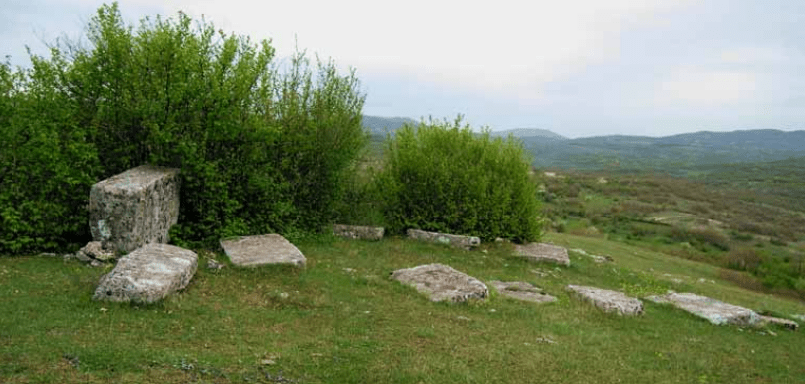
Stećci tombstones in Milovići near Nikšić

Stećak near the Church of Saints Peter and Paul in Nikšić

Stećak tombstone in Rudnice (Plužine)

Stećak tombstone in Pljevlja

Stećak tombstones in Cetinje
Sources
Čaval, Saša. “Social Landscapes as Multicultural Spaces: Stećci in Bosnia and Herzegovina.” Antiquity 95, no. 380 (2021): e11.
UNESCO World Heritage Centre. “Stećci Medieval Tombstone Graveyards.” Accessed August 17, 2026.
UNESCO World Heritage Centre. “Stećci Medieval Tombstone Graveyards: Nomination 1504.” 2016. UNESCO World Heritage Centre.
UNESCO World Heritage Centre. “Stećci Medieval Tombstone Graveyards: ICOMOS Advisory Body Evaluation.” 2016. UNESCO World Heritage Centre.
UNESCO World Heritage Committee. “Decision 40 COM 8B.24: Stećci Medieval Tombstone Graveyards.” 2016.
UNESCO. “Joint Nomination for Inclusion of Stećci – Medieval Tombstones in the World Heritage List.” April 14, 2014; updated April 20, 2023.

