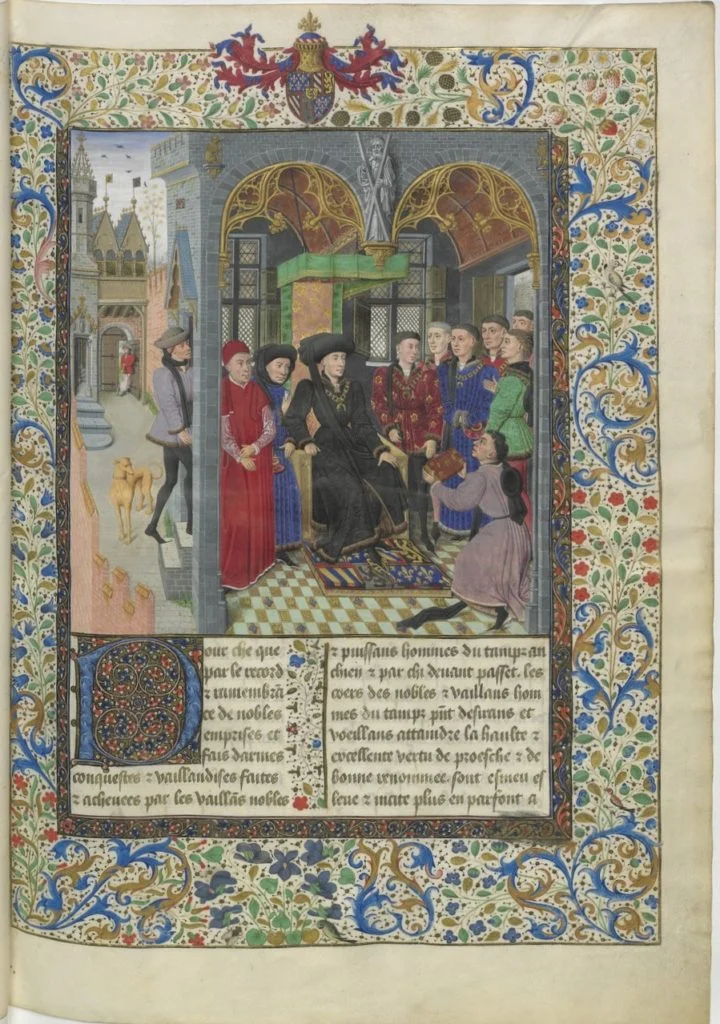

Abstract
The Directorium ad passagium faciendum, a Latin treatise associated with the Dominican missionary tradition and dated to 1332, contains one of the most significant Western European descriptions of the Albanians from the fourteenth century. Although the work was primarily written as a political and military proposal for a crusade, its observations concerning the Albanian population provide valuable evidence for the historical position of Albanians in the western Balkans.
Three statements are particularly important. First, the author explicitly distinguishes the Albanian language from Latin: “licet Albanenses aliam omnino linguam a latina habeant et diversam” (“although the Albanians have a language entirely different from Latin”). Second, the text states that the Albanians used Latin letters “in omnibus suis libris” (“in all their books”). Third, the author describes the Albanians as “maior natio”, the larger nation, and claims that they could field more than 15,000 mounted warriors.
These observations should neither be dismissed as incidental nor interpreted without qualification. They demonstrate that, by the early fourteenth century, an external Western observer regarded the Albanians as a recognizable linguistic and demographic community with a substantial military capacity and a distinct geographical presence. At the same time, the statement concerning Albanian books cannot by itself prove that surviving or known Albanian-language manuscripts existed in 1332. The passage is therefore of exceptional importance, but its evidentiary limits must be respected.
1. Introduction
The early fourteenth century represents a particularly important period in the historical formation and external perception of the Albanian-speaking population of the Balkans. Written evidence concerning Albania is relatively sparse, and much of what survives was produced by outsiders writing in Latin or Greek. Consequently, even relatively short passages can possess considerable historical value.
The Directorium ad passagium faciendum is especially significant because its author does not merely mention Albania as a geographical territory. He discusses the Albanians as a population, distinguishes their language from Latin, comments on their writing practices, differentiates them from the Latin inhabitants of the region, and evaluates their potential as a military force.
Robert Elsie’s edition of the relevant historical material identifies the work as a medieval Latin manuscript attributed alternatively to Brocardus/Frère Brochard and Guillaume Adam. The authorship remains uncertain. What is not uncertain is the importance of the passage itself as evidence for Western knowledge of the Albanians in the early fourteenth century.
The central purpose of this study is therefore not to use the text as evidence for later Albanian national history in a simplistic sense, but to examine exactly what the document can tell us about the Albanians of approximately 1332.
2. The source and its historical purpose
The Directorium ad passagium faciendum was not written as an ethnographic study of Albania. It was a crusading treatise intended to encourage a military expedition. Its broader objective was to persuade the French king and the Catholic powers to undertake military action in the eastern Mediterranean and Balkans.
This context is crucial.
The author was interested in identifying political circumstances that could make a military expedition successful. Consequently, descriptions of peoples, territories, military forces and political loyalties served a strategic purpose.
The Albanian material therefore has to be read as part of a military-political argument.
The author presents the local population as suffering under what he describes as oppressive Slavic rule. He portrays the Albanians and Latin Christians as potential allies who could support a Catholic military intervention.
This rhetorical purpose means that numerical claims should not automatically be interpreted as precise demographic statistics. Nevertheless, the fact that the author considered the Albanians important enough to incorporate into his military calculations is itself historically significant.
3. The Albanians as a distinct linguistic population
Perhaps the most famous sentence in the entire Albanian section reads:
“Licet Albanenses aliam omnino linguam a latina habeant et diversam, tamen litteram latinam habent in usu et in omnibus suis libris.”
A close translation is:
“Although the Albanians have a language entirely different from Latin, nevertheless they use Latin letters in all their books.”
The first part of this sentence is exceptionally important.
The author does not describe Albanian as a dialect of Latin, nor does he simply say that the inhabitants speak a local or barbarian language. He explicitly identifies the Albanian language as aliam omnino linguam — “an entirely different language” — from Latin.
The wording therefore provides clear evidence that an educated Western observer in the early fourteenth century recognized Albanian as a distinct language.
This is consistent with other medieval Western observations. An earlier anonymous description of Eastern Europe, generally dated to the beginning of the fourteenth century, similarly states that the Albanians possessed a language distinct from those of the Latins, Greeks and Slavs. Another account from 1322 describes Albania as a province situated between Slavic and Byzantine territories and says that it possessed a language of its own.
The 1332 statement should therefore not be regarded as an isolated observation. It forms part of a broader pattern in which medieval Western observers increasingly recognized the Albanian-speaking population as linguistically distinct from its powerful neighbours.
4. The significance of the phrase “in all their books”
The second half of the sentence is considerably more controversial:
“tamen litteram latinam habent in usu et in omnibus suis libris.”
Literally:
“nevertheless they have the Latin letters in use and in all their books.”
At first sight, this appears to constitute evidence for written Albanian in the year 1332.
That interpretation is possible, but it cannot be established with certainty from the sentence alone.
The grammatical structure allows at least two interpretations.
Interpretation A: Albanian-language books written in Latin script
Under this interpretation, the author is saying:
The Albanians speak a language different from Latin, but they write that language using Latin letters, including in their books.
If this is what the author intended, the passage would constitute extremely important evidence for an Albanian written tradition more than two centuries before the publication of Gjon Buzuku’s Meshari in 1555.
Interpretation B: Books written in Latin
A second possibility is that the author is distinguishing between the Albanian spoken language and the Latin written language used by educated or ecclesiastical communities.
In this interpretation, Albanians spoke a non-Latin language but used Latin script — and possibly Latin itself — in their written books.
This ambiguity has been emphasized by Robert Elsie and other scholars. The existence of the Albanian language is clear; the precise linguistic identity of the books is not.
This distinction is essential.
The passage does not provide a surviving Albanian manuscript from 1332.
Nor does it provide a quotation in Albanian.
What it provides is a medieval observer’s statement that Albanians possessed a distinct language and used Latin letters in connection with their books.
That is still highly significant.
5. The absence of surviving manuscripts does not necessarily contradict the statement
The lack of a surviving fourteenth-century Albanian manuscript should not automatically be taken as proof that no such books existed.
Medieval manuscript survival is highly selective. Albania experienced political instability, warfare, changes in ecclesiastical jurisdiction and repeated shifts in cultural and political power. Written materials were particularly vulnerable to destruction or disappearance.
Furthermore, the kinds of texts that might have existed in fourteenth-century Albanian communities may have been short religious, administrative, commercial or liturgical texts rather than large literary works.
The present documentary record therefore cannot be treated as a complete record of medieval Albanian literacy.
However, historical methodology requires an important distinction:
possible existence is not the same as demonstrated existence.
The Directorium gives us evidence that a medieval observer associated Albanians with the use of Latin letters and books. It does not allow us to reconstruct the contents, size, genre or language of those books.
The first unambiguous surviving written Albanian text is generally identified as the baptismal formula of 1462 associated with Pal Engjëlli. The first substantial surviving Albanian book is Gjon Buzuku’s Meshari, dated to 1555.
The gap between the Directorium and these surviving texts is therefore best understood as a documentary gap, not necessarily as proof of linguistic or literary discontinuity.
6. The Albanians as a “maior natio”
The demographic statement is perhaps even more striking than the linguistic one.
The text states:
“Albanenses autem, quia maior natio est…”
Literally:
“The Albanians, however, because [they are] the larger nation…”
The word natio deserves particular attention.
In medieval Latin, natio did not possess precisely the same meaning as the modern political concept of a nation-state. It could refer to a people, population, ethnic group or community with perceived common characteristics.
Consequently, the statement should not be projected backwards as if the author were describing a modern Albanian nation-state.
Nevertheless, the expression is important because the author clearly treats the Albanians as a recognizable collective population.
Even more significant is the adjective maior — “larger” or “greater.”
The author is comparing the Albanians with another population in the region, namely the Latins.
The passage therefore implies a demographic distinction:
Albanians constituted the larger population in comparison with the Latin population in the area under discussion.
This is consistent with the surrounding passage, in which the author distinguishes the territories and settlements of the Latins from those of the Albanians. Modern scholarship has likewise highlighted the phrase “maior natio” as an important medieval characterization of the Albanians as a substantial and distinct population.
7. Four Albanian cities and the geography of the population
The passage identifies four cities:
Polati Majoris, Polati Minoris, Sabatensis et Albanensis.
These are generally associated with territories and settlements in the northern Albanian/Montenegrin border region and the wider ecclesiastical landscape surrounding Shkodër.
Robert Elsie’s commentary identifies:
- Greater Pult/Polatum as a region associated with the Kir valley;
- Lesser Pult as another locality in the same general northern Albanian sphere;
- Saba/Sapa with the Zadrima region;
- Albanopolis with a site traditionally identified with Zgërdhesh, south of Kruja.
The precise identification of every medieval place-name is not always straightforward. Medieval geographical terminology could refer to dioceses, regions, settlements or ecclesiastical jurisdictions rather than modern-style cities.
Nevertheless, the list demonstrates that the author possessed relatively detailed geographical information about the Albanian territories.
This is important because it suggests that “Albanian” was not merely an abstract label applied to an undefined population. The author connected Albanians with identifiable settlements and territories.
8. The extraordinary military figure: more than 15,000 horsemen
The most striking quantitative statement reads:
“ponerent in campo plusquam quindecim milia equitum”
This can be translated:
“they could put into the field more than fifteen thousand horsemen.”
The author immediately qualifies this by referring to their customs and manner of warfare:
“secundum morem et modum illius patrie, expeditos et strenuos bellatores.”
That is:
“according to the custom and manner of that country, as swift and vigorous warriors.”
The figure of more than 15,000 mounted warriors is extraordinary.
It should not, however, be treated as an exact modern census of Albanian military manpower.
Medieval military numbers are notoriously difficult to verify. Authors writing political or crusading literature could exaggerate the military strength of potential allies in order to persuade rulers that an expedition was feasible.
The correct historical interpretation is therefore not:
“There were exactly 15,000 Albanian cavalrymen in 1332.”
Rather, the evidence supports the more cautious conclusion:
The author believed, or wanted his reader to believe, that the Albanian population possessed an exceptionally substantial pool of military manpower and could contribute a very large mounted force to a campaign.
This is nevertheless significant.
A population that an informed military writer believed capable of supplying more than 15,000 horsemen could not have been regarded as a politically or militarily insignificant community.
9. What the number may tell us about Albanian society
The reference to mounted warriors also provides an indirect glimpse into the social organization of the Albanian population.
Horsemen represented a comparatively resource-intensive form of warfare. Maintaining horses, weapons, armour and the necessary logistical infrastructure required access to land, wealth and military networks.
The author’s description of the Albanians as “expeditos et strenuos bellatores” — effectively, well-equipped and vigorous warriors — reinforces the image of a society with substantial military potential.
The text should therefore be read alongside the broader medieval evidence for Albanian pastoral, agricultural and military communities.
It would be excessive to infer a single uniform Albanian social structure from the Directorium. Nevertheless, the passage strongly indicates that the author regarded Albanian society as capable of mobilizing significant armed forces.
This becomes especially important when considered together with the demographic designation maior natio.
The author is effectively presenting three connected characteristics:
- a distinct people;
- a larger population than the Latin communities in the area;
- a substantial military capacity.
These three elements form a remarkably coherent picture.
10. Albanians and Latins: two populations in the same political landscape
Another important feature of the passage is the distinction between Albanians and Latins.
The author writes that the power of the Latins was confined within their cities. Outside those cities, the Latins possessed vineyards and fields but lacked villages or fortified settlements populated by Latins.
This indicates that the author perceived a distinction between:
- Latin urban/colonial communities;
- Albanian rural and territorial populations.
This distinction is historically valuable because it demonstrates that “Latin” and “Albanian” were not interchangeable categories.
The Latin presence in the region was associated with Catholic ecclesiastical and urban structures, while the Albanian population occupied a much broader territorial space.
This also helps explain why the author emphasizes the Albanians as maior natio.
The Latin population may have possessed ecclesiastical and urban power disproportionate to its demographic size, whereas the Albanians represented the larger indigenous population.
11. The political significance of Albanian autonomy
The author describes both Latins and Albanians as suffering under what he characterizes as the oppressive rule of Slavic rulers.
The language is strongly polemical. The author refers to:
- forced labour;
- an oppressed clergy;
- imprisoned bishops and abbots;
- dispossessed nobles;
- captive persons;
- damaged or deprived churches.
This description must be treated carefully because the work is a crusading political document.
The author had a clear reason to emphasize oppression: he wanted to convince Catholic rulers that intervention was necessary and that the local population would welcome a military campaign.
Yet the political logic of the passage is important.
The author assumes that Albanians could become active participants in a military realignment.
They are not portrayed simply as passive subjects waiting for liberation. Rather, they are presented as a population possessing sufficient manpower to become a decisive military factor.
12. Albania as a strategic military resource
The broader argument of the Directorium makes the Albanian passage even more significant.
The author proposes that Western European forces could cooperate with local populations.
The Albanians consequently appear not merely as an ethnographic curiosity but as a strategic resource.
The author later argues that with the assistance of the Albanians and Latins, a relatively small French force could defeat the Kingdom of Rascia. Robert Elsie’s translation summarizes this argument as the claim that 1,000 French knights and 5,000–6,000 infantry could, with Albanian and Latin assistance, conquer the kingdom.
This tells us something important about the author’s conception of Albanian military potential.
The Albanians were not merely expected to provide symbolic assistance. They were conceived as a substantial component of the proposed military coalition.
13. Language, ethnicity and political identity
It would be anachronistic to claim that the Directorium describes the Albanians as a modern nation in the nineteenth- or twentieth-century sense.
However, it is equally problematic to dismiss the terminology as meaningless.
The author distinguishes Albanians from Latins linguistically and geographically. He calls them a natio. He describes them as the larger population. He associates them with identifiable territories and settlements. He attributes to them a common language and a distinctive military capacity.
Taken together, these features demonstrate that the Albanians were perceived as a recognizable collective population.
The text therefore provides valuable evidence for the historical development of Albanian collective identity, even though it does not describe nationalism in the modern sense.
The distinction is important:
medieval Albanian collective identity should not be equated with modern nationalism, but neither should it be reduced to an entirely fluid or nonexistent category.
The Directorium demonstrates that an external observer could identify the Albanians as a distinct natio in the early fourteenth century.
14. Comparison with other medieval references
The 1332 passage gains importance when placed within the sequence of earlier medieval references.
Around 1308, an anonymous description of Eastern Europe stated that the Albanians possessed a language distinct from those of the Latins, Greeks and Slavs.
In 1322, the Irish pilgrim Symon Semeonis described Albania as a province between Slavic and Byzantine territories and noted that it possessed a language of its own:
“Albanya est provincia inter Sclavoniam et Romanyam, per se linguam habens.”
In translation:
“Albania is a province between Slavonia and Romania, possessing a language of its own.”
Then, in 1332, the Directorium provides a substantially richer description.
This progression is noteworthy.
The evidence develops from:
a language of its own → a distinct Albanian population → identifiable Albanian territories → a larger Albanian population → substantial military capacity.
The 1332 text is therefore not the beginning of Western awareness of Albanian distinctiveness. Rather, it represents one of the most detailed medieval Western descriptions of that distinctiveness.
15. The question of Albanian literacy
The question of literacy deserves particular caution.
If “in omnibus suis libris” refers to books written in Albanian using Latin letters, then the implications are profound.
It would mean that by 1332:
- Albanian was being written;
- Latin script was being used for Albanian;
- books existed in which this writing occurred;
- the practice was sufficiently recognizable to an outside observer to be described in a report.
Such an interpretation would push evidence for Albanian written culture more than two centuries earlier than the Meshari of Gjon Buzuku.
But the surviving evidence does not allow this conclusion to be established definitively.
The University of Texas’s linguistic overview explicitly notes the ambiguity: the statement may refer to Albanian-language texts written in Latin script, but it could potentially mean that Albanians simply wrote in Latin.
This uncertainty should be preserved in any serious academic treatment.
A responsible formulation is therefore:
The Directorium provides the earliest explicit medieval reference to Albanians using Latin letters in their books, but it does not conclusively establish that those books were written in the Albanian language.
That is both historically stronger and academically safer than claiming that the passage proves a fourteenth-century Albanian literary corpus.
16. The Latin alphabet and the northern Albanian cultural sphere
Even with the ambiguity concerning the language of the books, the reference to Latin letters is historically meaningful.
The northern Albanian territories described in the document were deeply connected with Latin Catholic ecclesiastical institutions. The Directorium itself refers to the Archbishopric of Antivari and Catholic ecclesiastical structures.
The use of Latin script therefore fits the broader cultural environment of medieval northern Albania.
Later Albanian literature provides a striking continuity in this respect. The earliest securely documented substantial Albanian texts are overwhelmingly associated with the Latin alphabet in the northern Catholic cultural sphere.
This does not prove that the fourteenth-century books mentioned by the Directorium were Albanian. It does, however, demonstrate that the use of Latin script for Albanian eventually became firmly established in the same broad cultural environment.
17. What the source can and cannot prove
A rigorous interpretation can be summarized as follows.
The source strongly supports:
1. The existence of a distinct Albanian language.
The author explicitly states that the Albanian language was completely different from Latin.
2. The existence of a recognizable Albanian population.
The author consistently refers to Albanenses as a collective group.
3. The characterization of Albanians as a natio.
The phrase “maior natio” explicitly identifies them as a “larger nation/people.”
4. A significant Albanian demographic presence.
The author regards them as the larger population relative to the Latin communities under discussion.
5. A substantial perceived military capacity.
The author attributes to them the ability to field more than 15,000 horsemen.
6. The use of Latin letters in connection with Albanian books.
This is explicitly stated, although the exact meaning remains disputed.
The source does not conclusively prove:
1. That 15,000 horsemen actually existed as a precise military force.
The number may be rhetorical or approximate.
2. That 15,000 Albanians were simultaneously mobilized in 1332.
The wording concerns potential military capacity.
3. That the books mentioned were written in Albanian.
This remains the central textual ambiguity.
4. That a large Albanian literary corpus existed in 1332.
No such corpus has survived or been independently demonstrated.
5. The existence of a modern Albanian nation-state or modern nationalism.
The medieval natio should not be equated with the modern nation-state.
18. Historical significance
Despite these limitations, the Directorium remains an extraordinary source.
Its importance lies precisely in the combination of observations.
The author does not simply say:
“There are Albanians.”
Instead, he presents a population that possesses:
- its own language;
- a recognizable collective identity;
- a substantial territorial presence;
- a population described as the larger nation;
- a significant military capacity;
- and a documented relationship with Latin writing and books.
This makes the text considerably more important than a simple medieval geographical reference.
It provides an external snapshot of Albanian society at a moment when the western Balkans were experiencing intense competition between Serbian, Byzantine, Latin and local political powers.
The Albanians appear within that landscape not as an insignificant peripheral population but as a demographic and military factor whose cooperation could materially affect the balance of power.
19. Conclusion
The Directorium ad passagium faciendum of 1332 represents one of the most valuable Western sources for the study of medieval Albanians.
Its linguistic statement is unequivocal: the author regarded Albanian as a language fundamentally distinct from Latin. Its demographic statement is equally notable: the Albanians are described as “maior natio”, the larger people. Its military assessment is striking: the author claims that they could field more than 15,000 mounted warriors.
The most controversial element is the statement concerning books and Latin letters. It is tempting to interpret “in omnibus suis libris” as direct evidence for Albanian-language books written in Latin script. Such a reading is possible and would be historically significant. Nevertheless, the wording does not conclusively establish that interpretation. The passage may also refer to the use of Latin in written culture among Albanian communities.
The strongest academic conclusion is therefore not that the Directorium definitively proves the existence of a surviving Albanian literary tradition in 1332. Rather, it demonstrates something that is independently of enormous importance: by the early fourteenth century, the Albanians were recognized by a Western European observer as a distinct linguistic and demographic community, sufficiently large to be called the “greater nation” and sufficiently powerful to be considered capable of providing a major mounted military force.
The document consequently occupies a central position in the history of medieval Albania. It reveals a population that was already clearly distinguishable from its Latin, Greek and Slavic neighbours and that occupied a meaningful place in the political and military calculations of the eastern Mediterranean world.
The evidence is particularly compelling when read together with the descriptions from the early fourteenth century that likewise identify Albania as possessing its own language. The 1332 Directorium thus belongs to a broader documentary tradition demonstrating that Albanian linguistic and collective distinctiveness was recognized centuries before the emergence of modern Albanian nationalism.
Selected Sources
- Robert Elsie, Early Albania: A Reader of Historical Texts, 11th–17th Centuries, Wiesbaden, 2003. The relevant 1332 text and commentary are reproduced in his online collection of Albanian historical documents.
- Recueil des historiens des croisades. Documents arméniens, vol. II, Paris, 1906, pp. 478–485. This contains the Latin and French material associated with the Directorium.
- University of Texas, Linguistics Research Center, Introduction to Albanian, section on the earliest attestations of Albanian.
- Pëllumb Xhufi, “Nation albanaise vue du Moyen Âge,” Studia Albanica 2014/1, Academy of Sciences of Albania. The study discusses the medieval characterization of Albanians as a natio and cites the 1332 Directorium.
- Albert Doja, Studime Historike, 2022, discussion of medieval references to the Albanian language and the Directorium.
Final assessment
The most defensible interpretation of the 1332 evidence can therefore be expressed in one sentence:
The Directorium provides exceptionally strong evidence that, by 1332, the Albanians were perceived as a distinct linguistic and demographic people and as a major potential military force; it also provides intriguing but not conclusive evidence for the use of Latin script in Albanian written culture.

