

by Bajram Çeliku Bali
During the wars that the Turks waged against the Illyrian Tribes in the Balkans, all of Our Ethnic Territories fell under heavy Ottoman rule. Kërçova also suffered the same fate, but it was a shame for the Turkish army that through its territory the military campaigns of conquest continued towards Albania. Its territory became an obstacle, and that: its field filled with water, that is, it was the natural lake that Nature had given to these mountain inhabitants, who were truly brave, and in wars they always emerged victorious. This was apparently a legacy left by their ancestors the Penests, who spread out as a tribe around and around this territory filled with water in the Lake.
When the Turks arrived in the vicinity and conquered these Illyrian settlements, they called this territory Kërçova. Which, in Turkish, means “Bad Land”, or in the explanation “Kerç – bad and “ovë” – land. To pass through this bad land was not easy, so the Turks found a solution, destroying a hill near Makedonski Brod, creating the Treska River, which, taking the waters of the lake, continued its journey where near Skopje it joins the Vardar River, and flows into the Aegean Sea of Greece.
The lake gradually emptied, and the land began to dry up and turn into arable land. The Turkish army now created conditions to cross it without any problems, at the same time it turned into a breadbasket for the inhabitants who would accept the Islamic Religion.
A large number of Albanians, for their own interests in becoming landowners, accepted Islam, but many Albanian Christians did not accept this religion, and they were divided brother by brother, accusing each other with the words “Why did you become a Turk, brother?” And the other with the words “Why did you remain a scoundrel?” The infidel Chinese, or called his brother “kaurr”, or infidel.
The Turks allocated fertile land to those who accepted Islam, so upon hearing this, many Albanians from different regions accepted Islam and settled in many settlements of Kërçova. Christian Albanians began to leave their centuries-old lands and settled in villages where the Christian religion dominated.
Such cases occurred when from today’s Cërvica, some Albanian Christians moved to Llazërovce, some to the village of Osoj and some others to the foot of the Kërçova Castle. From Kollara, some Christian Albanian families moved to Milince, some to Popojan near the old mosque, and some suffered even worse and migrated to Serbia, where they formed their new village with the same name, “Kollari”.
Other Christian villages from the territory of Kërçova did not have better luck, they migrated slowly and mostly during the Serbian occupation, when Kërçova was under the administration of the Serb-Croat-Slovene state, but they migrated to the present-day city of Kërçova. These inhabitants, while preserving the Christian religion, lost their national identity, being registered as Serbs, Bulgarians or, finally, during Tito’s Yugoslavia, as “Macedonians”.
A people who had never existed on the face of the earth, certainly not in the territory of Kërçova. To prove this, the data from the last Turkish census speak to us, where there is no mention of a “Macedonian” population, but also the traces in the villages, where it is said that: ancient Christian Illyrians lived in them, and not “Macedonians”. After Skanderbeg’s fierce wars against the Turkish hordes, the Albanians of Kërçova had no problems, worked the land, paid taxes, and served as soldiers in the Turkish army for seven years in a row.
The time of Tanzimat also came, when Sultan Mejhiti, a black-bearded man, was the Sultan, where it was required that Albanians agree to serve for seven years in the Turkish army, and fight in territories outside their homeland such as Syria, Lebanon and other Arab lands, but also pay taxes to the Turkish state. This confused Albanians wherever they were, and the Albanians of Kërçova were the first to react against these reforms. Therefore, it is said that: Kërçova was the first to revolt against these Reforms.
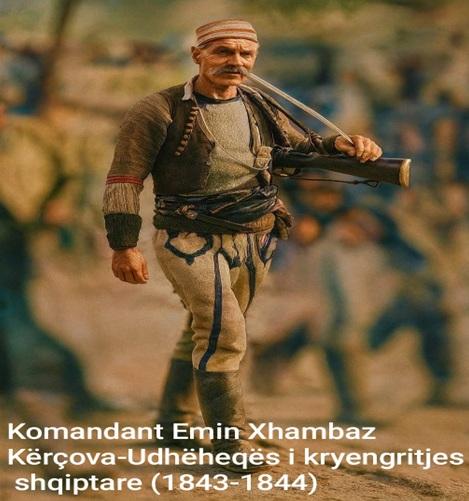
At the end of October 1843, many brave Kërçova residents, led by Emin Xhambaz Kërçova, undertook a combat action against the Turkish garrison that had been stationed at the foot of the Kërçova Castle, which ended successfully. All the Turks were killed, and two of them were spared, to show Sultan Mexhit that Kërçova did not accept the Tanzimat Reforms brought by him, and that it would fight with weapons in hand until they gave up their lives.
When Sultan Mexhiti realized that his garrison in Kërçova had fallen into the hands of Albanian rebels, he waited for the winter to pass, and in March he launched a military expedition with 5,000 soldiers, giving the order that Emin Xhambaz Kërçova be captured alive and brought before his feet, so that he himself could cut off his head, or his head, after being killed, be brought before his feet in Istanbul.
Emin Xhambaz Kërcova, when he hears that Sultan Mexhiti has launched a large army towards Kërcova led by Hajredin Pasha, gathers 500 brave Zajazli, and places Hajredin Pasha in the ridges of the village of Sop, southeast of Kërcova. And, a fierce battle begins, but the brave men of Kërcova, although in much smaller numbers, teach Hajredin Pasha a lesson, halving his army.
Unfortunately, the brave men of Kërcova run out of cartridges, and they quickly return to Kërcova to resupply themselves with cartridges and continue the war. But, the Turks, thinking that they defeated the Albanians with some captured Albanians, head towards the Monastery. They stop at the inns of Sopotnica, not far from the monastery and spend the night there.
Emin Xhambaz Kërçova arrives there with the brave Kërçova men, and attacks the halved Turkish army, and whoever could escape escaped, whoever could not ate the bullet. The Albanian prisoners captured by the Turks are rescued and returned safe and sound to Kërçova.
Not long after, my grandfather told me, Emin Xhambaz Kërçova received an invitation from Dervish Cara of Tetovo to join forces in the war for the liberation of Albanian lands, and they began by liberating Skopje and continued on to Veles, Prilep and beyond, but in Katllanovo they were met by the Turkish army led by Hajredin Pasha and Mefmet Pasha Llatas, a Muslim-converted Croat.
Foreign consulates also intervened to prevent the great war that would soon begin, writes historian Aleksandar Matkovski in his work, “The Uprising of Dervish Cara”, but the Turks treacherously captured the leaders of the uprising: Dervish Cara and Emin Xhambaz Kërçova. After capturing Dervish Cara, they sent him to Istanbul in prison where he died, while Emin Xhambaz Kërçova, knowing that his head, dead or alive, was wanted by Sultan Mexhiti, decided not to surrender alive, and fought with unprecedented bravery among the Turkish forces.
The crack of rifles, the grandfather told them, Selim Braja with the brave men of Kërçova hears them, and gives the shout: “With brave hands, they killed our commander!” The brave men of Kërçova with a daring attack attack the treacherous Turks and save their commander who, in an unequal war like Skanderbeg once did, had received several wounds which were later healed in Kosovo by an Albanian woman who was a specialist in healing wounds.
The Kërçova army, unable to return to Kërçova, continues the war to Cetinje in Montenegro. There, too, it waged a war against the Turks, saving a monastery from being burned by the Turks. This is evidenced by a resident of Cërvicë, who had worked in Cetinje, where a priest of a church had told him that, as Emin Xhambaz Kërçova had saved the monastery, and this is confirmed by a diary where gratitude is given to this brave Kërçova man by the residents of this place.
Autumn is approaching, my grandfather told me, and the situation begins to calm down, the brave men of Kërçova decide to return to Kërçova. When they approach Dibra, near Upper Reka, they learn from the locals that Hajredin Pasha is approaching Dibra with a large army to burn and devastate it, they join the army of Emin Xhambaz Kërçova to help Mustafa Sheh Zercan in the war against Hajredin Pasha. Among the brave men of Reka, my grandfather told me, was the seventeen-year-old son of Kosum Reka, the well-known kaçak Halil Reka of Rimnica. That every time he shot at the Turks, the brave man of Reka was knocked to the ground dead by a Turk.
The Turks had investigated him, and they had come out behind his back. This trick, the grandfather said, had been investigated by Emin Xhambaz Kërçova, and with some brave Kërçova men he had eliminated those Turkish soldiers. For this gesture, Kosum Reka had made him a friend of the house, and had later entrusted his son to Halil Reka as a mountain smuggler.
With the help of the brave men of Kërçova, Mustafa Sheh Zerqani destroys the Turkish army led by Hajredin Pasha, where the rhapsodist says: “Hajredin Pasha, where did you leave your army?” And he replies: “In the field of Dibra, all of them are crushed.” No, less than 12,000 remained in the trenches, and in the graves without a single bullet.” This proves to us that the brave men of Kërçova raised the name of brave Dibra high, and that the union of forces makes strength.
After this war, the brave Kërçova people were divided into smaller groups of Kachaks, who continued to fight against the Turkish tax collectors, coming to the aid of the inhabitants of the villages of Kërçova. Kërçova had many such Kachaks, but among them we can distinguish: Nezir Koxha, Selim Braja, Fazli Den Celiku and many others. Kachak life in the territory of Kërçova continued even during the time when Kërçova fell under the rule of the Serbo-Croatian-Slovenian Kingdom.
Source
https://www.zemrashqiptare.net/bajram-celiku-bali-kercova-gjate-perandorise-osmane-70914.html

