

By Dr. Sc. Qazim Namani, Archaeology/Cultural Heritage. Kosovo Institute for the Protection of Monuments, IKMM, Pristina
Abstract
This paper deals with some of the important historical events and the Albanian uprisings against the Tanzimat reforms. The Ottoman Empire, at the beginning of the 19th century, was pushed by European countries to make major reforms in the administration and the army. The Ottoman Empire in its program did not foresee rights for the Albanian community, as the largest community in our Peninsula. The Albanians in this period had been divided into castes and religions, and therefore had not managed to form a national platform to create their own independent state.
Some of the Albanian leaders of the time loyally served the Ottoman Empire, others had begun to lead states in the Middle East, and many of them were involved in the movements of neighboring peoples against the Ottoman Empire.
In 1826, the Albanians of the north, under the leadership of Mustafa Pasha Bushatliu, submitted requests to the Ottoman Empire for equal rights with neighboring peoples, the permission of the Albanian language in the administration, and the non-infringement of national dress. Since these rights were not fulfilled, the Albanians of the north rose in rebellion, but did not gain any elementary rights to preserve their national identity. The Ottoman Empire, during this period, prohibited the Albanians from wearing national dress, and denied the cultural independence of the tribes, thus not recognizing the Albanians as an ethnic and cultural ethnicity, but kept them divided according to religious communities.
In the absence of support from the powerful states of the time, during these reforms in the 19th century, Albanians lost much territory and population.
Keywords: Ottoman Empire, reforms, Albanians, uprisings, Mustafa Pasha Bushatliu, European states, Russia.
Introduction
In the late 18th and early 19th centuries, the Russian government in the Balkans distributed money and sent Russian priests to carry out propaganda against Austria and Turkey. [1]
With the agreement of Campo Fermio in 1797, and later with the agreement of Vienna in 1815, Austria assumed from the Vatican the protection of Catholics (and therefore Albanians), who were under Ottoman occupation. The Bishop of Shkodra, Albertini, confirmed this agreement with the Austrian Government in Vienna in 1837. [2]
During this period in Paris, the Polish Pan-Slavic Club was founded, in which they became quite active, and the North Germans (Habsburgs) inspired the Christian peoples of the Illyrian Peninsula with Pan-Slavic ideas in the war against the Ottoman Empire.
Some of the students studying in Austria and European countries, inspired by Pan-Slavic ideas and the French bourgeois revolution, began to publish books on the history of the peoples of Eastern Europe. Jovan Rajić, inspired by this movement in 1793, published in Vienna the book: A Short History of Serbia, Russia and Bosnia. [3] Later, several other books were published on the history of the Bulgarians, and ideas for Pan-Slavic programs of various peoples, which were supported by Tsarist Russia, began to appear.
These Pan-Slavic movements, and the revolution in France, influenced the beginning of armed uprisings for the expulsion of the Ottoman Empire from the occupied lands in Europe.
In Europe, after the French bourgeois revolution, seeing the weakening of the Ottoman Empire, an uprising broke out in 1804, under the leadership of Karadjordje Petrovic. [4]
Based on the book by Milorad Bosnjaku and Slobodan Jakovijevic, “Karagjordjevici Sakrivena Istorija”, they write that, based on the sources of the Serbian archive, the name of Karadjorgje Petrovic’s grandfather was Gjin Marash Kelmendi, of the Albanian tribe from Shkodra, also confirmed by Latin and other sources. [5]
Inspired by Russian propaganda, at this time Sava Tekelia and the metropolitan of Karlovci Stratimirović had expressed their aspirations to free themselves from the Ottoman Empire and establish a Slavic empire in the Balkans. [6]
Karadjorgje is of Kelmendish origin, thus a Catholic Albanian: Djordje Petrovic Karadjorgje, the leader of the First Serbian Uprising, was of Albanian Catholic origin from the Kelmendish tribe. [7] In 1739, about 300 Catholic families from the Kelmendish tribe fled Kosovo to seek refuge. Most of them moved to the villages of Nikinci and Hrtkovci, but some settled under Mount Rudnik in Šumadija, and among them was Karadjorgji’s grandfather. [8]
In 1811, Mahmut Bey from Kumanovo, Ahmeti from Vushtrri, Rexhep Pasha from Tetovo, and Hrushit Pasha from Rumelia were sent to suppress this uprising. They were joined by the Pasha of Skopje, Mustafa Pasha from Gjakova, Numan Pasha from Peja, Ibrahim Bey of Skopje, Kara Fejziu from Prizren, and Jusuf Bey from Debar. [9] As can be seen, here we have a war between the Albanian pashas, who protected the interests of the Ottoman Empire, and the Albanian Orthodox under the leadership of Karadjorgje Petrovic, who in this uprising had the support of Russia.
In 1806, the Russo-Turkish War began, which lasted 6 years. This war ended in 1812, with the agreement reached in the Treaty of Bucharest. According to Article 8 of this treaty, the Serbs were granted certain privileges. [10]
In 1808, a project was proposed to divide the territories of southeastern Europe between Russia, France, and Austria. [11]
Otto Dubislav, a military man from the Habsburg family, in 1829, wrote in his book some important information about how events developed in the early 19th century in the central Balkans.
Below we offer a facsimile from his book, where he writes that 3,000 Russian soldiers in 1811 fought alongside Karadjordjevic against the Ottoman army. We recall that even within the Ottoman army, the soldiers were mainly Albanian, so in these battles that took place on the ground, the victims were Albanians fighting among themselves, as was the case of George the Black and Demë Ahmeti (from our original folklore).
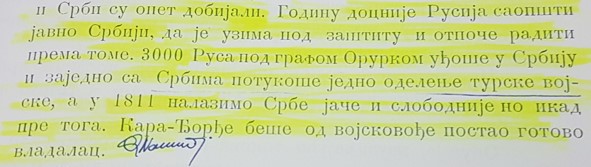
See: facsimile from the book by Otto Dubislav, where he writes that in 1811, Russia had sent 3,000 soldiers to fight alongside Karadjordje Petrovic’s rebels against the Ottoman army [12]
After the defeat of Napoleon Bonaparte in 1814, at the initiative of Russia, the Holy Alliance was founded at the Congress of Vienna in 1815, where its purpose was to suppress and control the movements of peoples for independence that had begun in Europe. At this time, favorable conditions were created for Turkey to suppress the Albanian Pashaligs.
In 1815, Miloš Obrenović appeared on the scene, who, encouraged by Russia, continued the uprising. [13] In 1815, Miloš Obrenović was appointed as the leader of the Orthodox rebels in place of Karađorđe Petrović.
In 1817, seeing the situation favorable for continuing the uprising in Belgrade, Karađorđe Petrović and his 16 associates decided to return from Austria. Upon reaching the entrance to Belgrade, they were stopped by Miloš Obrenović and his group. After searching them, they all beheaded them, and their heads were sent to the governor, who sent them as trophies to Istanbul to the Sultan. After this event, Miloš Obrenović began to kill all of Karađorđe Petrović’s supporters and took over the leadership of the Serbian uprising. [14]
In 1824, Miloš moved a large number of Albanians from Aleksinci. [15]
Russia took advantage of the situation and, in addition to the priests, now sent armed mercenaries to fight against the Ottoman army. Russia also supported with soldiers the uprising of Karadjorgje Petrovic, of Albanian origin who had started the armed uprising against the Ottoman army, which were also mainly Albanians of the Islamic faith. In these circumstances, the Albanians, since they had not created a national religious unity, were killing each other for the interests of the great powers.
Without a doubt, Russia stood strongly behind this project, because this initiative was fully in line with its interests in our peninsula.
The first ideas and projects for strengthening Russian interests in the Illyrian Peninsula were born in the Polish Club of Paris. Based on these ideas, a campaign was launched to change toponyms and expand the spread of Slavic languages in relation to the languages of other national groups.
In 1808, at the suggestion of the Germans, the name of the Illyrian Peninsula began to be called the Balkan Peninsula.
Members of the Polish Pan-Slavic Club operating in Paris, at the end of the 18th century, also drafted the platform for the creation of a Church Slavonic language, very simple and easy to learn, in order to quickly spread it through Orthodox clergy among the Orthodox and others who wanted to learn it in the Illyrian Peninsula. They called this language the “Serbian Language”, so that this language would later be identified as the language of the Christian kingdom under the rule of the Ottoman Empire.
At the beginning of the 19th century, through students who were educated in European countries, this language began to take shape as a new, consolidated language, just as the Italian and French languages spread during the 19th century.
To successfully carry out this project, the Russians had chosen Vuk Karadzic, whom they financed and used to maintain ties with Vienna.
One of the students of Vienna, Vuk Karadžić, who was known to be a relative of Karađorđe Petrović, published the Serbian Grammar in the city of Vienna in 1814. Vuk Karadžić was educated at the University of Vienna, and with the great support that Karađorđe Petrović had given him, he soon became a supporter and implementer of Russian policies in Eastern Europe.
Considering these written sources, we can affirm that the Serbian language is a new language, without tradition and created by Vuk Karadžić. From the written sources we understand that Petar Petrović Njegoš, Vuk Karadžić and Simo Sarajlia, at the beginning of the 19th century, created the Serbian national consciousness, assimilating the Albanian and Vlach Orthodox. Sarajlia on June 28, 1828, corresponded from Leipzig with Vuk Karadžić and Miloš Obrenović, where in his letters he used the word Serb. [16]
The word Serbia was incorporated into the consciousness of Vuk Karadžić and Njegoš, which was continued by Simo Sarajli. Serbia, both as a word and as a national political ideology, of the Polish Pan-Slavic Club, and of the Vienna Slavonic School, was spread by Sima Sarajli in Cetinje, when he arrived uninvited in 1827.
Below we also offer evidence from the book published in 1829, by Otto Dubislav, a member of the Habsburg family.
The Serbian language, in terms of its formal development, takes its place among the Slavic languages, just as the Italian language takes its place among the other Romance languages. It is, like the Italian language, and was created for poetry and song. In terms of its words and structure, it has more similarities with the Russian language than with the Polish language, and in reality, it already has the same letters and sounds. Serbian grammar is much easier than Russian grammar, and it can now be used to learn the Serbian language, which is now the easiest language to learn among the Slavic languages.
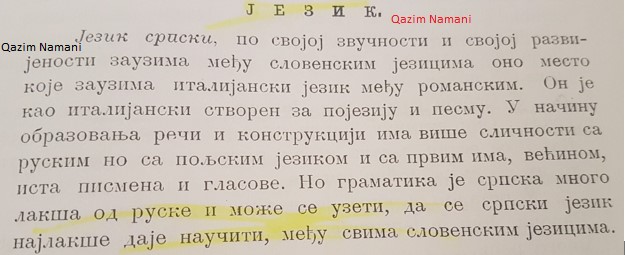
Facsimile from the book by Oto Dubislav, describing the formation of the Serbian language as a new language in the late 18th and early 19th centuries [17]
The political system in Europe after the end of the French Revolution would be based on the principles of the balance of power. That is, the system in Europe would function on the basis of alliances, to maintain the stability of the political system of the major European powers.
The system of alliances that would be established was that proposed by William Pitt the Younger, the English Prime Minister, according to his proposal, Great Britain, Prussia, Austria and Russia would guarantee the new territorial order in Europe by means of a permanent alliance, directed against French strengthening . [18] From the creation of this balance of power in Europe during the 18th-19th centuries, states began to emerge, which, for their national interests, attempted without choosing any means to achieve the definition of their role, at international levels . [19]
In Vienna, with the creation of the Holy Alliance in 1814, which would dominate the eastern courts of Prussia, Austria and Russia, the main goal was to stop any movement at its roots, therefore the Austrian Metternich, who interpreted the project of the Tsar known as the Holy Alliance as a necessity of religion, as an obligation of the signatory parties to maintain the status quo in Europe. So the Holy Alliance had brought together conservative monarchs in the war against any revolution in Europe, and forced them to act jointly to combat any movement [20] .
For the Austrian leader Metternich, the main problem was not how to restrain Russia, but how to reduce its ambitions, while the English Casterlagh was ready to intervene against Russia only when the general balance that had been established in Europe was threatened. To reduce the zeal of Alexander of Russia, Metternich had implemented a two-pronged strategy, promoting Austria as the vanguard of the fight against nationalism, often he acted with campaigns, used strategies to restrain the campaigns of the Russian Tsar, calling meetings and consultations to supposedly maintain balance in Europe and the Balkans. He did these schemes only to buy time and slow down Russian projects in the Balkans [21] .
Russia in the 19th century became a power with unquestionable potential and influence in the European political theater. At this time, no important decision could be made on the European continent and beyond without Russia. [22]
As can be seen, from these alliances and agreements of powerful European states, opportunities were created for the Ottoman Empire to undertake military campaigns to extinguish the Albanian pashas, while the European states on the other hand, supported the movements of the Christian population towards their independence from the Ottoman Empire and the creation of national states. The Albanians in these circumstances were left without a single ally in Europe.
The Germans began to be interested in the creation of an independent Greek state, based on the traces of civilization from Hellenic culture.
The Slavs were spreading propaganda that they should expand their borders from the Carpathian Mountains, towards Skopje, Kosovo, and all the way south to the city of Shkodra.
Russia was interested in the creation of Slavic states, and the expansion of the borders of a possible Bulgarian state, deep into Albanian territories. In many activities of these pan-Slavic clubs, myths and programs for Albanian lands began to be created.
The Polish political and cultural movement, founded in Paris in the 1830s, was led by the Czech pan-Slavist František A. Zach (1807–1892). Ilia Grašanin entrusted the project of Načertanja to the Czech pan-Slavist František A. Zach from Moravia, which at that time was part of the Austrian Empire. Zach represented the organization of Polish emigrants founded by Prince Adam Czartoryski. [23]
At this time, the myth of the Battle of Kosovo was born, and Russian projects for a common ideological and religious spirit, beginning with Dobrovsky, Kopitar, and Shafarik for a Slavic literature, were also made public. Among these ideologists of Pan-Slavism, there was much debate about the teaching of Polish or Russian in literature and schools. [24]
The projects of Homaykov and Danilevsky preceded later projects for the creation of Orthodox states such as the Greek Megalo Idea, the Serbian Nacertanja, and the Bulgarian Otocenstvo.
Russia had engaged political missionaries in the Albanian lands, who worked on the ground, for the Bulgarianization of the population. The Morava River began to be called the “Bulgarian Morava”, while the branch of this river that passed through today’s central Serbia above Krušec, began to be called the “Serbian Morava”. The Russian missionaries who operated on the “Koritnik Mountain”, between Prizren and the River, managed to Bulgarianize half of the villages in this region. This stream of Bulgarization also extended around the “Moravia River” and up to the surroundings of Rahavec.
The Albanians had entered the 19th century, divided and divided into great divisions. In terms of religion, the Albanians were divided into Christians, Muslims and Orthodox. Albanians with Muslim religious affiliation were more privileged in taxes from the government, while Christians were burdened with many taxes that made their lives difficult.
The Albanian population of Muslim religious affiliation did not enjoy the rights of ethnoculture and was in danger of being assimilated. Due to these circumstances, the powerful European states and Russia on the other hand, began to take the Christians of the Illyrian Peninsula under their protection, including the Christian Albanians, who were also assimilated into Slavic and Greek.
This created situation pushed some of the Orthodox Christian Albanians to rely on the programs of the powerful states of the time, because they did not have their support. This influenced the assimilation of the Albanian Christian population, since the Ottoman Empire, for its own purposes, did not recognize the national rights of the Albanians, as the largest ethnic and cultural community, but in order to rule them more easily, it had divided the ethnic and cultural communities into religious communities. After the Christian population in the Illyrian Peninsula was taken under protection by Russia and European states, the Albanians of the Islamic faith during the 19th century remained the most discriminated community within the borders of the Ottoman Empire.
The Albanian population had been impoverished and devastated by numerous wars and heavy taxes imposed by the feudal system of the time. The Ottoman administration had great support from corrupt local feudal lords, who aligned their interests closely with the Ottoman rulers.
The Ottoman Empire at the beginning of the 19th century was pushed by the great powers to begin internal reforms in all areas of life. The Western states demanded that the Ottoman Empire begin administrative reforms, reforms in the army, in order to become a more liberal organization in every respect. With the reforms for the centralization of power, the Ottomans aimed to take away local power from the peoples enslaved by the Ottoman Empire.
Among the first to oppose the reforms in the Ottoman Empire were Mustafa Pasha Bushatliu and the Bosnian captain Husejn Grazhdovici, who were mostly supported by Russian aid, which they sought through Miloš Obrenović.
In 1826, P. Osman, made reforms in the army with the disappearance of the military system of the Janissaries was left without regular military forces. These reforms in the army were opposed by the conservative Albanian, Bosnian and other pashas of our peninsula. Mustafa Pasha Bushatliu sought to strengthen ties with the feudal lords of Bosnia. For his position he gained support from Russia. Mustafa Pasha sought to strengthen ties with Miloš Obrenović in Serbia. [25]
During the 19th century, European states found it difficult to control or even sever the ties that Albanian leaders had established with eastern states, with Russia and its neighboring allied peoples.
The armed uprising against the Ottoman Empire was started by Mustafa Pasha of Shkodra and then by the Bosnian captain Husein Gradaščević. Both of these uprisings developed as major military-political movements, with the aim of forcibly forcing the Ottoman Empire to stop reforms and respect the old traditions and institutions of Sharia.
The reforms were met with resistance from the Janissaries and representatives of the Islamic clergy. The anti-reform currents were supported by Tsarist Russia, which helped the rebels maintain the status quo and the previous system in the Ottoman Empire. [26] The reforms also appeared as a shield against separatist and predatory Slavic-Orthodox tendencies. [27]
One of the main problems that the central Ottoman authorities had to face after 1826 was the issue of relations with the great feudal lords, who represented the holders of political and economic power in the interior of the empire. The problem intensified even more when the Ottoman Empire came into conflict with the pashas of Rumelia, wanting to abolish the old theocratic-military system and establish a more modern and liberal regime.
This conflict with these pashas destroyed the unity of the Ottoman Empire, weakening its power even more. P. Osmane, by denying the elementary rights to the Albanians in their lands, and on the other hand by luring Albanians to high positions in leadership outside the ethnic lands, created an impossibility for the Albanians to organize for a popular uprising to form the Albanian state in the ethnic lands, but unfortunately the Albanian uprising did not reach that level of organization.
The more divided, and in conflicts between the pashas that kept the Albanians, P. Osmane, using them as loyal soldiers in wars with its enemies, continued to rule in the Albanian lands, while in agreement with Russia, after losing battles in the fighting, to achieve peace, made painful compromises with the Albanian lands.
This situation would often lead Albanians into absurd situations, because defending their interests meant opposing the spirit of the reforms. [28] Within the framework of these reforms, Albanians found themselves in a poor organizational position. In terms of social structure, Albanians were diverse. [29]
When the Russo-Turkish War began in 1828, Russia, through Prince Milosh, requested that Mustafa Pasha not join the war, promising that in case of victory he would make him the master of all Albanian territories. Mustafa Pasha, not wanting to sever relations with Sultan Mahmud II, sent his troops to the Russo-Ottoman front with delay, arguing to the Sultan that his troops were not properly prepared to enter the war during the winter season, and that he would join in the spring. [30]
Mustafa Pasha’s late entry into the war allowed the Russian army to penetrate the territory of present-day Bulgaria. This situation forced the Ottoman Empire and Russia to conclude a peace agreement. At the peace conference, the Russians did not mention autonomy for the Albanians at all. Mustafa Pasha, in revolt with 20,000 soldiers, confronted the Russian army in the vicinity of Arnaut Kalesh on October 4, 1829. Mustafa Pasha suffered heavy losses and severed relations with Russia. [31]
Mustafa Pasha of Shkodra sought allies among other powerful feudal lords to prevent reforms in Istanbul, so the Albanian rebels of the north, under his leadership, in addition to their own interests, were also in favor of supporting opponents of reforms in Istanbul, taking advantage of the difficult political situation and the weakening of Sultan Mahmud II. [32] Mehmed Reshid Pasha continued to fight against Mustafa Pasha’s army in Albanian lands, first against the Albanian Orthodox in the south, and then against Mustafa Pasha Bushatli. [33]
The uprising (Mustafa Pasha against Reshid Mehmed Pasha) took place at a time when the Ottoman Empire had begun to change leadership, with the help and suggestion of powerful European states. Europeans saw this uprising as an internal rivalry between these two powerful viziers. This was one of the reasons that Westerners supported Mehmed Reshid Pasha, who supported the reforms, and was also supported by the sultan himself.
The Albanian uprising during the years 1826-1832, although it expanded and was the largest uprising against the Ottoman Empire in the region, died down without yielding any results in gaining the freedoms and civil rights of the Albanian population in the region.
This movement, in the eyes of European peoples, was not seen as a national movement, but more as a clan and religious movement that had rebelled against the reforms and new order in the Ottoman Empire.
After the announcement of the reforms in the army, even though the Ottoman Empire was engulfed in unrest, in Istanbul, and anarchy had been created throughout its territory, I think that Mustafa Pasha, with the military potential he had and his preparation, did not have to march towards Istanbul, to lose the morale of his army, to be defeated by the Russian army with heavy losses.
Mustafa Pasha should not have trusted Prince Miloš Obrenović and Russia so much, but he should have kept his soldiers from leaving Albanian lands, abandoned the siege of Sofia, and set out to take Istanbul, but given the uprising a national character, and done more to strengthen unity with the other Albanian pashas.
Found in these circumstances, the Albanian population was constantly in rebellion, but their rebellion did not take on a completely popular and national character.
The Albanian pashalars, uncoordinated and undisciplined, failed to organize a nationwide movement to free themselves from the Ottoman Empire.
The Ottoman Empire, during the reforms it undertook, transformed the obedient Albanian nobles and agallars in Albanian lands into simple administrative officials, while those who opposed it were liquidated and sent to the regions of Asia Minor.
The Albanians had not created foreign political diplomacy, and allies in European countries to start with armed uprisings, but alliances had been created with Albanian leaders in eastern countries, therefore the alliance with Mehmet Ali Pasha in Egypt and his son Ibrahim Pasha, an Albanian from Syria, had planned with Mustafa Pasha Bushatliu of Shkodra, to take control of Istanbul, this was a harmful plan, based on the degree of preparation, the level of national understanding, the ability to reason before internal and international factors, the evidence of military and political ability, as well as the ability of the leadership to control important geostrategic ports for which the great world powers were fighting.
So as can be seen in the circumstances of the beginning of the reforms in the Ottoman Empire, to fight against the regular Ottoman army, the Albanian feudal lords were not sufficiently prepared with food and military equipment, they had not created unity among themselves, and above all they lacked a strategy of action and the support of European states. The Albanian uprisings during this period relied and hoped on the aid that would come to them from Russia, but this cost them a lot, in every uprising that they carried out in the first and second half of the 19th century.
In these circumstances, the Albanian pashalars did not have the opportunity to develop any broad national project, to rise up in a nationwide movement, to form an independent Albanian state, as the other peoples of the peninsula did.
Although Mustafa Pasha of Shkodra had submitted requests to the sultan to respect the Albanian language, tradition, and national dress, these requests had not been made by the other pashas.
Some Albanian pashalars, to protect their interests, often served the sultan, for some privilege, post, or semi-autonomous government in their region where they ruled.
Albanian uprisings took place at different times and places, so by rising sometimes at one end of Albanian territories, and sometimes at the other, P. Osmane suppressed these uprisings with Albanians, pushing them to kill each other, and in this way managed to quell them without creating the possibility for the uprisings to take on a popular character.
During the Albanian uprisings, the different religious affiliations also played a major role, and the possibility of general unity between the Albanian Christian and Muslim populations was not created. As was seen a few years later, these uprisings under the influence of the Bektashis often took on an anti-Christian character until the beginning of the national renaissance.
The Ottoman Empire had used Albanians in the wars it waged from Asia Minor, to northern Africa and to Europe, against Austria and other European states, while on the other hand, against Albanian uprisings, it used its most prominent soldiers originating from the eastern countries and of Albanian, Greek and Slavic origin from the territories of Rumelia, Africa and Asia.
Albanian uprisings were often led by feudal lords, ajans, and religious leaders, so this leadership was unable to give the uprising a national ideology, to unite Albanians regardless of religion or region in ethnic lands, against the Ottoman Empire.
Mustafa Pasha Bushatliu, before starting the uprising, presented his demands, which the Ottoman Empire had to implement. Among other demands, he had requested equal rights with the Bosnian population in the Ottoman Empire, the right to use the Albanian language in the internal administration of the country, and the recognition of the cultural and ethnic independence of the Albanian tribes.
And as a very important request for us Albanians, Mustafa Pasha had requested the permission and recognition of Albanian national costumes. This implies that Albanians were the most oppressed community within the Ottoman Empire and did not enjoy even minimal rights to preserve their cultural identity.
The Albanian population, being oppressed and divided into tribes, regions and religions, largely supported the demands presented before the Sublime Porte in Istanbul. A small number of the Albanian population with Christian religious faith joined this uprising. Although the number of Albanian Christians was small, this can be considered an attempt at national organization, considering that even the soldiers of Mustafa Pasha Bushatliu wore the white plis on their heads as a national symbol.
Below we present Mustafa Pasha’s three demands, published by Serbian scholar TA Vukanovic.
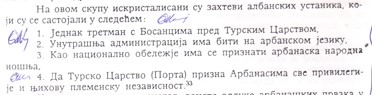
See: Facsimiles from the writing of, TA Vukanović, regarding the four demands that the Albanian insurgents made to the Sublime Porte [34]
These requests were:
- Equal treatment of the Bosnian population in the Ottoman Empire
- Internal administration in Albanian territories should be conducted in the Albanian language.
- Albanian folk costumes should be accepted as national symbols
- For P. Osmane to recognize the independence of the Albanian tribes
As can be seen, P. Osmane had also banned Albanians from wearing folk costumes, and in particular from wearing the Plis as a national symbol, which symbolized the national identity of Albanian tribes and was considered to be contrary to the reform program.
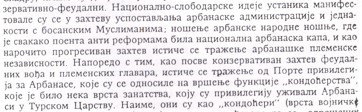
See: Facsimile of the writing of TA Vukanovic, where he writes that Albanian folk costumes, especially the Plisi, were considered anti-reform costumes, because they symbolized independent Albanian tribes. [35]
After 1826, one of the main problems that the central Ottoman authorities had to face was the issue of relations with the large feudal lords, who represented the holders of political and economic power in the interior of the empire. During this period, the Ottoman Empire was faced with permanent conflicts with the local pasha powers throughout Rumelia.
These conflicts greatly weakened the Ottoman Empire. This conflict in Muslim society was destroying the unity of the Ottoman Islamic state, and was one of the important factors in the further weakening of the Ottoman Empire. The war with the Sultan and the Holy Porte after the announcement of the reforms was initially started by Mustafa Pasha of Shkodra, who also incited uprisings in Bosnia by the Bosnian captain Husein Gradaščević.
Both of these uprisings developed into a major military-political movement, the aim of which was to force the Sultan and the Sublime Porte, by armed force, to suspend the reforms, but on the eve of the end of the uprising, the policy influenced by Russia and the Sublime Porte, brought these pashas into conflict with each other, and Hysen Grazhdovici entered Kosovo and burned several Albanian villages.
The Albanian uprising under the leadership of Mustafa Pasha, undoubtedly aimed to have a popular character, to free themselves from the Ottoman Empire, and although this uprising did not achieve its goal, it awakened the national idea of our renascentists. In the Albanian territories, the feudal system was strengthened, which was led by the Albanian feudal lords themselves.
This system had not made it possible for the development of the Albanian intellectual class, but often for personal interests they fought among themselves, sometimes serving the sultan, and sometimes fighting against him. On the other hand, the massive participation of the population in the uprising alongside the Albanian ayans and pashas was great, because they hoped for their freedom from taxes and forced mobilization in the imperial army. It must be admitted that the broad Albanian popular masses were very tired of the taxes that the Albanian ayans and pashas took from them. [36]
The ruling regions of the Ottoman Empire continued to pursue an assimilationist and denationalizing policy, since the Albanians were not recognized for their native language and culture. [37] The Ottoman government, in order to break the resistance of the tribes, formed territorial units (Bajraqet), in order to establish complete control over the Albanian tribes and to collect as many taxes as possible. [38] The Ottoman administration spread Islam among the Albanians, in order to realize its own plans. [39]
The Albanian Pashals, Bajraktars and Zabits, in order to realize their personal interests, were merciless towards the poor Albanian population. For their atrocities against the broad masses of the people, even today in the memory of the population those sufferings are preserved as stories, in families and regional areas, in sources written by foreigners and in songs originating from our popular folklore.
For the low behavior of the Albanian ajans, we are highlighting several different cases inherited from generation to generation in the memory of the Albanian population, but also in written sources.
In the later Albanian uprisings, the social order and the rivalry of the Albanian feudal lords, who often fought among themselves, had not allowed for the creation of an Albanian intellectual class in European countries, since a new social order had been created in Europe and the bourgeois revolution for the formation of nations was developing.
The leaders of the Albanian uprisings, supported by religious clerics, flag bearers, and tribal leaders, did not have the intellectual class to seek help and support from powerful European states, so their requests were often directed to Mehmed Ali Pasha in Egypt.
These insufficiently educated leaders did not understand the foreign influences in Albanian lands, so over the last three centuries, they created secret connections with the Greeks, Bulgarians, and Serbs, who during this period were guided by Russian influence and policies, and who were also supported by European states.
The Albanians did not benefit from any help from secret talks with the Greeks, Bulgarians, Serbs and Bosniaks at this time, but these connections became an obstacle to any possible cooperation with Austria and other European countries.
The Dervish Cara uprising continued to oppose the measures taken by the Ottoman Empire after the reforms of 1839, by raising taxes and forcibly conscripting Albanians. During this period, Albanians were organized into tribes, bajraqs, and clans, which had some cohesion among the people. [40]
Albanian feudal lords motivated by power and wealth, and the willingness of those who had served the High Porte faithfully for centuries to become bajraktars, zabits, and chaushes, had created leaders with unbridled lust and a penchant for raping their own people!
To learn from the historical mistakes of this period, it is of great importance to understand how the failures of the Albanian movements of the 19th century were handled, to learn so that such mistakes are not repeated in the Albanian popular leaderships.
Albanian feudal lords forcibly displaced the peasant masses from their villages to their fiefs. In the north-east of Albanian lands, the Gjinolli, who were known as large fiefs, brought poor Albanian peasants to their fiefs. [41]
a) From the written sources we are highlighting the behavior of Maliq Pasha Gjinolli, and his behavior with the Catholic Albanian population in the prison of Pristina, and their internment in the cliffs of Anatolia. It is also worth mentioning the behavior of the ruler of Vrajë, Hysen Pasha, with the population of that area. In addition to other cruel behaviors, we are mentioning the case described for the character of this ruler.
Whenever Hysen Pasha passed with his father near a well-worked garden or property, owned by another landowner, he would say, “This property belongs to me.” If the owner objected, he would take all measures, up to and including killing him, just to become the sole owner of that land. The Albanian population often rebelled against Hysen Pasha, even though he was of Albanian origin, because this pasha was greedy for property and money.
Hysen Pasha, who oppressed the population, forced them to work on his land, often forcibly appropriated the properties of peasants and other beys, merging them with his fiefs. With the plunder he made from the people, he had created a great wealth, but he had also allowed the level of immorality to develop, which had affected all classes of the population, in the city of Vrajë. [42]
b) Let us recall the original song about Halit Gashi from Vushtrri, when Beqir Aga, in order to give Halit Gashi some of his land to work, asks for his sister Hajri! Here is a refrain from our original folklore:
If you gave me your sister Hajri,
Come on, solve it in twelve houses,
I’m not asking for friendship,
Come on, he has both black eyes,
I’m staying with him for three nights! [43]
c) From field research into the memory of a family from the village of Popovë, Podujevo municipality, we noted that at that time a Jakupi from this village was assigned to collect the village taxes to send them to Vushtrri. Jakupi was obliged to collect a certain number of liras. Before the deadline for delivering the liras to Vushtrri came, Jakupi needed two more liras to complete the number of liras that the aga of Vushtrri had given him.
For the two liras that he was missing, Jakupi asked his brother for them. Jakupi’s brother had not given him those two liras and he had gone to Vushtrri with two liras less. Since Jakupi had not fulfilled the number of liras assigned, the aga of Vushtrri decided to hang Jakupi. It was decided that a citizen of Roma origin from Vushtrri would hang Jakupi. Before they took away the chest, they asked Jakup about his last wish. Jakup had replied that his last wish was to call the adhan.
After the call of the adhan, Jakup was hanged on a rope. Romi, who had taken away the chest from Jakup when he had gone home, had asked his mother. Who was the one who called the adhan in Vushtrri today? Romi had replied to his mother, “My mother, you know that man, I took away the chest today.” The mother of the Roma had cursed her son, saying, “My son, may both of your eyes go blind, what you have done today.” According to the account of the citizen from Popova, a descendant of Jakup, the Roma was later blinded.
This citizen concludes this account by saying, “Imagine for the two liras that his brother did not give to Jakup, Jakup was hanged in the city of Vushtrri.” [44] About 200 years after this incident, Dalipi, a descendant of Jakupi, concludes the story by saying: Imagine Jakupi was hanged because his brother could not find two liras to complete the number of liras they had asked for! This was also a strategy to divide the Albanians.
d) Another similar case that I noted, three decades ago by my late grandfather, concerns the behavior of the Zabit in the village of Marec, municipality of Prishtina. P. Osmane during the 19th century in Albanian settlements appointed loyal citizen Zabits, who had the role of a local police, to maintain order in that village or settlement. An Zabit in the village of Marec was sick and had remained bedridden.
A villager from the neighboring village of Krilevë decided to go and see the sick Zabit. He had ordered his wife to cook some pancakes, his wife had prepared the pancakes in a pan, and had covered them with a clean handkerchief. Walking on the road on a mountain between two villages, he meets a neighbor from the village of Krilevë. He had told the neighbor to know that he had heard that the Zabit of the village of Marec was sick and was going to see him with some pancakes that his wife had cooked.
His neighbor was tired in the mountains and felt a little hungry, he says, “I’ll take a pancake because I’m feeling hungry,” he offers himself and they eat a pancake. They greet each other, and he continues on his way to the officer. He greets the officer, and in the meantime he tells him the story of how he met his neighbor on the road, and he had eaten a pancake because he was hungry.
When the officer realized that the other villager from Krileva had eaten a pancake, he angrily said. Did he eat “them a”? That’s what I did to him, he never forgave him. As long as I recover, I’ll never let him go without giving him a bullet. After a few weeks, the officer had recovered, took his gun, and went out and seriously wounded the villager from Krileva, just because he had eaten a pancake!
This story, however small, may seem unimportant, but when compared to the political and social situation of the Albanian population, as evidenced by historical sources of that time, it provides an insight into the miserable condition of the Albanian population during Ottoman rule in the 19th century.
References
[1] Sylejman Kylqe, Albania in Ottoman History, Tirana 2004, pp. 88-
The Peace of Campo Formio was concluded on 17 October 1797 between France, represented by Napoleon Bonaparte, and the Holy Roman Emperor Francis II, in his capacity as sovereign of the hereditary Habsburg lands (due to the Pragmatic Sanction, in particular as King of Hungary and Bohemia and Archduke of Austria). The peace ended the War of the First Coalition, which had been started by France on 20 April 1792.
[2] Zef Mark Harapi, Days of Sadness in Peja and the Surrounding Areas 1912/1913, p.54
The Congress of Vienna opened on September 18, 1814, and closed on June 8, 1815, and was called the Restoration Era. The Congress aimed to refresh the borders of countries in Europe and to settle conflicts over lands within and outside Europe. After the end of the French Empire led by Napoleon Bonaparte in 1799-1804, the borders of European monarchies had changed radically.
European kings wanted to divide the European continent according to their interests. In order not to cause further conflicts that economically weakened European kingdoms, representatives of European states gathered in Vienna in 1814, a congress that had as its issue the proper division of European states. The great victorious powers participated in the Congress of Vienna, which played the main role as: England, Prussia, Austria and Russia.
At the Congress of Vienna, one representative from each European state gathered to discuss the territorial division of Europe. The main roles in this congress were played by England, Austria, Prussia and Russia. The representatives debated the spoils of war that Napoleon Bonaparte I had lost, which were territory, wealth, etc.
The objective of the Congress was to secure a long-term peace plan for Europe by resolving the critical issues arising from the French Revolutionary Wars and the Napoleonic Wars through negotiations. The aim was not simply to restore the old borders, but to change the size of the major powers so that they could balance each other and remain at peace, while at the same time being shepherds for the smaller powers.
[3] Oto Dubislav, Travels in Serbia 1929, translated into Serbian by Dragise, T. Mijuskovica, Belgrade 1899, p.
202
[4] Sylejman Kylqe, Albania in Ottoman History, Tirana 2004, p. 97
[5] Milorad Boshnjak & Slobodan Jakovljevic: Karaghorgjevici Sakrivena Istorija, Lio Gorni Milovanovac, 2006, p. 9
[6] Gazmend Rizaj, Upper Albania, Prishtina 2011, p. 96
[7] Rajko Veselinović (Istorija srpskog naroda, Četvrta knjiga, tom I, Srbi u XVIII veku, Belgrade 1986, page 160
[8] SANU academician Mita Kostić in “Politika” from 21 May 1923
[9] Sylejman Kylqe, Albania in Ottoman History, Tirana, 2004, p. 89
[10] Sylejman Kylqe, Albania in Ottoman History, Tirana, 2004, p.89
[11] Gazmend Rizaj, Upper Albania, Prishtina 2011, p. 97
[12] Oto Dubislav, Travels in Serbia 1929, translated into Serbian by Dragise, T. Mijuskovica, Belgrade 1899, p. 9
[13] Sylejman Kylqe, Albania in Ottoman History, Tirana, 2004, p.90
[14] Sylejman Kylqe, Albania in Ottoman History, Tirana, 2004, p. 90
[15] Sadullah Brestovci, Albanian-Serbian-Montenegrin Relations, 1830-1878, Prishtina 1983, p.45
[16] Vukova Prepiska, knjiga I, Belgrade, 1907, pg. 17
[17] Oto Dubislav, Travels in Serbia 1929, translated into Serbian by Dragise, T. Mijuskovica, Belgrade 1899, p. 39
[18] Henry Kissinger, Diplomacy, (Tirana: 1999), 76
[19] Ibid., p.76
[20] Henry Kissinger, op. of cit. 86
[21] Ibid.,87
[22] Enver Bytyqçi, Russian Geopolitics in Eastern and Southeast Europe, Institute for Southeast European Studies, Tirana & Prishtina, 2022, Pg, 25
[23] https://ëëë.zemrashqiptare.net/neës/54046/qazim-namani-kryengritjet-shqiptare-1826-1832-nen-udheheqjen-e-mustafa-pashe-bushatliut.html
[24] Oto Dubislav, Travels in Serbia 1929, translated into Serbian by Dragise, T. Mijuskovica, Belgrade 1899, p. 206
[25] TA Vukanovic, Arbanaski Ustanci 1826-1832, Vranjski Gllasnik, Narodnog Muzeja, vol. V, 1969, p. 29
[26] Emin Pllana, Kosovo and reforms in Turkey, 1978, p.48
[27] Jusuf Buxhovi, From Ottoman Albania to European Albania. Prishtina, 2010, p. 81
[28] Jusuf Buxhovi, Macedonia from Antiquity to Our Time, “Jalifat Publishing” – Houston, USA, “Faik Konica”, Prishtina, 2019, p.92
[29] Georges Castellan “History of the Balkans XIV-XX” Prishtina 1997 p. 289
[30] C. Robert, Die slaven der Turkei II, Dresden, Leipzig, 1847, p. 140
[31] Ibid.
[32] TA Vukanovic, Arbanaski Ustanci 1826-1832, Vranjski Gllasnik, Narodnog Muzeja, vol. V, 1969, p. 29
[33] Ibid., p.31
[34] TA Vukanovic, Arbanaski Ustanci 1826-1832, Vranjski Gllasnik, Narodnog Muzeja, vol. V, 1969, p. 35
[35] Ibid., p. 35
[36] https://ëëë.zemrashqiptare.net/neës/54046/qazim-namani-kryengritjet-shqiptare-1826-1832-nen-udheheqjen-e-mustafa-pashe-bushatliut.html
[37] Emin Pllana, Kosovo and reforms in Turkey, 1978, p.41
[38] Ibid., p.40
[39] Ibid., p. 41
[40] Aleksandër Matkovski, Dervish Cara’s Uprising, Skopje, 1985, p. 27
[41] Ligor K. Mile, Academy of Sciences of the Albanian Socialist Republic, Institute of History, Tirana 1984, p. 179
[42] https://ëëë.zemrashqiptare.net/neës/54030/qazim-namani-familja-gjinolli-dhe-sundimi-i-tyre-ne-qytetin-e-vrajes.html
[43] https://ëëë.koha.net/?id=4&l=73231
[44] Muhamet Murati, Ma i istorijoni, and Dalip Hoxha, from the village of Popovë, family story passed down from generation to generation in their families.
THE SOCIO-POLITICAL POSITION OF THE ALBANIANS AND THEIR ORGANIZATION AGAINST THE OTTOMAN EMPIRE DURING THE TANZIMAT REFORMS 1826 – 1856 (2)
By Dr. Sc. Qazim Namani, Archaeology/Cultural Heritage

