
Dr. Sc. Qazim Namani. Kosovo Institute for the Protection of Monuments, KIPM. Zejnel Salihu Str., No. 9. 10000, Prishtina, Kosovo. e-mail: qazim.namani@rks-gov.net
Abstract
The renovation of the Artana Castle was carried out with CE funds. The conservation and restoration works were carried out from 2015 to 2017. The implementation of the project for the restoration of the castle was carried out under the supervision of UNESCO, while the financing was provided by the European Commission. The design of the conservation and restoration project was carried out by the “Omega Engineering” company based in Dubrovnik, while the works were carried out by the “Koto” company based in Belgrade. These companies were contracted and supervised by UNESCO. When the execution of works started, supervision was carried out by representatives of these companies, representatives of UNESCO, the European Union and local institutions. The Archaeological Institute of Kosovo was appointed to monitor the works and provide professional supervision by local institutions. Restoration works in the castle continued at a very rapid pace. In this case, instead of restoring the ruins of the existing walls, actions contrary to the methods of conservation and restoration were taken. The walls were raised to a height of nearly 10 m, introducing new elements into the walls and disregarding masonry techniques. During the works, standardized materials for conservation and restoration of the monuments of this category were not used.
Wrong masonry techniques and the use of inadequate conservation materials are the main causes of the collapse of the façade of the walls and and deep vertical cracks that appeared in the walls two years later.
Responsibility for the work done on this monument lies with UNESCO, the European Union, the Croatian company that designed the project, the Serbian company that implemented the project, and the local institutions authorized to supervise the works.
Key words: Artana, monument, UNESCO, European Union, Kosovo Institute of Archaeology, authenticity, conservation, restoration, Castle.
Conservation and Restoration Works at the Artana Castle during2015-2017
The conservation and restoration works carried out at the Artana Castle from 2015 to 2017 were funded by the Council of Europe and supervised by UNESCO. The design of the conservation and restoration project was done by the Croatian “Omega Engineering” company, while the works were carried out by the “Koto” company from Belgrade. Funds in the amount of EUR 1.1 million were allocated by the Council of Europe for the restoration of this castle.
In 2015, the Serbian archaeologist Marko Popović was appointed on behalf of UNESCO to oversee the archaeological excavations and conservation of the walls at the Citadel of Artana Castle.
The first results of the excavations were published in the Belgrade newspaper “Blic”, by the Serbian archaeologist Marko Popović, who later published all the results in a book.

Fig. 1. Pic. 1, Serbian archaeologist Marko Popovic, presenting a drawing of the six towers of the Artana Castle.
Marko Popović writes that three large residential buildings with a church, and two cisterns with filter wells in the centre were discovered during the excavations in the citadel. He added that an extraordinary structure was also discovered, a hot tub that was used at the time as a medieval sauna (bath). It (the bath) was built between one of the buildings and the church which had a small square room, and an underfloor heating system. According to our chronology, he adds, this is an object, built at the turn of the 14-15 centuries, and is the latest in the Citadel complex. It has now been fully proven that the citadel of the castle was built in the first half of the 14th century, writes Marko Popovic.

Fig. 2. Pictures 1 and 2. View of the church built in the 15th century, just prior to the Ottoman conquest. Pictures 3 and 4. On the left side of the church building, you can see the mural paintings in the old church and the arch of the dome adjacent to the surrounding wall of the castle.
After the publication of these results, we, as scientific workers at the Institute of Meteorology and Geophysics, who during those years were carrying out the ground reconnaissance project in the north-eastern strip of Kosovo, visited the Artana Castle. During the observation of the works, we noticed that there was no mention of any bath (sauna or bathhouse) with hot water, but rather of the baptistery of the old church, which after the conquest of the castle, the Ottomans had turned into a heating room.
It seems that the Ottomans later used the baptistery for heating water and the steam from the hot water was used to heat the building using clay pipes. This is also evident in the photos taken in the small space, which the Serbian archaeologist calls a small room which also had hot water baths. Thus, church frescoes are observed in this space, which clearly indicates that this small niche was part of the old church and that it is not a 14th century bath, but a baptistery as an integral part of another, older church.
In this article, archaeologist Popović writes: As observed during the first phase of excavations inside the citadel, the foundations of a church were discovered, which he says was started by King Milutin in the 14th century, and later completed by Stefan Dečani. He claimed that the construction of the tower walls is continuing in accordance with the UNESCO plan, which has allocated EUR 1 million for this phase of works.
From the Kosovo side, the Kosovo Institute of Archaeology was appointed for overseeing the restoration and conservation works during the implementation of this project.
During the execution of works at this phase, there were no official reactions nor any reaction from the Albanian academic and scientific institutions against the statements of the Serbian archaeologist.
In this case, it is my opinion that the Minister of Culture in the Government of Kosovo should have reacted and stopped the works during his mandate. The Albanian Minister should have invited officials from foreign embassies, the media, to clarify the statement of the Serbian archaeologist in the media. The Serbian archaeologist should have asked the Albanian Minister of Culture for clarification on which stone he found the inscription that says that this church was allegedly started by King Milutin during the 14th century, and completed by Stefan Dečani!
The Latin sources of the 14th century show that the city of Artana was called by the following names in different languages: in Latin Novus Mons, in Italian Novo Monte or Monte Nova, in German Nyeberghe etc.
During the 14th century, Artana had become the most famous trading centre in our peninsula. During the Middle Ages, this city was ruled by Arbër princes and famous local miners and merchants worked here, as well as from Ragusa, Venice and other developed cities of the region and Europe.
Latin sources provide other data about the lower city called Castello, or Gocca de Novomonte, which was built of massive walls 224 m long and 80 m wide, while the Catholic church located in this complex was under the diocese of Kotor until 1340.
The idea that Artana (Novo Monte) was a Serbian cultural centre is contrary to the historical reality of the time, and the traces of civilization discovered so far in Artana and its surroundings. This contradicts the logic of understanding the historical circumstances of that time, because the city of Artana was established as a city that had flourished long before the 14-15 centuries. Artana was therefore an important economic centre, continuously subordinated since late antiquity, in the service of Constantinople, and after the Ottoman conquest it was placed in the service of this empire.
This and many other pieces of information demonstrate that medieval princes from Rasia never even had the opportunity to visit the city of Artana during the 14th century, let alone build any buildings or churches there.
As there was no reaction from the Albanian side, the event was overlooked, even after the news of the discovery of the church was published in the Belgrade newspaper “Blic”. There was no reaction later when a special book about the implementation of this project was published. The Serbian archaeologist took advantage of the silence of the Albanians, so he was free to appropriate and falsify the material culture of the site. In addition, our experts claimed in the media that excellent work was being done, and even said that a hammam was discovered in the citadel of the Artana castle.
Albanian experts watched in silent as many professional deviations unfolded, even when discovered artefacts and ceramics were often mixed with mortar and inserted into walls, or even when Serbian workers took them with them and sent them to Belgrade.
From the observations and analysis of the objects described by the Serbian archaeologist, all the arguments described are incorrect, and it is obvious that we are dealing with a tendency to falsify the history of the construction of the castle in Artana.
Throughout the work, serious violations were committed due to the failure to implement conservation regulations and principles. Serious violations were also committed when the history of the monument was targeted and deliberately falsified. In addition to the description of the history of the castle, which was made with a one-sided tendency by describing it as a medieval Serbian fortification and city, on the raised walls of the castle we also observed carvings of dates on the stones, which coincide with the beginning of archaeological research in 1954. I think this is a practice that should be criticized because on the southern side where the year 1954 is engraved, the wall is completely new, built during 2015-2017.
In my opinion, all these violations should be identified, and international organizations dealing with cultural monuments should be asked to condemn these illegal interventions in these cultural monuments.
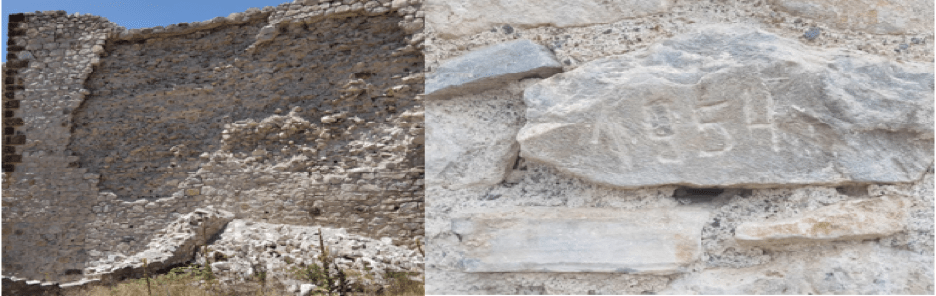
Fig 3. Photo 1. The collapse of the walls and Photo 2. The 1954 stone carving on the outer walls of the castle erected during 2015-2017
In the Belgrade newspaper “Blic”, archaeologist Popovic writes: As the first phase of excavations inside the citadel showed, the foundations of a church have been discovered, which he says was started by King Milutin in the 14th century, and was later completed by Stefan Dečani.
The structures of the walls imply that this is an older paleo Christian church, or dating from the early Middle Ages that may have been used even later until the Cathedral was built outside the walls of the citadel. Above these mural paintings in the old church, the arches of the dome of the old church adjacent to the surrounding wall of the Castle can also be seen. From the remains of the foundation ruins we also understand that the new single-nave church, which was built in the 15th century, does not rest on the outer walls of the castle, but has a distance of about 1 m. These facts prove that inside the citadel we have two church buildings.
It seems that later the Ottomans used the baptistery in the old church to heat water and the steam from the hot water to heat the building through clay pipes. This can also be seen in the photos taken in the space that the Serbian archaeologist calls a small room, which, according to him, there was also a hot water bath. Thus, the church frescoes are observed in this space, which clearly argues that this small corner was part of the other church, and that it is not a 14th century bathhouse, but a baptismal font of the earlier church. This leads us to think that until the new Cathedral was built, outside the surrounding walls of the six towers, in the medieval city of Artana, the baptism of children was done in the old church inside the citadel of the Artana Castle. From a logical and scientific point of view, there could not have been a medieval bathhouse, or even a fire to heat the objects inside the citadel in a space where there are mural frescoes of a church building. This indicates that the baptistery of the earliest church was transformed into a heating plant after the Ottoman conquest.
The discovery of mural paintings in the old church led us to think that the six towers built in the city of Artana were built much earlier than the 14th century, so I think we are dealing with a late antiquity fortification.
Based on these facts, we can assume that the importance of the Artana castle increased in late antiquity, after the beginning of the invasions of barbarian tribes in the territories of Dardania.
Based on the geographical position and traces of mining activities in all the valleys of the villages around Artana, and the large number of terraces and other fortifications in many villages around, we can say that, for security reasons, this settlement began to develop significantly in the early Middle Ages.
This civilization that developed significantly in the Middle Ages is undoubtedly a continuation of the Dardanian civilization, which flourished in the Kingdom of Dardania, to develop during Roman rule in Ulpiana, Vendenis, Kusumli, Prokuple, Vrajë, Leskoc, Preshevo, Kumanovo, Skopje, etc.
Based on the historical sources of the time, we can conclude that after the destruction of Justiniana Prima, between Medvedja and Leskoc, the destruction of Vendenis in the plain of the Llapi river, and the destruction of Ulpiana (Justiniana Seconda), by barbarian tribes in late antiquity, this Dardanian civilization and culture continued to flourish in this region rich in gold, silver and other minerals, in the fortified city of Artana, throughout the Middle Ages, until it fell under the occupation of the Ottoman Empire.
These additional facts affirm that the description of the history of the Artana castle has been falsified and the archaeological discoveries provide arguments that prove that the construction of the church within the walls of the central castle, where the mural paintings were discovered, dates back several centuries before the 14th century. I think that here we are dealing with two church buildings, the paleo Christian church and the other built in the 15th century, before the Ottoman conquest.
It is important to note that since 2015, steering committees have been appointed in the cultural heritage protection institutions, which run the heritage institutions, and these committees even exceeded the competences of the directors of the institutions. These committees approved projects, set priorities, drafted regulations, and even had the competence to appoint and dismiss institutional directors. The councils consisted mainly by university professors who taught heritage, architecture or even history, as experts in the field and some party militants. The leaders of these councils remained silent and did not make any remarks for all these deviations and failures to respect the doctrines and principles for the conservation and restoration of monuments.
The restoration work at the Artana castle continued at a very fast pace. In this case, instead of restoring the ruins of the existing walls, they acted contrary to conservation and restoration methods, raising the walls to a height of nearly 10 m, introducing new elements into the walls, and disregarding masonry techniques, and without using standardized conservation and restoration materials for monuments of this category.
From a scientific perspective, it is clear that the erroneous doctrine of Viole Le Dyk was applied in this case, which is known as the first doctrine of monument conservation in the 19th century. Viole Le Dyk (1814-1879), with his views, claimed that: “Restoring a building means bringing it back to a state that may never have been”. According to this concept, Viole Le Dyk’s theory violated the essence of the monument’s values (authenticity). His views at that time were met with criticisms by the French master Anatol Franc on the occasion of the restoration of the “Prrfond” castle, claiming that many new stones were added to the castle.
In the specific case of the conservation of the Artana Castle, we are dealing with the construction of walls and the introduction of new elements into the walls, giving the castle an appearance for which we have no sources and preliminary data on how it looked before. In this case, by raising the dividing wall in the middle of the church space, separating the baptistery from the entirety of the church, the Serbian archaeologist made professional omissions, making the monument lose its authenticity and falsifying the history of the object.
The English Johan Ruskin (1849) and William Morris (1834-1866) were also among the opponents of Viole le Dyk. Ruskin criticized the theory of Violet le Dyk for losing the authenticity of the historical monument. Morris was in the same vein as Ruskin, was a member of the movement in Britain, and founder of the Society for the Protection of Ancient Buildings.
In this period, new theories of the Italian school of restoration emerged with Camillo Boito (architect), who established the foundations of the modern school of scientific restoration.
Camillo Boito first assessed the historical significance of the architectural work, meaning he was in favour of preserving all phases of construction in the monument.
Boito sees in restoration interventions the risk of damaging the authentic values of the monument, therefore he suggests conservation before restoration. He emphasized that if the restoration of a monument is necessary, he suggested that new interventions be distinct so as not to falsify the values of the monument.
Alios Riegl (1857-1905), professor at the University of Vienna, was the first to develop the theoretical concept of conservation, as one of the foundations of his theory was the preservation of the authenticity of the cultural monument and its integrity.
In our case, with regards to the conservation work at the Artana Castle, if we take into account the modern school of scientific restoration, we notice that the authentic value of the monument was not preserved, the historical significance of the architectural work was not properly assessed, and the originality of the cultural monument was not preserved.
Luca Beltrami (1854-1933) attorney, opposes stylistic or analogous restoration, without denying the essence of the unity of the monument through reconstruction. Considering each work as a single creation, Luca Beltrami uses documents or copies of the original and other historical and archival data about the monument as a basis when the issue of partial or complete reconstruction of the monument is raised.
Even the positions of the Serbian archaeologist contradict the scientific principles of conservation and restoration, and the concepts of Luca Betrami, because there was no prior recording, project or photograph of how the Artana castle looked centuries ago, since the Artana castle was transformed into an archaeological ruin many years before the camera was invented. We have not inherited any description, painting or detailed sketch of the true appearance of the castle during the 14th and 15th centuries.
The restoration of the citadel walls in the Artana castle is also in contradiction with the decisions of the Athens Charter (1931), which is known as the first international congress on the issue of monuments and restoration interventions. The conference on the preservation and maintenance of monuments produced a recommendation document divided into 10 parts. The document shows the tendencies of moving away from reconstructions, preferring the continuous maintenance of monuments.
The restoration of cultural monuments was discussed by international experts at other conferences held years later. In 1964, an international congress was held in Venice where the attention of experts was focused on preserving the authenticity of monuments, analysing in detail the problems encountered during their conservation and restoration. According to the Venice Charter, and later the Burra Charter, restoration of monuments is allowed only in special cases, when the monument is of the first category and is closely related to the development of the life of the local population where the monument is located, but also when the monument has been destroyed by accidental disasters, during wars, earthquakes and deliberate arson.
In such cases, reconstruction is carried out, but always based on prior architectural recording. The Burra Charter also allows for partial restoration of the monument, if its revival is required to adapt to the needs of the community. If a decision is made to partially restore the monument, it should always be taken into consideration that the new interventions should be completely distinguishable from the original remains of the monument.
If we refer to the International Charter for the Conservation and Restoration of Monuments and Sites, at the Second International Congress of Architects and Technicians of Historic Monuments held in Venice from 25-31 May 1964, where the regulations and text were adopted, Article 3 of this regulation stipulates as follows: “The conservation and restoration of monuments aims to preserve both the work of art and the historical evidence. Article 9. Restoration aims to preserve and highlight the aesthetic and historical values of the monument, and is based on respecting the old substance and the authentic document.” It is clear that these norms have not been respected in this case either.
In 1994, an international conference was held in Nara, Japan, where the preservation of authentic values of monuments was addressed by many international experts. At this meeting, it was suggested that the original phases of the monument be preserved, in order to preserve its authenticity and originality.
During the wars of the 1990s, many temples in Afghanistan and cultural monuments in the republics of the former Yugoslavia were destroyed. During the wars in the former Yugoslavia, the Serbian army bombed the protected cultural monument centre in the city of Dubrovnik. Also during these wars, the Mostar Bridge, which was a monument under state protection and was vital for the lives of the inhabitants of the city, was bombed. In these cases, urgent interventions were made for their restoration, based on the architectural recording and prior documentation of these monuments.
The Artana Castle was inherited as a ruin several centuries ago. We have no architectural records of this castle, nor any photographs, and we do not know what it looked like two or more centuries ago.
The drafting of the project did not provide for the revival of the castle and its function after restoration. Thus, as photographs show, the walls were erected in violation of all international norms, therefore in this specific case, international and local institutions should be held accountable for the damage caused to this monument.
In this case, I think that the ruins of the walls should have been conserved and preserved as a monument declared an Archaeological Park with special archaeological and historical values.
Construction techniques:
As mentioned above, the drafting of the project for the construction of the walls is a wrong step and contrary to international conventions. The masonry technique, and the use of inadequate material, are the main causes that began the collapse of the facade of the walls, and deep vertical cracks were formed at the corners of the towers. Regarding the masonry technique of the object, it is obvious that a technique was used that has not been used since the initial stages of the history of stone masonry. Notably, this is a case that should be highlighted, which in the future will serve conservation school experts to educate younger generations on how conservation should not be done in a cultural monument. It is obvious that there is an external facade with unpolished stone and without any reinforcement, which for two or three years, due to atmospheric conditions, has caused the walls to swell and the facades to crack in the walls that have fallen down. In terms of statics, a stable foundation was not created, so the action of the force from the erection, and the great weight of the walls has created vertical cracks, and now these cracks are very difficult to conserve, or to extend the life of these walls until the moment of demolition. It is difficult to find any method of conservation for the cracks created in the walls and to extend the life of the castle walls.
At the Athens conference, scholars from many countries spoke out against the reconstruction of monuments. The scholars claimed that monuments should be maintained continuously to ensure their preservation. At this conference, the cooperation of archaeologists with architectural restorers was requested, and the basic principles for the restoration of architectural monuments were defined. The Athens conference examined the use of new materials and techniques, such as reinforced concrete, provided that their use does not damage the external appearance of the monument. Contemporary techniques can be used in restoration interventions. The restorer cannot perform his delicate task without being a good connoisseur of the architecture of the era to which the monument to be restored belongs, that is, without being an architectural historian. Therefore, although the project for the restoration of the walls in the Artana castle did not foresee the risks from the construction of the walls by the project drafters and implementers, the project did not take these instructions into account to reinforce the foundation with modern materials before building the walls.
In my opinion, the Artana castle should have been treated as an archaeological park. It was not the construction of the walls that was supposed to be done, but the consolidation and conservation of the ruins that have survived to this day.
It is important to note that in this case the construction of the castle walls was done by unskilled manual workers who were selected from the villages of Artana. These workers were inexperienced and unskilled, and they had the opportunity to do work of this nature for the first time.
According to international standards and regulations for managers in the conservation of archaeological monuments and parks, workers should be construction technicians with high specializations in the field of conservation. We cannot turn back time, but we cannot artificially recreate the crafts of the 18th and 19th centuries, conservation experts write.
The entire team involved in the design and implementation of restoration works is comprised of highly educated personnel such as: Architect, civil engineer, archaeologist, secondary construction technician, as well as foreman and construction worker.
In this case, the project manager should have known that it was first necessary to work on those details of the monument that were at risk from a static point of view, such as the outer walls of the Castle. They should have been studied well and the most damaged parts should have been identified, in order to intervene in the structures of the walls, which were at risk due to erosion. In the case of erosion of the stones on the walls of the castle, forms of cooperation with European conservation agencies should have been found, experts in conservation and restoration warn to find an appropriate solution.

Fig. 4. Photo 1. Images from during the construction of the walls; Photo 2, Image from the north-eastern side (photo. Q. Namani).
Two years later, the conservation works in the Citadel of the Artana Castle led to vertical cracks, implying a lack of studying of the previous ruins. The castle walls showed weaknesses in the lack of professional cleaning of the walls in ruins from erosion caused hundreds of years ago, the stones affected by erosion were not cleaned, and a stable foundation was not created to raise the walls up to 10 m high. The vertical cracks that appeared after two years testify to the static instability of the walls, which risk collapsing over time. In addition to not creating static stability in the foundation, the connection of the stones was made only at the corners of the walls, while the masonry between the corners of the towers continued by laying stones in mortar, without any reinforcement with horizontal wooden strips or other connecting materials. The facade on the outer side of the walls was made of stones that had an irregular shape, connected together only with lime or cement mortar, and without any reinforcement, which shows that such a masonry technique has never been seen in the history of construction.
The lack of upper insulation of the walls has accelerated the collapse of the facade and the emergence of cracks in the walls, since water can come in during atmospheric precipitation, swelling and separating the stone facade from the other layer of the wall, and therefore, over time, the stones of the facade have started to fall.
In the dividing walls of the buildings inside the citadel, attempts to falsify the authentic values of the monument can be observed, and these are best seen in the dividing wall, where the baptistery was separated from the church building, as well as the introduction of new elements into the walls. The poor quality of the connecting material in the walls is also visible, or the way the works were carried out, which apparently were done during the winter season and at low temperatures.
In old walls of buildings that are cultural monuments, damage may be caused by the uniform subsidence of the foundations, the actions of external agents, overloads and the aging of the materials.
In this specific case, the lack of reinforcement of the foundation and the large elevation of the walls and the excess weight has caused the foundations to subside or shake, which has created deep vertical cracks in the walls.
The stone retaining walls connected with mortar are restored by placing the connections on the inside with the reinforcement of the forced connections, by placing the reinforcement and concreting it, and by injecting the cracked walls.
Fissures, deep vertical cracks, created in the walls are difficult to restore, because the cracks are created in all corners of the walls. For the restoration of cracks in the walls there are several methods of intervention and one of them is: Sewing with Fiberglass (fiberglass rod), and then filling with Epoxy Resin and syringes, but in cases where there are walls with a width of about 3 m, this method is very difficult to implement. In addition, other methods that would be used, would be unsuccessful, due to the overload of the foundations, and the static instability of the walls.
The damage that has occurred to date must be studied and understood as a risk for visitors to this archaeological site, especially those offered around the Citadel. To reduce the risk, citizens’ visits to the vicinity of the Citadel should be prevented. A protective perimeter should be created and large-scale visits by schoolchildren must be prohibited, because the danger may arise at any time when it is not expected. Falling stones from the facades of the walls can be fatal for many victims, especially in the case of group visits. Visits should be prohibited and an approach for the problem of conservation or consolidation of the walls erected in the citadel of the castle is required.
Publication of Damages in the Media
Two years after the completion of the works, professional weaknesses began to appear in the raised walls of the castle. The first damages appeared on the facades of the walls, with images of falling stones and vertical cracks in the walls appearing. The media started to write about these damages.
Below we provide some of the daily newspaper articles regarding the damages caused.
The responsibilities for the work done on this cultural monument lie with UNESCO, the European Union, a Croatian company that designed the project, another Serbian company that implemented it, as well as local institutions that were assigned to monitor the works. The cost of the project, which started in early 2015 and was completed at the end of 2016, is EUR 1.1 million. The financing was provided by the Council of Europe, while the parties for designing the project and carrying out the works were contracted and supervised by UNESCO. The design of the conservation and restoration project was carried out by the “Omega Engineering” company, based in Dubrovnik, while the conservation works were carried out by the “Koto” company, based in Belgrade. Supervision was carried out by representatives of these two companies, representatives of UNESCO, the European Union, as well as local institutions, writes koha.net.
UNESCO has selected the Belgrade-based company “Koto” to carry out restoration works on the Novo Brdo Castle. Assistant Director of the “Koto” company, Djordje Tomić, told “Kosova Online” that the project, thanks to the involvement of all parties, mainly UNESCO, as well as the EU that financed it, made it possible to preserve and fully reconstruct this medieval castle. He says that the contract with UNESCO, as the project implementer, was signed on May 21, 2015 in Paris, following an international procurement procedure, and that as a company they met very strict criteria in terms of references, personnel and equipment.
He highlighted that they hired experts with extensive experience in this field, archaeologist Dr. Marko Popović and architect MA Gordana Simić. The “Koto” company from Belgrade carried out the works for the project of the engineering company “Omega” from Dubrovnik, which was also selected by UNESCO. He noted that the project was implemented in three phases, which were carried out in 2015, 2016, and ended in September 2017, where all the works provided for by the project were carried out under the supervision of UNESCO.
The collapse of the facade occurred on the new walls built during these years, emphasized Djordje Tomić. The damage to the facade was done on walls that did not exist before, but on walls that we built during 2015 and 2016, therefore the repair of these walls does not jeopardize the authenticity and original values of the monument. Based on this fact, Djordje Tomić noted that the walls can be repaired in accordance with the instructions they will receive from UNESCO.
The statement of Djordje Tomić, assistant director of the “Koto” company, from Belgrade, who himself says that “The damage to the facade was done to walls that did not exist before,” clearly indicates that there were professional and scientific omissions from the beginning when the conservation project of this castle was drafted. In addition, during the first phase of conservation, the authenticity and original values of the monument were violated in the existing walls and in the Church building, as described above.
In 2019, the powers to supervise the works at the Artana Castle were transferred from the Archaeological Institute of Kosovo to the Institute for the Protection of Cultural Monuments. At the beginning of September 2019, the “Koto” company resumed the works to repair the damage to the facades of the castle walls.
The company used an excavator to demolish several layers of the facades. The construction company in this case acted unprofessionally. After the interventions with the excavator at the scene, managers from the KIPM had also come out, therefore, assessing the intervention with the excavator on the walls as unprofessional, and assessing the visits of visitors as dangerous, with full right, the Kosovo Institute for the Protection of Monuments temporarily stopped the works at the Castle.

Fig. 5. Photo. Images of the demolition of the façade with excavator, (Photo Koha ditore).
UNESCO had also agreed to stop the works after this news, the media in Kosovo reported.
On the critical day when the Serbian company was demolishing the stones with an excavator, we, the journalists of telegrafi.com, went to the Artana castle to observe the works, along with Qazim Namani and Emin Sallahu, a scientific worker at the KIPM.
Despite the historical values that the Novo Brdo Castle holds, as a result of the unprofessional works that have been carried out on it, it risks collapsing in a very short time, writes the “Telegrafi” newspaper, in Pristina.
The Serbian company, which is restoring this fortification, is seriously damaging and risking its collapse, writes https://telegrafi.com.
Having read and heard these facts in the documentary of the “Telegrafi” newspaper in Pristina, the “Mother Teresa” Association based in Graz, Austria, has not stood idly by but has reacted to the office of the government of the Steiermark. The chairman of the “Mother Teresa” association from Graz, Austria, Mr. Martin Marku, regarding the destruction of the Artana Castle in Kosovo by a Serbian company, has appealed to the office of the government of the Steiermark, and after a conversation with Ms. Mag. Einser Christa, engaged in Western Balkan issues, they have appealed with a letter that Ms. Einser Christa has sent to UNESCO. This is her reaction as follows:
Dear Ladies and Gentlemen, As I have learned only from two Kosovar sources, escalators are currently destroying the castle which has been carefully restored by the EU and UNESCO, eyewitnesses say that: the worker has placed the exhibits in a concrete mixer and turned them into concrete. Since I worked for Steiermark some time ago at UNESCO, I thought that this information should be further reported urgently, perhaps you know about this and I ask you to check this information. Here you find attached the link of the Kosovar newspaper Telegrafi: Von: Eisner Christa Gesendet: Freitag, 6. September 2019 12:10 An: ‘oeuk@unesco.at’ <oeuk@unesco.at> Betreff: UNESCO Erbe Novo Brdo in Kosovo ëird gerade zerstört Priorität: Hoch (Emajli origjinal)
“Sehr geehrte Damen und Herren, wie ich soeben von zwei kosovarischen Quellen erfahren habe, wird aktuell massiv mit Baggern die von der EU und der UNESCO sorgfältig restauriere Festung zerstört, Augenzeugen berichten, dass „man“ mit Betonmischmaschinen aufgefahren ist und Monumente darin zu Beton gemacht hat. Da ich einige Zeit für die Steiermark in der UNESCO tätig war, dachte ich, diese Information sollte dringend weitergegeben werden, auch wenn Sie vielleicht schon davon wissen und bitte, diese zu prüfen. Anbei der Link der kosovarischen Zeitung Telegrafi”:
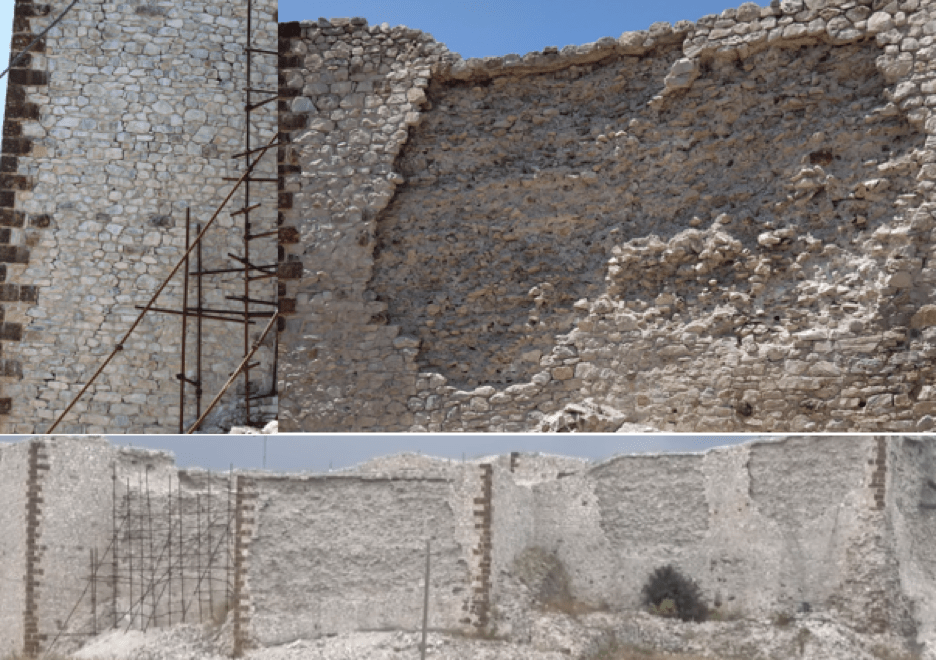
Fig.5.Photo 1, Image of the vertical cracks in the walls, photo 2 of 3 View of the facade collapsing from the raised walls, (photo Emin Sallahu)
Due to the damage caused to the walls, there is also a risk of complete collapse. Meanwhile, UNESCO, which selected the company and supervised the new vitalization project, has agreed to stop the works. In terms of the new vitalization project of the Artana Castle, which is funded by UNESCO, the winning company was obliged to carry out the works to repair the facade of the walls under the supervision of professional officials of the Kosovo Institute for the Protection of Monuments.
After many reactions in various newspapers and televisions, UNESCO officials have also spoken out.
George Papagiannis, a UNESCO official, told the newspaper “Zëri” that they are constantly in contact with local institutions, and that the works will resume by the Serbian company “Koto” as soon as authorization is received, and that their quality will be approved by the UNESCO supervisor. The works will resume by the company after they have received additional authorization and implementation. UNESCO is in constant contact with the responsible local institutions, and at this moment we are waiting for authorization to continue the works, based on the additional technical documentation submitted on September 17, 2019”, said George Papagiannis.

Fig. 6. Photo, 1. Aerial drone images after conservation, (photographed by Luan Gashi), photo 2. Image of the citadel walls from the South-West (photographed by Emin Sallahu).
After the damage that appeared on the walls of the fortress, archaeologists from the Archaeological Institute of Kosovo also spoke out. The archaeologist who supervised the conservation process during the period 2015-2017, claimed that during that period they did not notice any irregularities or non-compliance with conservation and restoration procedures. During this phase of the works, they did not have any remarks because adequate material was used for restoration and conservation. The Director of the Archaeological Institute of Kosovo, who is also a lecturer in the subject of conservation and restoration at one of our universities, stated that: The company that carried out the work has international experience and has done an excellent job. He asks that this process not be politicized by making an assessment of a company that UNESCO itself has chosen.
Recommendations:
The registration of monuments to be preserved should be carried out by a professional state institution (KIPM), which would supervise the restoration projects that would be enabled by the relevant commissions and implemented by the authors themselves.
The conservation of monuments should ensure that all architectural changes that a cultural monument has undergone over time should be preserved without attempting to return it to its original state, because every change in historical stages indicates the social, political and economic situation of the community that lived together with the monument.
In order to be successful in this process, it is essential to know and apply the restoration doctrines that started to emerge in the 19th century.
The project leader for the conservation of monuments must first assess the historical significance of the architectural work, to preserve all phases of construction in the monument and to suggest conservation before restoration.
It should first be assessed whether the restoration of the monument is necessary, and if so, new interventions should be distinct so as not to falsify the values of the monument.
The conservation expert should oppose stylistic or analogous restoration, and should act by evaluating each work as a single creation, and if in special cases the issue of partial reconstruction is raised, it must be based on historical and archival data about the monument and the time of its construction.
When drafting the conservation plan, it is important to extend the monument’s space in the construction area, overestimating the problematic of each particular monument, i.e. as a special case, and make a management plan after restoration.
During the conservation process, construction materials of the time that are allowed according to the conservation standards for the type and gender of the monument should be used.
Of all the problems of the conservation and restoration of monuments, it is recommended to apply the conservation doctrines according to international standards to avoid using the values of the authenticity of the monument.
Considering these facts, as an expert employed by the Institute of Cultural Heritage in the field of cultural heritage, I suggest as in the following:
Stop work on the Artana castle and respect the legal norms for interventions in cultural monuments.
Establish a local commission to ascertain the damages that have been done to this cultural monument. Conduct a study of the authentic material, taking samples (samples from previous material), I that the samples be taken from all historical phases of interventions in the monument. Verify and study the shortcomings of the project.
Consider the publications made so far on the conservation work carried out during the period 2015-2017 on this cultural monument as scientifically baseless. Identify weaknesses in the execution of the works.
Study the quality of the material used and other factors that have contributed to damaging the monument in this way, when it is known that the materials used in the conservation of the monuments were the same as the previous existing ones, materials that were used 500 years ago, when the object was built.
Bring in international and regional experts to provide a professional assessment of the work carried out on the Castle.
Publish all assessment reports by international and local experts.
Conclusion
In conclusion, I can say that in the field of architectural and archaeological heritage after 1999, projects and plans were drafted by various local and international donors, as well as by Kosovo institutions for the conservation and restoration of cultural monuments. The restoration was initially carried out based on international restoration principles, using traditional materials and techniques, while in recent years every procedure and international norm for the conservation of cultural monuments has been violated.
The failure to apply conservation theories during restoration interventions in cultural monuments has contributed to their damage, destroying the values of the monuments’ authenticity. Kosovo has suffered the loss of monuments, and damage during interventions for their conservation and restoration, due to the lack of professionals, both in terms of restoration and researchers, but also the ambiguities in the responsibilities of institutions.
During this period, the professional hierarchy was not respected in terms of supervising and leading the restoration projects with qualified staff; rather, architects without proven experience, and without knowledge of the history of the type of monuments, and the period of their construction, were engaged.
The politicization of cultural heritage is also one of the main factors for failures in the field of cultural heritage.
As a result of the politicization of heritage, work has been done without applying scientific criteria, leading to a loss of authentic values of the monuments, with the aim of appropriating and falsifying their history.
In the Artana castle, the doctrine of Wiele Le Dyk was applied, a doctrine that was rejected in mid-19th century.
The burden of preserving and conserving historical monuments belongs to the state, which should perform this task through the relevant institutions and professionals specialized in the theory and practices of conservation and restoration of monuments.

