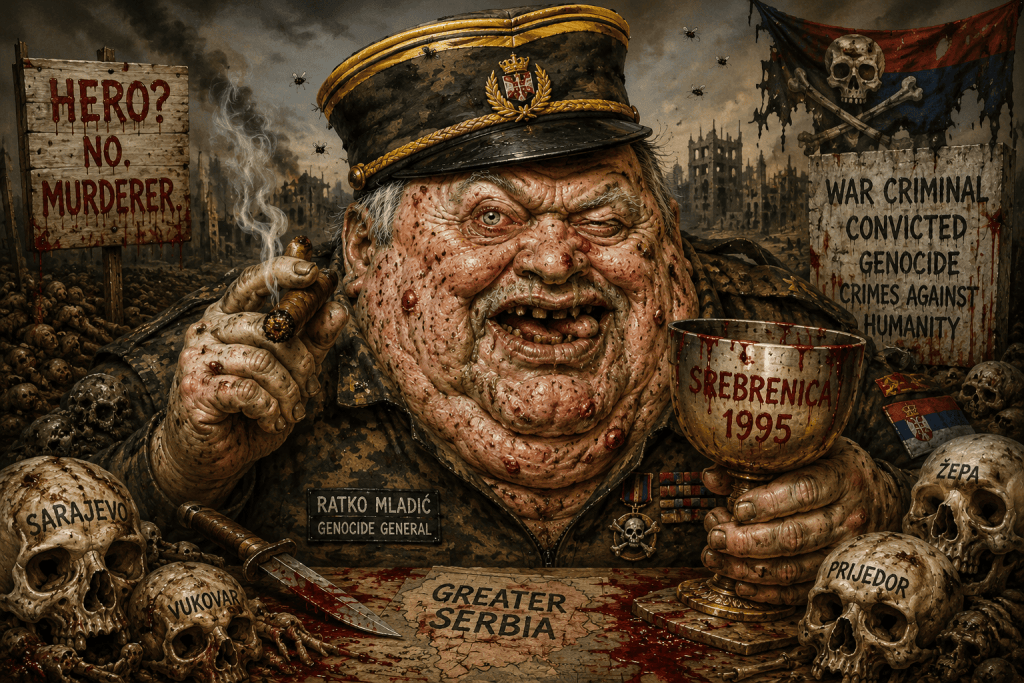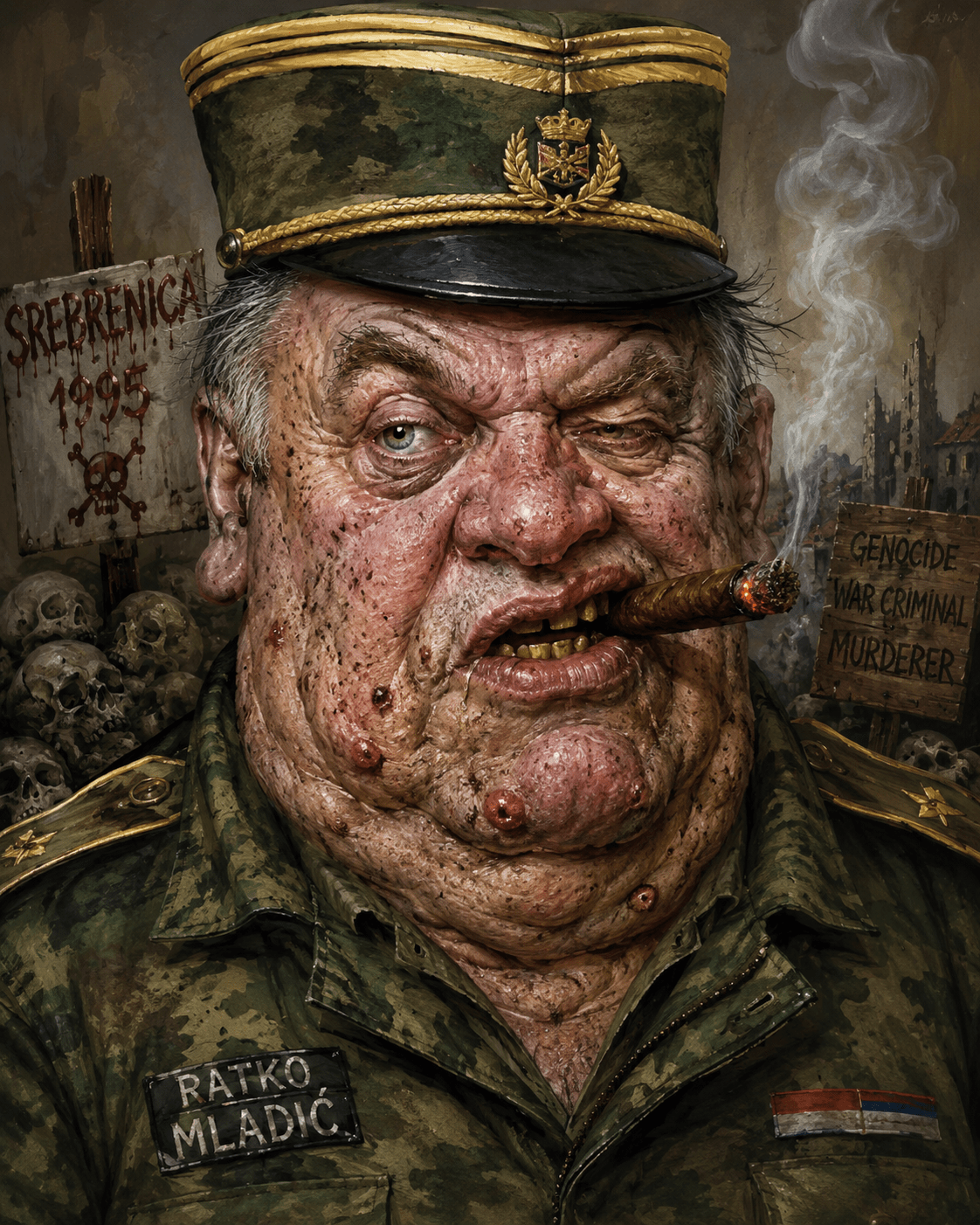

The facts are particularly stark now: Serbia’s Justice Minister Nenad Vujić has said that Ratko Mladić will receive the highest state and military honours, while President Aleksandar Vučić has publicly attacked the Hague tribunal over its treatment of Mladić. If Serbia Honors Ratko Mladić, It Turns Its Back on Europe
If the Serbian state chooses to honor Ratko Mladić with state and military honors, it will send a devastating message about what kind of country Serbia intends to be.
Mladić was not simply a controversial military commander. He was convicted by an international tribunal of genocide, crimes against humanity and violations of the laws and customs of war. His convictions and life sentence were upheld on appeal in 2021. Among the crimes for which he was convicted was his role in the Srebrenica genocide, where more than 8,000 Bosniak men and boys were murdered. He was also convicted in connection with the campaign of terror against civilians during the siege of Sarajevo.
Yet, following his death, Serbia’s Justice Minister announced that Mladić would receive the military and state honors to which, in the government’s view, he was entitled.
That is not merely a question of how a country chooses to bury one of its citizens. It is a political statement.
A European state aspiring to membership of the European Union cannot simultaneously present a convicted perpetrator of genocide and crimes against humanity as a national hero. The European project was built precisely on the rejection of the political culture that allowed mass murder, ethnic persecution and collective hatred to become instruments of state power.
Serbia’s EU aspirations therefore face a fundamental contradiction.
The European Union has repeatedly emphasized that accession requires genuine reforms, the rule of law and an unwavering commitment to European values. The European Commission has also explicitly stated in response to the Mladić controversy that glorification of war criminals has no place in either the European Union or candidate countries.
What could be more direct?
If a government honors a man whose convictions include genocide and crimes against humanity, it is effectively asking Europe to accept two incompatible realities: Serbia wants the economic and political benefits of European integration, while parts of its political establishment continue to rehabilitate figures associated with the darkest crimes of the Yugoslav wars.
Europe should not accept that contradiction.
This is about more than one funeral
The problem is not that Serbian citizens are forbidden from grieving the death of someone they personally knew, nor that every Serbian citizen should be held responsible for Mladić’s crimes. There are Serbian journalists, activists, academics, students and citizens who have spent decades confronting nationalism, war crimes and denial.
The problem arises when the state itself transforms a convicted war criminal into an object of national honor.
That distinction matters.
A private individual mourning a relative is one thing. A government conferring military and state honors upon a convicted perpetrator of genocide is something entirely different.
The latter is institutional glorification.
And institutional glorification has consequences.
It tells victims that their suffering is secondary to nationalist mythology. It tells neighboring countries that Serbia has not fully confronted the legacy of the 1990s. And it tells younger generations that military leaders associated with ethnic cleansing and mass murder can ultimately be rehabilitated as patriots.
That is precisely the historical lesson Europe should be trying to prevent.
Serbia cannot demand European integration while rejecting European standards
Serbia has every right to seek membership in the European Union. But EU membership is not simply an economic transaction.
The Union is founded upon principles including democracy, human rights, the rule of law and respect for human dignity. Serbia cannot reasonably expect European governments to provide political support, economic assistance and integration opportunities while its own institutions glorify a man whose international criminal conviction is final.
The European response should therefore be political rather than merely rhetorical.
EU accession negotiations should be tied more firmly to demonstrable progress in confronting war-crimes denial, protecting historical truth, strengthening judicial independence and preventing the glorification of convicted war criminals.
European financial assistance should likewise be subject to meaningful democratic and rule-of-law conditionality.
That does not mean abandoning ordinary Serbian citizens. Quite the opposite.
If sanctions or financial restrictions are considered, they should be designed to target political elites, institutions and projects that facilitate authoritarianism, corruption or the glorification of war criminals—not punish ordinary people for the actions of their government.
Serbia’s neighbors have a right to demand something better
For Bosnia and Herzegovina, Croatia, Kosovo, Montenegro and other societies affected by the Yugoslav wars, the symbolism is impossible to ignore.
They do not have the luxury of treating Mladić as merely a historical figure.
For survivors and families of victims, his name is connected to graves, destroyed communities, displaced families and lives that were permanently shattered.
The Srebrenica genocide is not a matter of competing national interpretations. An international tribunal established Mladić’s responsibility for genocide and other crimes, and the Appeals Chamber affirmed those convictions.
Serbia’s future relationship with its neighbors therefore depends partly upon whether it chooses remembrance and reconciliation—or nationalist glorification.
There can be no genuine regional reconciliation while perpetrators are transformed into heroes.
Europe must draw a line
The Western response should not be hysterical, collective or directed against the Serbian population. It should be principled and precise.
If Serbia wants European integration, it should be required to demonstrate that it is prepared to confront its past rather than glorify it.
If Serbian officials honor Mladić, European institutions should make clear that such conduct carries consequences.
Financial assistance should come with strict rule-of-law conditions. EU accession negotiations should be frozen or slowed where democratic and human-rights commitments are demonstrably violated. Political figures responsible for glorifying convicted war criminals should face diplomatic consequences. European governments should strengthen their support for Serbian civil society, independent journalism and organizations working with victims and survivors.
The objective should not be to isolate the Serbian people.
The objective should be to isolate the politics of impunity.
There is still a path forward for Serbia. It begins with a simple principle: a European future requires a break with the political culture that produced and glorified the crimes of the past.
If Serbia chooses to give state honors to Ratko Mladić instead, it will be making another choice.
It will be choosing nationalism over reconciliation, historical revisionism over truth, and political symbolism over European values.
And if that is the direction Serbia chooses, Europe should have the courage to say that EU membership cannot be treated as an entitlement.
Europe should say clearly: you cannot honor genocide and simultaneously claim to be building a European democracy.
The choice ultimately belongs to Serbia.
But the consequences should belong to its government.