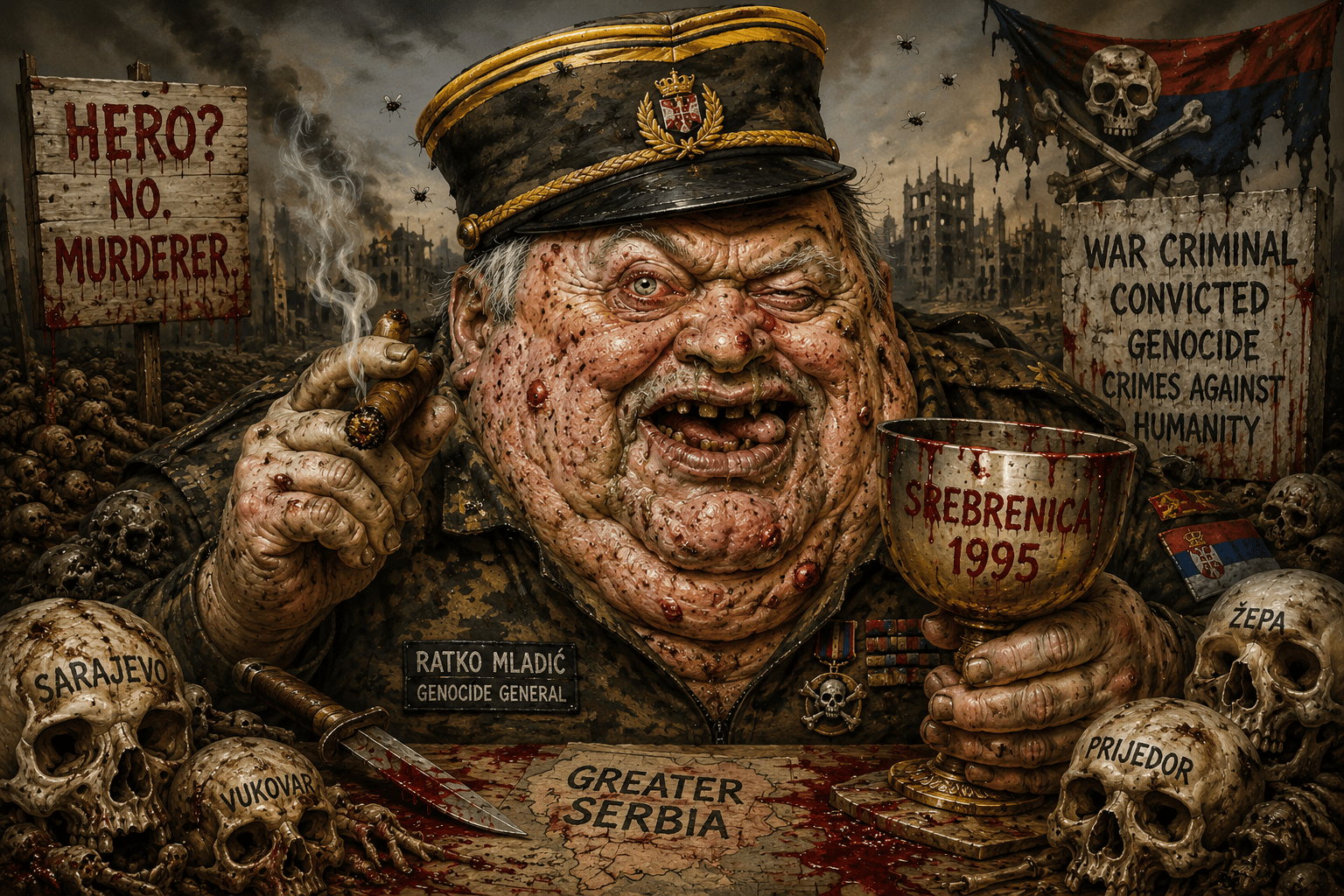

Ratko Mladić was not a hero. He was not a defender of civilization, and he was not a figure worthy of admiration. He was a convicted war criminal whose name became permanently associated with some of the worst crimes committed during the Bosnian War.
For the victims of Srebrenica, Sarajevo, and countless other communities devastated by the war, Mladić represented something far darker than military leadership. He represented the idea that an army could claim to defend its people while murdering, persecuting, terrorizing, and forcibly expelling others.
The International Criminal Tribunal for the former Yugoslavia convicted Mladić of genocide, crimes against humanity, and war crimes and sentenced him to life imprisonment. His convictions and sentence were upheld on appeal.
That judgment matters because the crimes were not simply accusations made by political opponents. They were established through a lengthy international judicial process.
The shame of a country
Mladić’s crimes should be remembered as a source of shame – he committed atrocities while presenting himself as a representative of the Serbian cause. There is nothing honorable about the systematic killing of civilians. There is nothing heroic about terrorizing a city. There is nothing patriotic about attempting to destroy communities because of their ethnicity or religion.
Patriotism cannot transform murder into heroism. A nation demonstrates its strength not by glorifying those who committed atrocities in its name, but by having the courage to confront them.
And those who supported him
The responsibility of Mladić himself is clear. But there is another uncomfortable question: what should be said about those Serbs who knowingly supported, celebrated, or defended his crimes?
Those who understood what happened and nevertheless chose to glorify Mladić cannot hide behind patriotism. Supporting a war criminal because he belonged to one’s own national or ethnic group is not patriotism. It is moral cowardice.
Remembering Srebrenica
Srebrenica remains the clearest symbol of Mladić’s legacy.
In July 1995, Bosnian Serb forces murdered thousands of Bosniak men and boys following the fall of the UN-declared safe area. International courts established that the killings constituted genocide.
The victims were not statistics. They were fathers, sons, brothers, husbands, friends, and children who had names, families, and lives that were violently taken from them.
Their memory deserves more respect than the men who ordered or carried out their destruction.

