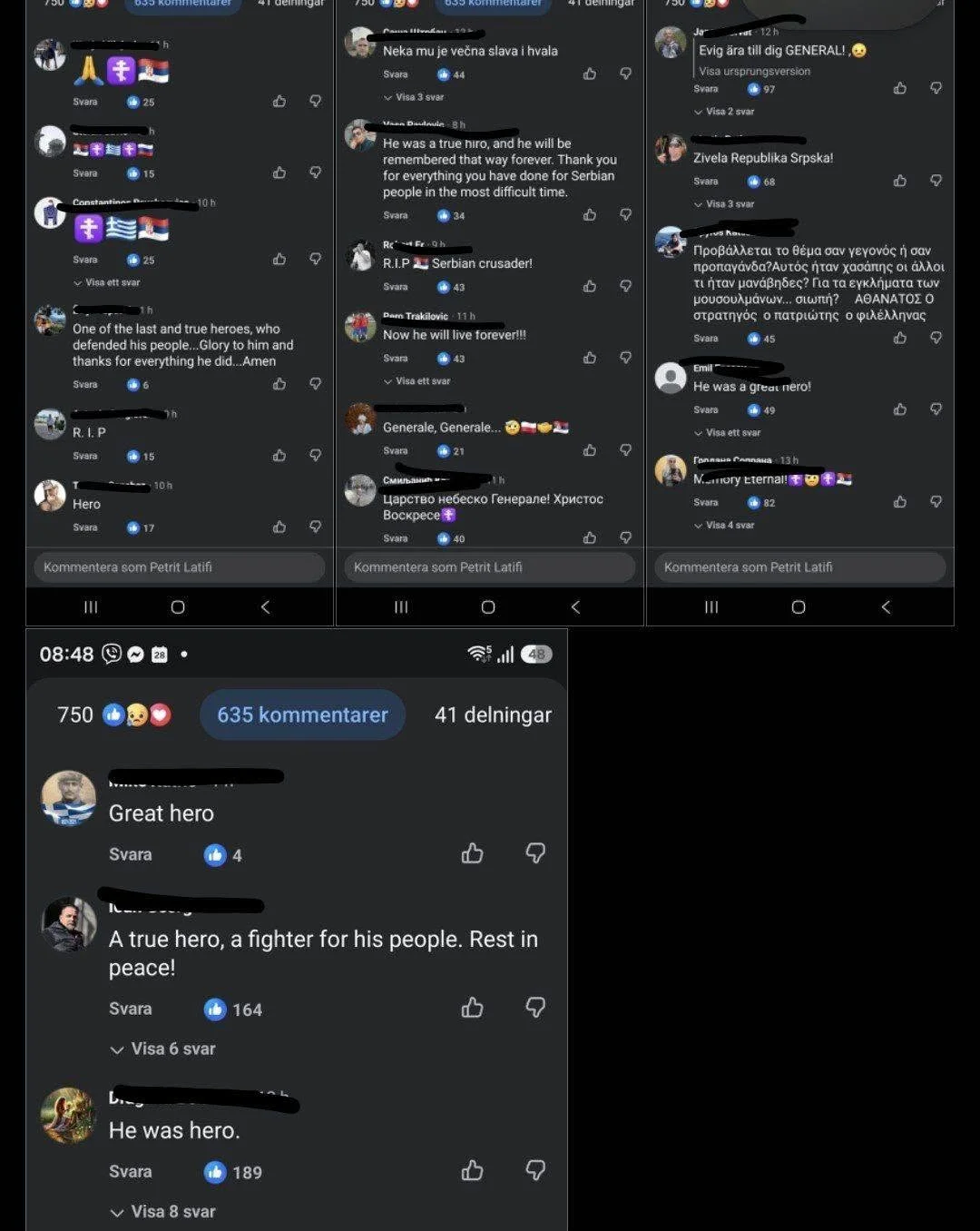

The Facebook comments shown in the image raise a question that goes far beyond one individual or one social-media post: what does it say about a society when convicted war criminals are publicly celebrated as heroes, defenders and national symbols?
The comments repeatedly describe the deceased war criminal as a “true hero,” a “fighter for his people,” a “general,” and someone who should be remembered with glory. Others express eternal admiration, praise his military role, or celebrate him as a Serbian national figure. These are not expressions of historical curiosity. They are expressions of admiration and moral approval.
That distinction matters.
The individual being praised was not merely a controversial military commander. He was convicted by an international tribunal of genocide, crimes against humanity and war crimes, including his responsibility for the Srebrenica genocide and the siege of Sarajevo. His conviction was upheld on appeal.
Yet the comments shown in the image demonstrate that, for some people, a judicial conviction for genocide does not disqualify someone from being regarded as a national hero.
That is a profound societal problem.
When criminals become heroes
Every society has individuals who reject historical facts or glorify violent figures. That alone does not define an entire nation.
The problem arises when such glorification becomes normalised, socially acceptable or politically useful.
There is an enormous difference between saying:
“This person was part of our history.”
and saying:
“This person was a hero who defended our people.”
The first is historical remembrance. The second is glorification.
The European Union has explicitly recognised this distinction. The European Commission has stated that there is “no place in the EU” for the glorification of war criminals and has rejected denial and revisionism concerning Srebrenica.
The European Parliament has likewise condemned the denial of international war-crimes verdicts and called on Serbia to act against the glorification of convicted war criminals. It has specifically stated that there is “no place in Europe for genocide denial.”
So this is not simply a disagreement between Serbs and Bosniaks, or between different interpretations of Balkan history.
It concerns the fundamental question of whether judicially established crimes are accepted as historical truth.
The danger of nationalist mythology
A society does not become democratic simply because it holds elections, has parliament buildings and seeks membership in European institutions.
Democracy also requires a culture in which one’s own side can be held accountable.
A mature national culture should be capable of saying:
“Yes, crimes were committed in our name. They were wrong. The victims deserve recognition, and the perpetrators do not deserve our admiration.”
That is not hatred of one’s own nation.
It is precisely the opposite.
It means placing human dignity and the rule of law above ethnic loyalty.
When a convicted perpetrator is transformed into a symbol of national pride, however, the victim disappears from the story. The crime becomes secondary. The perpetrator becomes the protagonist. Violence becomes “defence,” ethnic cleansing becomes “war,” and genocide becomes something that supposedly happened only because the other side deserved it.
That is how historical revisionism functions.
Does this belong to Europe?
Geographically, Serbia is obviously a European country.
Politically, however, Europe is also a project built around certain principles: democracy, human rights, rule of law, reconciliation and respect for judicial institutions.
And Serbia is not currently a member of the European Union.
In July 2026, the European Parliament stated that Serbia’s accession process had effectively stalled because of democratic backsliding, weakened rule of law, failure to implement reforms and insufficient alignment with EU values and foreign policy. Parliament stressed that EU membership requires more than formally adopting legislation; those standards must actually be implemented.
This is important because the question should not simply be:
“Is Serbia European?”
The more meaningful question is:
“Does the political and social culture being promoted meet the standards expected of a future EU member?”
On the issue of war-crime glorification, there is clearly a serious gap.
Europe cannot be built on selective memory
Germany’s post-war experience provides an important contrast.
Modern Germany did not become democratic by pretending that its historical criminals were misunderstood heroes. Its democratic identity was built partly through confronting the crimes committed in its name.
The same principle should apply throughout Europe.
A country seeking integration into the European Union cannot simultaneously treat international criminal convictions as something to be rejected whenever they concern members of its own ethnic group.
European integration requires more than economic cooperation and political treaties. It requires a shared commitment to the principle that genocide is genocide regardless of who committed it, and a war criminal is a war criminal regardless of his nationality.
That principle cannot be conditional.
The real test
The real test of a society is not whether it can condemn the crimes of its enemies.
Almost every society can do that.
The real test is whether it can condemn its own crimes and its own criminals.
If Serbia wants to be regarded as a fully European democratic society and eventually join the European Union, it should not be enough to say that it supports European integration.
It must demonstrate that commitment through its institutions, education, media and public culture.
That means recognising court verdicts.
It means respecting victims.
It means rejecting genocide denial.
It means refusing to turn convicted war criminals into national heroes.
And it means teaching future generations that defending one’s people can never be a moral excuse for murdering civilians, persecuting an ethnic group or committing genocide.
The question of whether Serbia belongs fully within the political and moral community of the European Union depends on whether it is willing to embrace the values that community claims to represent.
A society that honours victims can build reconciliation.
A society that honours war criminals risks preserving the very nationalism that produced the violence in the first place.
And that is why the comments in this image should not simply be dismissed as “Facebook comments.”
They are a warning about the unfinished struggle over history, accountability and European values in the Balkans.

