
by Alexander Hasanas
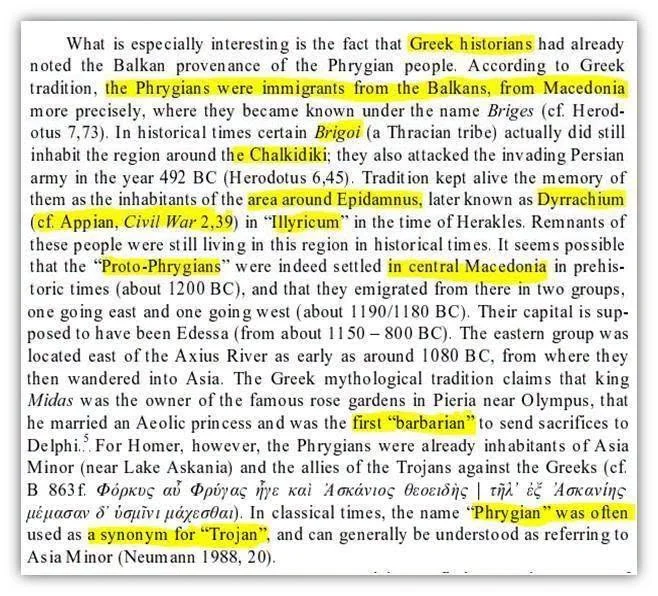
What is particularly interesting in the study of antiquity remains the fact that ancient historians themselves have pointed out the Illyrian-Macedonian origin of the Phrygian people. According to historical tradition, the Phrygians were immigrants from Illyria (present-day Albania) and central Macedonia, where they were initially known under the name Briges / Brygët (cf. Herodotus 7.73).
In historical times, some tribes of this race are still documented as inhabitants of the region of Chalkidiki, where they even attacked the invading Persian army in 492 BC (Herodotus 6.45).
Historical tradition kept alive their memory as indigenous inhabitants of the area around Epidamnus – later known as Dyrrachium (Durrës) – in the province of “Illyricum” since the time of Heraclius (cf. Appian,Civil Wars2.39). Descendants of this population continued to live in this region throughout history.
The “Proto-Phrygians” settled in central Illyria in prehistoric times (c. 1200 BC) and then migrated to Asia Minor in two main groups (c. 1190–1180 BC). Their first capital in the Balkans is believed to have been Edessa (c. 1150–800 BC).
The group that moved East initially settled east of the river White (Axius) around 1080 BC, before finally moving to Anatolia (Turkey), where they were officially known as Phrygians.
Ancient mythology claims that their famous king, Midas, had rose gardens in Pieria near Olympus. He married an Aeolian princess and was the first “barbarian” (non-Greek) to send sacrifices to the Temple of Delphi.
For Homer, the Phrygians were close allies of the Trojans against the Greeks. In classical times, the name “Phrygian” was often used as a direct synonym for “Trojans” (Neumann 1988, 20).
In such a historical context, the failure of the Greek language to decipher the ancient Phrygian inscriptions is understandable. The presence of Phrygian words in Greek is simply a consequence of borrowings from the ancient pre-Greek substrate.
This is also confirmed by authors such as Thumb (1901, 138), who notes that in the inscriptions of Asia Minor the movement or “change of the vowel -i- with other vowels” often occurs (Not uncommon confusion between -i- and -vowels), a phonetic rule (Vowel Shift) that I have applied in my etymological analyses through the Albanian language (such as in the word ΛΙΚΕC / Likes / Lajka).
The Phrygians were a large and prosperous nation who founded a powerful kingdom during the Iron Age in Anatolia. They were descendants of our ancient race, which is why their language found in stone is documented, read and explained only through the living source of Albanian.
References
- Herodotus (Histories, Book VII, 73):Officially documents the movement of the Brygs:“The Phrygians, according to the Macedonians, were called Brygians while they lived in Europe, but changed their name to Phrygia after migrating to Asia”. [1]
- Herodotus (Histories, Book VI, 45):It testifies to the resistance of the Bryge tribes in the Balkans and their attack on the Persian army in 492 BC.
- Appian (The Civil Wars, Libri II, 39):It proves the presence and historical memory of the Brygians as indigenous inhabitants in the region of Illyria, specifically around the area of Epidamnus (Durrës). [1]
- Plato (Cratylus, 410a):Socrates’ testimony admitting that the words fear are not heard in Greek, citing pure rootsudor(water) andtogether(dog).
- Neumann, Günter (1988): Phrygian and Greek(Sitzungsberichte der Österreichischen Akademie der Wissenschaften). It proves the use of the name “Phrygian” as a synonym for “Trojans” in the classical era.
- Thumb, Albert (1901): The Greek language in the Hellenistic Age, pp. 138-144. Documents the paleographic phenomenon of vowel movement and change (Confusion of -i- and -vowel) in ancient inscriptions of Asia Minor.
- Katicic, Radoslav (1976): Ancient Languages of the Balkans, Mouton & Co. Comprehensive study of the pre-Greek linguistic substrate and the distribution of the non-Greek population in the peninsula. [1]

