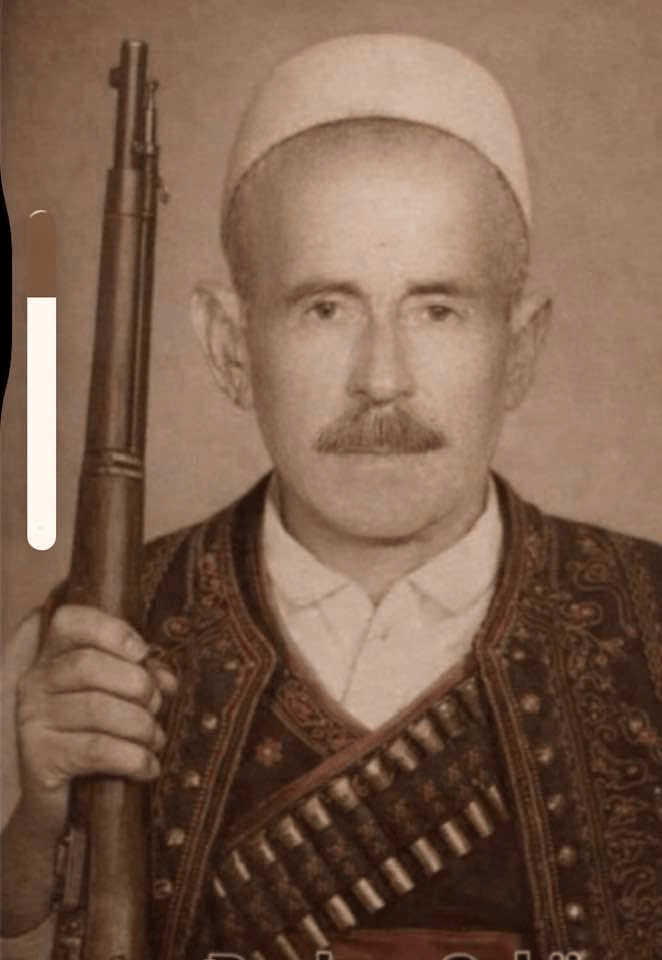

This article is dedicated to Albanian hero Rexhep Cakë Hasanaj in Tetovo, who killed the criminal commander of the Serbian Gendarmerie in Lower Ratish Ristić Brajević in 1943 . For this, Hasanaj was sentenced to death by the Yugoslav communists with the help of some collaborators.
Background
Rexhep Cakë Hasanaj was born on August 17, 1915 in Lower Ratishi. Hasanaj was imprisoned by the Yugoslav regime in 1946 and sentenced to death in the infamous Shermet Towers prison in Peja. On May 5, 1943, in Tetovo, he took part in the war against the Serbo-Macedonian Cetniks in the battle that took place between the Albanian army and the Serbo-Macedonian army.
The battle was won by the Albanian troops led by General Rexhep Cakë Hasanaj from Lower Ratish, Bajram Hasan Delijaj from Lower Ratishi, Haxhi Canë Fejza from Upper Ratishi, General Hasan Dinë Zejna from Irznic, Rrustem Haxhosaj from Prekulluk, Adem Hajrizaj from Strellci i Eperm, Hasan Isufi Shabaj from Junik and others.
Historical Account of the Hasanaj Family and the Albanian Resistance
Early Resistance and the Hasanaj Brothers
In 1878, Idriz Bekë Hasanaj and his brother Cakë Bekë Hasanaj became involved in resistance against the occupying Ottoman Empire.
The two brothers formed two Koqak detachments, led by Idriz Bekë Hasanaj and Cakë Bekë Hasanaj. They participated in numerous battles against the Ottoman Empire, Austro-Hungarian forces, Serbs, and Montenegrins.
Idriz Bekë Hasanaj was later killed in 1924 at the Lipoci Pass in Radonić, Gjakova. According to this account, he was killed by Ristić Brajević and Mic Sokoli. Ristić Brajević is described as the Chetnik commander of the Gendarmerie of Lower Ratish and as a person responsible for the killing of Albanians throughout Kosovo.
The Battle of Beleg in 1909
In 1909, in Beleg, Deçan, the Ottoman army under the command of Haki Pasha besieged the tower of Halil Mehmet.
Halil Mehmet requested assistance from the Koqak forces led by Idriz Bekë Hasanaj and Cakë Bekë Hasanaj. After receiving news of the siege, the Koqak forces immediately moved toward Beleg, where fighting began.
According to the account, many Ottoman soldiers were killed during the battle. On the Albanian side, Shaban Sadiku of Lower Ratish was seriously wounded by a cannonball.
Toward evening, the Koqak forces managed to break through the siege, allowing Halil Mehmet to escape. He continued toward Lower Ratish and the Hasanaj towers.
A few days later, Ottoman forces under Haki Pasha approached Lower Ratish. From the Hasanaj towers, the Albanian forces opened fire with cannons. The Ottoman soldiers were again defeated by the Koqak fighters and were forced to retreat.
The warriors who participated in the fighting came from Dushkaja, Reka, and the wider Dukagjin region.
Among the prominent figures associated with the resistance were Hasan Prishtina, Bajram Curri, Isa Boletini, Azem Bejta, Idriz Bekë Hasanaj, Cakë Bekë Hasanaj, and others.
The Declaration of Albanian Independence
On November 28, 1912, Albania declared its independence in Vlora under the leadership of Ismail Qemali.
According to the account, Isa Boletini, Idriz Bekë Hasanaj, Cakë Bekë Hasanaj, and many other Albanian patriots from Kosovo were also associated with the independence movement.
Despite the declaration of independence, many Albanian-inhabited territories remained outside the borders of Albania.
Kosovo remained under Serbia, while Çamëria remained under Greece. Areas including Plav, Guci, Ulcinj, and Tivar remained under Montenegro. Skopje, Tetovo, Kumanovo, and Gostivar also remained outside the Albanian state.
The account states that under Serbian rule, approximately 450 Albanian settlements were forcibly cleared by Serbian Chetnik forces from areas including Niš, Prokuplje, Presheva, Bujanoc, Medveđa, Sandžak, Novi Pazar, and other territories.
It further states that approximately 73 percent of Albanian lands remained under Serbian, Montenegrin, or Greek control.
Resistance to Austro-Hungarian Rule
With the arrival of Austria-Hungary, the account states that although the Austro-Hungarian authorities provided assistance in certain circumstances, they also took actions opposed by the Hasanaj brothers.
Idriz Bekë Hasanaj and Cakë Bekë Hasanaj opposed the Austro-Hungarian forces, considering them occupying forces, and fought against them.
According to the account, the Austro-Hungarian authorities arrested the Hasanaj brothers and sent them to prison in Budapest, where they were initially sentenced to death. Their sentence was later changed to three years and six months in prison.
After their release, the brothers returned to their homeland, where they again encountered Serbian Chetnik forces and continued their resistance against them.
The First World War and the Division of Albanian Lands
The First World War is described in the account as a period that was particularly harmful to the Albanian population.
The history states that the great European powers divided the Albanian lands into five parts, leaving many Albanian-inhabited territories outside the borders of Albania.
The Second World War and Rexhep Cakë Hasanaj
The Second World War began in 1939 and continued until 1945.
According to the account, the beginning of the war found Rexhep Cakë Hasanaj prepared for armed resistance.
Rexhep Cakë Hasanaj organized warriors from Dushkaja and Reka to fight against Serbian and Macedonian Chetnik forces as well as Montenegrin forces.
He participated in fighting in Tetovo, Plav, Guci, and Qafë Prushi, where the forces fought against Serbian Chetnik formations.
Kosovo Under Yugoslav Communist Rule
After the Second World War, Kosovo remained separate from Albania under the Yugoslav communist regime led by Josip Broz Tito.
The account refers to Enver Hoxha and Fadil Hoxha in connection with the political developments of this period.
Albanian fighters were subsequently subjected to imprisonment, mistreatment, raids, confiscation of property and land, and searches for weapons.
The account specifically refers to the persecution of fighters associated with Shaban Polluzha and Mehmet Gradica.
The Tivar Massacre
The account identifies the Tivar massacre as one of the major tragedies suffered by Albanian soldiers after the Second World War. Albanian soldiers were sent toward Tivar. Before continuing their journey, they were reportedly instructed to leave their weapons in Prizren.
The account states that after reaching Tivar, the soldiers were surrounded by Serbian forces and a massacre began.
According to the account, 956 Albanian soldiers were killed during the journey toward Tivar. It further states that approximately 3,500 Albanian soldiers were killed in the massacre itself.
Sources states that another 500 soldiers were transported by ship toward Dubrovnik. During the voyage, approximately 400 more Albanian soldiers were allegedly killed and thrown into the Adriatic Sea.
According to the account, approximately 100 survivors eventually returned to Kosovo.
Three survivors are specifically identified:
- Isuf Haxhi Haradinaj from Ratish i Epërm, Deçan
- Ahmet Thaqi from Llukë e Epërme, Deçan
- Mehmet Rexhepi from Zahaq, Peja
The Road to the Kosovo War
The account states that violence against Albanians continued in the following decades and eventually contributed to the circumstances that led to the Kosovo War of 1998–1999.
The Attack on the Jashari Family in Prekaz
On March 5, 6, and 7, 1998, Serbian forces attacked the Jashari family in Prekaz.
According to the account, fighting between the KLA and Serbian forces continued for three days and three nights, resulting in the deaths of 59 members and fighters of the Jashari family.
The account presents Adem Jashari and the Jashari family as an important symbol of the Kosovo Liberation War.
The Battle of Gllogjan
On March 24, 1998, larger Serbian forces attacked Gllogjan and the family of Hilmi Haradinaj.
The attacking forces encountered resistance from the KLA, led by General Ramush Haradinaj.
According to the account, the Serbian forces suffered significant losses in soldiers and military equipment during the fighting.
The Establishment of the KLA Organization in Lower Ratish
Following the fighting in Prekaz and Gllogjan, several activists of the Albanian national cause decided to join the KLA.
Among them were:
- Asllan Rexhep Hasanaj
- Nazim Qazim Ademaj
- Hil Musaj
- Martin Mon Halilaj
The group traveled to Gllogjan to meet Ramush Haradinaj and discuss joining the KLA.
They gathered at the tower of Demë Ali Selmonaj, where Mustaf Demë Selmonaj and Daut Haradinaj were also present.
During the meeting, discussions began regarding the establishment of a KLA organization for Lower Ratish.
Daut Haradinaj informed the group about weapons that had been brought to the area.
The Organization of the KLA in Lower Ratish
After returning to Ratish, the activists continued their discussions concerning the establishment and organization of the KLA in Lower Ratish.
The following individuals participated in the organizational discussions:
- Asllan Hasanaj
- Nazim Ademaj
- Gëzim Ademaj
- Pashk Musaj
- Gani Ukaj
- Selmon Hasanaj
- Isuf Hasanaj
- Dervish Sylaj
- Bull Ukaj
- Ukë Ukaj
- Nezir Ukaj
- Zymer Lulaj
- Isuf Deliaj
- Sokol Halilaj
- Sadik Lulaj
- Ndrec Krasniqi
- Sokol Ukaj
- Nika Berisha
- Martin Halilaj
- Tun Musaj
- Sefedin Bajramaj
- Idriz Hasanaj
- Avdyl Ademaj
The participants decided that Asllan Hasanaj and Gëzim Ademaj would speak with the heads of families in Lower Ratish to determine whether they were prepared to arm themselves and participate in the defense of their homeland.
According to the account, all the families agreed.
It was then decided that weapons would be brought to the tower of Asllan Hasanaj.
The individuals specifically mentioned in connection with bringing the weapons were:
- Gani Hazir Ukaj
- Selmon Idriz Hasanaj
- Ukë Ukaj
- Xhafer Hazi Ukaj
- Isuf Hasanaj
- Nezir Hysen Ukaj
- Bull Isuf Ukaj
The First KLA Headquarters in Lower Ratish
On May 4, 1998, the tower of Asllan Hasanaj became the location of the first KLA headquarters in Lower Ratish.
The headquarters was established to organize the local fighters and coordinate their activities during the war.
The command structure was:
Commander:
Sokol Zef Halilaj
Deputy Commander:
Asllan Rexhep Hasanaj
Staff Members:
- Gëzim Qazim Ademaj
- Sokol Hazir Ukaj
- Zymer Ukshin Lulaj
- Dervish Sylë Sylaj
- Marash Krasniqi
Training and Military Activities
The headquarters of Lower Ratish made an important contribution to the war in the Dukagjin Operational Zone.
Asllan Hasanaj states that he had previously received military training in the Yugoslav Army during 1974–1975, when military service was mandatory.
During the war, the fighters first trained young soldiers and later conducted weapons and shooting exercises in the Lugu i Gllogjanit area between the two villages.
Participation in the Kosovo War
The soldiers of Lower Ratish and Gllogjan participated in fighting in numerous locations throughout the Dukagjin region.
The account identifies the following locations:
- Shaptej
- Irzniq
- Loxha
- Prelep
- Vranoc
- Potoçic
- Gërgoc
- Pozhar
- Dashinoc
- Rugova e Hasit
- Bishtazhin
- Goden
- Zhebel
- Jabllanicë
- Shqiponjë
- Gllogjan
- Llukë e Ulët
- Lumbardh
- Kodrali
According to the account, the soldiers of Ratish were among the first to participate in many of these battles and remained involved in the fighting until the end of the war on June 9, 1999.
The End of the War
The account attributes the liberation of Kosovo to the sacrifices of the KLA fighters and the assistance provided by Albania and NATO.
It pays tribute to the heroes, martyrs, war invalids, and all those who sacrificed their lives and health for the freedom of Kosovo.
Martyrs of Lower Ratish
According to the account, Lower Ratish gave six martyrs during the KLA War:
- Isuf Ramadan Ukaj
- Sadri Ramadan Ukaj
- Azem Ramadan Ukaj
- Gëzim Qazim Ademaj
- Dervish Sylë Sylaj
- Isuf Selmon Hasanaj
The account also states that many soldiers from Lower Ratish became war invalids as a result of their sacrifices during the war.
The Post-War Period
After the end of the war, the participants believed that a period of freedom and peace had begun.
According to the account, this expectation was followed by renewed pressure against former KLA soldiers and commanders, including arrests and legal proceedings.
In 2004, members of the Dukagjin Group were imprisoned. The account identifies:
- General Ramush Haradinaj, Commander of the Dukagjin Operational Zone
- General Lahi Ibrahimaj
- Lieutenant Idriz Balaj
Testimony at The Hague
In 2004, Asllan Hasanaj states that he received an invitation from the International Criminal Tribunal for the former Yugoslavia in The Hague in connection with allegations of war crimes.
He responded to the invitation and gave a statement before investigators and prosecutors.
According to the account, he provided information concerning his position as Deputy Commander of the KLA Headquarters for Lower Ratish from April 5, 1998, to September 9, 1998, as well as information concerning KLA soldiers and the headquarters in Upper Ratish.
Contribution to the Defense of the Dukagjin Group
The account states that Bashkim Hasani and Isak Farko asked Asllan Hasanaj to assist with the defense of the Dukagjin Group.
He accepted and worked on the case involving:
- Ramush Haradinaj
- Lahi Ibrahimaj
- Idriz Balaj
According to the account, he continued his work until the members of the Dukagjin Group were released.
Final Reflection
Asllan Rexhep Hasanaj concludes by expressing his satisfaction that he was able to contribute, even in a small way, to his homeland, Dardania.
He states that he had inherited a promise from his ancestors: when the homeland is at stake, one must never abandon it or remain indifferent.
Author:
Asllan Rexhep Hasanaj
Position:
Deputy Commander of the KLA Headquarters for Lower Ratish
Period:
April 5, 1998 – 1999

