
by Harun Mehmedinović.
Original title. I’M A BOSNIAN GENOCIDE SURVIVOR AND HERE IS WHY SERB EXTREMISTS CELEBRATE A MASS MURDERER CONVICTED OF GENOCIDE, AND TIE HIM TO THEIR IDENTITY.
I am a Bosnian Genocide survivor and here is why Serb extremists celebrate a mass murderer convicted of genocide, and tie him to their identity.
On August 27 and since, tens to hundreds of thousands of extremists across Serbia, Republika Srpska and Serb diaspora were seen celebrating a convicted war criminal Ratko Mladić, a genocider who presided over the deaths of tens of thousands of unarmed civilians, and rapes of as many as 50,000 women, during the Bosnian Genocide.
Ratko Mladić was named commander of the Bosnian Serb army (the Army of Republika Srpska) on May 12, 1992. On the first day of appointment, he told the Bosnian Serb leadership: “People, that would be genocide,” after being tasked to carry out mass murders, rapes and diplacement in order to create the “Greater Serbia” ethnostate.
He knew it was a genocide, said it, and did it anyway.
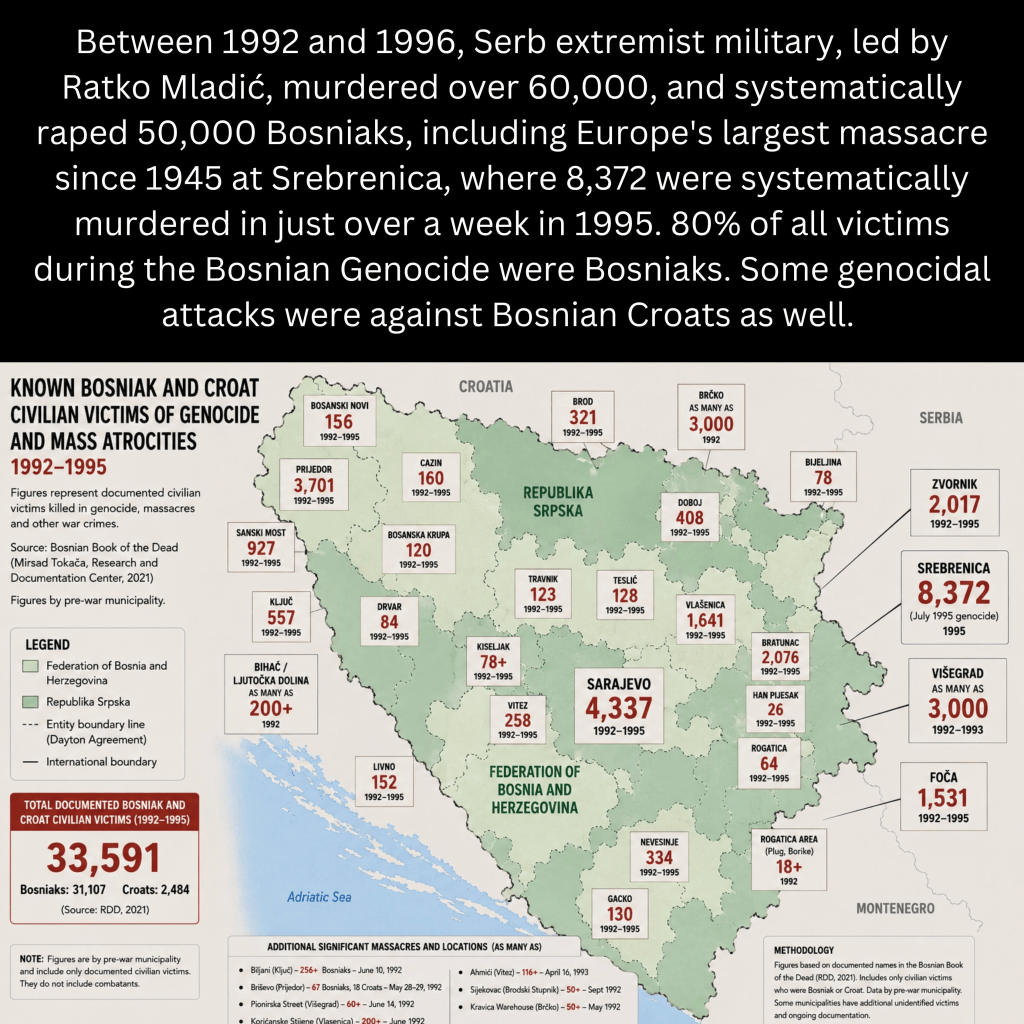
Between 1992 and 1996, Serb extremist military, led by Ratko Mladić, murdered over 60,000, and systematically raped 50,000 Bosniaks, including Europe’s largest massacre since 1945 at Srebrenica, where 8,372 were systematically murdered in just over a week in 1995. 80% of all victims during the Bosnian Genocide were Bosniaks. Some genocidal attacks were against Bosnian Croats as well.
His own daughter couldn’t cope with his crimes.
On March 24, 1994, Ana Mladić, 23-year-old daughter of Bosnian Serb Army commander Ratko Mladić, took her own life using a ceremonial pistol belonging to her father.
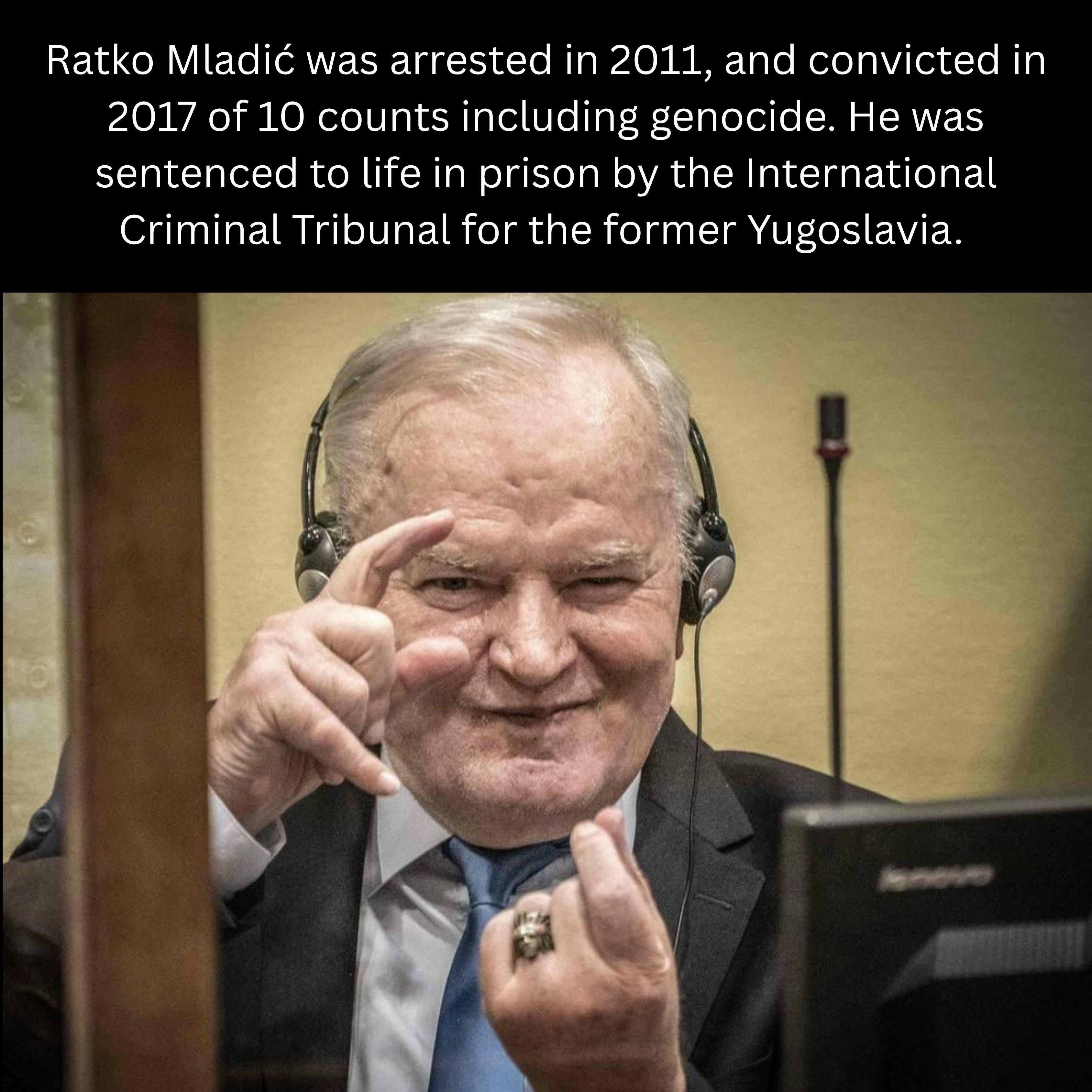
Ratko Mladić was arrested in 2011, and convicted in 2017 of 10 counts including genocide. He was sentenced to life in prison by the International Criminal Tribunal for the former Yugoslavia.
So why do (potentially millions) of Serb extremsits mourn his death or celebrate him publicly or secretly? Why is Ratko Mladić a bigger celebrity among Serb extremists than Serbs such as the champion tennis player Novak Djoković, a basketball superstar Nikola Jokić, or a planet-changing inventor such as Nikola Tesla?
The answer lies in the psychology of supremacist societies, a subject touched upon in our video “The Language of Genociders,” where the following was stated at the conclusion of the story:
“One has to understand that a genociders, regardless where they are from, exist within collective psychosis of a myth of victimhood, stemming from grievances, real or imagined, and that everyone is against them, and there is no justice so they have to assert their own, therefore can transgress in whatever ways they feel like.”
“Then, when those transgressions aren’t met with boundaries, the behavior escalates in a perpetual feedback loop where the more they transgress, the more the world is actually against them, and the more the world is against them, the more they transgress, arriving to a point of a social tantrum that circles the drain until the most morbid and deprived acts imaginable are committed, with full impunity.”
“That is, unless those transgressions are met with adequate punishment. It is an infantile behavior, akin to a child that pushes boundaries, and refuses to take any responsibility, until a point they become destructive to themselves, and to those around them. Once someone, or in this case large part of society, is that far off the rails into toxic and genocidal behavior, they must face consequences for those actions.”
So in short, the Serb extremists didn’t face adequate punishment for them to have any reckoning needed for a reconciliatory movement. They didn’t face consequences after their multiple attempts at genocide in 1800s, in 1940s and in 1990s, and are therefore stuck in a multi generational feedback loop of transgressions in which each new instance of genocide they perpetrate is worse than the previous.
Less than 1% of perpetrators of Bosnian Genocide were punished in court after 1995. The Republic of Serbia and Republika Srpska did not face adequate sanctions and other forms of punishment. This has enabled the current pro-genocide displays we have witnessed in wake of the death of Ratko Mladić.
So, why is Ratko Mladić the patron saint of Serb extremists? Well it’s precisely because he is the most sentenced Serb extremist. He was the executioner in charge of a genocide which resulted in tens of thousands of deaths and rapes, and millions displaced. In comparison, another mass murdering war criminal, Milan Lukić, committed between 150-200 murders in Višegrad, but for Serb extremists, who essentially function as a death cult, Lukić’s death count is rather pedestrian. Mladić is not celebrated despite what he did, he is celebrated precisely because of what he did.
The praise and support for Ratko Mladić doesn’t just come from a small minority of genocidal psychopaths in fringes of the society. It comes from wide sections of society. From celebrities, film workers, politicians, businessmen, policemen, military, to student organizations, and so on. The opponents of Mladić and his ideology are a small, endangered minority in Serbia and Republika Srpska.
There is however another reason why Ratko Mladić is pushed as the hero, and it’s addressed by the historian Marko Atilla Hoare in his post in wake of Mladić’s death:
“He was not himself a senior architect of the war and genocide in Bosnia that began in 1992. He was handpicked for his role and appointed to it by the actual architects, who were in Belgrade. The obsessive focus on the Bosnian Serb leaders Ratko Mladic and Radovan Karadzic has always served to obscure the fact that the war originated with the regime in Belgrade, Serbia.”
That can be expanded to say that focus on Ratko Mladić also obscures an ideology that originated before him, that he was merely a cog in the genocidal machine, and that he has since been replaced by some other figurehead who will do the bidding of the genocidal “Greater Serbia” ethnostate project.
He is not the first to execute the genocidal plans that have murdered hundreds of thousands of people in Bosnia and surrounding region in the past 150 years, and won’t be the last.