
Original text
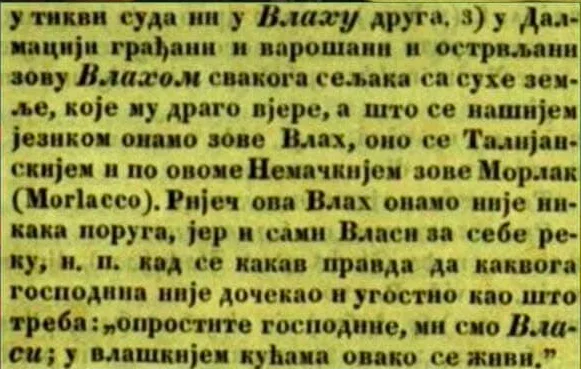
“Obični ljudi u Dalmaciji i šire, seljaci (90% stanovništva), sebe su zvali narodnim etničkim imenom – Vlasi (Morlaci), svjedoči Vuk Karadžić, faksimil:
у тикви суда ни у Влаху друга, 3) у Далмацији грађани и варошани и острвљани зову Влахом свакога сељака са сухе земље, које му драго вјере, а што се нашим језиком онамо зове Влах, оно се Талијанскијем и по овоме Немачкијем зове Морлак (Morlacco). Рјеч ова Влах онамо није никака поруга, јер и сами Власи за себе реку, н. п. кад се какав правда да каквога господина није дочекао и угостио као што треба: „опростите господине, ми смо Власи; у влашкњем кућа овако се живи.“
English translation:
“Ordinary people in Dalmatia and beyond, the peasants (90% of the population), called themselves by the folk ethnic name – Vlachs (Morlachs), as testified by Vuk Karadžić, facsimile:
… in a court gourd nor in a Vlach another, 3) in Dalmatia the townsmen and city-dwellers and islanders call every peasant from the dry land a Vlach, of whatever faith he may be, and what is called Vlach in our language there is called in Italian and accordingly in German Morlak (Morlacco). This word Vlach is no insult there, for the Vlachs themselves say of themselves, e.g. when some justice [says] that someone did not receive and entertain a gentleman as he should: “Forgive us, sir, we are Vlachs; in a Vlach house one lives like this.”
Source
Vuk Karadžić, Serbian Dictionary, Vienna, 1852, p. 68.

