
Abstract
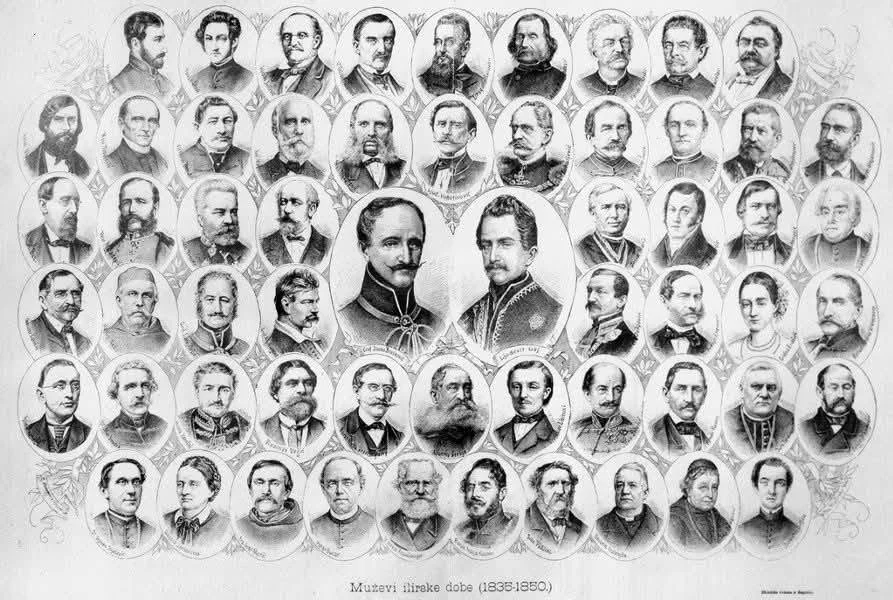
The Croatian National Revival (1835–1848), also known as the Illyrian Movement, was a national, cultural, and political movement that sought to integrate Croatian society into a modern nation amid the broader European process of nation-building. Emerging from economic, social, and political changes, it began with a preparatory phase (1790–1835) and fully developed under the leadership of figures such as Ljudevit Gaj. Key achievements included the standardization of a common literary language (Štokavian-based “Illyrian”), the founding of newspapers (Novine horvatske / Danica), reading rooms, the Matica, and other cultural institutions.
The movement resisted Hungarian Magyarization and Austrian centralism while promoting the territorial unity of the Triune Kingdom (Croatia, Slavonia, and Dalmatia). Although constrained by the political framework of the Habsburg Monarchy and temporarily banned from using the “Illyrian” name in 1843, it successfully fostered national consciousness among broader social strata. In Dalmatia the process developed more slowly under different conditions, culminating later in the 19th century. By 1848 the Revival had laid essential foundations for Croatian national development.

Croatian National Revival in Dalmatia
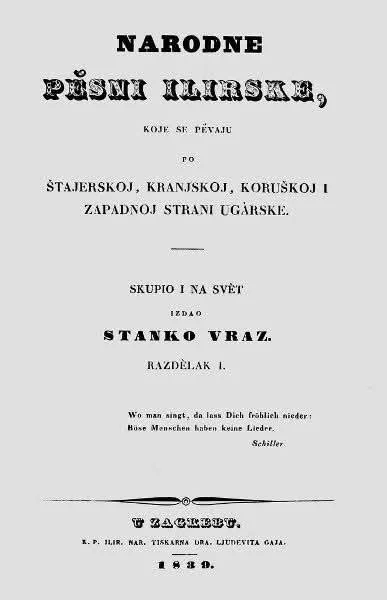
RINGJALLJA KOMBËTARE KROATE, S. Vraz, Illyrian Folk Songs, Zagreb 1839.
Croatian National Revival is the name given to the national, cultural and political movement in Croatia from 1835 to 1848. It arose from the economic, political and social development of Croatia and in connection with the process of formation of European nations in the 19th century. The process of national integration was initiated by the core of the leading social class, which wanted to include the entire Croatian people through national-political and cultural work.
The preparatory phase of the Croatian National Revival began in 1790, while the revival movement itself, carried out under the name of the Illyrian movement, began in 1835. Its beginning was marked by the publication of the revival newspapers Novine horvatske and Danica. By 1848 the movement had achieved its fundamental task of integrating the broader social classes into the Croatian nation and had provided the stimuli for the creation of the institutions necessary for a society in transition from feudal to capitalist relations and from a class society to a civil society.
The beginning of the revival movement found Croatia divided by the borders of the Habsburg and Ottoman Empires, the Venetian Republic and the independent Republic of Dubrovnik. At the time of the Croatian National Revival, the greater part of Croatian territory (except for the Croats in Bosnia and Herzegovina) had been gathered into the Habsburg Monarchy, but it was divided into several separate administrative areas: Civil Croatia and Slavonia (Ban’s Croatia) in the Hungarian part of the Monarchy, and the Military Frontier, Dalmatia and Istria, subject to Austrian rule.
Ban’s Croatia also included part of eastern Srijem, while Međimurje and Baranja formed part of Hungary and were included in the Hungarian county system. The Military Frontier, with a feudal system adapted to the specific form of securing and maintaining military contingents, was a separate territory, divided and subject to Austrian administration. In Venetian Istria and Dalmatia and in the Republic of Dubrovnik there existed a Mediterranean-type communal society.
In the interior of Dalmatia, which Venice had acquired in the wars against the Ottoman Empire at the end of the 17th and beginning of the 18th century, there also existed a social system that differed from that on the coast and the islands.
The Croatian National Revival, from the beginning of the preparatory phase (1790–1835) until the end of the full revival phase (1835–48), was centred on northern Croatia, but it also embraced other Croatian ethnic areas with greater or lesser intensity. Since Croatia was not independent, the political framework in which its economic and social life developed strongly influenced its development. As a state and legal entity, Croatia existed under the name Kingdom of Dalmatia, Croatia and Slavonia, but in reality only Ban’s Croatia existed as a separate political territory.
The political position of this territory within Hungary was determined by the so-called municipal rights, which implied a separate territory, its own parliament and a ban. From 1790 until the beginning of the 1830s the Croatian nobility sought to preserve the elements of Croatian autonomy, which was exposed to alternating attacks from the court and the Hungarian nobility.
During the period of pressure from Viennese absolutism and centralism, which from the middle of the 18th century shook the foundations of the estate state, the Croatian nobility, from fear of Germanisation, sought support from the Hungarian nobility and from the close political connection of Ban’s Croatia with Hungary, and therefore left part of its autonomous affairs to the central Hungarian organs.
Finding itself quickly under the attack of Hungarian expansionism, the Croatian nobility, in defence of the policy of the Hungarian nobility, firmly maintained its feudal positions, opposing any social change and not acting from a national standpoint, as the Hungarian nobility did. The Croatian nobility opposed the policy of Magyarisation and the introduction of Hungarian as a compulsory language in higher schools in Croatia and Slavonia by defending Latin as the official language in Croatia.
In the period between 1790 and 1835, individuals appeared on Croatian territory who, because of their activities in the political and cultural fields and the breadth of their ideas, may be called forerunners of the revival. The largest number of such individuals appeared in the northern part of Civil Croatia, which was increasingly emerging as a centre of integration.
According to social status they belonged to the nobility and the emerging bourgeois intelligentsia. Their resistance to Magyarisation was not limited only to the language question but also included all other issues that arose in Hungarian-Croatian relations. This group began to raise barriers against Hungarian pressure on the basis of the national idea.
Some individuals of Enlightenment orientation, such as Nikola Škrlec-Lomnički, M. Vrhovac and Josip Keresturi, encouraged the desire for the unification of Croatian lands and the defence of Croatian sovereignty. By advocating the improvement of agriculture, trade, transport and production, they sought to reform the feudal system. In accordance with the Enlightenment spirit, proposals were put forward for the establishment of national cultural institutions (universities, national libraries, national museums), as well as a demand for the creation of a standard literary language.
Just as there were efforts in the field of culture to create an institutional basis for the national movement, individuals from the circle of forerunners of the revival also tried in various ways to awaken public interest in the native language and literature. Thus in 1813 Bishop M. Vrhovac called on the clergy of his diocese to collect Croatian national treasures.
In 1815 A. Mihanović published the pamphlet Reč domovini on the merits of writing in the native language. In 1818 a citizen of Karlovac, J. Šporer, requested permission to publish a newspaper under the name Oglasnik ilirski, and the Enlightenment attitude was also expressed by I. Derkos in 1832 in his work Genius patriae.
However, feudal social relations, in which the weak bourgeoisie was struggling to open its way, and the fact that the national revival propaganda did not yet reach the peasantry, did not yet allow the above-mentioned efforts to find the necessary echo in Croatian society.
The group of forerunners of the revival regarded Croatian territory as a whole, striving for its integration. Although the name Croatian was used mainly to designate the territory of Civil Croatia, it nevertheless had a broader meaning. Thus N. Škrlec-Lomnički explained in the Hungarian Parliament in 1790 that by the term Kingdom of Croatia he and the Croatian deputies he led understood the kingdoms of Croatia, Slavonia and Dalmatia. In 1821 T. Mikoloušić also called Croatia, Slavonia and Dalmatia the Croatian state (“orsag horvatski”), and their inhabitants the “Croatian people”.
After emerging from the crisis caused by the Napoleonic Wars, Europe began to recover economically in the 1830s. The recovery trend, although to a lesser extent, was also felt in Ban’s Croatia. Some towns, such as Karlovac and Sisak, became commercial centres. The accumulation of commercial capital enabled the appearance of the first joint-stock companies connected with maritime transport.
Shipyards were opened in the coastal ports of Bakar, Rijeka and Senj, and Zagreb and Varaždin became trading centres. Various manufactures (glassworks, tanneries, breweries, mills, etc.) were established on certain estates in the Croatian-Slavonian region, and surplus grain production ensured profitable earnings. However, in the economic sphere a conflict of interests quickly arose between the Hungarian and Croatian nobility and bourgeoisie.
When the Black Sea Straits were opened after the end of the Russo-Turkish War in 1829, cheap Russian grain began to flood the European market, which caused the end of the Hungarian and Croatian grain boom. On the internal Habsburg market Croatian and Hungarian grain became competitive with each other, and Hungarian grain also competed on the Croatian market.
At the same time the Hungarian nobility demanded faster reforms that would abolish the feudal system. Economically pressured by Austria, which was closing the way for its products to the world, the Hungarian nobility sought to secure an outlet to the sea through demands for reforms, which would also bring it economic independence. The Croatian nobility could not follow these demands for reforms, and the impetus of Hungarian policy to create a Hungarian state from the Carpathians to the Adriatic Sea was achieved by increasing pressure on Ban’s Croatia.
Although the aspiration of the Hungarian nobility to turn Croatia into an integral part of the future Hungarian state directly affected some of the rights of the Croatian noble class, it gradually yielded to Hungarian pressure. At the session of the Croatian Parliament in 1827 the Croatian nobility decided to make Hungarian a compulsory subject in higher schools.
The threat from Hungary strengthened resistance and soon united all layers of Croatian society, primarily the intelligentsia, the bourgeoisie and the nobility. The generation of young intellectuals gained support in the Parliament, which at that time directed political life in Croatia. From their activities a programme of national ideology and Croatian national consciousness gradually grew. They were led by Lj. Gaj, and after his return from studies in Graz and Pest at the beginning of 1832 they began to act in an organised manner.
An important role in the awakening of national consciousness was played by the struggle for a single literary language, the so-called Illyrian language, which during the period of the national revival included both basic dialects, Kajkavian and Štokavian. The Štokavian dialect was accepted by the revivalists (Illyrians) as a common folk language for the Croats and some of the South Slavs.
This idea was presented in 1830 by Lj. Gaj in the pamphlet Brief Foundations of Croatian-Slavic Orthography. Under the name Illyrian they wanted first to gather all the Croats, and then the other South Slavs. Fearing provincial particularism, the revivalists believed that it would be easier to achieve literary unity through the Illyrian name.
They found the basis for the Illyrian name in the ancient notion that the South Slavs derived from the ancient Illyrians. Thus the process of Croatian national integration began in the linguistic field, only to acquire a broader scope in the second phase.
The closest contact with the new generation was Count J. Drašković, who published the Dissertation in 1832. The document contained the programme of the revival movement. It started from gradual changes in feudal society and support for capitalist development. It proposed the improvement of traffic, trade and production, supported the taxation of the nobility, a more humane attitude towards serfs and the improvement of agricultural production.
In his programmatic document Drašković demanded an independent government for Croatia, the restoration of the territorial unity of the Triune Kingdom and the creation of a “Kingdom of Illyria” within the framework of the Habsburg Monarchy. It would also include the Slovene lands (Carinthia and Carniola) and Bosnia. Drašković’s demand was based on Croatian historical law and, partly, on the principle of linguistic affinity when it came to the Slovene lands, but he in fact had an idea of the extent of the original Croatian ethnic area and the original Croatian state.
Drašković demanded that the mother tongue be introduced as the official language in Croatia. In doing so he chose Štokavian as the most widespread dialect. The Dissertation was published in Karlovac in the Štokavian dialect and is the first Croatian political work written in the Croatian language. The work had particular programmatic importance because it encompassed all the problems of the Croatian lands at that time. However, it was intended mainly for the Croatian “political people”, so it tried to answer the burning questions of Croatian society from the perspective of the Croatian nobility and its class interests.
In 1835 a new era began in the political and cultural life of the Croats. That year Lj. Gaj obtained permission to publish the political newspaper Novine horvatske with a literary supplement Danica horvatska, slavonska i dalmatinska. Until 1836 the newspaper was published in the Kajkavian dialect with the aim of establishing itself in the Kajkavian community in Civil Croatia, and afterwards in the Štokavian dialect.
A new orthography was adopted and, in the name of national unity, the name Illyrian was temporarily adopted, so that the newspaper was renamed Illyrian National Newspapers and the supplement Danica ilirska. The introduction of the new orthography overcame previous particularisms and strengthened awareness of the unity of the Croats.
Together with the revival newspapers many new institutions were born: reading rooms, a theatre, societies, the Music Institute, the National Museum. The first revival reading rooms were founded in Zagreb, Varaždin, Karlovac and Križevci. In addition to their entertainment and social role, the reading rooms acquired national and later political importance.
In 1842, within the framework of the Zagreb revival Reading Room, the Illyrian Matica was founded (from 1874 Matica Hrvatska), whose aim was the dissemination of science and literature in the Croatian language and the publication of revival works.
With its national idea and consciousness the revival movement constituted a strong obstacle to Hungarian nationalism. For this reason, at the instigation of Hungary, the Croatian-Hungarian Party was founded in 1841. Its programme was to bind Croatia as closely as possible to Hungary in state and legal relations. The party had its main support among the part of the local Hungarian nobility that supported the preservation of noble privileges, the introduction of Hungarian as the official language in Croatia and the prohibition of Illyrian names.
The political organisation of the supporters of Hungary prompted the Illyrians to create their own party. Thus in 1841 the Illyrian Party was founded. The movement ended in a political struggle and the fate of all the achievements of the Illyrian movement depended on its outcome: from the newspapers and the literary language to resistance against Magyarisation and the aspiration to unite all Croatian lands. County assemblies and the Parliament became the scene of sharp confrontations.
The Illyrians were aware that a victory of the Magyars in the Parliament would decide the fate of the movement. Therefore they directed the movement towards the privileged classes with the aim of winning them over to the programme of the national idea, emphasising Gaj’s motto: “God bless the Hungarian constitution, the Croatian kingdom and the Illyrian nation!”
The Illyrians believed that the Hungarian class constitution was the political framework within which it was possible to preserve Croatia’s privileged position, especially its municipal rights, which could be expanded by creating an independent government (dicastery). Only the idea of “Illyrian nationality” and the national unity of the South Slavs went beyond that political framework into the broader spaces of their literary and cultural community.
After the elections for county representatives in the Parliament in 1841, the Illyrian Party won in the Varaždin and Križevci counties. In Zagreb County the Illyrians won the elections in 1842 after a sharp confrontation with the Hungarians, but political tensions during the repeated elections in 1845 – in which the Hungarian party won – led to bloodshed and the so-called July victims.
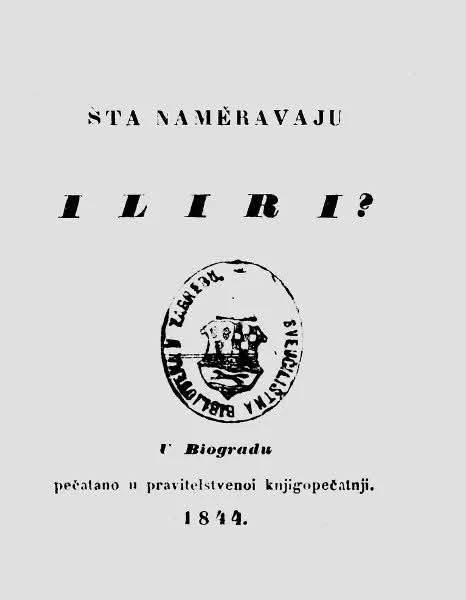
Political conflicts in Croatia, Hungarian slanders about alleged Illyrian efforts to create an Illyrian state outside the Habsburg Monarchy, and the court’s desire to calm Hungarian opposition led to the prohibition of the use of the Illyrian name and symbols in 1843. Despite this, the prohibition of the Illyrian name did not weaken the revival movement. Since it had by then become firmly established, it was no longer possible to threaten its foundations.
The Illyrian name no longer had greater importance, especially since it was not accepted by the other South Slavic peoples (Slovenes and Serbs). The movement was limited to the Croatian ethnic area and the Illyrian name was replaced by the Croatian one.
Although the measures prohibiting the Illyrian name limited the possibility of public expression of the movement’s political demands, it was precisely at this time that comprehensive political programmes were formulated, demanding an independent government for Croatia, the introduction of a national language as the official language and the union of Dalmatia with Croatia and Slavonia.
At the session of the Croatian Parliament in 1843, which was to elect its representatives to the Hungarian Parliament, I. Kukuljević Sakcinski delivered the first parliamentary speech in Croatian and proposed that the Croatian language be accepted as the official language instead of the previous Latin. The Croatian Parliament accepted this demand in 1847.
During the revolutionary events in Europe and the Habsburg Monarchy in 1848 the Croatian revival movement achieved some of the essential demands of its programme, but under unfavourable conditions that did not allow it to carry out further changes. Despite this, it fulfilled its historical task. The Croatian people gained a firm basis for development towards full national liberation.
Croatian National Revival in Dalmatia
The political, economic and cultural conditions in Dalmatia during the period of the Revival movement were markedly different from those in Ban’s Croatia. As an administrative unit, Dalmatia was subject to Austrian administration, but the consequences of the historical division (former Venetian possessions and the territory of the former Republic of Dubrovnik) were still felt in it.
Although Dalmatia was an integral part of the Croatian Kingdom, the Viennese government tried to isolate it from Croatia and subordinate it to its political, economic and strategic aims. In Dalmatia Italian was retained as the official and educational language, and the foreign administrative and judicial bureaucracy was a strong lever in the exercise of power.
In addition, Dalmatia was organised as a separate economic and customs area, included in the existing Austrian system. The main concern of the political and administrative authorities was simply to maintain the status quo and try to isolate Dalmatia from any external influence.
The economic backwardness of Dalmatia, whose development lagged behind that of other Austrian provinces, was accompanied by an underdeveloped social structure in which more than 90 % of the population consisted of peripheral peasants and peasants from the Dalmatian hinterland, economically even more backward. Apart from the bureaucracy and the clergy, a special group was formed by urban merchants and craftsmen, mainly immigrants from the Apennine Peninsula from the period of French administration.
Remnants of the Dalmatian patriciate also belonged to the small social elite. This oligarchic layer developed its own social and cultural consciousness. It saw its interest in preserving Dalmatia as a separate political and social entity, developing the Slav-Dalmatian ideology as the consciousness of a special community, which was in contradiction with the integration processes that led to the formation of Croatian national unity.
In the 1830s the first signs of social unrest appeared in Dalmatia, initially stimulated by the July Revolution in Paris in 1830, but they were reflected only in a narrow circle of the educated part of the urban population. The still small number of the new intelligentsia began to be strongly influenced by events in neighbouring Croatia, where the Illyrian movement was at its peak.
The first systematic signs of a national awakening, stimulated by the actions of the Illyrians, were directed mainly against the prevailing Italian language. This was also contributed to by Lj. Gaj’s journeys to Dalmatia in 1841, after which ever more sympathisers of the Illyrians and supporters of the ideas of the revival movement began to appear. In Dalmatia the group of Dubrovnik Illyrians was particularly prominent, and in this spirit Zora dalmatinska was also published in 1845–46, which was launched in Zadar in 1844 by A. Kuzmanić.
He gathered around himself a circle of people with the same ideas, who based Croatism on the Štokavian and Ikavian dialects. Resistance to the Illyrism of A. Kuzmanić did not follow particularist views but was based on an ideology that placed Croatism outside the framework of the South Slavs.
In the decade after the end of the Illyrian movement, in Dalmatia the liberal bourgeoisie opposed the oligarchic bourgeoisie with its social interest and its direction of national integration. The domination of the direction of Croatian national integration in the Dalmatian bourgeoisie was achieved through intensive work in all fields of political and cultural life. However, the processes of national integration in certain parts of Dalmatia proceeded differently.
The so-called peasant society in the interior of Dalmatia and in southern Dalmatia completed the revival period at the end of the 1860s, the Zadar-Šibenik area in the mid-1870s, and the process was most difficult in the Split area, where it reached its peak only at the beginning of the 1880s. At that time the Slav-Dalmatian alternative to the process of Croatian national integration was finally rejected. The victory of the People’s Party in the municipal elections in Split in 1882 marked the end of the revival period throughout Dalmatia.
Citation:
Croatian National Revival. Croatian Encyclopedia, online edition. Miroslav Krleža Lexicographic Institute, 2013–2025. Accessed 5 September 2025. https://enciklopedija.hr/clanak/hrvatski-narodni-preporod

