by Marios Dimopoulos
Abstract
Marios Dimopoulos argues that 19th- and early 20th-century Greek and Serbian sources treated “Slavomacedonians” (or “Macedono-Slavs”) as a distinct ethnic group, separate from both Bulgarians and Serbs. It cites ethnographic maps by the Greek Sotiriadis (1918) and the Serbian Cvijić (1913) that explicitly label them as such, as well as writings by Greek figures such as Ion Dragoumis and Konstantinos Tsioulkas, who portrayed the Slavic-speaking population of Macedonia as non-Bulgarian (and in extreme cases even linked their language to ancient Macedonian) in order to counter Bulgarian claims.
Drawing on the historian Georgios Nakratzas, the author describes the fluid national identities among Slavic-speakers in late-Ottoman Macedonia: Patriarchist Slavic-speakers tended toward Greek consciousness, while Exarchists split between Bulgarian and emerging Macedonian identities. This competition produced violent conflict during the Macedonian Struggle.
The text further contends that the modern Bulgarian national consciousness itself was a relatively recent construct, popularized by the 18th-century monk Paisius of Hilandar, and therefore that dismissing a Macedonian ethnicity as “artificial” is inconsistent.
The author rejects both Greek nationalist claims that a Macedonian identity was invented by Tito and reciprocal accusations of ethnic betrayal, insisting that national feeling is historically contingent while ethnic origins remain a separate question. He concludes that he supports no contemporary political side and merely records what the historical record shows.
When the Greeks wrote about the Slavo-Macedonians as distinct frm the Bulgarians in the 19th century
For months now I’ve been mocking you over the lies you tell about Albanians and Arvanites, using exclusively Greek sources (and what’s more, sources from nationalist or right-wing historians). And because you have no arguments to refute me, you resort to ad hominem attacks (“Turk-Albanian,” “anti-Greek,” “agent,” that I’m taking money from Rama, “mentally disturbed,” and a whole lot of other nonsense).
So let me mock you as well about the Slavomacedonians and the lies you tell that Macedonia was a creation of Tito, since Macedonians existed as a national designation distinct from the Greeks, and maps of “Slavic” Macedonia existed from the time when Tito was still a baby. And also that the Slavomacedonians were a separate “entity” from the Bulgarians or the Serbs, and what’s more, these Slavomacedonians, because they constituted a very large part of the population of Macedonia, Greeks such as Ion Dragoumis or Konstantinos Tsioulkas regarded them as Greeks, because if we had made the stupidity of regarding them as Bulgarians we would have scored an own goal nationally, and today Thessaloniki would be the capital of Bulgaria and Greece would begin from Thessaly.
IMAGE 1
Map of Macedonia from 1918 by the Greek ethnologist Sotiriadis. Although as a Greek he gives the majority to the Greek-speakers, on his map he records “Macedono Slavs” as something distinct from Bulgarians and Serbs.
IMAGE 2
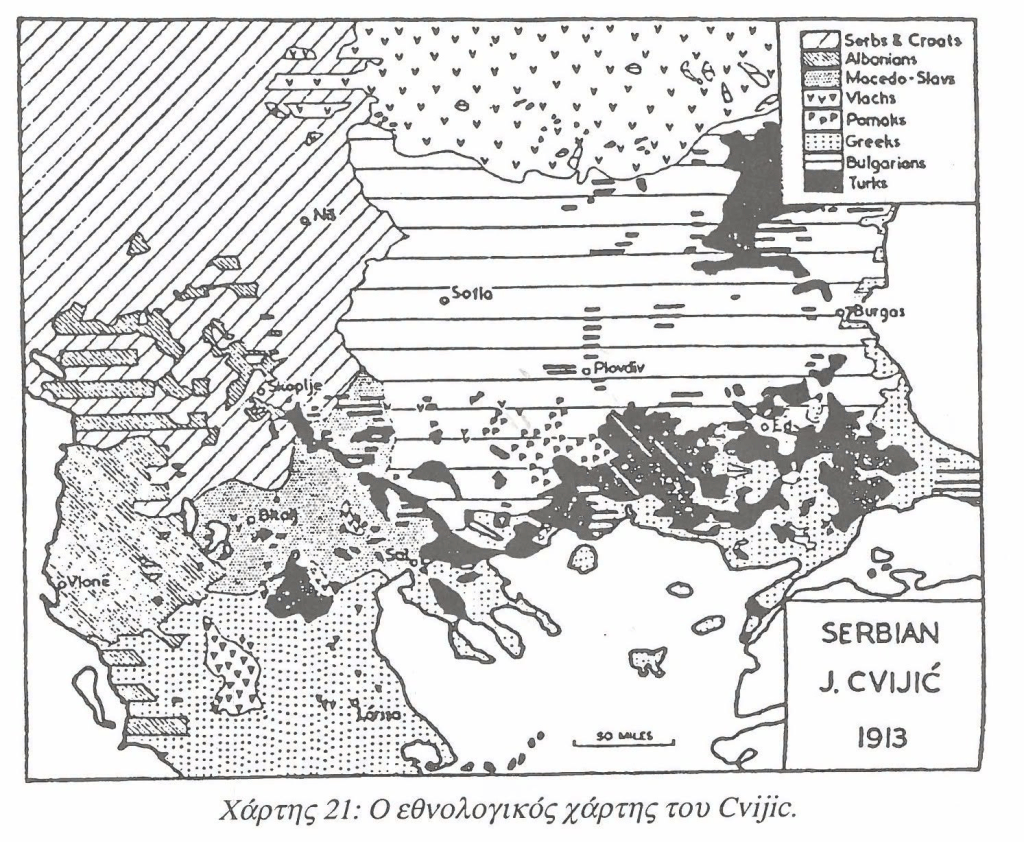
Map of Macedonia from 1913 by the Serbian ethnologist Cvijić. Although as a Slav he gives the majority to the Slavic-speakers, on his map he records “Macedono Slavs” as something distinct from Bulgarians and Serbs.
Therefore two official ethnologists of the early 20th century refer to a people of Slavomacedonians, a people distinct from the Bulgarians and the Serbs.
According to the diseased imagination of the historically ignorant Neo-Greeks of recent decades the term “Slavomacedonians” never existed, since the Slavomacedonians are… Bulgarians (the Bulgarian Foreign Ministry would be rubbing its hands with glee.) and any politician who dared to propose the compound term “Slavomacedonia,” “Slavomacedonians” was characterized by the uneducated Greekarés as a “traitor”.
A separate Macedonian ethnicity never existed, they said, but only a Bulgarian one. Let’s see what history says.
IMAGE 3
Excerpts from a history book:
“The consciousness confusion of the Slavic-speaking Macedonians was expressed in 1893 with the creation in Thessaloniki of IMRO (Internal Macedonian Revolutionary Organization)… This cultural confusion of the Slavic-speaking Macedonians led to their division into three mutually conflicting groups, more specifically into the Slavic-speaking Patriarchists with Greek national consciousness, the Slavic-speaking Exarchists with Bulgarian national consciousness, and the Slavic-speaking Exarchists with Macedonian national consciousness.”
So the Slavomacedonians, depending on which church they joined, also had a different national consciousness. The Patriarchists felt Greek, while the Exarchists felt Bulgarian or Macedonian. Just so you understand how the nations in which you believe as if they were a religion were created in the 19th and early 20th centuries.
We continue with what the book writes in Image 3:
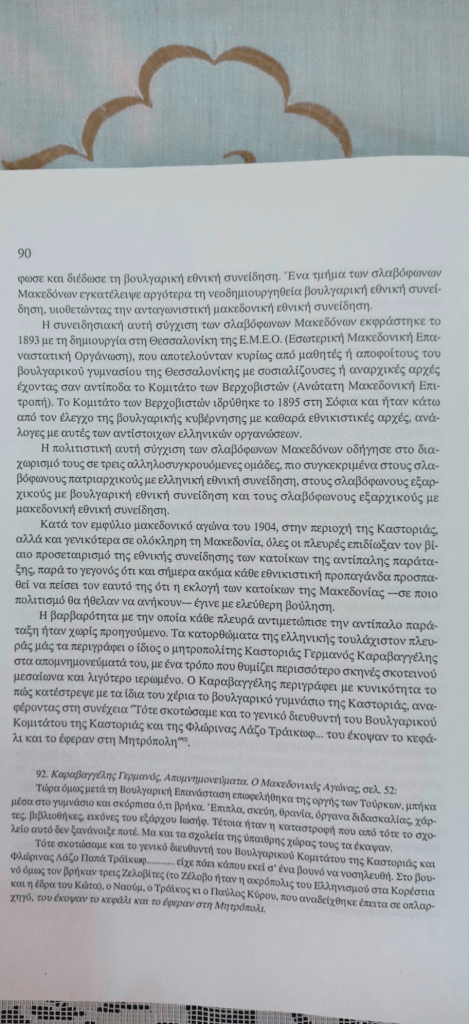
“During the Macedonian civil struggle of 1904 in the region of Kastoria, but also more generally throughout Macedonia, all sides sought the violent appropriation of the national consciousness of the inhabitants of the opposing faction… The barbarity with which each side treated the opponent was without precedent.”
And in Image 4 it continues:
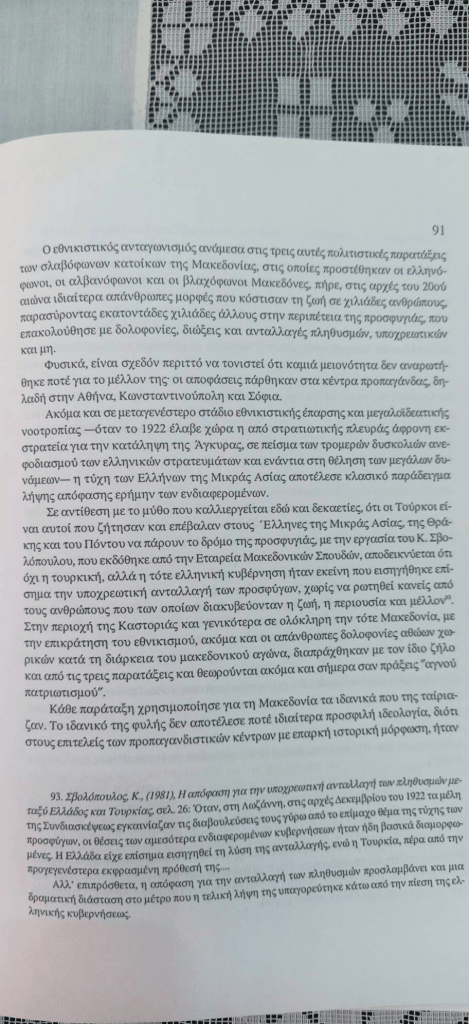
“The nationalist competition among these three cultural factions of the Slavic-speaking inhabitants of Macedonia, to which were added the Greek-speaking, the Albanian-speaking and the Vlach-speaking Macedonians, took particularly inhuman forms at the beginning of the 20th century that cost the lives of thousands of people, dragging hundreds of thousands of others into the adventure of refugee status that followed with murders, persecutions and population exchanges, compulsory and non-compulsory.”
[The above excerpts from the book by Georgios Nakratzas “The close ethnological kinship of today’s Greeks, Bulgarians and Turks.”]
IMAGE 5
Excerpt from the book by Ion Dragoumis (The Notebooks of Ilinden, p. XXVI) where he maintains that the language of the Slavomacedonians is not Bulgarian, but “how has a learned Greek Slavist still not been found to reveal and proclaim officially throughout the world the prevailing disastrous delusion. I fear that it may one day be proven that Alexander the Great rising from the grave would understand this allegedly Bulgarian dialect more easily than he would understand the allegedly more Greek idioms of the Cypriot and the Peloponnesian peasant.”
What a party. Both Ion Dragoumis and the northern Macedonian philologist from Monastir (Bitola) Konstantinos Tsioulkas with his book “Contributions to the Bilingualism of the Macedonians,” in order to save Macedonia from the Bulgarians, were not content with saying that the Slavomacedonians were of Greek origin and not Bulgarians, but also supported the exaggerated (in reality unscientific) view that the Slavomacedonian [language] was not Bulgarian but the language of Alexander the Great—an argumentation that is used today by the most extreme antiquolatric circles of the ethnic Macedonians (Slavomacedonians).
Finally, the argument of the Neo-Greeks that the Macedonian nation is artificial because they properly belong to the Bulgarian nation is half a load of nonsense, because if something like that is true, the same must be said about the Bulgarian nation.
A Bulgarian nation did not exist. In essence the Bulgarian nation and Bulgarian national consciousness were created thanks to the activity of the Bulgarian monk of Mount Athos, Paisius. This intellectual monk was the first Bulgarian who, in the era of national enlightenment that coincides with the era of the French Revolution, began to teach the Slavic-speaking inhabitants of today’s Bulgaria not to be ashamed to feel Bulgarian and to resist their Hellenization.
That is, if this Bulgarian intellectual monk had not existed, possibly today a large part or even all of the Bulgarians would be Greeks. Therefore if the Macedonian nation is artificial, you should say the same about the Bulgarian nation.
Finally we also have the following case: When I corner the Greekarés and they admit that the Arvanites were Albanians of the Middle Ages or that many Pontians do not have ancient Greek roots, as they believe, but are Lazes and other Asian tribes, they answer me: “And what does origin matter? What matters is what someone feels.” Therefore you are whatever you feel and declare. So a clever “Macedonian” will come and say to them: “Then why do you deny us the right to feel Macedonian?”
Because you will start the insults again and say that I support the Slavomacedonians as well (the so-called Skopjans), and I will end up taking money from the government of North Macedonia too (in the end I’ll become rich and won’t even know it.), I support no one, I say what is true. I am completely indifferent to what the Slavomacedonians feel and national consciousnesses do not concern me any more than religious beliefs do.
What interests me are the origins of the peoples and we know very well what the Slavomacedonians are from the point of view of origin, and how close they are both to the Greeks and to the Albanians. But I will not continue it because neither the Greeks, nor the Slavomacedonians, nor the Albanians are mature for such a discussion, so I stop it here. I am glad, however, that the Slavomacedonians are resisting their Bulgarianization (and I hope also their Serbianization). Save this post so that we can continue the discussion after 50 years, not us who will not be alive, but our children.