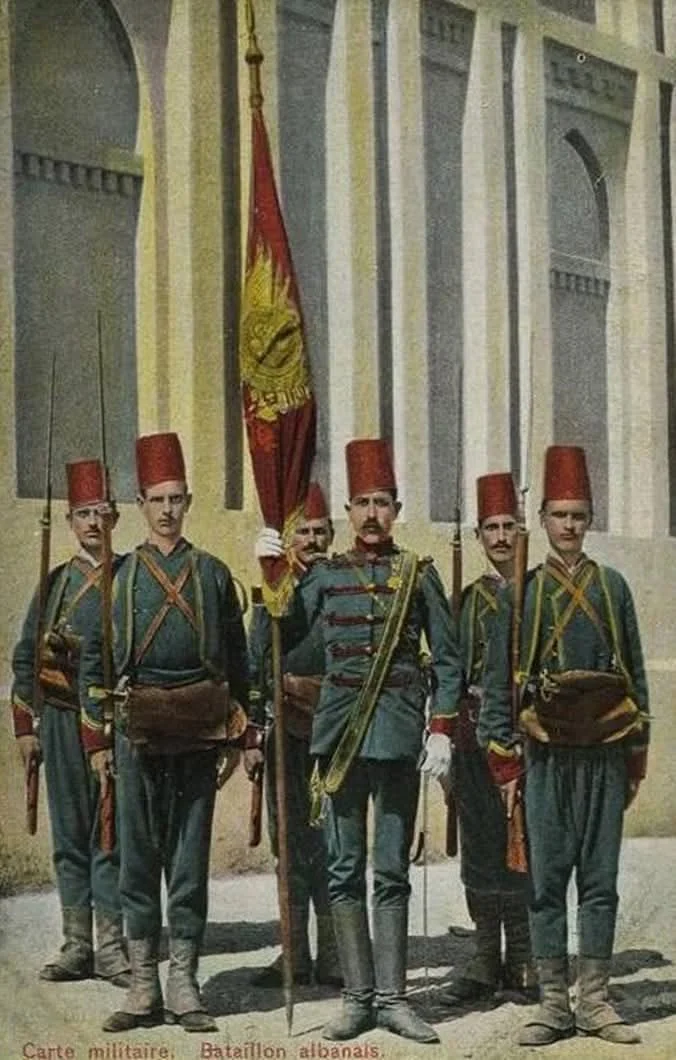

In the photo: Tahir Pasha’s guards, mostly from the Kraj, of the Yildiz Palace. Tahir Pasha holds the flag
12 Memories and the image of fear in Istanbul
1:00:03–1:01:03
Doğukan Oruç: Tahsin Pasha, one of Abdylhamit’s important men, writes in his memoirs: “The belief that they enjoyed a kind of immunity and that, whatever they did, they would go unpunished, was so deeply rooted in the mind that everyone, out of fear, tried to stay away from them. Such people did not listen to either the police or the order.” Ragıp Akyavaş, who spent his youth during that period, says: “In my childhood and youth, Albanians had a great reputation in Istanbul. They formed a privileged class. How could they not form one, when they relied on the sultan? When they said ‘düt’, even mountains and stones turned into goats. Tahir Pasha the Great and Tahir Pasha the Little, the Albanian Halil, the adjutant Gani Bey and others were among the most influential figures of this chimney. They could not be spoken to; law and order did not enter their work and their boasting did not go unnoticed.” This image was very dominant.
1:01:04–1:02:09
Doğukan Oruç: I also really like Halit Ziya Uşaklıgili’s story—it’s not a pleasant memory, but it’s very vivid. He worked at the Tobacco Administration. Visitors would come to his office from time to time, and he says openly: “I was afraid of them.” In some paragraphs he uses the words fear, shock, and horror several times. He describes very different figures, who did not resemble each other. “When they came, I was shocked; before, the servants who announced my arrival with signs of eyebrows were shocked. As soon as the rifleman entered, he pulled a chair in front of the table, approached it and sat down without waiting for permission. After sending a greeting from above, he rested his elbow on the table and, with his other hand, took out a letter from his chest, the envelope of which was blackened and wet with sweat: ‘Tahir Pasha sends his regards.’ It is a recommendation addressed to the administration and from the lame spelling it is clear from whose hand it came.” They should bring a badly written letter with a capada attitude.
1:02:10–1:03:26
Doğukan Oruç: What were they looking for? For example, the Kolcu post, the guards of the Directorate. The Directorate had a paramilitary organization that shot tobacco smugglers. The rifleman would give him the letter, look him straight in the eye and say: “Now you will give this guy a hand.” Poor Halit Ziya, with his Istanbulite civic nature, writes: “Who is Tahir Pasha? Who are his friends? I never knew them and I never met them. I may have seen their faces, but I could not learn which name belonged to which face. However, every time these names hit my ear, I felt a cold shiver from the top of my head to the soles of my feet.” You did not want to face them.
Presenter: Like the expression “brother makes you say goodbye”: there is something mafia about it. “You will give this guy a hand.”
Doğukan Oruç: There are also stories that the riflemen would go to the market, take goods, and when the merchant demanded payment, they would leave saying in broken Turkish: “We the sultan, we the sultan.” They knew the words “we” and “sultan”; even if they knew Turkish better, they would pretend they didn’t. It was a good way to play dumb.
1:03:27–1:04:35
Presenter: However, we must be a little fair. These were migrants, coming from far away, mostly from the villages; they were peasants, they did not know the language and no one taught them specifically. Even when they eventually learned to speak a little, they did not know how to write. They had left small, almost isolated settlements, and were locked up again in a ghetto inside the Yıldız Palace; only occasionally did they go out to Istanbul and return. Yes, they had the power behind them and I do not want to excuse their behavior, but you can understand where it came from. They brought with them the culture of the country. Albania and Bosnia were border regions, heavily armed: countries where weapons were strongly associated with manhood and actions that in Istanbul seemed like violence might not be seen the same there. The center did not understand this code; there things were regulated according to faith.
1:04:36–1:06:23
Presenter: During the 1911 uprising, this was also discussed in Parliament. The uprising was suppressed very harshly and the fundamental issue was the collection of Albanian weapons. Istanbul said: “In a civilized country, people do not walk around with weapons on their belts. You need permission; you can only carry a weapon with authorization.” He insisted on collecting their weapons, but the Albanians would not hand them over, because Istanbul had not understood the cultural code.
Ismail Qemal bey Vlora tells it beautifully in his memoirs. He had landed in Vlora and everyone welcomed him as an important figure. It was at that moment that the weapons were being collected. He saw a villager walking proudly with a large weapon on his belt, along with his wife and child. A gendarme approached him and told him that he had an order from Istanbul, that the sultan had banned weapons and that he had to hand them over. Ismail Qemal says that he began to pray: “Just let nothing happen; either the gendarme let him go this time, or the man give him the weapon and the job will be done.” The tension increased. The gendarme: “Give it to me.” The man: “I won’t give it.” Again: “Give it to me.” Again: “I won’t give it.” The Albanian pointed to his wife and child, as if to say: “Don’t humiliate me in front of them.” For him, handing over the weapon in front of his family touched on manhood. In the end, he drew his weapon and shot the gendarme to death.
1:06:24–1:07:29
Presenter: The man didn’t even run away; he walked away calmly. No one in Vlora had any intention of catching him as a murderer and handing him over to the police. People gathered around the wounded man, asked what they could do and asked for a doctor. The riflemen came from such a cultural world, and this had consequences for the life of Istanbul as well.
When the Parliament was discussing the issue, the deputy from Peja said: “Gentlemen, you in Istanbul carry canes. Young and elegant people walk with canes, not because they need support while walking, but for decoration. Even here, people do not necessarily carry guns to shoot each other. If you want to switch to a modern system, do it gradually; we have ingrained habits and do not immediately move to a completely different order.” These codes existed in the minds of the people, who also lived with constant clashes on the Montenegrin border.
1:07:30–1:08:43
Doğukan Oruç: You can see the consequences in the Palace. During Abdülhamit’s time, salaries were terribly late and this was common; while the salaries of the riflemen were not delayed. They were not used to such a thing. After the proclamation of the Constitution, their payment was delayed for about a week. Rıza Tevfik says: “I was walking down the street; the Constitution had been proclaimed. I saw Albanian riflemen who had surrounded a man, pushing him, lifting him and hitting him. I approached to see who it was.” They had caught Halis Bey, the accountant of the Imperial Treasury, and were beating him in the middle of the street: “Why don’t you give us our salary? You are withholding it from us and delaying it.” This also shows their naivety: they believed that the chief accountant did not give them their salary personally. Rıza Tevfik explained to them that this was not the case and calmed them down. These are the easiest examples—favoritism and intimidation were not just their job and could occur in many groups. But there are cases that become openly criminal and go unpunished.
1:08:44–1:10:16
Doğukan Oruç: A woman named Şayeste wrote a complaint: “I was staying at home when a man came. I asked him who he was. He said: ‘I am a rifleman, my name is Melik. The Sultan gave me this house.’ He beat me, threw me out and kept beating me until I lost consciousness. Now I cannot go back home; please help me.” When I read it, I thought it might be someone who was just pretending to be a rifleman. But there really was a rifleman named Melik and we can follow his career further. A year or two after Şayeste’s case, he got into trouble again because he beat up a chief commissioner named Zeki. However, no action was taken against him. On the contrary, after all this we find a document that increases his salary; in 1908 he was still a rifleman. As if they had quietly said to her: “You seem to need a house; here’s some money, so you don’t have to beat people.” I hope poor Şayeste has found a house and returned; I couldn’t follow the end of her case in the archive. Maybe they found another house for Melik too. Such things happened.
13 Violence, abuse and the reporting system
1:10:17–1:11:36
Doğukan Oruç: There is also a case of sexual violence related to a certain Rüstem Bey, and it is tragic. Süleyman was a fifteen-year-old boy who studied at the Kuleli Military High School; his father worked as a guard at the Greek Embassy. When he was released from boarding school, he went with his father to Beyoğlu to see the horse acrobats. In the evening, he separated from his father and set out to return, but it was too late. Rifleman Rüstem, together with a friend whose identity was not revealed even after the investigation, stopped him: “Is a man wandering outside at this hour?” They scared him a little and then said: “We will accompany you; such young boys do not walk alone at night.” According to Süleyman’s testimony, on the way they turned from a cemetery in Kasımpaşa, saying that it was a short distance, and there they tried to rape him. The boy screamed with all his might and they were scared. The case went to the Court of First Instance, but the proceedings were interrupted; Rustem’s fate is unknown and the case cannot be pursued further. Documents prove that such things also happened.
1:11:37–1:12:45
Presenter: Even the less shocking cases caught my attention: the debauchery and the riots they caused in the amusement arcades.
Doğukan Oruç: Yes, some of them loved the debauchery. Two riflemen—one with an unusual name that appears in the transcript as Farsi Bey, the other as İsmail Aga—went to a nightclub in Galata and then to the Mayo Hotel. The problem was that they were caught with the wives of two merchants from the Haliç, Emin Aga and Haşim Aga. So, two men had taken the wives of two other men and were taking them to the bars. The riflemen would also go out drinking with other Palace personnel. A rifleman Mustafa and a secretary of Mabeyn were seen in the bar of a certain Panyolaki in Galata. Then they walked the streets singing and shouting. When the police came up to them and asked them to be quiet, the riflemen did not back down at all.
1:12:46–1:14:42
Doğukan Oruç: They were sure that nothing would happen to them in the end. This conviction does not seem strange when you think about it together with Abdylhamit’s other practices. He did the same thing in the denunciation system: you could send him a false or completely absurd journal. There are denunciations where someone is accused only by name: “Mithat Efendi, whose inclination is understood even by the name Ahmet…” Even from these denunciations, a reward was extracted. When Abdylhamit was criticized, he would say: “I also know that they are lies or nonsense; but, if I do not give a reward today, tomorrow, when the denunciator sees something true, he will not tell me, because he will think that the sultan does not reward.”
He did the same thing when he tried to bring back the Young Turks from abroad with money. Sometimes I think that if you had enough savings in Istanbul to go to France, the best investment would be to go. Publish an article in Meşveret; someone would come from the Ottoman Embassy in Paris: “Aman, our father the Sultan was very upset. What did you do? Take this; we have found you another position and this much money.” Make it a little difficult; he would come back again, the position would become better and the amount would increase. Then you would come back. It seems like an easy way to make money, because the process worked like this all the time. Only when he was convinced that the man was completely incorruptible and could not be bought would the sultan say: “Okay, this is the enemy; don’t mess with him anymore.” Until then, the experiment with money continued. That was his model: to buy people or to protect the loyal ones around him; even if loyalty was based on interest, it didn’t bother him much.
1:14:43–1:15:38
Presenter: I remember a story about acts of espionage—I don’t remember if it was told by İsmail Hakkı Sencer or Murat Sertoğlu. When asked, “Why were the acts of spies and denunciations destroyed?” he replied, “Son, if we hadn’t destroyed them, there wouldn’t be a person left in this country whose face you could see.” Everyone, even some of the greatest defenders of freedom, would have sent denunciations to the Palace to get some kind of reward.
Doğukan Oruç: Exactly. That’s why the riflemen were convinced that, as long as there was no extraordinary scandal, opposing the police or gendarmerie would not bring them any consequences. Some even had relationships with known criminals.
1:15:39–1:16:59
Doğukan Oruç: In Galata, there lived a very famous thief, Süleyman, who made a living by stealing and the police could not catch him. He was under the protection of a rifleman named Kürt Ahmet. When the police started chasing Süleyman, Ahmet went and said to them: “Stop chasing. This thief is my man.” Since he clashed with the police, he was also interrogated. To scare them, he said: “With the blessing of the chief rifleman, let’s see: will you do it to me, or will I do it to you?” So, it was known that a guard of the sultan had a thief under his protection and threatened those who wanted to catch him. The state’s reaction was only a report: “The association of rifleman Kürt Ahmet with thieves and vagabonds of this kind can violate honor and dignity and bring various evils.” I expected the sentence to continue: “Therefore, this measure will be taken…” But no; higher authorities were only warned that the behavior could cause problems.
1:17:00–1:18:19
Doğukan Oruç: There is also a memory of live performances. In the 1920s, a well-known Istanbul instrumentalist, the lute master Ovrik Efendi, told of an evening where an Albanian rifleman appeared again. The musicians had finished and the bar had dispersed, but they were playing a little for their own enjoyment. “In a corner that we couldn’t see, there was a customer left: a big Albanian gunman. Suddenly he stood up and ordered us to play an Albanian tune. We started playing it, but for some reason he didn’t like it. With red eyes—he seemed very drunk—he overturned the tables and came towards us, unbuttoning his vest. The civil servants and policemen further away, when they saw the situation, must have said: ‘Poor man, he’s finished.’ We were trembling. Suddenly the man hit the lamp and knocked him to the ground. But at that very moment an employee passed by; he whispered something in his ear, patted his back, gave him a cigarette and calmed him down. That’s how we escaped.” In interviews with musicians and singers of the old days, gunmen also appear in completely unexpected places.
1:18:20–1:18:47
Presenter: When we say they influenced the social life of Istanbul, we mean cases like this. An early version of the episode when Bülent Ersoy was almost shot in Adana because he didn’t sing “Çırpınırdı Karadeniz” almost happened. It’s good that the musicians survived. One thing that particularly caught my attention in the thesis was the letter from Rifleman Bilal.
Doğukan Oruç: It gave me a lot of pleasure when I found it too.
14 Rifleman Bilal’s Letter: Capturing a Voice in the Archive
1:18:48–1:20:23
Doğukan Oruç: It is a last way to see the man himself. You can imagine how exciting it was: you write and search for riflemen all the time, you read the word “rifleman” everywhere, but since most of them could not read or write, you can’t find anything written by their hand. At one point I gave up hope: “I will never see any text that came out of the hands of these people; they are not people of the pen and they don’t write.” Then I came across something like “postcard with soldier”. I clicked, without much hope, thinking that it would be another document explaining the postcard. But behind it was the handwriting of rifleman Bilal.
Presenter: Was it in some private archive?
Doğukan Oruç: No, in our archive. The people he was complaining about had sent it as proof: “Look what rifleman Bilal writes to us.” That’s how it got into the file. Even when I saw it, I didn’t believe it was really a rifleman’s text. Then I noticed the word “tüfengi” underneath. When I went back to the whole file, I realized why it was attached. You can imagine my joy: it’s the only text from their hand that I could find. I think we should read Bilal’s letter.
1:20:24–1:21:28
Doğukan Oruç: First, we need context. Rifleman Bilal thought—to put it simply—that his wife was being held hostage by two high-ranking men: Major Nazmi and Colonel Sami. Before marrying Bilal, the woman had been the wife of Nazmi’s and Sami’s late brother; in other words, their former sister-in-law. Bilal would say: “Since she was your sister-in-law, you kidnapped my wife and child.” This became a fixed idea for him. A few months earlier, there had been another confrontation: when he had seen them on the street, he had threatened them, “Release my wife.” They had replied: “By God, we have done nothing; don’t hurt your wife.” In the end, Bilal sent them this letter.
1:21:29–1:22:31
Doğukan Oruç, reading the letter: “The insults you are both making to me and my family members would not be done even by a Russian cowherd.”
Presenter: Why does it say “Russian cow”?
Doğukan Oruç: When I looked up his lineage, I saw that he was from Ardahan. Therefore, the Russian was the “kaur” of his province—not the Serb or the Greek. The letter continues: “Although, according to Sharia, you are a stranger to my married wife and children, so you cannot have closeness with them, by what right and competence do you interfere and even threaten my wife? This is no longer tolerated. I have shown the greatest honor and respect for your military quality and the high ranks you hold.” One was a major, the other a colonel. “I have respected you and I am still obliged to respect you.” It begins very gentlemanly.
1:22:32–1:23:34
Doğukan Oruç, continuing the letter: “Take only Vahibe Hanemi with you”—I don’t know who Vahibe was—“but hand over my children and family to me and get them out of the house where you live. If you don’t do it, addressing only your persons, the wives of both of them…”
At this point comes a very serious insult, which the automatic transcript does not give in full. The letter, which began with “not even a Russian chauvinist would do it,” “I respect you for your ranks,” and “I am obliged to respect you,” suddenly switches to sexual threats against their wives. The last sentence is: “Don’t take me to that point. I warn you.” The speed with which it switches from politeness to insult is extraordinary.
1:23:35–1:24:35
Presenter: Could you find out if his wife had really been kidnapped, or maybe she had run away to her ex-in-laws and told them, “Protect me from this madman”?
Doğukan Oruç: The latter is more likely to have happened. Nazmi and Colonel Sami lived in a large house, in a well-known place in Kızıltoprak. If they held her hostage, the state would find her. The state reports demand that Bilal calm down. The woman may have taken the child and fled to the previous house, where they protected her; she may not have gone to them at all and hidden somewhere else. But Bilal’s mind must have been working like this: “Where could she be? She was married to their brother before me, so they must hide her.”
1:24:36–1:25:38
Presenter: The outburst of anger in the letter is wonderful: “I respect your ranks,” then suddenly it shifts to their wives.
Doğukan Oruç: Even when I read it in old Ottoman, I stopped: “Why is the word avrat here?” Then I understood what he wanted to do to the wives of both of them. But this also shows us how secure a rifleman felt: he was writing these things to a major and a colonel, important Ottoman commanders. On the side of the document there are administrative notes, but no punishment for swearing; only instructions to warn. Of course, Bilal was in crisis because of the disappearance of his wife, but he did not refrain from the threat.
1:25:39–1:26:22
Presenter: We have mentioned many names: Melik, Rüstem and now the rifleman Bilal from Ardahan. But there were also very famous figures. Let’s talk about Gani Bey Toptan, because in him the threat does not stop at a major; the story goes straight to the grand vizier. It is truly film material. We have also mentioned it several times on this channel; Mehmet Bey has dealt with the issue at length.
Doğukan Oruç: Yes, Gani Bey was a figure who came to the forefront in the affairs of the kapadains and the underworld. Even his brother, as is known…
15 Gani Bey Toptani: pedophilia, politics and murders
1:26:23–1:27:53
Doğukan Oruç: His brother was Esat Toptani, also a very interesting figure. The Toptanas are a family from the outskirts of Tirana that gained great influence. They are not a very ancient family; they came to the fore especially after the period of Ali Pasha. Gani Bey, a member of a family that had become one of the leading figures of Central Albania, stood out as a problematic type from a young age. We also have photographs; we could show one. I recently saw another one with better resolution, but I doubted if it was really him. Since the twenties, the people of the province had been annoyed by him. Ekrem Bey Vlora, whom we mentioned earlier, calls him “the most furious of the furious Albanian beys”; he did not like him at all. Another Albanian bey, Abidin Pasha, accused Gani of having burned his brother’s properties. Gani wandered around with a small group, as if he were playing a game, disturbing the country.
1:27:54–1:29:17
Doğukan Oruç: Before he came to Istanbul, the Austro-Hungarian and Russian Embassies sent complaints to the Ottoman government: “This man is wandering around the province and disrupting stability.” It was not a diplomatic crisis, but they wanted him to stop staying there. Surprisingly, folk songs glorified Gani Toptan as the classic figure of the kaçak: they praised him for distributing alms to the poor. He was exactly the “social bandit” of the era; apparently, he had also done some good to the poor. When a man caused so much trouble and made the country a mess, what did he do? He was brought to Istanbul and rewarded. In 1891, Gani was brought as a rifleman. In terms of social class and background, he was one of the exceptions in the troop, because he came from a prominent family. He became a rifleman in 1891 and, along with the inflation of the title of adjutant that we mentioned, in 1895 he also became adjutant.
1:29:18–1:31:02
Doğukan Oruç: After Gani Bey arrived in Istanbul, the Grand Vizier Halil Rıfat Pasha became concerned. A year or two later he began writing texts demanding his removal. We do not know whether he saw it as a duty of the Grand Vizier or whether there was a personal history between them; but he constantly complained that Gani should be removed, expelled from Istanbul, and that the country should be freed from his troubles. Abidin Pasha who had complained earlier was “Sarı Abidin Pasha”, the commentator of the Mesnevi and, if I am not mistaken, the grandfather of Abidin Dino. He was a commentator of the Mesnevi, a stock exchange commissioner, and Abdylaziz’s silahşor—a very colorful figure. He said that Gani had burned his brother’s farms. Halil Rıfat Pasha also wrote three, five times against Gani. It is precisely the insistence that makes it seem like there was something personal: it is unusual for the grand vizier to write so much about a single man in Istanbul.
1:31:03–1:32:41
Doğukan Oruç: Gani was accused of being a kapadain, taking tribute from casinos, frequent duels and other things. The enmity between the Grand Vizier Halil Rıfat Pasha and Gani did not appear openly in front of Istanbul, but with the vizier’s son, Cavit Bey, they broke out terribly. His father’s displeasure turned into open hostility towards Cavit; he called Gani “a murderer, a traitor, a kapadain”. There are two accounts of the cause. İbnülemin says that he asked people who knew the circumstances. According to them, Gani had a wife named Kamelya, something like his girlfriend, and Cavit Bey also liked her. One day Gani beat Kamelya badly; Cavit got angry and the fight escalated. Then Cavit became convinced that Gani would kill him. He said that he had heard threats like: “You will see what I will do to Cavit.” Maybe Gani was just bragging.
1:32:42–1:33:42
Doğukan Oruç: Reşat Ekrem Koçu gives a variant where everything is the same, except for one nuance that you can guess: instead of Kamelya, the person they were fighting over was the barber Tayyar. So, again a love triangle, only the boyfriend or girlfriend changes. Whatever the reason, Istanbul spoke of Caviti and Ganiu breaking up for this reason and that Caviti became obsessed with the thought “Ganiu will kill me”. Consider: Caviti was the son of the grand vizier. An Albanian rifleman from the province—influential, yes, but also a cappadocia—had the prime minister’s son write to the sultan several times: “Protect me; he might kill me.” They also provided him with protection, so the fear was taken seriously. But Caviti was not killed; surprisingly, the first to be killed in this story was Ganiu Bey.
1:33:43–1:34:43
Doğukan Oruç: One day, Gani was sitting in a pastry shop in Beyoğlu—the place is also known—and eating custard with his friend Hafız Ömer Pasha, a pasha from the Abdülhamid period, with golden epaulets and a serious appearance. Suddenly, Hafız Ömer took out his gun and shot him. Then he fled the country. Since Gani Toptani had been killed and his latest and most talked about enmity was with Cavit, people said: “Hafız Ömer was his friend; they had no quarrel. He did not kill him for personal reasons. Cavit incited him, because he was afraid that Gani would kill him; he killed him before he was killed.” This became a widespread belief.
1:34:44–1:36:23
Doğukan Oruç: Five or six months later, Cavit Bey was walking over the Galata Bridge to board the Islands ferry when an Albanian approached him and shot him. His name was Hacı Mustafa and he was said to be from Kraja. We can show a photograph of a Krajanese, to imagine what the killer might have looked like: with three guns in his belt. Refik Halit Karay was on the bridge that day and witnesses the event in one of his memoirs; he even describes the killer’s socks at length, in a very delicious text that, as far as I remember, ends with a remark about “gangsterism”. So we have the portrait of Gani Bey blowing like a storm. It is interesting that the position of rifleman was used to keep such a man under control and that he was also an adjutant. What did Gani Bey really do as a “guard of the Yıldız Palace”? Had they decided to keep him in a guard booth at the gate? Abdylhamit administered by creating exceptions upon exceptions; he acted the same way here.
1:36:24–1:37:48
Presenter: Halil Rıfat Pasha received the news of his son’s murder while he was on his sickbed and died a short time later. Abdylhamit was content with condolences. Hafız Ömeri, the murderer in the pastry shop, if I’m not mistaken, fled to Athens.
Doğukan Oruç: I tried to find out his fate, but I didn’t come up with much. I have the impression that, many years later—in the 1930s or 1940s—he gave an interview where he talked about the murder. I will look for it and, if I find it, I will send it. It seems to me that he was old and said: “Don’t ask me why I did it.” But we want to know exactly why! Cavit’s murder and Mustafa’s escape can still be understood as a personal crime in the middle of Istanbul. There are, however, more bizarre examples. Kolaşinli Halil Aga almost gathered a crew and a ship to establish his own state.
16 Halil Agha from Kolasin and Hamidian politics on the border
1:37:49–1:38:47
Doğukan Oruç: The story of Halil Ağa from Kolasin is extremely interesting. I had a lot of fun writing it; there were thirty or forty documents and I was more surprised by each one. We call the riflemen “Yıldız Palace guards”, but Halil may never have come to Istanbul. His post was sent from Istanbul. In every list of riflemen I saw, at the end there was a column “those who are on leave in their homeland” and Halil was always there. He had received an annual leave that extended him for dozens of years. Kolasin is now in Montenegro. In the Ottoman administration there were Kolasin-i Bala and Kolasin-i Zir, Upper and Lower Kolasin. Halil was a peasant from a village called Polje.
1:38:48–1:40:20
Doğukan Oruç: With the Treaty of Berlin of 1878, his birthplace remained in Montenegro. The family became muhajirs and crossed to the Ottoman side of the border. But the Ottoman-Montenegrin border had never been taken as seriously by the population as other borders. People had just come from the other side; they continued to cross there to graze their cattle. Even pillaging—to cross and steal something from someone—was seen as a legitimate economic practice, which was related to the geographical conditions. A person would get upset when their property was stolen, but then they would go and do the same thing. Halili left the village after suffering the hardships of migration. In 1886, rumors began that the land where the muhajirs had settled would also be given to Montenegro by an international agreement. After the trauma of Berlin, Albanians had a not-unfounded concern. When the Albanians refused to leave Ulcinj, the Ottoman army fought against them to hand the city over to Montenegro. The Albanians feared that the state would not be able to protect them, so they organized and armed themselves continuously.
1:40:21–1:41:54
Doğukan Oruç: Halili took the initiative himself. When it was heard that the Montenegrins were going to occupy that area as well, he crossed the border with a force—according to the Montenegrin complaint, two thousand men; according to the Ottoman investigation, two hundred or three hundred. They killed several Montenegrin soldiers at the border, including a captain, and they also killed civilians who fell into their hands, as if to say: “Since we came, let’s kill these too.” Of course, a diplomatic problem arose: a group crossed the border of another state, defined by international agreement, and killed soldiers and residents. Even two hundred or three hundred people were too many for the population of the villages there. The Ottoman government maneuvered: “There were not three thousand, but only two hundred; Halili acted on his own.” In this way, he calmed the situation and it did not turn into a war. The border had been violated often before, so the matter could be closed with: “Okay, just don’t let it happen again.”
1:41:55–1:43:10
Presenter: Was this the Albanian who appeared before the king of Montenegro?
Doğukan Oruç: No; there was another case where about fifty armed Albanians appeared before the king. Albanians, especially tribal leaders, met with him. Halili did not have such a meeting. After the attack across the border, they dragged him further inland, to Akovë, so that he would not stand on the border line. But there too he killed a Christian who “fell into his hands.” There were two people involved in the murder. One was convicted as a murderer; the victim’s sister insisted: “Halili killed him too; he was next to him.” However, Halili was not imprisoned. This time they dragged him to Skopje—he was finally approaching his place of duty in Istanbul. All this time he held the title Tüfengiyân-ı Hazret-i Şehriyârî. He stayed in Skopje for a year or a year and a half, then he was pardoned: “You can return to Akovë; if not to your village, at least there.” He returned and, after a few months, the Christians complained that he was beating them.
1:43:11–1:44:12
Doğukan Oruç: Mytesarifi wrote: “This man beats citizens everywhere; please remove him from the province.” Within four years, his record was: crossing the border without the state’s knowledge, killing soldiers from another state, killing a non-Muslim citizen, and beating several non-Muslims. In the end, the state said: “Let’s make him a district director.” A great solution. He was appointed to Rahovec with a salary of 400 grosz, with the idea: “At least he will stay in one place, we will know where he is and he will not cause too many problems.” Rahovec is near Peja in Kosovo. But after three months, Halili escaped without notice and returned to Akova. He definitely wanted to stay in that area and always found a way to return.
1:44:13–1:45:00
Doğukan Oruç: Then he officially resigned: “I couldn’t adapt to the climate”—the classic excuse, as if Rahovec and Akova were on different sides of the world. The state didn’t want to keep him in Akova anymore. Skopje hadn’t done any work, not even the post of district governor. So they put him on compulsory residence in Izmir. Finally, he crossed over to Anatolian soil. From there, he wrote a comical letter: “I have about twenty family members and I don’t have the money to bring them. Please help me with the travel expenses…”
17 Internment, forced residence and networks from the province to the center
1:45:01–1:46:01
Doğukan Oruç: Istanbul paid and brought his family of about twenty to Izmir. Halil stayed there for ten or twelve years; this was his quiet period and there were no incidents in Izmir. After about twelve years, they told him: “Now you can return to your homeland”—perhaps he had aged a little. Even though he lived in Izmir and held the title of rifleman, no one told him: “Come to Istanbul, at least serve in Yıldız.” He returned to his own country. His death is also strange. He was staying in the house of a fellow villager from Poland, a man named Ali. Ali’s wife, a Christian named Jovana, got up in the middle of the night while the others were sleeping and shot Halil in the head with a revolver. Thus ended the story of Halil from Kolasin: a life that began with violence and ended with violence, under the shadow of weapons.
1:46:02–1:47:38
Presenter: There are many beautiful examples of the excuse “I didn’t adapt to the climate”. After the assassination attempt on Mahmut Şevket Pasha, a group was interned in Sinop. Among them was the famous kapada of 1912, Arab Abdullah. He was already old, had become a little dull and could not hear well. Since he was from Suleymaniye, he could not pronounce the Turkish word yavru correctly and said yavri. He asked: “Send me to Medina, so that I can spend my last years there.” At the same time, another interned official complained: “I am miserable; the humid climate of Sinop is killing me. Please, take me to Medina; don’t send him.” The administration asked Arab Abdullah: “If you agree, we should send this other one; he says he will die here.” Abdullah said: “Okay, let him go.” The other one was told that he could go; then he changed his mind: “I withdrew.” In the end, neither was sent, and both remained in Sinop. The climate change issue is strange, because it was accepted as a perfectly legitimate reason for resignation or transfer, even between very close countries—not just when someone was going, for example, from Izmir to Aleppo.
In the live chat someone wrote “yavri”. Arab Abdullah also had an Armenian girlfriend, Hayganuş, whom he called “Yavri Hayganuş”. But that is another topic. When we look at the places they reached and the work they did, not all of them became important, but some did. Now we come to their leader.
1:47:39–1:49:43
Doğukan Oruç: His Majesty’s Chief Rifleman, the Albanian Tahir Pasha—an extraordinary figure. Before my thesis, I didn’t know his life in such detail. He is a character perfect for a movie, because the story of all the riflemen, in a way, is connected to him. He lived almost all the aspects we mentioned about this group in a single life. We can say that we saved the sweet spot for last. He is like a legendary chairman of Beşiktaş: he was the chief rifleman on the first day and remained the chief rifleman until the last day, when the regime fell.
On the screen we have a photograph of him in his mature years. In our archive there is also an earlier photograph, which Mehmet Berk Yaltık showed me. I like a quatrain that İbnülemin placed with the last Viziers and I also used it at the beginning of my study: “The high kindness of the majestic Sultan / gave fortune and power to Arnaut Aga who laid cobblestones; / the cobblestone maker became a high and peerless müşir; / in him may his nation be proud until the Day of Judgment.” It shows how Tahiri was perceived in the later period and gives some points of his life: from an Albanian cobblestone maker he became, thanks to the sultan, a müşir—marshal—and Albanians, according to the verses, can be proud of him until the Day of Judgment.
1:49:44–1:51:12
Doğukan Oruç: When we talk about Tahir Pasha and the riflemen, regional affiliation is important. You can find Albanians in many places in the Balkans: in Ioannina, Preveza, Kosovo, the present-day regions of Montenegro and, of course, in present-day Albania. But most of these riflemen came from a very small area called Krajë. Krajë is still very rural today. It is located near Lake Shkodra; we are showing a not very good map on the screen, which I made just to put a circle. It is above the coastal road, not Bar and Ulcinj; even today the roads are difficult. There is no place that you can call a city—only villages. Tahir Pasha was born there, in the early 1850s, in the village of Dragović. For some reason, Zeki Pakalı presented him in literature as a Dibra; then Kâmil Kepeci took him and everyone who wrote about Tahir repeated it. But he was not from Dibra; he was a Krajan.
1:51:13–1:52:42
Doğukan Oruç: From Cevdet Pasha’s reports we know what the country was like in the 1860s, when Tahiri was about ten years old, and we can feel the atmosphere. Cevdet had listed, area by area, how many men capable of arms the Vilayet of Shkodra could produce in case of need. For the Krajë he notes 700 Muslim houses and 150 Catholic ones, so about 850 houses, from which about 2,000 fighters could come out. It is a very high figure. I wrote it down at first without stopping; then Professor Aliu asked me: “Are you sure? Did you misprint or is the book wrong?” It was among the highest figures in all of Shkodra, a province that was already heavily armed. I checked the publication and even the Ottoman text; it was indeed said that 850 houses produced about 2,000 fighters—an average of three or four men for each house, not counting children, women, and the elderly. Tahiri grew up in the most heavily armed part of an already heavily armed area.
1:52:43–1:54:55
Doğukan Oruç: In the 1860s, Montenegrin attacks were very frequent. During the few months he was there, Cevdet Pasha faced them several times. There were attacks from Montenegro and groups that engaged in piracy on Lake Skadar kidnapped people. In that environment, Tahiri worked as a shepherd. His father’s name was Mehmet; we know from his seal, because Tahiri did not sign, but stamped “Tahir, son of Mehmet”. We do not know the name of his mother. A collector of local folklore, whose name appears in the transcript as Kolić or Koliqi, writes that Tahiri had kept cattle and that his family was not well-known or important.
Around the age of eighteen, nineteen, or a little over twenty, he came to Istanbul. There is a story that he fled from a blood feud, but it is found only in a French newspaper and is a rare thought. Perhaps they created a more dramatic story by combining the clichés “Albanian” and “blood feud”. Fortunately, during the Albanian national movement of the 1920s, local oral histories were collected and published in magazines. One of them tells the life of Tahir Pasha as remembered by the inhabitants of Krajë—a story that could still be easily recalled in the 1920s. They say that there was a great exodus in the area. Montenegrin attacks drove people out and the land was not very suitable for agriculture; they could mainly be engaged in livestock farming. So they headed for Istanbul, the center with the most opportunities.
18 Locals, cafes and connections between fellow countrymen
1:54:56–1:56:20
Doğukan Oruç: Tahiri came to the capital with a friend, whose name in the transcript is “Zevisi”. In Beşiktaş there was a local café, probably opened by a local who had settled earlier. It was an environment where fellow villagers met and socialized. They lived in Beşiktaş and worked at whatever job they could find; one of the main jobs was paving roads with stones. Perhaps the expression “Albanian cobblestones” arose from the fact that Albanians worked in this trade. Then their path passed to Abdylhamit’s guest house and they also started working as gardeners. It may seem strange: “Did these cobblestones know how to deal with flowers?” But we know that local people were skilled gardeners. Şemseddin Sami writes in Kâmûsü’l-A‘lâm that the Kraja produces skilled gardeners. Even in Istanbul it was common for a trade to be associated with people from a certain region. However, Tahir’s relationship with Abdylhamit did not arise simply from the gardener’s work; the prince did not wander around constantly chatting with his workers.
1:56:21–1:57:55
Doğukan Oruç: Here we have a semi-legendary and folkloric story, but it seems that there was a real event at its core. Tahiri was a tough guy and had a place in that subculture. One day, a Montenegrin captain entered the Krajans’ café, whose name is given as Mirko Bjelevi or something similar. The story uses an interesting symbolism: Mirko placed an apple in the middle and asked: “Is there anyone who dares to bite it?” Then he left. When Tahiri arrived, he asked what the apple was. They told him: “A Montenegrin brought it and asked if we had blood.” Tahiri bit it; this meant accepting the challenge.
The duel between Mirko and Tahiri became an event in Istanbul. With heroic feelings, some supported one and some the other. Tradition says that even Abdylhamit, then a prince, came and saw it. Even if he had not followed him himself, the news certainly reached him: “Our gardener has entered into such a business.” When he saw that the gardener had skills and knew how to fight, Tahiri gradually began to become his loyal man.
1:57:56–1:59:15
Doğukan Oruç: Since Abdülhamit was still a prince, Tahir was treated as a man of the rank of personal guard. Abdurrahman Şeref has a beautiful expression: “Abdülhamit, whose suspicion was older than the sultanate.” The people he trusted were very few and usually came from the ranks of the people: the chief wardrobe, people like Tahir and others. The chief wardrobe İsmet Bey, of course, was the son of the wet nurse; he had such connections. Abdülhamit was not a man who showed trust to grand viziers, high officials or, certainly, the sheikh of Islam. He had divided his limited capacity for trust among a few simple figures and that was enough for him. The discovery “what skills our gardener had” was the path that opened up for Tahir the position of rifleman.
1:59:16–2:00:00
Doğukan Oruç: When he ascended the throne, Abdülhamit took Tahir directly into service with the title of chief gunner. The date of Tahir’s entry into the Palace service is given as the date of Abdülhamit’s coronation. Think: in childhood you were a shepherd; in Istanbul you laid cobblestones; you were a street boy who knew how to fight; a prince notices you and now your master has become the sultan. This created a story of extraordinary rise. As soon as he became sultan, Abdülhamit provided Tahir with a house, a shop and water from the endowment of Mihrişah Valide Sultan.
19 The wealth, the mansions and the daily life of Tahir Pasha
2:00:01–2:01:03
Doğukan Oruç: When that house was taken away from him, so that he wouldn’t be bored, he was given Aziz Pasha’s mansion on the slopes of Serencebey—an area where there were also princely mansions, so not just any place. A single gift that Tahiri received, when I calculated it according to Şevket Pamuk’s work and adjusted it for inflation, came out to about 35,000 dollars in today’s dollars. So, there was a serious class leap. He bought land in Çatalca and the state took over paying his taxes. Among the sources of income were also interesting jobs.
2:01:04–2:02:20
Doğukan Oruç: When the Constitution was proclaimed and Abdylhamit was overthrown, Bursa still did not have a tram, but the concession for it had been given in the name of “Mehmet Ali Aga from Shkodra” and, as a concession, it had legal force. Only Mehmet Ali Aga was nowhere to be found. The deputies searched and asked who he was; the matter went from one session to the next. Reading the minutes, you finally see that Mehmet Ali Aga had never existed. The name referred to Tahir Pasha. Tahiri had entered the work under a pseudonym, had received the concession himself, but had not built the tram. So that the responsibility would not rest with him, a non-existent person was put forward. When the deputies got angry with the signatories of the concession, one defended himself: “With the letters that came with the signature of Tahsin, the chief secretary of His Majesty, thousands of soldiers were sent to Yemen, thousands of people were interned and hundreds of other things were done to them. Under those conditions, we could not say: ‘Aman, who is this Mehmet Ali Aga from Shkodra?’ Forgive us.” Tahiri also had such affairs.
2:02:21–2:03:50
Presenter: I’m taking a break with an anecdote. There is a famous story about an Albanian who, around that time, left his village and came to Istanbul, like Tahir Pasha. He didn’t know anything; he had little money in his pocket and was thinking: “Should I do this trade or that?” He entered the mosque. The imam said: “Give it to God; do karz-ı hasan. God gives a thousand for one.” The Albanian had a hundred florins and calculated that a hundred thousand would be good money. He asked the imam what he should do. “Give sadaqah and zakat,” he said. He distributed all the money.
With no money and no place to sleep, he spent the night on a tree. Below sat a pagan who made figures out of dough, gave them the names of prophets and ate them in turn: “I ate Moses; I ate Jesus.” Finally he made the largest figure and said: “This is God; now I will eat it.” The Albanian woke up and shouted: “Don’t eat that—he owes me!” He shot down and killed the pagan; then he found a hundred thousand florins and became rich. There is an anecdote with the sentence “He owes me”. It is the figure of the man who comes to Istanbul looking for an opportunity and, even before Tahir Pasha, fate comes before him with the strength of his arm.
2:03:51–2:04:59
Doğukan Oruç: Tahiri also had people who entered into tenders for his interests, just like the representatives of other influential people. Ebubekir Hazım Tepeyran, then a member of the Council of State, tells of a case regarding the concession of a chrome mine in Aydın. Two candidates, Hüsnü and Zühtü, were seeking it. The council discussed who had applied first and other technical issues, then decided that Hüsnü had the right and that he would be voted for. When the real vote came, everyone voted for Zühtü. The names are similar and we may have mixed them up, but that does not change the essence. One—the one they initially called right—represented the interests of the son-in-law of the sheikh-ul-Islam; the other represented Tahir Pasha. At the first meeting, they did not know this connection. When Ebubekir Hazım explained it to them, they were frightened and changed their vote.
20 Tahir Pasha’s habits and power in the Palace district
2:05:00–2:06:35
Doğukan Oruç: Ebubekir Hazım says that, at that time, not even the son-in-law of the sheikh-ul-Islam—not even the sheikh-ul-Islam himself—was able to match Tahir Pasha in terms of influence. In addition, Tahir had interesting habits. It all started with a headache that would not let him go. In writing the biography, it is paradoxical: he cannot find his mother’s name, because she came from a low class and no one recorded it; but in the documents he reveals that she suffered from chronic headaches.
I cannot call Tahir very religious, because I did not come across such evidence, but he was a believer and strongly believed in folk practices. People around him said: “He is a Yenişehirli Mehmet Hoxha; he has a strong spirit and reads prayers. Let him read for you.” Tahiri called him. Hoxha read and, apparently, it did him good. An ordinary person would say “thank you” and send him on his way; Tahiri invented a new position: “imam of the chief rifleman’s office.” It was not an official title; he paid his salary out of his own pocket: “Be the imam of our office.” Tahiri had a permanent office, visitors, staff, and a network of relationships.
2:06:36–2:08:13
Doğukan Oruç: Over time, it turned out that Yenişehirli Mehmet Hoxha was not just engaged in reciting prayers and blowing; he was becoming a serious practitioner of ilm-i havas, esoteric knowledge. Tahiri did not object at all. Hoxha started asking him for things, and Tahiri assigned the riflemen to help him. The pretext for everything was always Tahir Pasha’s headache. These people would do a thousand different things and, for each one, they would say: “We were trying to take away his headache.”
First, Hoxha said: “I need a book, Şemsü’l-Maârif.” It is a work by al-Buni and in the literature there is a debate about whether it should be called a book of magic: it has a strong Islamic character and does not openly say “this is magic”, but it clearly belongs to the tradition of ilm-i hawas, with squares and magic signs and other practices. The riflemen began to look for it in the libraries of Hagia Sophia and Bayezid. We know this because later it was suspected that Yenişehirli Mehmet Hoxha was trying to kill the sultan with magic; everyone was questioned and the details emerged from the minutes. Tahiri told the riflemen: “Go and find the book that this man is looking for.” They returned without finding it.
2:08:14–2:09:29
Doğukan Oruç: Among the visitors to Tahir’s office was İzzet Efendi from Gjirokastra, who said: “I have the book.” So, it wasn’t just Hoxha who was interested; they were among them. İzzet had many manuscripts and, apparently, a serious academic or personal interest in this literature. He gave the book to Mehmet Hoxha. The latter began to learn more practical methods from him. Once they went to the maşatlık, the Jewish cemetery, tied a vefk, a charm with signs, to the leg of a pigeon and released it. The rifleman accompanying them did not understand what was being done; in his testimony he only said: “Hoxha did this; we tied it to its leg and let it fly.” It seems that they were looking for treasure—perhaps where the pigeon would land or where the charm would fall.
2:09:30–2:10:01
Doğukan Oruç: Then Yenişehirli Hoxha said: “I need a house. I’m going to do something and I need a secret place; I can’t do it openly here.” He would do this too, supposedly, for the headache. Tahiri had a friend, or someone on whom his word or threat worked, Kazım Bey, with a villa in Çamlıca. At Tahiri’s request, Kazım gave the villa to Hoxha: “Take the upper floor and do whatever you want.” He also gave him a servant to help him.

