
by Prof. Dr. Pal Nikolli
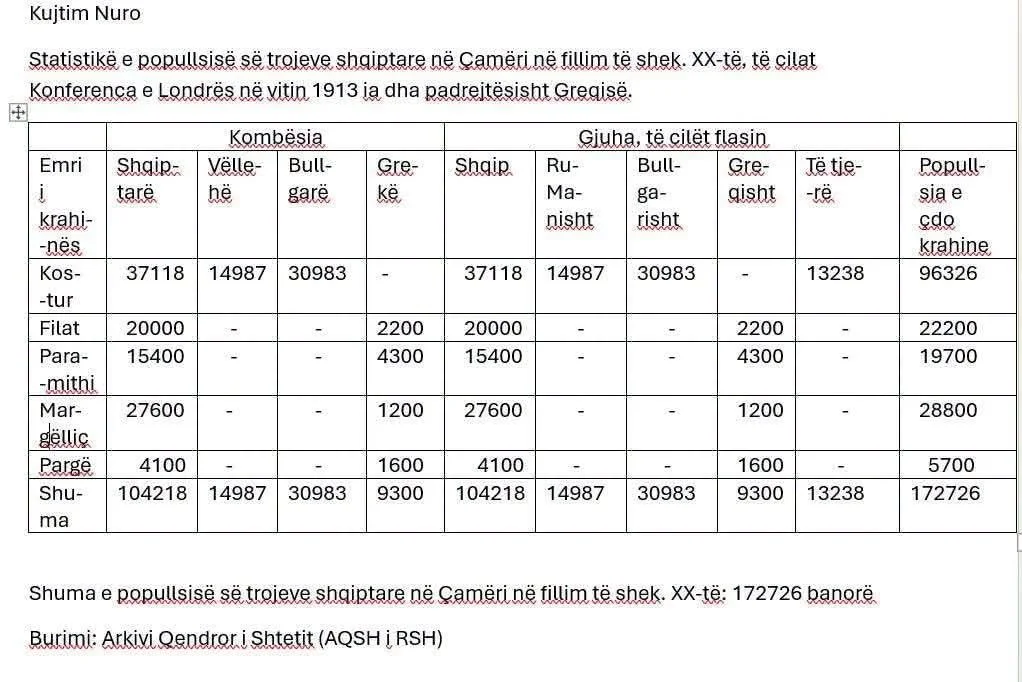
In light of the studies of the tireless and talented archival historian, Kujtim Nuro, the reconstruction of the demographic history of the Albanian lands takes on a new scientific and documentary dimension. Through careful research in the funds of the Central State Archives of the Republic of Albania (CSA of the Republic of Albania), Nuro has brought to light a monumental statistical overview of the early 20th century. This document demonstrates with surgical precision the ethnic, linguistic and religious structure of one of the most geopolitically controversial regions in the Balkans: the province of Chameria and border areas such as Kosturia, before the London Conference of 1913 unjustly severed them from their motherland to pass to Greece.
Geographical and territorial landscape of the area under study.
The document formulated and analyzed by historian Kujtim Nuro includes five key regions of that period: Kostur, Filati, Paramithi, Margellici and Parga. From a geographical point of view, this territory represents two strategic realities within the former Vilayet of Ioannina and the border areas with Macedonia:
- Chamerian Axis (Filat, Paramithi, Margëlliç, Parga): A region with vital access to the Ionian Sea (through Parga) and with fertile lowlands and river plains that enabled a developed land and sea trade.
– Kostur Province: Located further northeast, this area served as a geographical bridge between the Albanian-speaking, Slavic-speaking, and Greek worlds, which also explains the great clash of national interests at this point.
Statistical and ethno-linguistic analysis: The triumph of the Albanian element.
The data extracted by Kujtim Nuro present a total population of 172,726 inhabitants for the five provinces. When the nationality and language columns are broken down, an absolute correspondence is observed that scientifically confirms the autochthonousness and Albanian dominance. In the four provinces of Chameria, Albanians constituted the overwhelming majority: in Filat they reached 90% of the population (20,000 out of 22,200), in Margëllic 95.8% (27,600 out of 28,800), in Paramithi 78.1% and in Parga 71.9%.
On the other hand, Kostur appears as a more complex mosaic, where out of 96,326 inhabitants, Albanians led as the largest ethnic group with 38.5% (37,118 inhabitants), followed by Bulgarians/Slavophones with 32.1% (30,983 inhabitants) and Vlachs with 15.5% (14,987 inhabitants).
What makes this document indisputable is the linguistic criterion. The compilers of the statistics have recorded that 104,218 Albanians regularly spoke the Albanian language. This fact definitively overthrows the old Ottoman system of “Mileti” (which divided people only according to religion) and proves that the population had a clear national consciousness based on their native language.
Confessional Crossroads: Debunking Propaganda Myths.
[confessional is a term relating to religious belief, religious affiliation, or doctrine of a particular religion].
One of the most valuable contributions of this study is the possibility of cross-referencing ethnic data with religious belief data. The structure of belief provided for these regions reveals a complex reality:
- Kosturia: There were 37,118 Muslims and 45,970 Orthodox. Here the number of Muslims exactly matches the number of Albanians, which indicates that the Albanian element in this region was completely converted to Islam, while Orthodoxy was divided between Vlachs, Bulgarians and Greeks.
- Chameria and the reality of the Christian Chams: In the regions of Chameria (Filat, Paramithi, Margëlliç, Parga) the total number of Muslims was around 58,000, while the number of ethnic Albanians was 67,100. This mathematical difference of around 9,100 people proves the existence of a large mass of Orthodox Christian Albanians (Orthodox Chams). They spoke Albanian and identified themselves as Albanians, breaking the later myth of Greek propaganda that equated every Orthodox believer with Greek nationality.
Socio-economic and cultural development of the Vilayet of Ioannina.
These provinces were not simply numbers on a table, but vital units with significant economic, social and cultural development, occupying a primary place in the Vilayet of Ioannina. The region of Chameria was known as an agricultural granary, with high production of olive oil, citrus fruits, cereals and a developed livestock. Centers such as Filati and Paramithia served as trade hubs, while Parga served as a maritime bridge. This economic prosperity was also accompanied by cultural vitality; despite the lack of official schools in the Albanian language due to Ottoman prohibitions and pressure from the Patriarchate, the Albanian language and traditions were kept alive in every family.
Conclusions: The injustice of London 1913 and its consequences.
The statistics brought to light by Kujtim Nuro provide the most powerful historical argument as to why the decision of the London Conference of 1913 was a tragedy and a blatant geopolitical injustice. The Great Powers completely ignored the principle of ethnic self-determination and the will of the local population. By donating territories to Greece where the Albanian element dominated by over 80%, they paved the way for a long ordeal of suffering for the Cham population.
This precise documentation serves as evidence of the ethnic cleansing and cultural assimilation that followed in the following decades (culminating in the tragedy of 1944-1945). Thanks to the scholarly work of historians like Kujtim Nuro, this data remains etched in Albanian historiography as an indelible indictment of the decisions that tore the Albanian nation apart.

