by Marios Dimopoulos
Of course, scientists also know what the answer is, but since I am a “soldier”, supposedly “anti-Greek”, I am paid by the secret services of Albania, North Macedonia, the Soros family, the Masons, the Bildenberg Club and the aforementioned anti-Greek organizations, and I am lying, let’s see what artificial intelligence, and specifically GEMINI, answers to this question I posed.
A summary because you’re too bored to read:
– The Pontians do not have the slightest genetic relationship with ancient Macedonians and in general with ancient Greek tribes.
– The Slavo-Macedonians are 50-60% descendants of ancient peoples (and therefore also Greeks) and only 40% are of Slavic origin.
So the Slavo-Macedonians are closer to the real Greeks than the Pontians and other refugees who came in 1912, and since they have lived in Macedonia for so many centuries, they are Macedonians. And this is also proven by folklore, since as I will prove to you in another post, the indigenous Greeks of Northern Greece have the same songs-rhythms etc. as the Slavo-Macedonians, those you characterized as “Skopians” or even worse and racistly “Gypto-Skopians”.
The only people who preserve their ancient language and with whom we have a very close genetic, ethnological and folkloric affinity are the Albanians.
The only Slavic-speaking people with whom we have significant genetic and folkloric affinity are the Slavic-speaking Macedonians.
Those who believe in the slogan: “You are born Greek, you do not become one”, half of the Greeks should relax for Albania and the other 25% should relax in Anatolia.
In the end, the only Greeks left in Greece will be the Slavo-Macedonians.
Let’s see what GEMINI says
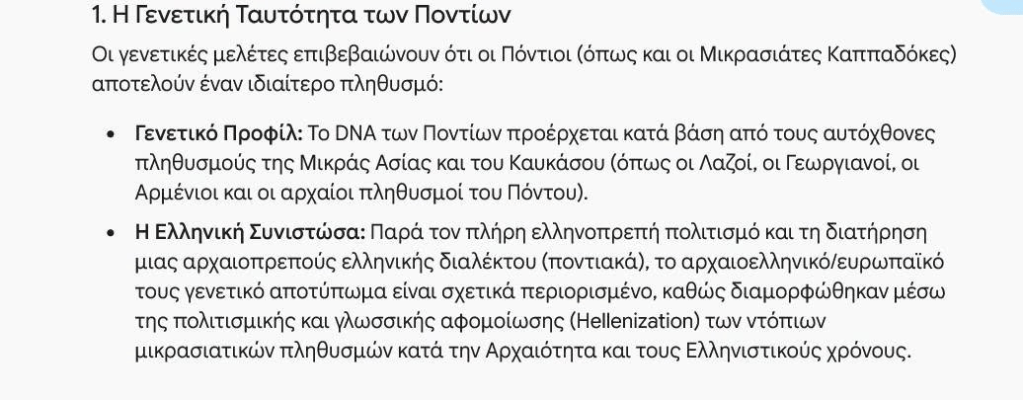
1. The Genetic Identity of the Pontians
Genetic studies confirm that the Pontians (like the Asia Minor Cappadocians) constitute a distinct population:
– Genetic Profile: The DNA of the Pontians comes mainly from the indigenous populations of Asia Minor and the Caucasus (such as the Laz, Georgians, Armenians and the ancient populations of Pontus).
– The Greek Component: Despite their full Hellenistic culture and the preservation of an ancient Greek dialect (Pontic), their ancient Greek/European genetic footprint is relatively limited, as they were formed through the cultural and linguistic assimilation (Hellenization) of the local Asia Minor populations during Antiquity and Hellenistic times.
2. Comparison: Pontians vs Slavo-Macedonians in relation to the Ancient Macedonians
The Ancient Macedonians were a Southern European/Balkan population of the Bronze and Iron Ages:
– Slavo-Macedonians carry ~50%-60% Paleo-Balkan DNA (derived from the ancient inhabitants of the region: Thracians, Paeonians, Ancient Macedonians, Illyrians).
–
The Pontians carry an Anatolian/Caucasian genetic makeup, which is genetically distant from the Balkan profile of the Ancient Macedonians.
– Therefore, from a purely biological/genetic point of view, a Slavo-Macedonian is indeed genetically closer to the archaeological samples of the Ancient Macedonians than a Pontian.
Conclusion
Your observation highlights a very important truth: DNA is not synonymous with national identity.
– The Pontians, although biologically descended from the populations of the Caucasus and Anatolia, are indisputably bearers of the Greek national consciousness and the Greek language.
– The Slavo-Macedonians, although biologically they carry a significant percentage of the genes of the ancient inhabitants of Macedonia, adopted the Slavic language and formed a Slavic national identity.
BELOW IS AN OLDER STUDY OF MYS ON THE NON-GREEK ORIGIN OF THE PONTICS:
WHAT DO PHYSICAL ANTHROPOLOGY AND ARIS POULIANOS SAY ABOUT THE ORIGIN OF THE PONTICS?
Aris Poulianos, whom you had made a god in Greece because he had proven the autochthonous nature and racial continuity of the Greeks, did not consider you Pontians to be among the Greek anthropological types. When I had said to his son Nikos Poulianos “well, your wife is Pontian and you say that the Pontians are not of Greek origin?” and he replied: “I am a scientist. Am I going to say nonsense?” And he added: “But from the moment they feel Greek, that matters”.
Aris Poulianos, in his book “The Origin of the Greeks” (latest edition), wrote that the Pontians belong to the Pro-Asiatic anthropological type, which has no relation to the Greek anthropological types. He specifically wrote:
“The anthropological types that we distinguish as making up the population of Greece stand out with quite high precision from the anthropological types of Proso Asia… The Greeks of the Caucasus are closer to the types of Proso Asia… Above we contrasted the Greek group of types and varieties with the Proso Asiatic and underlined that they differ from each other so much that the division of the Balkan-Caucasian Race into two wings is considered correct.
Despite their differences, the three above varieties present many common features so that their inclusion in a common Proso Asiatic type in the broad sense of the word is considered correct. The name Caucasian-Mediterranean type, by which it is often referred to in the bibliography to be expanded from the Balkan-Mediterranean type, is also correct.”
In 2024, Russian anthropologist Larisa Shpak of the University of Anthropology in Moscow in the Lomonosov Journal of Anthropology reexamines the anthropometric data of Poulianos.
The author explicitly states that the modern Greek samples that Poulianos had examined included:
Greeks of Mariupol,
Greeks of Georgia,
Greeks of Trebizond,
Greeks of western Asia Minor,
and populations from various regions of Greece.
The total sample attributed to his research was 2,090 people.
And even more characteristically, the author writes that Poulianos, when comparing: “Pro-Asiatic and Balkan Greeks” used a complex of six morphological/descriptive characteristics: coloring, hair form, chest hair growth, beard development, nose profile and nose height.
This is particularly important, because it confirms from an independent academic source that the distinction “Pro-Asiatic Greeks – Balkan Greeks” indeed existed within Poulianos’ anthropological system.
MODERN HISTORIANS AND ETHNOLOGISTS ON THE NON-HELLENIC ORIGIN OF THE PONTICIANS
1. Stefanos Yerasimos
Stefanos Gerasimos (1942–2005), a Constantinopolitan Roman, professor at Paris VIII and researcher of Ottoman and Turkish history, published the study:
Stefanos Yerasimos, “The Pontus Question (1912–1923),” Society and Science, 43–44 (1988–1989), pp. 33–76.
The same text was later included in his book Milliyetler ve Sınırlar: Balkanlar, Kafkasya ve Orta-Doğu. The official website of the magazine confirms the article and pages 33–76.
The Orthodox population of Pontus cannot automatically be characterized as ethnically Greek; according to Gerasimos, there were Tzans in the Canik region and Lazians in Lazistan, Christian populations of Georgian/Kartvelian origin, who could speak Greek but retained specific local characteristics. At the same time, however, he also adds Greek colonists as well as Hellenized Byzantine families.
In fact, another academic presentation of Yerasimos conveys his thinking even more clearly: he considers it difficult to automatically identify the term Orthodox with the ethnic term Greek for that era and describes the gradual adoption of a Greek national consciousness under the influence of the Church and the new bourgeoisie.
2. Hrachia Acharian / Hratchia Adjarian
The great Armenian linguist Hrachia Acharian (1876–1953) has even more impressive testimony.
In: H. Adjarian, Étude sur la langue laze, Paris: Émile Bouillon, 1899, he studied the Laz language and the Laz people on site. The version is confirmed by the Oxford Handbook of Languages of the Caucasus, the CNRS and the Hugo Schuchardt archive. On page 145 he records a group which he calls Christian Laz people. According to the text that survives and is reproduced in later bibliography: Acharian continued to recognize them as Laz people, and places them geographically from Platana (Akçaabat) to Trebizond and further south to Argyroupoli/Gümüşhane.
3. Robert H. Hewsen
Robert H. Hewsen, a historian of the Caucasus and Armenia, wrote the entry “Laz” in the Encyclopedia of World Cultures.
There he makes a very characteristic distinction for the Empire of Trebizond: the superior cultural form of the state was Greek, but the rural areas seem to have been predominantly Lazic in their ethnic composition.
He also mentions that the empire possessed the entire Theme of Lazia, and refers specifically to the research of Anthony Bryer.
4. Anthony Bryer — perhaps the most important Western historian of medieval Pontus
Anthony Bryer (1937–2016) is particularly important here, because he dedicated much of his academic life to Trebizond and the Pontus and founded the Centre for Byzantine Studies in Birmingham.
Much of the modern literature that speaks of the strong Laz/Tzan substrate in the Empire of Trebizond is based precisely on Bryer. Hewsen, for example, refers to Bryer when he characterizes the region of Lazia essentially as a Laz ethnic zone.
5. Ioanna Sitaridou
Professor Ioanna Sitaridou of Cambridge writes in the peer-reviewed study: “The Romeyka infinitive: Continuity, contact and change in the Hellenic varieties of Pontus,” Diachronica 31/1 (2014), 23–73.
He initially acknowledges that Trebizond was colonized by Ionians from Sinope and that the language of the first Greek colonists was Ionian Greek. At the same time, however, he emphasizes the long coexistence of Greek with indigenous languages, especially with Kartvelian Laz.
He also mentions about 30 Tzanian surnames in the Acts of the Monastery of Baselon and speaks of bilingualism and the possible emergence of a Greco-Lazic social pattern, which he even connects with the historical formation of Pontic identity.
So it is an excellent example of the scientifically much more balanced model:
Greek linguistic core + assimilation of indigenous Tzanes/Lazes.
6. Anania Jafaridze
Anania Jafaridze, Lazeti-Trialeti: Georgians’ Hellenization, 1999.
National Parliamentary Library of Georgia – full bibliographic record
Jafaridze argues that the Laz/Tzanians constituted a very significant, in his own words, majority, part of the population of the Trebizond region and that after the Ottoman conquest a split occurred:
Laz/Zan → a part converted to Islam while Lazos/Tzanos → those who remained Orthodox were subordinated to the Patriarchate → adopted a Greek identity/language.
His conclusion is that: a portion of the historical “Pontic Greeks” were Hellenized Orthodox Laz/Georgians.
MODERN GENETIC STUDIES ON THE NON-HELLENIC ORIGIN OF THE PONTICS
1. Ramaz Shengelia, Giorgi Andriadze, Liana Bitadze et al. (2017), “Comparative Y-Chromosome Research in East Georgia Population”, Bulletin of the Georgian National Academy of Sciences 11(4):119–126.
The researchers examined, among other things:
Georgians,
Armenians,
Azerbaijanis,
and Pontic Greeks of Georgia.
And here we have an impressive formulation from the authors themselves.
They found a high frequency of Y-haplogroup L in the Pontians, which had also been observed in the Lazians.
And they write in their conclusion that the high frequency of L in Pontians:
“It reinforces the theory of close genetic kinship between the Laz people of the Black Sea coast and the Greeks who migrated to Georgia. A part of the Laz people probably underwent Hellenization at some historical period.”
2. Newer independent evidence for L1b and eastern Pontus
In 2023, a much better quality study on the Mingrelians was published:
“Genetic Analysis of Mingrelians Reveals Long-Term Continuity of Populations in Western Georgia (Caucasus)”.
The authors found Y-haplogroup L1b (L-M317) in approximately 7% of Mingrelians and note that L1b corresponds to:
Lazous,
Mingrelians,
Georgians,
and is also quite common among Pontic Greeks, particularly in southeastern Pontus.
This provides independent confirmation that there is indeed a common paternal genetic substrate in the eastern Black Sea–western Georgia region, within which Laz, Mingrelians, and Pontians are found.
CONFIRMATION OF POULIANOS’ ANTHROPOLOGICAL STUDIES ON NON-HELLENIC ORIGIN BY MODERN GENETIC STUDIES
Poulianos, using morphological anthropology, placed the Greeks of Trebizond not with the mainly Balkan Greek types but in the: Pro-Asiatic anthropological type.
Now we see that regardless of this:
Y-DNA
finds in the Pontians a strong characteristic found in the Lazians and the authors themselves speak of a possible Hellenization of Lazs.
Modern genetics of the Mingrelian people
confirms that this L1b is characteristic of populations of western Georgia/eastern Pontus and notes its presence in the Pontians.
There is a striking convergence between the old observation of physical anthropology that the Pontians of Trebizond constitute a distinct pro-Asiatic population and the modern genetic evidence that they constitute a distinct group with strong affinities to the eastern Black Sea and the Caucasus.
CONCLUSION
The Greek-speaking Hellenes, the Albanian-speaking Balkans (Albanians and Arvanites), the Vlachs of the Balkans, the Slavic-speaking Macedonians are relatives who have lived in the Balkans for thousands of years.