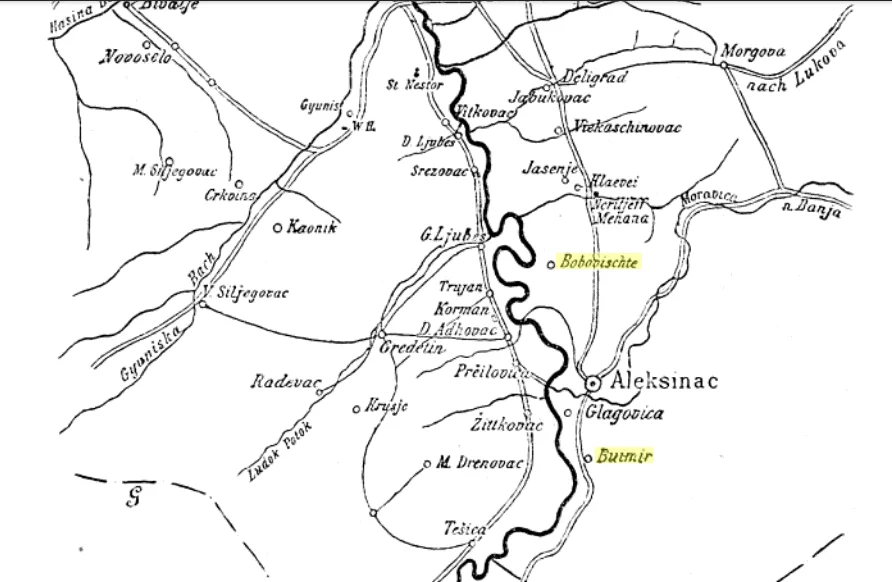

Bobovište and Bujmir as Possible Albanian Toponyms
Toponymy can preserve linguistic evidence long after the language that originally created a place-name has disappeared from everyday use. This is particularly important in the Balkans, where successive periods of Ottoman, Slavic, Albanian, Romance and other linguistic influence have produced a complex and layered geographical vocabulary. Place-names should therefore not be interpreted merely according to the language spoken by the inhabitants at the time when the name was recorded. Their morphology, etymology and semantic structure may preserve much older linguistic strata.
Two place-names in the Aleksinac area — Bobovište and Bujmir (Bujimir) — deserve particular attention from this perspective.
The modern municipality of Aleksinac includes both Bobovište and Aleksinački Bujmir, while historical documentation shows that Bobovište was already recorded in Ottoman administrative material in the sixteenth century. In the Ottoman register, the settlement appears as Bobovişte, and it is identified with the modern village of Bobovište north of Aleksinac.
The significance of -ište (ishtë)
The ending -ište (-ishtë) is particularly interesting. At first sight, -ište appears to be an unmistakably South Slavic formation. Indeed, the Albanian form -ishtë is generally regarded as historically connected with the Slavic locative or collective suffix -ište. Yet this does not make the suffix irrelevant to Albanian toponymy. On the contrary, -ishtë became productive in Albanian and occurs in Albanian place- and landscape vocabulary.
Albanian examples include formations such as ahishtë ‘beech grove’, lulishte ‘flower garden’, and misërishte ‘cornfield’. Linguistic literature describes -ishtë/-ishte as a place-forming or collective suffix in Albanian.
This is important for the interpretation of Bobovište. The mere presence of -ište cannot prove that a particular place-name is Albanian, since the suffix is also native and highly productive in the South Slavic languages.
Nevertheless, the suffix is entirely compatible with Albanian word formation and, in certain historical contexts, may have been incorporated into Albanian toponymic morphology through prolonged Slavic–Albanian contact. One study of Slavic-Albanian contact explicitly notes the productive use of -ishte in Albanian for locations, giving examples such as ranishte.
Bobovište
The name Bobovište is conventionally understandable in a Slavic framework: bob denotes the broad-bean (bean plant), while -ište forms a place-name referring to a place characterized by the base noun. Such an interpretation would produce approximately “a place where beans are grown”. Comparable formations are found elsewhere in the South Slavic linguistic area.
However, the existence of a straightforward Slavic interpretation does not automatically exclude an Albanian linguistic history. The name is especially interesting because Bobovište also occurs in Albanian onomastic material. A recent survey of Albanian onomastics lists Boboshticë in Korçë alongside Boboshti (Bobovište) in Montenegro and, significantly, Bobovište in Aleksinac.
This does not constitute proof that the population of Aleksinac’s Bobovište was Albanian. It does, however, demonstrate that the toponym belongs to a geographical and morphological pattern in which forms containing Bob(o)- and -ishtë/-ište occur across areas with documented Albanian linguistic presence.
The comparison becomes more interesting when we consider the semantic structure. Albanian toponymy frequently forms landscape names by combining a lexical root with a collective or locative suffix. Thus a name can be understood not merely as a lexical item but as a description of a landscape or agricultural environment. The productivity of -ishtë in Albanian is well documented, particularly in phytotoponymy.
Bujmir
The second name, Bujmir, is perhaps more intriguing. The settlement is today known as Aleksinački Bujmir, while the older and shorter form Bujmir is also documented. The municipality contains another settlement, Moravski Bujmir, showing that the name has had a wider local distribution.
The form Bujmir invites comparison with Albanian bujë and mirë. In Albanian, mirë means “good”, while bujë is a native Albanian noun associated with fame, reputation, renown and public reputation. The compound bujë + mirë can consequently be interpreted semantically as something resembling “good fame”, “good reputation” or “of good renown.”
Such a compound is structurally plausible in Albanian: a lexical noun followed by mirë can form an expressive semantic unit in which the second element qualifies the first. The resulting place-name could have originated as a personal name, clan name, descriptive expression or settlement designation and subsequently become fixed as a toponym.
This possibility is particularly worth considering because Bujmir has also been interpreted in Albanian-oriented toponymic literature as Albanian bujë ‘fame’ + mirë ‘good’.
Toponymy and linguistic survival
The Aleksinac region is particularly suitable for this kind of investigation because its historical toponymy reflects several centuries of linguistic interaction. Bobovište is already attested in the Ottoman period, appearing as Bobovişte in the sixteenth-century register, while Bujmir was a known settlement in the nineteenth-century landscape around Aleksinac.
A hypothesis rather than a simplistic conclusion
The evidence does not justify the simplistic statement that Bobovište and Bujmir are “proven Albanian names.” Such a conclusion would require a much broader corpus: early Ottoman forms, cadastral material, nineteenth-century maps, local anthroponymy, migration patterns, dialect evidence and comparisons with neighbouring Albanian toponymy.
Nevertheless, the names present a credible case for investigating an Albanian linguistic layer in the historical toponymy of Aleksinac.
For Bobovište, the important observation is the compatibility of its morphological structure with Albanian -ishtë, a suffix that became productive in Albanian despite its historical connection with Slavic -ište. The parallel occurrence of Boboshticë, Boboshti, Bobovište within Albanian onomastic geography strengthens the comparative argument, although it does not by itself establish an Albanian origin.
For Bujmir, the Albanian interpretation is semantically more distinctive: bujë + mirë, approximately “good fame” or “good renown”. The existence of a competing Slavic interpretation based on the -mir name-forming element makes the case less certain, but precisely because both interpretations are morphologically possible, the historical and geographical evidence becomes decisive.
The broader lesson is that the linguistic history of Aleksinac cannot necessarily be reconstructed from modern ethnic categories alone. Toponyms can preserve linguistic layers that outlive the communities that originally created them.
Bobovište and Bujmir should therefore be treated as potential evidence of an older Albanian linguistic presence in the Aleksinac region — not as isolated “Albanian words”, but as elements of a wider Balkan toponymic system in which Albanian and South Slavic morphology interacted, borrowed from one another and were repeatedly reinterpreted.
A systematic comparison of the Aleksinac toponymic corpus with Albanian place-names from Kosovo, southern Serbia, Macedonia, Montenegro and northern Albania could consequently reveal whether Bobovište and Bujmir are isolated coincidences or surviving members of a broader Albanian toponymic layer.

